NIGHT Token Price Prediction and 2025-2030 Investment Outlook: Deep Dive into Midnight Market Performance

Key Takeaways

 
  • NIGHT token launched on December 9, 2025, with price plummeting from $0.105 to $0.0232 on day one, down 77.92%
  • Current crypto price approximately $0.0232, market cap $385 million, ranked #209 on CoinMarketCap
  • Technical indicators show oversold conditions, short-term bounce possible to $0.080-$0.100 range
  • Long-term price prediction: 2030 target price $0.50-$0.60, dependent on enterprise adoption and DeFi integration
  • MEXC Exchange offers best liquidity and zero-fee trading, the preferred platform for trading NIGHT
 

Introduction

 
Midnight (NIGHT) as a privacy project in the Cardano ecosystem has attracted widespread attention in the crypto market since its launch. This article provides in-depth analysis of NIGHT token price trends, market performance, technical indicators, and offers price predictions for 2025-2030 to help cryptocurrency investors make informed decisions.
 

NIGHT Token Price History Analysis


Launch Day: Beginning of Extreme Volatility

 
On December 9, 2025, NIGHT token officially launched on multiple mainstream crypto exchanges including MEXC. According to CoinMarketCap data:
  • Opening Price: Approximately $0.035
  • All-Time High (ATH): $0.105 (within hours of launch)
  • 24-Hour Low: $0.0232
  • Price Fluctuation: Over 200%
This extreme volatility reflects typical characteristics of newly listed tokens: early investor profit-taking, market sentiment swings, and liquidity establishment. For investors trading on MEXC and other exchanges, this presents both opportunities and challenges.
 

Current Market Data (As of December 10, 2025)

 
  • Current Price: $0.0232
  • 24-Hour Trading Volume: $29.74 million
  • Market Cap: $385 million
  • Circulating Supply: 16.6 billion tokens (69% of total supply)
  • Fully Diluted Valuation (FDV): Approximately $557 million
NIGHT currently ranks #209 on CoinMarketCap, showing its early market position as a new project. Compared to launch day, the price has stabilized in the $0.02-$0.03 range, indicating the market is seeking reasonable valuation.
 

Technical Indicators and Chart Analysis


Relative Strength Index (RSI) Analysis

 
As of December 10, 2025, NIGHT token RSI indicators show:
  • 4-Hour RSI: 28 (oversold territory)
  • Daily RSI: 32 (approaching oversold)
RSI below 30 is typically viewed as an oversold signal, meaning price may experience a technical bounce. For investors trading on MEXC, this could be a potential entry opportunity.
 

Moving Average (MA) Analysis

 
NIGHT's moving averages show a clear downward trend:
  • 7-Day MA: $0.045
  • 25-Day MA: N/A (too short listing time)
  • Current Price vs 7-Day MA: Price below average by approximately 48%
When price is below moving averages, it typically indicates a short-term downtrend. However, for newly listed tokens, this divergence often adjusts as the market matures.
 

Volume Analysis

 
24-hour trading volume approximately $29.74 million, with volume-to-market-cap ratio around 7.7%, showing:
  • High market activity
  • Sufficient liquidity support
  • Continued investor interest
On major exchanges like MEXC, the NIGHT/USDT trading pair demonstrates excellent liquidity performance, ensuring investors can execute trades quickly at optimal prices.
 

Support and Resistance Level Analysis

 
Based on technical analysis, key price levels for NIGHT token:
Support Levels:
  • First Support: $0.020
  • Second Support: $0.015
  • Strong Support: $0.010
Resistance Levels:
  • First Resistance: $0.035
  • Second Resistance: $0.050
  • Strong Resistance: $0.080
 

NIGHT vs Other Privacy Coins Comparison


Market Cap and Valuation Comparison

 
Project
Market Cap
Circulating Supply %
Technical Features
Monero (XMR)
$3 billion
100%
Ring Signatures
Zcash (ZEC)
$800 million
~70%
zk-SNARKs
Midnight (NIGHT)
$385 million
69%
zk-SNARKs + Compliance
 
NIGHT's market cap is significantly lower than Monero, but considering its innovative compliance design and Cardano ecosystem backing, substantial growth potential exists.
 

Technical Advantage Comparison

 
Compared to traditional privacy coins, Midnight's unique advantages:
  1. Selective Disclosure: User-controlled information transparency
  2. Enterprise-Level Compliance: Meets GDPR and other regulatory requirements
  3. Developer-Friendly: TypeScript smart contract language Compact
  4. Ecosystem Integration: Seamless integration with Cardano DeFi
These advantages make NIGHT more competitive for institutional adoption, which Monero and Zcash struggle to achieve.
 

NIGHT Token Price Predictions: 2025-2030


End of 2025 Prediction: Conservative Recovery

 
Scenario Analysis:
Optimistic Scenario ($0.080-$0.100):
  • Federated mainnet on track for Q1 2026 launch preparation
  • 100+ ecosystem partners confirmed participation
  • Validator node growth exceeds expectations
  • MEXC and major exchanges provide sufficient liquidity
Neutral Scenario ($0.040-$0.060):
  • Normal project progression pace
  • Market volatility gradually decreases
  • Token unlock pressure absorbed
Pessimistic Scenario ($0.015-$0.025):
  • Overall crypto market bear trend
  • Increased regulatory policy uncertainty
  • Competitors launch similar products
 

2026 Prediction: Ecosystem Breakthrough Year

 
2026 is Midnight's critical development year, with four-phase roadmap implementation:
Q1-Q2 (Kūkolu Phase):
  • Federated mainnet launch
  • Expected price range: $0.10-$0.20
Q3-Q4 (Mōhalu & Hua Phases):
  • Incentivized testnet launch
  • Hybrid dApp deployment
  • Expected price range: $0.20-$0.35
 

2027-2028 Prediction: Accelerated Enterprise Adoption

 
These two years will be critical for Midnight to achieve enterprise-level application breakthroughs:
Key Catalysts:
  • Fortune 500 company real-world use cases
  • DeFi TVL breakthrough to $300-500 million
  • Daily active addresses exceed 100,000
Price Target: $0.30-$0.45
 

2030 Long-Term Prediction: Privacy Infrastructure

 
By 2030, if Midnight successfully establishes leadership in privacy blockchain infrastructure:
Best Case ($0.50-$0.60):
  • Market cap reaches $12-14.4 billion
  • Becomes standard protocol for privacy DeFi
  • Widespread enterprise-level application deployment
Realistic Case ($0.30-$0.40):
  • Market cap reaches $7.2-9.6 billion
  • Maintains top three position in privacy sector
 

Key Factors Affecting NIGHT Price


Token Unlock Schedule

 
82% of NIGHT tokens currently locked, unlock schedule is important price factor:
Glacier Drop Unlock:
  • December 2025-December 2026: 25% unlock every 3 months
  • Total: 4.5 billion tokens
  • Potential impact: Each unlock may bring short-term selling pressure
Team and Investor Unlock:
  • 1-year cliff (until end of 2026)
  • Followed by 4-year linear vesting
  • This design reduces short-term pressure
 

Ecosystem Development Milestones

 
Q1 2026 - Federated Mainnet Launch
  • Expected to catalyze 20-40% price increase
Q2 2026 - Incentivized Testnet
  • Attracts Cardano SPO participation
  • Increases network decentralization
Q3 2026 - Interoperability Achievement
  • Integration with other blockchains
  • Expands application scenarios
 

Macro Market Factors

 
Crypto market overall trends:
  • Bitcoin price trends
  • Regulatory policy changes
  • Institutional capital inflows
Privacy Technology Demand:
  • Global digital privacy legislation
  • Enterprise data protection needs
  • Decentralized Identity (DID) development
 

Trading NIGHT on MEXC: Optimal Timing and Strategies


Why Choose MEXC for Trading NIGHT?

 
MEXC Exchange provides unparalleled advantages for NIGHT traders:
  1. Minimal Slippage: Deep liquidity pools ensure large trades execute at optimal prices
  2. Zero-Fee Trading: Visit MEXC zero-fee page for latest offers
  3. 100% Reserves: Check Proof of Reserve for fund security
  4. 24/7 Customer Support: Resolve trading issues anytime
 

Trading Strategy Recommendations


Short-Term Trading Strategy (1-3 Months)

 
Buy Timing:
  • When RSI below 30 (oversold territory)
  • Price approaching support at $0.020-$0.025
  • Short-term pullbacks after major positive news
Sell Timing:
  • When RSI above 70 (overbought territory)
  • Price approaching resistance at $0.050-$0.080
  • Reaching preset profit targets
Risk Management:
  • No single trade exceeding 5% of total capital
  • Set stop-loss 10-15% below entry price
  • Use MEXC's stop-limit order features
 

Medium-Term Holding Strategy (6-12 Months)

 
Position Building Strategy:
  • Build position in batches, reduce average cost
  • Buy 3-5 times in $0.020-$0.035 range
  • Use MEXC's DCA feature for automatic execution
Target Prices:
  • First Target: $0.080 (breakeven zone)
  • Second Target: $0.120 (Q1 2026 federated mainnet launch)
  • Final Target: $0.200 (end of 2026)
 

Long-Term Investment Strategy (2-5 Years)

 
Value Investment Logic:
  • Midnight technological innovation (zk-SNARKs + compliance)
  • Cardano ecosystem support ($400M+ treasury)
  • Privacy market growth potential (projected $100 billion)
Holding Recommendations:
  • Allocate NIGHT as 5-10% of investment portfolio
  • Hold long-term until 2028-2030
  • Regularly reinvest profits on MEXC
 

Risk Warnings and Investment Advice


Major Risk Factors

 
  1. Extreme Volatility
    1. Day-one 77.92% drop illustrates risk
    2. Price instability normal for new projects
  2. Token Unlock Pressure
    1. 4.5 billion tokens unlocking gradually in 2026
    2. May bring cyclical selling pressure
  3. Competitive Risk
    1. Monero and Zcash already captured market share
    2. Other new privacy projects may compete
  4. Regulatory Uncertainty
    1. Countries have varying attitudes toward privacy coins
    2. May face regulatory restrictions
 

Investment Recommendations

 
Suitable Investors for NIGHT:
  • Understand blockchain privacy technology
  • Can tolerate high volatility
  • Have 3-5 year investment horizon
  • Believe in Cardano ecosystem long-term value
Unsuitable Investors for NIGHT:
  • Seeking stable returns
  • Cannot bear 50%+ drawdowns
  • Need short-term liquidity
  • Unfamiliar with crypto markets
Capital Allocation Recommendations:
  • Conservative investors: 2-3% of portfolio
  • Balanced investors: 5-8% of portfolio
  • Aggressive investors: 10-15% of portfolio
 

How to Start Trading NIGHT on MEXC


Quick Start 5 Steps

 
Step 1: Visit MEXC Official Website to register account
Step 2: Complete KYC verification (increase trading limits)
Step 3: Deposit USDT or other crypto to account
Step 5: Select order type, enter quantity, execute trade
 

MEXC Advanced Trading Features

 
Limit Orders: Set desired buy/sell prices
Stop-Loss Orders: Automatic stop-loss to protect capital
Grid Trading: Automated buy-low-sell-high strategy
Futures Trading: Up to 20x leverage (use with caution)
 

Market Sentiment and Community Analysis


Current Market Sentiment (December 2025)

 
Based on social media and community discussions:
  • Cautiously Optimistic: 55% investors bullish long-term
  • Wait-and-See: 30% investors waiting for more data
  • Pessimistic: 15% investors concerned about further declines
 

Community Development Indicators

 
  • Twitter Followers: ~150,000
  • Discord Members: ~80,000
  • GitHub Activity: Continuously updated
  • Partners: 100+ ecosystem projects
 

Conclusion: NIGHT's Investment Value

Midnight (NIGHT) as an innovative project in the privacy blockchain sector has the following investment highlights:
Technological Leadership: Unique combination of zk-SNARKs + compliance
Strong Backing: Charles Hoskinson and Cardano ecosystem
Massive Potential: Privacy market projected to reach $100 billion
Quality Platform: MEXC provides best trading experience
⚠️ High Risk Warning: New token with extreme volatility, invest cautiously
For investors bullish on privacy technology and Cardano ecosystem long-term, building positions in NIGHT at $0.02-$0.03 range may be an opportunity. Recommend buying in batches on liquid exchanges like MEXC, set reasonable stop-losses, and prepare for long-term holding.
Start your investment journey now at MEXC NIGHT Trading Page!
 

Frequently Asked Questions (FAQs)


Is NIGHT token worth buying now?

 
From technical analysis, NIGHT is currently oversold and may bounce short-term. However, considering high volatility, recommend building positions gradually rather than investing large amounts at once. On MEXC and other exchanges, you can set limit orders to build positions step by step.
 

How much could NIGHT reach by 2030?

 
According to analyst predictions, if Midnight successfully implements its roadmap, price could reach $0.50-$0.60 by 2030. However, this highly depends on market environment, technical delivery, and enterprise adoption.
 

What advantages does NIGHT have over Monero and Zcash?

 
NIGHT's biggest advantage is combining privacy protection with regulatory compliance, which traditional privacy coins struggle to achieve. Additionally, Cardano ecosystem support and TypeScript development environment are important advantages.
 

Which exchange is best for trading NIGHT?

 
MEXC Exchange provides the best NIGHT trading experience, including: sufficient liquidity, zero-fee trading, 100% reserve guarantee. Visit MEXC to start trading.
 

Will NIGHT token unlocks cause price drops?

 
Token unlocks may indeed bring short-term selling pressure, especially during 2025-2026 Glacier Drop unlock period. However, if project develops well, market demand may absorb this pressure.
 

How to reduce risk when investing in NIGHT?

 
  • Diversify investments, don't go all-in
  • Set stop-losses to protect principal
  • Only invest what you can afford to lose
  • Trade on liquid exchanges like MEXC
  • Hold long-term, avoid short-term trading
 

Disclaimer

 
This article is for informational and educational purposes only and does not constitute investment advice. Cryptocurrency investments carry extremely high risks with severe price volatility that may result in total capital loss. Price predictions in this article are based on current market analysis, but actual future performance may differ significantly.
Before making any investment decisions, investors should:
  • Conduct independent research and due diligence
  • Assess personal risk tolerance
  • Consult professional financial advisors
  • Only invest capital you can afford to lose
MEXC Exchange and the author of this article are not responsible for any investment losses resulting from using this information. Crypto market risks are your own responsibility.
Market Opportunity
Midnight Logo
Midnight Price(NIGHT)
$0.04853
$0.04853$0.04853
-24.11%
USD
Midnight (NIGHT) Live Price Chart

Description:Crypto Pulse is powered by AI and public sources to bring you the hottest token trends instantly. For expert insights and in-depth analysis, visit MEXC Learn.

The articles shared on this page are sourced from public platforms and are provided for informational purposes only. They do not necessarily represent the views of MEXC. All rights remain with the original authors. If you believe any content infringes upon third-party rights, please contact service@support.mexc.com for prompt removal.

MEXC does not guarantee the accuracy, completeness, or timeliness of any content and is not responsible for any actions taken based on the information provided. The content does not constitute financial, legal, or other professional advice, nor should it be interpreted as a recommendation or endorsement by MEXC.

Latest Updates on Midnight

View More
On the night of the Fed's rate cut, the real battle was Trump's "monetary power grab."

On the night of the Fed's rate cut, the real battle was Trump's "monetary power grab."

Tonight will see the Federal Reserve's most anticipated interest rate cut decision of the year. The market is widely betting that an interest rate cut is almost a certainty. However, what will truly determine the trend of risk assets in the coming months is not another 25 basis point cut, but a more crucial variable: whether the Federal Reserve will inject liquidity back into the market. Therefore, this time, Wall Street is not focusing on interest rates, but on balance sheets. According to predictions from institutions such as Bank of America, Vanguard, and PineBridge, the Federal Reserve may announce this week a $45 billion monthly short-term debt purchase program starting in January, as a new round of "reserve management operations." In other words, this means the Fed may be quietly restarting an era of "disguised balance sheet expansion," allowing the market to enter a period of ample liquidity before interest rate cuts. But what truly makes the market nervous is the context in which this is happening—the United States is entering an unprecedented period of monetary power restructuring. Trump is taking over the Federal Reserve in a way that is far faster, deeper, and more thorough than anyone anticipated. It's not just about replacing the chairman; it's about redefining the boundaries of power in the monetary system, reclaiming control over long-term interest rates, liquidity, and the balance sheet from the Fed to the Treasury. The central bank's independence, which has been considered an "ironclad rule" for decades, is quietly being shaken. This is why, from the Fed's interest rate cut expectations to ETF fund flows, from MicroStrategy and Tom Lee's contrarian buying, all seemingly disparate events are actually converging on the same underlying logic: the United States is entering a "fiscal-led monetary era." What impact will all of this have on the crypto market? Micro-strategies are making their move. Over the past two weeks, the entire market has been discussing the same question: Will MicroStrategy be able to withstand this round of decline? Bears have simulated various scenarios of the company's "collapse". But Saylor clearly doesn't think so. Last week, MicroStrategy increased its Bitcoin holdings by approximately $963 million, or 10,624 BTC to be exact. This was its largest purchase in recent months, exceeding even its total purchases over the past three months. It's worth noting that the market had been speculating whether MicroStrategy would be forced to sell its tokens to avoid systemic risk when its mNAV approached 1. However, when the price actually fell to almost 1, MicroStrategy not only didn't sell, but actually increased its position significantly. Meanwhile, the ETH camp also staged a similarly impressive contrarian move. Tom Lee's BitMine managed to raise a large amount of cash by continuously tapping into ATMs despite the ETH price crash and the company's market value falling by 60%. Last week, they bought $429 million worth of ETH, pushing their holdings to $12 billion. Even though BMNR's stock price has fallen by more than 60% from its peak, the team is still able to keep raising money through ATMs (share issuance mechanism) to continue buying. CoinDesk analyst James Van Straten put it more bluntly on X: "MSTR can raise $1 billion a week, whereas in 2020 it would have taken them four months to achieve the same scale. The exponential trend continues." In terms of market capitalization impact, Tom Lee's move was even more significant than Saylor's. BTC's market capitalization is five times that of ETH, so Tom Lee's $429 million buy order is equivalent to "twice the impact" of Saylor's $1 billion BTC purchase in terms of weight. No wonder the ETH/BTC ratio has started to rebound, breaking free from a three-month downtrend. History has repeated itself countless times: whenever ETH leads the recovery, the market enters a short but powerful "alt bounce window." BitMine currently holds $1 billion in cash, and the ETH pullback presents the perfect opportunity for him to significantly lower his average cost. In a market where liquidity is generally tight, having institutions capable of sustained buying power is itself part of the price structure. The ETF activity is not an outflow of funds, but rather a temporary retreat of arbitrageurs. On the surface, the outflow of nearly $4 billion from Bitcoin ETFs over the past two months, with prices falling from $125,000 to $80,000, has led the market to a hasty and crude conclusion: institutions have withdrawn, ETF investors are panicking, and the bull market structure has collapsed. However, Amberdata offered a completely different explanation. These outflows are not due to "value investors running away," but rather "leveraged arbitrage funds being forced to liquidate." The primary source is the collapse of a structured arbitrage strategy called "basis trading." Funds originally earned a stable interest rate spread by "buying spot/shorting futures," but starting in October, the annualized basis dropped from 6.6% to 4.4%, remaining below the break-even point 93% of the time. The arbitrage turned into a loss, forcing the strategy to be dismantled. This triggered a "two-way action" of ETF selling and futures covering. Traditionally, capitulation selling is characterized by extreme emotional conditions following a continuous decline, where market panic reaches its peak, investors cease attempting stop-loss orders, and instead completely abandon all holdings. Typical characteristics include massive redemptions across almost all issuers, soaring trading volumes, a flood of sell orders regardless of cost, and extreme sentiment indicators. However, this ETF outflow clearly does not conform to this pattern. Although there was an overall net outflow, the direction of the funds was not consistent: for example, Fidelity's FBTC maintained continuous inflows throughout the period, while BlackRock's IBIT even absorbed some incremental funds during the most severe phase of net outflows. This indicates that only a few issuers, rather than the entire institutional group, truly withdrew. More crucial evidence comes from the distribution of outflows. In the 53 days from October 1st to November 26th, Grayscale funds contributed over $900 million in redemptions, accounting for 53% of the total outflows; 21Shares and Grayscale Mini followed closely, together accounting for nearly 90% of the redemptions. In contrast, BlackRock and Fidelity—the most typical institutional allocation channels in the market—saw net inflows overall. This is completely inconsistent with a genuine "panic-driven institutional retreat," and instead resembles a kind of "localized event." So, which type of institutions are selling? The answer is: large funds that engage in basis arbitrage. Basis trading, in essence, is a direction-neutral arbitrage structure: funds buy spot Bitcoin (or ETF shares) while simultaneously shorting futures, profiting from the contango yield. This is a low-risk, low-volatility strategy that attracts significant institutional participation when the futures premium is reasonable and funding costs are controllable. However, this model relies on a crucial premise: the futures price must consistently be higher than the spot price, and the interest rate spread must be stable. Starting in October, this premise suddenly disappeared. According to Amberdata's statistics, the 30-day annualized basis compressed from 6.63% to 4.46%, with 93% of the trading days falling below the 5% break-even point required for arbitrage. This means that such trades are no longer profitable and may even start to lose money, forcing funds to exit. The rapid collapse of the basis caused a "systemic liquidation" for arbitrageurs: they had to sell their ETF holdings and simultaneously buy back the futures they had previously shorted to close the arbitrage trade. This process is clearly visible in market data. Open interest in Bitcoin perpetual contracts decreased by 37.7% during the same period, a cumulative reduction of over $4.2 billion, with a correlation coefficient of 0.878 with basis changes, indicating almost simultaneous movement. This combination of "ETF selling + short covering" is a typical path for exiting basis trading; the sudden surge in ETF outflows was not driven by price panic, but rather an inevitable result of the collapse of the arbitrage mechanism. In other words, the ETF outflows over the past two months are more like a "liquidation of leveraged arbitrage positions" rather than a "retreat of long-term institutions." This is a highly professional and structured dismantling of trades, rather than panic selling caused by a collapse in market sentiment. More importantly, after these arbitrageurs were cleared out, the remaining capital structure actually became healthier. Currently, ETF holdings remain at a high level of approximately 1.43 million Bitcoins, with the majority coming from institutional investors focused on asset allocation rather than short-term funds chasing interest rate differentials. As the leverage hedging of arbitrageurs is removed, the overall market leverage ratio decreases, volatility has fewer sources, and price action will be more driven by genuine buying and selling forces rather than by forced technical maneuvers. Marshall, head of research at Amberdata, described this as a "market reset": after arbitrageurs withdrew, new funds flowing into ETFs became more directional and long-term, structural noise in the market decreased, and subsequent market movements will reflect real demand more. This means that although it appears to be a $4 billion outflow, it may not necessarily be a bad thing for the market itself. On the contrary, it could lay the foundation for the next, healthier rally. If Saylor, Tom Lee, and ETF funds represent the attitudes of micro-level investors, then the changes happening at the macro level are deeper and more dramatic. Will there be a Christmas rally? To find the answer, we may need to look at the macro level further. Trump "takes control" of the monetary system For decades, the independence of the Federal Reserve has been regarded as an "ironclad rule of the system." Monetary power belongs to the central bank, not the White House. But Trump clearly doesn't agree with that. Increasing signs indicate that the Trump team is taking over the Federal Reserve in a much faster and more thorough manner than the market expected. This is not merely a symbolic "replacement of a hawkish chairman," but a complete rewriting of the power distribution between the Fed and the Treasury, a change to the balance sheet mechanism, and a redefinition of how interest rates are priced. Trump is attempting to restructure the entire monetary system. Joseph Wang, former head of the New York Fed trading desk (who has studied the Fed's operating system for many years), also explicitly warned: "The market has clearly underestimated Trump's determination to control the Fed, and this change could push the market into a higher-risk, higher-volatility phase." From personnel arrangements and policy directions to technical details, we can see very clear traces. The most direct evidence comes from personnel appointments. The Trump campaign has placed several key figures in core positions, including Kevin Hassett (former White House economic advisor), James Bessent (a key Treasury policymaker), Dino Miran (a fiscal policy advisor), and Kevin Warsh (former Federal Reserve governor). These individuals share a common characteristic: they are not traditional "central bankers," nor do they insist on central bank independence. Their goal is clear: to weaken the Federal Reserve's monopoly on interest rates, long-term funding costs, and systemic liquidity, and to return more monetary power to the Treasury. The most symbolic point is that Bessent, widely considered the most suitable successor to the Federal Reserve Chairman, ultimately chose to remain at the Treasury Department. The reason is simple: in the new power structure, the Treasury Department's position has more influence than that of the Federal Reserve Chairman. Another important clue comes from changes in term premiums. This indicator may be unfamiliar to ordinary investors, but it is actually the most direct signal for the market to judge "who controls long-term interest rates". Recently, the spread between 12-month US Treasury bonds and 10-year Treasury bonds has once again approached a high point. This round of rise is not due to a good economy or rising inflation, but rather the market is reassessing: in the future, the Treasury Department may not be the one determining long-term interest rates. The continued decline in 10-year and 12-month Treasury yields indicates strong market bets that the Federal Reserve will cut interest rates, and at a faster and more significant pace than previously expected. The SOFR (Single-day Freight Forwarder) experienced a precipitous drop in September, indicating a sudden collapse in US money market interest rates and a significant easing of the Federal Reserve's policy rate system. The initial rise in yield spreads was due to market expectations that Trump's inauguration would lead to an "overheated" economy; later, after tariffs and massive fiscal stimulus were absorbed by the market, the spreads quickly fell back. Now, the spreads are rising again, reflecting not growth expectations, but uncertainty about the Hassett-Bessent system: if the Treasury controls the yield curve in the future by adjusting debt duration, issuing more short-term debt, and compressing long-term debt, then traditional methods for judging long-term interest rates will become completely ineffective. A more subtle but crucial piece of evidence lies in the balance sheet system. The Trump team has frequently criticized the current "ample reserve system" (where the Federal Reserve expands its balance sheet and provides reserves to the banking system, making the financial system highly dependent on the central bank). However, they are also keenly aware that current reserves are already significantly tight, and the system actually needs to expand its balance sheet to maintain stability. This contradiction of "opposing balance sheet expansion, yet being forced to expand it" is actually a strategy. They use this as a pretext to question the Federal Reserve's institutional framework and push for the transfer of more monetary power back to the Treasury. In other words, they don't want to immediately shrink the balance sheet, but rather use the "balance sheet controversy" as a breakthrough to weaken the Federal Reserve's institutional position. If we put these actions together, we see a very clear direction: the term premium is being compressed, the duration of US Treasury bonds is being shortened, and long-term interest rates are gradually losing their independence; banks may be required to hold more US Treasury bonds; government-funded institutions may be encouraged to leverage their purchases of mortgage-backed securities; and the Treasury may influence the entire yield structure by increasing the issuance of short-term debt. Key prices previously determined by the Federal Reserve will gradually be replaced by fiscal tools. The likely outcome is that gold will enter a long-term upward trend, stocks will maintain a slow upward trend after a period of consolidation, and liquidity will gradually improve due to fiscal expansion and repurchase mechanisms. The market may appear chaotic in the short term, but this is simply because the power boundaries of the monetary system are being redefined. As for Bitcoin, which is of utmost concern to the crypto market, it is on the periphery of this structural change, neither the most direct beneficiary nor the main battleground. On the positive side, improved liquidity will provide a floor for Bitcoin's price; however, looking at the longer-term trend over 1-2 years, it still needs to undergo a period of re-accumulation, waiting for the framework of the new monetary system to truly become clear. The United States is moving from a "central bank-led era" to a "fiscal-led era". In this new framework, long-term interest rates may no longer be determined by the Federal Reserve, liquidity will come more from the Treasury, the independence of central banks will be weakened, market volatility will be greater, and risky assets will usher in a completely different pricing system. When the underlying structure of a system is being rewritten, all prices will behave more illogically than usual. But this is a necessary stage in the loosening of the old order and the arrival of the new order. The market trend in the next few months will likely emerge from this chaos.
2025/12/11
Cardano Price Dips 10% as Midnight Token Launch Turns Sour
Cardano Price Dips 10% as Midnight Token Launch Turns Sour

The post Cardano Price Dips 10% as Midnight Token Launch Turns Sour appeared on BitcoinEthereumNews.com. Cardano price has experienced a 10% decline in the last
2025/12/11
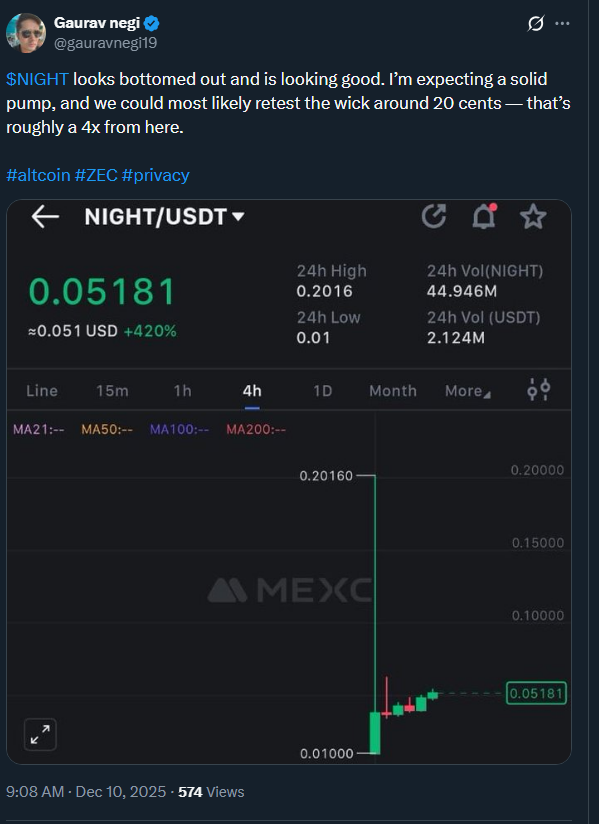
NIGHT Hits Bottom: Analyst Eyes 4x Rally to $0.20

NIGHT Hits Bottom: Analyst Eyes 4x Rally to $0.20

NIGHT token analysis displays a bottoming pattern. Analyst Gauravnegi19 projects 4x pump to $0.20. Midnight blockchain introduces privacy to Cardano. The NIGHT
2025/12/11
View More