The dominant force in this cycle comes from institutions. The four major cryptocurrencies, BTC, ETH, SOL, and BNB, have all hit new highs, but only BTC and BNB have continued to rise by over 40% since breaking through their all-time highs. SOL achieved a breakout earlier this year thanks to Trump's coin launch, while ETH experienced a revaluation mid-year driven by DAT buying, but neither has yet reached a new high. The Federal Reserve cut interest rates last night. How far can this round of institutional-led market trends go? 1. The institutional configuration logic of the three major currencies The positioning of crypto assets directly determines their long-term value, and different positioning corresponds to different institutional configuration logic. Bitcoin: The anti-inflation property of digital gold Positioned as "digital gold," its long-term logic is strongly tied to the fiat currency inflation cycle. Data shows that its market capitalization growth is synchronized with Global M2 and negatively correlated with the US dollar index. Its core value lies in its "inflation resistance" and value preservation and appreciation, making it a fundamental target for institutional investment. Ethereum: The Institutional Narrative Dividend of the World Computer Positioned as the "World Computer," although the foundation's "Layer 2 scaling" narrative has failed to gain traction in the capital market, its stable system, with 10 years of zero downtime, has capitalized on the development of institutional narratives such as US dollar stablecoins, RWAs, and the tokenization of US stocks. It has shrugged off the collapse of the Web3 narrative, and with the crucial push from DAT, has achieved a revaluation of its market capitalization. Ethereum, with its stability and security, will become the settlement network for institutional applications. Solana: The Active Advantage of Online Capital Markets Positioned as an "Internet Capital Market," Solana (ICM) stands for on-chain asset issuance, trading, and clearing. It has experienced a resurgence following the collapse of FTX. Year-to-date, it accounts for 46% of on-chain trading volume, with over 3 million daily active users year-round, making it the most active blockchain network. Solana, with its superior performance and high liquidity, will be the catalyst for the crypto-native on-chain trading ecosystem. The three platforms have distinct positioning, leading to different institutional investment logic. Traditional financial institutions first understand the value of Bitcoin, then consider developing their institutional business based on Ethereum, and finally, perhaps recognize the value of on-chain transactions. This is a typical path: question, understand, and become a part of it. Second, institutional holdings of the three major currencies show gradient differences The institutional holdings data of BTC, ETH, and SOL show obvious gradient differences, which also reflects the degree and rhythm of institutions' recognition of these three projects. Chart by: IOBC Capital From the comparison, we can see that institutional holdings of BTC and ETH account for > 18% of the circulating supply; SOL currently only accounts for 9.5%, and there may be room for replenishment. 3. SOL DAT: New Trends in Crypto Concept Stocks In the past month or so, 18 SOL DAT companies have come onto the scene, directly pushing SOL up by more than 50% from its August low. The louder SOL DAT company: Chart by: IOBC Capital Among the existing SOL DAT companies, Forward Industries, led by Multicoin Capital founder Kyle Samani, may become the SOL DAT leader. Unlike BTC DAT, which simply hoards coins, many SOL DAT companies will build their own Solana Validators, so that this is not limited to the "NAV game". Instead of simply waiting for token appreciation, they will continue to obtain cash flow income through the Validator business. This strategy is equivalent to "hoarding coins + mining", which is both long-term and profitable in the short term. 4. Crypto Concept Stocks: A Mapping of Capital Market Betting Crypto concept stocks are a new bridge between traditional capital and the crypto market. The degree of recognition of various Crypto businesses by the traditional financial market is also reflected in the stock price performance of crypto concept stocks. Chart by: IOBC Capital Looking back at the crypto stocks that have seen significant gains this round, we can see two common characteristics: 1. Only by betting big can a valuation reassessment be achieved. There are 189 publicly listed companies holding BTC, but only 30 hold 70% of their stock market capitalization, and only 12 hold more than 10,000 BTC—and these 12 have seen significant gains. A similar pattern is observed among listed ETH DATs. A superficial DAT strategy can only cause short-term stock price fluctuations and cannot substantially boost stock market capitalization or liquidity. 2. Business synergy can amplify commercial value. Transforming a single-point business into a multifaceted industry chain layout can amplify commercial value. For example, Robinhood, through its expansion into cryptocurrency trading, real-world asset trading (RRE), and participation in the USDG stablecoin, has formed a closed-loop business cycle for capital flow, leading to record highs in its stock price. Conversely, while Trump Media has also invested heavily in crypto (holding BTC, applying for an ETH ETF, and issuing tokens like Trump, Melania, and WLFI), the lack of synergy between its businesses has ultimately led to a lackluster market response to both its stock and its token. Ending The project philosophies of Bitcoin, Ethereum, and Solana correspond to three instincts of human beings when facing the future: survival, order, and flow.The dominant force in this cycle comes from institutions. The four major cryptocurrencies, BTC, ETH, SOL, and BNB, have all hit new highs, but only BTC and BNB have continued to rise by over 40% since breaking through their all-time highs. SOL achieved a breakout earlier this year thanks to Trump's coin launch, while ETH experienced a revaluation mid-year driven by DAT buying, but neither has yet reached a new high. The Federal Reserve cut interest rates last night. How far can this round of institutional-led market trends go? 1. The institutional configuration logic of the three major currencies The positioning of crypto assets directly determines their long-term value, and different positioning corresponds to different institutional configuration logic. Bitcoin: The anti-inflation property of digital gold Positioned as "digital gold," its long-term logic is strongly tied to the fiat currency inflation cycle. Data shows that its market capitalization growth is synchronized with Global M2 and negatively correlated with the US dollar index. Its core value lies in its "inflation resistance" and value preservation and appreciation, making it a fundamental target for institutional investment. Ethereum: The Institutional Narrative Dividend of the World Computer Positioned as the "World Computer," although the foundation's "Layer 2 scaling" narrative has failed to gain traction in the capital market, its stable system, with 10 years of zero downtime, has capitalized on the development of institutional narratives such as US dollar stablecoins, RWAs, and the tokenization of US stocks. It has shrugged off the collapse of the Web3 narrative, and with the crucial push from DAT, has achieved a revaluation of its market capitalization. Ethereum, with its stability and security, will become the settlement network for institutional applications. Solana: The Active Advantage of Online Capital Markets Positioned as an "Internet Capital Market," Solana (ICM) stands for on-chain asset issuance, trading, and clearing. It has experienced a resurgence following the collapse of FTX. Year-to-date, it accounts for 46% of on-chain trading volume, with over 3 million daily active users year-round, making it the most active blockchain network. Solana, with its superior performance and high liquidity, will be the catalyst for the crypto-native on-chain trading ecosystem. The three platforms have distinct positioning, leading to different institutional investment logic. Traditional financial institutions first understand the value of Bitcoin, then consider developing their institutional business based on Ethereum, and finally, perhaps recognize the value of on-chain transactions. This is a typical path: question, understand, and become a part of it. Second, institutional holdings of the three major currencies show gradient differences The institutional holdings data of BTC, ETH, and SOL show obvious gradient differences, which also reflects the degree and rhythm of institutions' recognition of these three projects. Chart by: IOBC Capital From the comparison, we can see that institutional holdings of BTC and ETH account for > 18% of the circulating supply; SOL currently only accounts for 9.5%, and there may be room for replenishment. 3. SOL DAT: New Trends in Crypto Concept Stocks In the past month or so, 18 SOL DAT companies have come onto the scene, directly pushing SOL up by more than 50% from its August low. The louder SOL DAT company: Chart by: IOBC Capital Among the existing SOL DAT companies, Forward Industries, led by Multicoin Capital founder Kyle Samani, may become the SOL DAT leader. Unlike BTC DAT, which simply hoards coins, many SOL DAT companies will build their own Solana Validators, so that this is not limited to the "NAV game". Instead of simply waiting for token appreciation, they will continue to obtain cash flow income through the Validator business. This strategy is equivalent to "hoarding coins + mining", which is both long-term and profitable in the short term. 4. Crypto Concept Stocks: A Mapping of Capital Market Betting Crypto concept stocks are a new bridge between traditional capital and the crypto market. The degree of recognition of various Crypto businesses by the traditional financial market is also reflected in the stock price performance of crypto concept stocks. Chart by: IOBC Capital Looking back at the crypto stocks that have seen significant gains this round, we can see two common characteristics: 1. Only by betting big can a valuation reassessment be achieved. There are 189 publicly listed companies holding BTC, but only 30 hold 70% of their stock market capitalization, and only 12 hold more than 10,000 BTC—and these 12 have seen significant gains. A similar pattern is observed among listed ETH DATs. A superficial DAT strategy can only cause short-term stock price fluctuations and cannot substantially boost stock market capitalization or liquidity. 2. Business synergy can amplify commercial value. Transforming a single-point business into a multifaceted industry chain layout can amplify commercial value. For example, Robinhood, through its expansion into cryptocurrency trading, real-world asset trading (RRE), and participation in the USDG stablecoin, has formed a closed-loop business cycle for capital flow, leading to record highs in its stock price. Conversely, while Trump Media has also invested heavily in crypto (holding BTC, applying for an ETH ETF, and issuing tokens like Trump, Melania, and WLFI), the lack of synergy between its businesses has ultimately led to a lackluster market response to both its stock and its token. Ending The project philosophies of Bitcoin, Ethereum, and Solana correspond to three instincts of human beings when facing the future: survival, order, and flow.

After the interest rate cut, how far can the institutional bull market go?

2025/09/18 19:00

The dominant force in this cycle comes from institutions.

The four major cryptocurrencies, BTC, ETH, SOL, and BNB, have all hit new highs, but only BTC and BNB have continued to rise by over 40% since breaking through their all-time highs. SOL achieved a breakout earlier this year thanks to Trump's coin launch, while ETH experienced a revaluation mid-year driven by DAT buying, but neither has yet reached a new high.

The Federal Reserve cut interest rates last night. How far can this round of institutional-led market trends go?

1. The institutional configuration logic of the three major currencies

The positioning of crypto assets directly determines their long-term value, and different positioning corresponds to different institutional configuration logic.

Bitcoin: The anti-inflation property of digital gold

Positioned as "digital gold," its long-term logic is strongly tied to the fiat currency inflation cycle. Data shows that its market capitalization growth is synchronized with Global M2 and negatively correlated with the US dollar index. Its core value lies in its "inflation resistance" and value preservation and appreciation, making it a fundamental target for institutional investment.

Ethereum: The Institutional Narrative Dividend of the World Computer

Positioned as the "World Computer," although the foundation's "Layer 2 scaling" narrative has failed to gain traction in the capital market, its stable system, with 10 years of zero downtime, has capitalized on the development of institutional narratives such as US dollar stablecoins, RWAs, and the tokenization of US stocks. It has shrugged off the collapse of the Web3 narrative, and with the crucial push from DAT, has achieved a revaluation of its market capitalization. Ethereum, with its stability and security, will become the settlement network for institutional applications.

Solana: The Active Advantage of Online Capital Markets

Positioned as an "Internet Capital Market," Solana (ICM) stands for on-chain asset issuance, trading, and clearing. It has experienced a resurgence following the collapse of FTX. Year-to-date, it accounts for 46% of on-chain trading volume, with over 3 million daily active users year-round, making it the most active blockchain network. Solana, with its superior performance and high liquidity, will be the catalyst for the crypto-native on-chain trading ecosystem.

The three platforms have distinct positioning, leading to different institutional investment logic. Traditional financial institutions first understand the value of Bitcoin, then consider developing their institutional business based on Ethereum, and finally, perhaps recognize the value of on-chain transactions. This is a typical path: question, understand, and become a part of it.

Second, institutional holdings of the three major currencies show gradient differences

The institutional holdings data of BTC, ETH, and SOL show obvious gradient differences, which also reflects the degree and rhythm of institutions' recognition of these three projects.
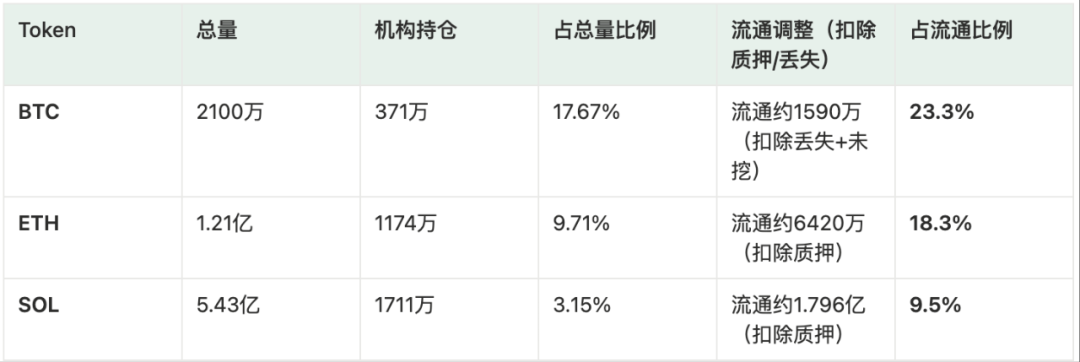
 Chart by: IOBC Capital

From the comparison, we can see that institutional holdings of BTC and ETH account for > 18% of the circulating supply; SOL currently only accounts for 9.5%, and there may be room for replenishment.

In the past month or so, 18 SOL DAT companies have come onto the scene, directly pushing SOL up by more than 50% from its August low.

The louder SOL DAT company:
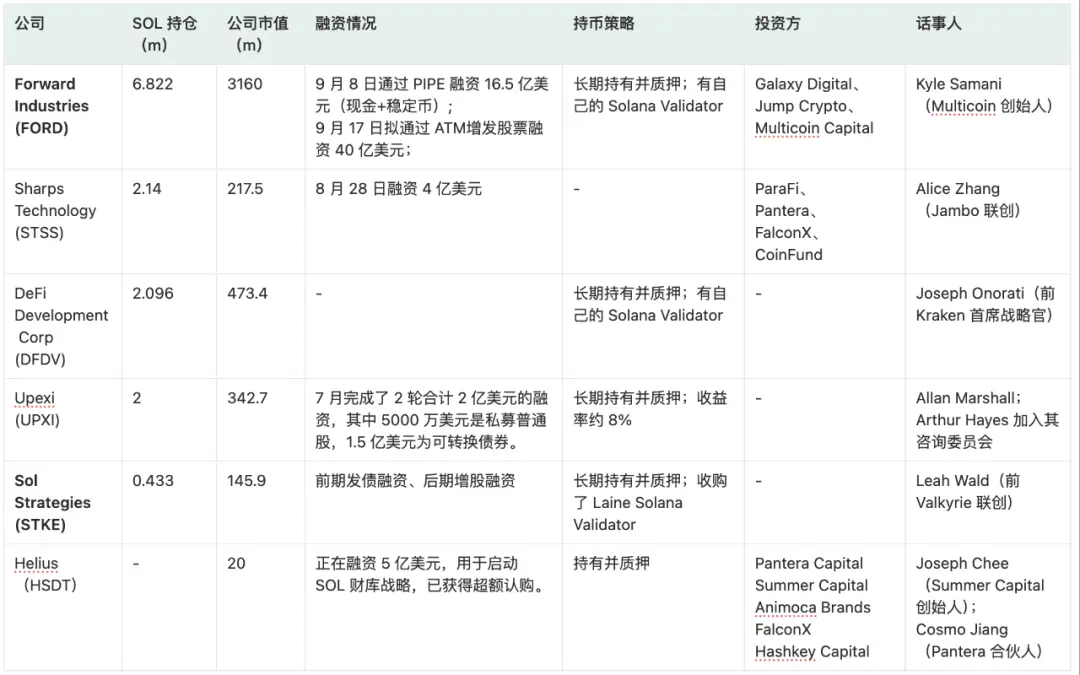
 Chart by: IOBC Capital

Among the existing SOL DAT companies, Forward Industries, led by Multicoin Capital founder Kyle Samani, may become the SOL DAT leader.

Unlike BTC DAT, which simply hoards coins, many SOL DAT companies will build their own Solana Validators, so that this is not limited to the "NAV game". Instead of simply waiting for token appreciation, they will continue to obtain cash flow income through the Validator business. This strategy is equivalent to "hoarding coins + mining", which is both long-term and profitable in the short term.

4. Crypto Concept Stocks: A Mapping of Capital Market Betting

Crypto concept stocks are a new bridge between traditional capital and the crypto market. The degree of recognition of various Crypto businesses by the traditional financial market is also reflected in the stock price performance of crypto concept stocks.
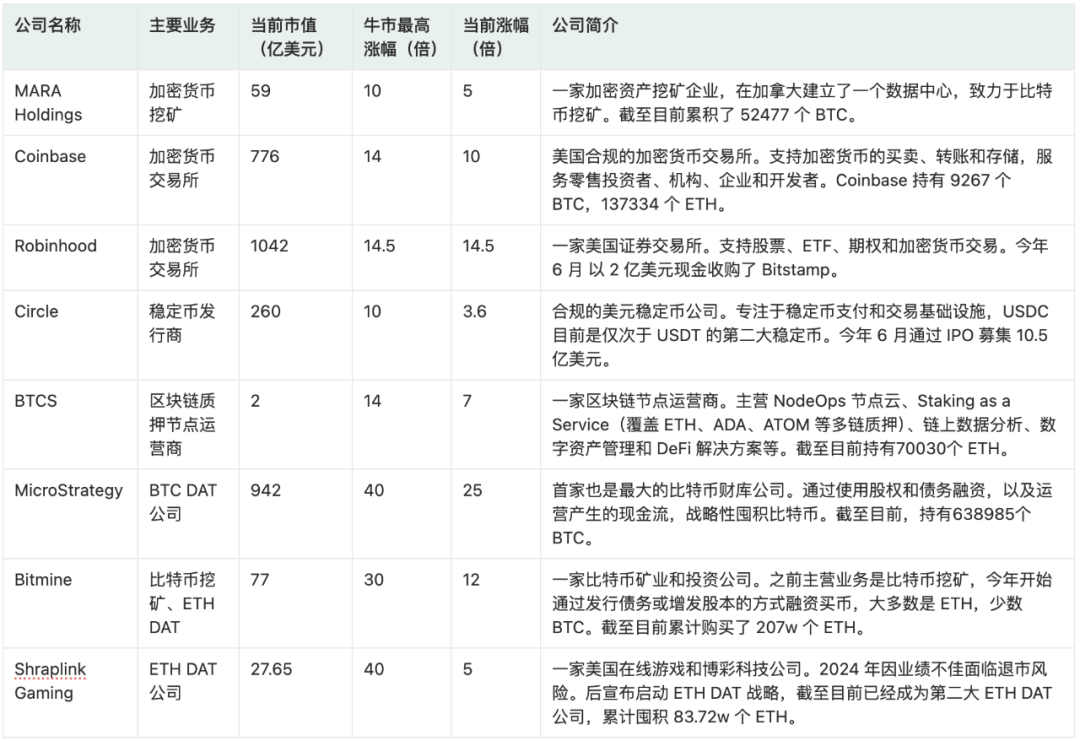
 Chart by: IOBC Capital

Looking back at the crypto stocks that have seen significant gains this round, we can see two common characteristics:

1. Only by betting big can a valuation reassessment be achieved. There are 189 publicly listed companies holding BTC, but only 30 hold 70% of their stock market capitalization, and only 12 hold more than 10,000 BTC—and these 12 have seen significant gains. A similar pattern is observed among listed ETH DATs. A superficial DAT strategy can only cause short-term stock price fluctuations and cannot substantially boost stock market capitalization or liquidity.

2. Business synergy can amplify commercial value. Transforming a single-point business into a multifaceted industry chain layout can amplify commercial value. For example, Robinhood, through its expansion into cryptocurrency trading, real-world asset trading (RRE), and participation in the USDG stablecoin, has formed a closed-loop business cycle for capital flow, leading to record highs in its stock price. Conversely, while Trump Media has also invested heavily in crypto (holding BTC, applying for an ETH ETF, and issuing tokens like Trump, Melania, and WLFI), the lack of synergy between its businesses has ultimately led to a lackluster market response to both its stock and its token.

Ending

The project philosophies of Bitcoin, Ethereum, and Solana correspond to three instincts of human beings when facing the future: survival, order, and flow.

Market Opportunity
Solana Logo
Solana Price(SOL)
$142.62
$142.62$142.62
-0.59%
USD
Solana (SOL) Live Price Chart
Disclaimer: The articles reposted on this site are sourced from public platforms and are provided for informational purposes only. They do not necessarily reflect the views of MEXC. All rights remain with the original authors. If you believe any content infringes on third-party rights, please contact service@support.mexc.com for removal. MEXC makes no guarantees regarding the accuracy, completeness, or timeliness of the content and is not responsible for any actions taken based on the information provided. The content does not constitute financial, legal, or other professional advice, nor should it be considered a recommendation or endorsement by MEXC.

You May Also Like

The Channel Factories We’ve Been Waiting For

The Channel Factories We’ve Been Waiting For

The post The Channel Factories We’ve Been Waiting For appeared on BitcoinEthereumNews.com. Visions of future technology are often prescient about the broad strokes while flubbing the details. The tablets in “2001: A Space Odyssey” do indeed look like iPads, but you never see the astronauts paying for subscriptions or wasting hours on Candy Crush.  Channel factories are one vision that arose early in the history of the Lightning Network to address some challenges that Lightning has faced from the beginning. Despite having grown to become Bitcoin’s most successful layer-2 scaling solution, with instant and low-fee payments, Lightning’s scale is limited by its reliance on payment channels. Although Lightning shifts most transactions off-chain, each payment channel still requires an on-chain transaction to open and (usually) another to close. As adoption grows, pressure on the blockchain grows with it. The need for a more scalable approach to managing channels is clear. Channel factories were supposed to meet this need, but where are they? In 2025, subnetworks are emerging that revive the impetus of channel factories with some new details that vastly increase their potential. They are natively interoperable with Lightning and achieve greater scale by allowing a group of participants to open a shared multisig UTXO and create multiple bilateral channels, which reduces the number of on-chain transactions and improves capital efficiency. Achieving greater scale by reducing complexity, Ark and Spark perform the same function as traditional channel factories with new designs and additional capabilities based on shared UTXOs.  Channel Factories 101 Channel factories have been around since the inception of Lightning. A factory is a multiparty contract where multiple users (not just two, as in a Dryja-Poon channel) cooperatively lock funds in a single multisig UTXO. They can open, close and update channels off-chain without updating the blockchain for each operation. Only when participants leave or the factory dissolves is an on-chain transaction…
Share
BitcoinEthereumNews2025/09/18 00:09
Markets await Fed’s first 2025 cut, experts bet “this bull market is not even close to over”

Markets await Fed’s first 2025 cut, experts bet “this bull market is not even close to over”

Will the Fed’s first rate cut of 2025 fuel another leg higher for Bitcoin and equities, or does September’s history point to caution? First rate cut of 2025 set against a fragile backdrop The Federal Reserve is widely expected to…
Share
Crypto.news2025/09/18 00:27
Buterin pushes Layer 2 interoperability as cornerstone of Ethereum’s future

Buterin pushes Layer 2 interoperability as cornerstone of Ethereum’s future

Ethereum founder, Vitalik Buterin, has unveiled new goals for the Ethereum blockchain today at the Japan Developer Conference. The plan lays out short-term, mid-term, and long-term goals touching on L2 interoperability and faster responsiveness among others. In terms of technology, he said again that he is sure that Layer 2 options are the best way […]
Share
Cryptopolitan2025/09/18 01:15