Starlink rival Amazon Leo has launched a waitlist for many countries, including Nigeria, to collect details of would-be…Starlink rival Amazon Leo has launched a waitlist for many countries, including Nigeria, to collect details of would-be…

Starlink rival, Amazon Leo launches waitlist for many countries, including Nigeria

2025/11/26 20:47
3 min read
For feedback or concerns regarding this content, please contact us at crypto.news@mexc.com

Starlink rival Amazon Leo has launched a waitlist for many countries, including Nigeria, to collect details of would-be early users of its satellite Internet service when it eventually rolls out. Recall that the company recently began its first public testing with select enterprise customers ahead of an anticipated wider commercial rollout in 2026.

The list provides for three broad categories of users:

  1. Government: Government agencies and service providers like schools, hospitals, etc.
  2. Personal: individual users like you
  3. Business: corporate users and business owners

It also provides three different router types:

  • Ultra: It will support download speeds of up to 1Gbps and upload speeds of 400Mbps. Amazon boasts that it will be the world’s fastest satellite Internet antenna.
  • Nano: the smallest and lightest antenna, and most likely going to be the most affordable. The antenna weighs around 1kg. It will have a square dish panel that measures less than 18cm from side to side. It supports download speeds of up to 100Mbps.
  • Pro: Bulkier and heavier, measuring approximately 28cm across and weighing 2.4kg. It will offer download speeds of up to 400Mbps.

To apply, simply click here to start.
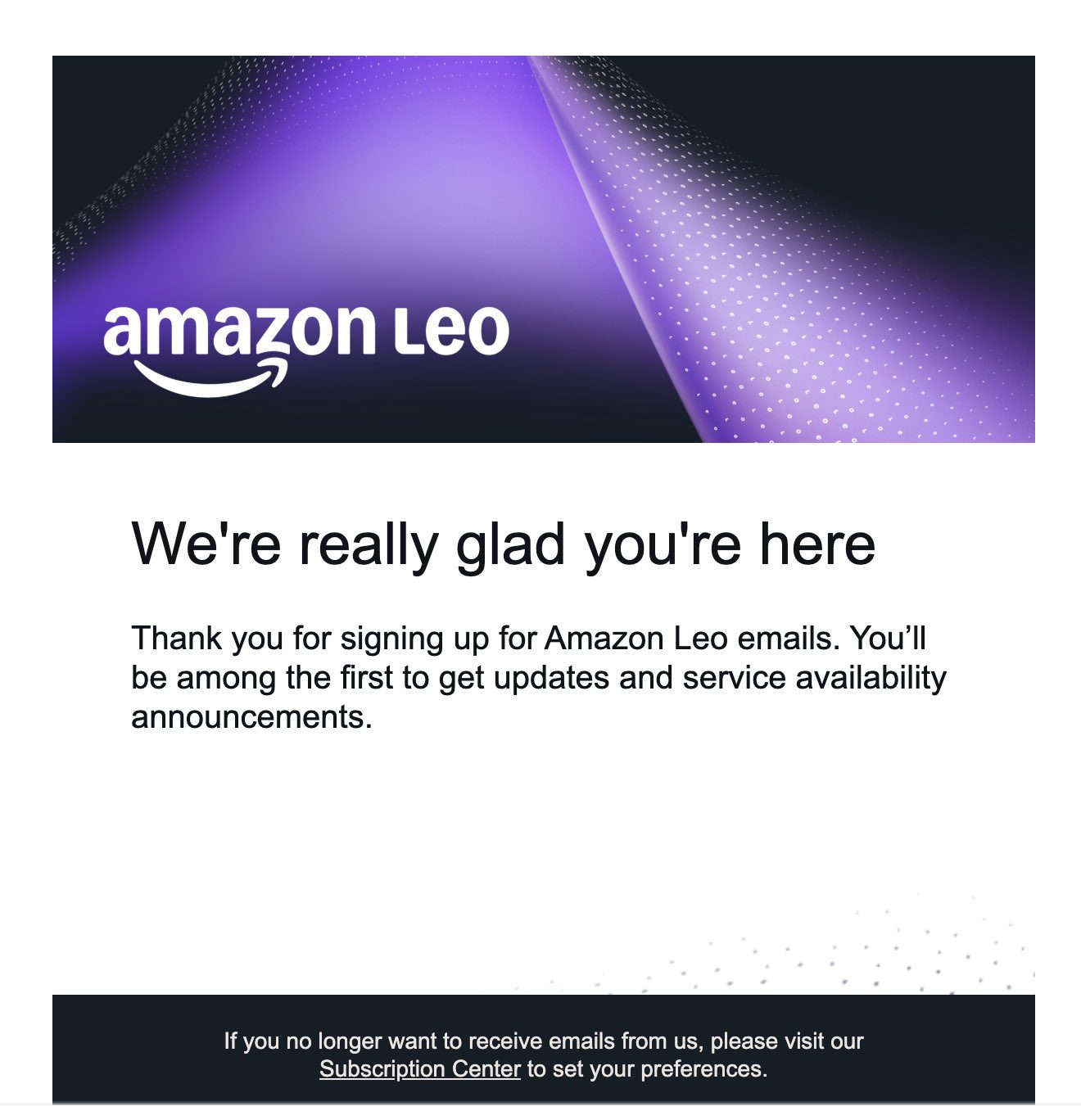
Starlink rival, Amazon Leo launches waitlist for many countries, including NigeriaYou will get a welcome email, like this, after you join the waitlist…

Recall that Amazon has partnered with Vanu, a US-based company, to deploy cellular towers in far-flung and rural parts of Southern Africa. There isn’t an announcement for a distribution structure for West Africa yet.

What you need to know about Amazon Leo

Previously known as Project Kuiper, Leo launched its first operational batch of internet satellites into low Earth orbit (LEO) last year. The mission, dubbed “KA-01” (Kuiper Atlas 1), saw 27 satellites lifted off aboard a United Launch Alliance (ULA) Atlas V rocket from Cape Canaveral Space Force Station in Florida in September.

The project now has a fleet of 153 production satellites in orbit and aims to expand to 1,618 satellites by 30 July 2026. Although this pales when compared with Starlink’s 10,000 satellites, the Amazon-owned company claims that its top-end product will offer speeds of up to 1Gbps.

Amazon’s ambitious initiative to provide global broadband access has been at least 10 years in the making. The company aims to deploy a constellation of more than 3,200 LEO satellites to deliver fast, reliable internet to customers worldwide, including underserved regions.

The first phase of the deployment will consist of 578 satellites orbiting around 630km above the Earth’s surface, slightly higher than Starlink’s fleet. Using these satellites, Amazon is rolling out 12 ground stations to provide backhaul connectivity to the Internet.

While SpaceX’s Starlink has a head start with its reusable Falcon 9 rockets and a licensed capacity for 12,000 first-generation satellites (plus 7,500 more for its second generation), Amazon is betting on its technological prowess and global reach to carve out a competitive niche.

The company has secured 80 launch missions with multiple providers, including ULA, Arianespace, and Jeff Bezos’ Blue Origin, to build out its initial constellation.

Experts believe that the setup process is likely to take at least one more year, with the earliest optimistic global launch date being late 2026 or early 2027.

Disclaimer: The articles reposted on this site are sourced from public platforms and are provided for informational purposes only. They do not necessarily reflect the views of MEXC. All rights remain with the original authors. If you believe any content infringes on third-party rights, please contact crypto.news@mexc.com for removal. MEXC makes no guarantees regarding the accuracy, completeness, or timeliness of the content and is not responsible for any actions taken based on the information provided. The content does not constitute financial, legal, or other professional advice, nor should it be considered a recommendation or endorsement by MEXC.

You May Also Like

MAGA insiders suddenly embrace 'indispensable' energy they long derided as a 'parasite'

MAGA insiders suddenly embrace 'indispensable' energy they long derided as a 'parasite'

President Donald Trump spent much of his first year in office in an all-out war against solar power, even going so far as to change regulations so that renewable
Share
Rawstory2026/03/03 05:09
How to earn from cloud mining: IeByte’s upgraded auto-cloud mining platform unlocks genuine passive earnings

How to earn from cloud mining: IeByte’s upgraded auto-cloud mining platform unlocks genuine passive earnings

The post How to earn from cloud mining: IeByte’s upgraded auto-cloud mining platform unlocks genuine passive earnings appeared on BitcoinEthereumNews.com. contributor Posted: September 17, 2025 As digital assets continue to reshape global finance, cloud mining has become one of the most effective ways for investors to generate stable passive income. Addressing the growing demand for simplicity, security, and profitability, IeByte has officially upgraded its fully automated cloud mining platform, empowering both beginners and experienced investors to earn Bitcoin, Dogecoin, and other mainstream cryptocurrencies without the need for hardware or technical expertise. Why cloud mining in 2025? Traditional crypto mining requires expensive hardware, high electricity costs, and constant maintenance. In 2025, with blockchain networks becoming more competitive, these barriers have grown even higher. Cloud mining solves this by allowing users to lease professional mining power remotely, eliminating the upfront costs and complexity. IeByte stands at the forefront of this transformation, offering investors a transparent and seamless path to daily earnings. IeByte’s upgraded auto-cloud mining platform With its latest upgrade, IeByte introduces: Full Automation: Mining contracts can be activated in just one click, with all processes handled by IeByte’s servers. Enhanced Security: Bank-grade encryption, cold wallets, and real-time monitoring protect every transaction. Scalable Options: From starter packages to high-level investment contracts, investors can choose the plan that matches their goals. Global Reach: Already trusted by users in over 100 countries. Mining contracts for 2025 IeByte offers a wide range of contracts tailored for every investor level. From entry-level plans with daily returns to premium high-yield packages, the platform ensures maximum accessibility. Contract Type Duration Price Daily Reward Total Earnings (Principal + Profit) Starter Contract 1 Day $200 $6 $200 + $6 + $10 bonus Bronze Basic Contract 2 Days $500 $13.5 $500 + $27 Bronze Basic Contract 3 Days $1,200 $36 $1,200 + $108 Silver Advanced Contract 1 Day $5,000 $175 $5,000 + $175 Silver Advanced Contract 2 Days $8,000 $320 $8,000 + $640 Silver…
Share
BitcoinEthereumNews2025/09/17 23:48
Gold continues to hit new highs. How to invest in gold in the crypto market?

Gold continues to hit new highs. How to invest in gold in the crypto market?

As Bitcoin encounters a "value winter", real-world gold is recasting the iron curtain of value on the blockchain.
Share
PANews2025/04/14 17:12