Citi Prepares to Launch Bitcoin Custody Service for Institutions
Key Insights
- Citi’s Bitcoin custody service integrates crypto with traditional assets, offering institutional-grade security and compliance.
- With $30 trillion under custody, Citi’s entry could unlock major institutional capital flows into Bitcoin.
- Critics warn of centralization risks, but proponents see custody as essential for mainstream adoption and legitimacy.
Citigroup Inc. is one of the world’s largest banks. It has announced plans to launch a Bitcoin custody service later this year. This service will be institutional-grade. It marks a big step in bringing cryptocurrency into traditional banking.
The announcement was made at the Strategy World event in Las Vegas. Nisha Surendran, Citi’s head of digital asset custody development, shared the news.
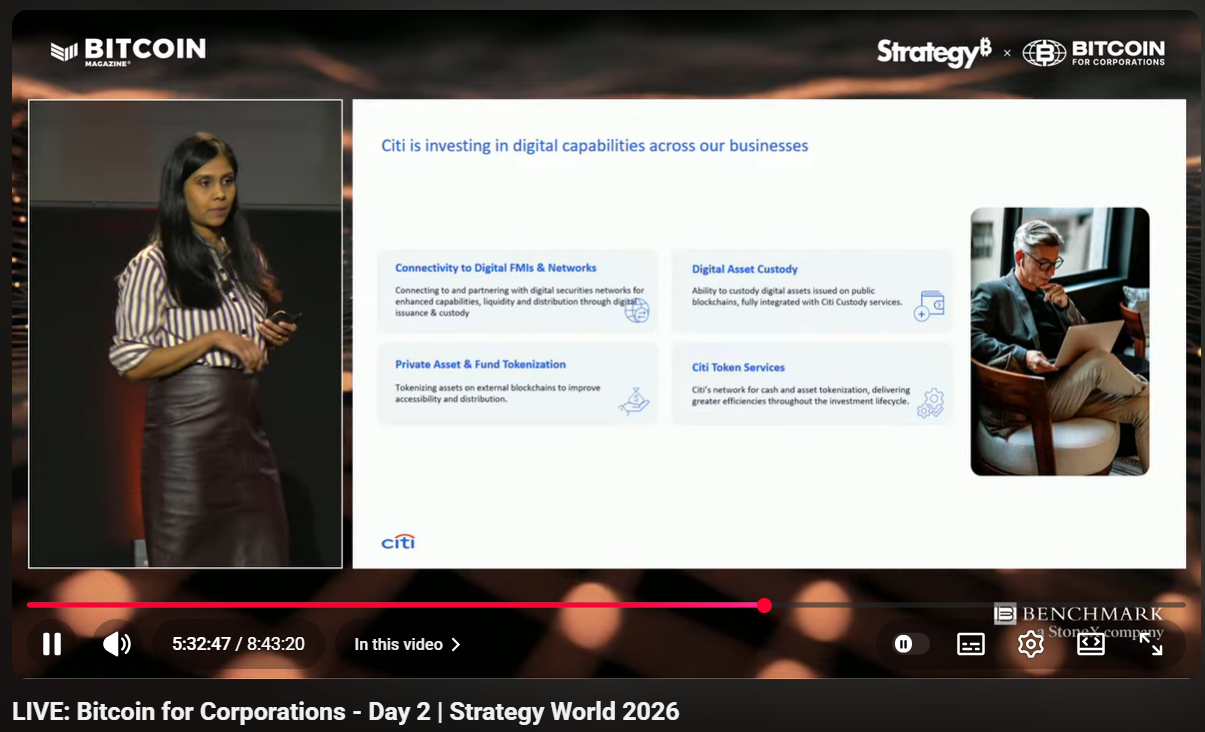 Nisha Surendran speaking at Strategy World 2026 Event | Source: Bitcoin Magazine, YouTube
She said the goal is to make Bitcoin “bankable.” The plan will allow institutional clients to manage Bitcoin alongside traditional assets such as stocks, bonds, and cash.
Building Bitcoin Into Traditional Finance
Surendran explained Citi’s vision during her speech at the conference. “Later this year, Citi will be launching our infrastructure that integrates Bitcoin into traditional finance,” she said.
The bank will begin with custody and safekeeping capabilities, institutional-grade key management, and wallet infrastructure.
The service will use Citi’s existing risk management, compliance, and reporting systems. This means clients will not need to handle private keys or navigate blockchain complexities themselves.
The bank will provide seamless integration with tax reporting, SWIFT transfers, API connectivity, and potential cross-margining. In this model, Bitcoin could serve as collateral for other financial activities.
Citi’s plan also includes holding Bitcoin directly on its balance sheet. This is a departure from indirect exposures such as exchange-traded funds.
The initiative has been in development for two to three years. Rising demand from institutional investors drives Citi to provide regulated, bank-level security for digital assets.
Industry Context and Competition
The announcement comes as other Wall Street giants expand their crypto offerings. Morgan Stanley is broadening its custody and tokenization services.
On the other hand, JPMorgan and Goldman Sachs are also active in the sector. Citi’s entry intensifies competition in the growing digital asset custody market, which analysts expect to expand rapidly.
Citi already has experience in digital assets. In 2025, the bank launched tokenization services for institutional clients and explored stablecoins. With approximately $30 trillion in assets under custody, Citi’s new service could unlock significant capital flows into Bitcoin.
Industry experts see the move as a catalyst for adoption. One analyst noted, “By treating Bitcoin like any other asset in their custody ecosystem, Citi is bridging the gap between crypto and traditional finance.”
The timing aligns with regulatory progress in the United States. Clearer guidelines on digital asset custody have encouraged banks to enter the space.
Surendran acknowledged challenges such as asset segregation and collateral management. However, she said these would be addressed in phased expansions.
No specific launch date beyond “later this year” has been provided, and details on fees or minimum requirements remain undisclosed.
Opportunities and Concerns
The initiative reflects the evolving financial landscape, where digital assets are increasingly seen as integral. Bitcoin’s price hovers around $65,000. ETF approvals and corporate treasuries boost the market. Citi’s move could drive further appreciation. It could also add legitimacy to Bitcoin.
Surendran described the bank’s vision as “one big idea” to make Bitcoin “bankable.” She added, the goal is a “single service model across crypto, securities, and money.” This is paving the way for a more interconnected financial future.
However, not all reactions are positive. Critics in the crypto community argue that bank-led custody could centralize control, which contrasts with Bitcoin’s decentralized ethos.
Proponents counter that institutional custody is essential for scaling adoption and providing the security large investors require.
Despite differing views, Citi’s announcement has sparked optimism among investors. It signals that major financial institutions are committed to embedding cryptocurrency into the global economy.
The post Citi Prepares to Launch Bitcoin Custody Service for Institutions appeared first on The Market Periodical.
You May Also Like

XRPL Sidechain Proposal Targets Options Trading and Leverage

Crypto market’s weekly winners and losers – ASTER, DEXE, FARTCOIN, SPX