

Ethereum Roadmap Could Advance Faster With AI, Vitalik Buterin Says
Ethereum’s long-range protocol roadmap may move faster than many expect as AI tools improve, according to Vitalik Buterin, who pointed to a recent experiment that used agentic coding to assemble an ambitious reference client spanning much of Ethereum’s planned 2030-era architecture.
The comment came after developer Jiayao Qi, posting as YQ via X, unveiled ETH2030, an experimental Ethereum client built to target the network’s draft “2030+” roadmap. The project weighs in at 702,000 lines of Go, covers 65 roadmap items across eight phases, passes 36,126 official Ethereum state tests, and can sync with mainnet through an integration with go-ethereum v1.17.0. Qi said the client was built in roughly six days using Claude Code at a cost of about $5,750 and 2.77 billion tokens.
AI Could Speed Up Ethereum Roadmap
Buterin called the effort “quite an impressive experiment,” while also stressing that a prototype built at that speed comes with obvious limits. “Such a thing built in two weeks without even having the EIPs has massive caveats,” he wrote. “Almost certainly lots of critical bugs, and probably in some cases ‘stub’ versions of a thing where the AI did not even try making the full version. But six months ago, even this was far outside the realm of possibility, and what matters is where the trend is going.”
That distinction mattered more to Buterin than the raw demo itself. In his view, AI is not just compressing development time. It could change how Ethereum engineers approach assurance. “Probably, the right way to use it, is to take half the gains from AI in speed, and half the gains in security,” he said. “Generate more test-cases, formally verify everything, make more multi-implementations of things.”
He tied that directly to ongoing formal verification work around Ethereum. Referring to the Lean Ethereum effort, Buterin said one collaborator had already used AI to produce a machine-verifiable proof of a complex theorem underpinning STARK security. “A core tenet of @leanethereum is to formally verify everything, and AI is greatly accelerating our ability to do that,” he wrote. “Aside from formal verification, simply being able to generate a much larger body of test cases is also important.”
ETH2030 itself was presented less as a candidate client than as a stress test for the roadmap. Qi repeatedly framed it as a rough draft, not production software, and argued that its value lies in forcing hard engineering questions into the open now rather than years from now.
The roadmap, as implemented in the project, aims at a version of Ethereum with 10,000-plus TPS on L1, finality in seconds instead of 15 minutes, solo staking for 1 ETH, stateless nodes running on a $7 Raspberry Pi, and more than 1 million TPS across L1 and L2. But the experiment also surfaced deep coupling between upgrades, from block access lists and gas repricing to PeerDAS, native rollups and fast finality.
Qi was blunt about the gaps. Pure-Go cryptographic implementations lag production code by roughly 10x to 100x, the consensus logic has not been battle-tested on a live beacon chain, and the jump from roughly 5 million gas per second today to a 1 billion gas-per-second target remains highly speculative under real-world MEV and contract dependency patterns.
Buterin did not claim AI would make those problems disappear. In fact, he cautioned against expecting a secure protocol from a single prompt. “There WILL be lots of wrestling with bugs and inconsistencies between implementations,” he wrote. “But even that wrestling can happen 5x faster and 10x more thoroughly.”
That, more than the headline numbers, is the point now in front of Ethereum researchers and client teams. If AI can speed both implementation and verification, the roadmap may not just be a distant architectural sketch. As Buterin put it, people should at least be open to the “possibility” that Ethereum’s roadmap could be completed “much faster than people expect, at a much higher standard of security than people expect.”
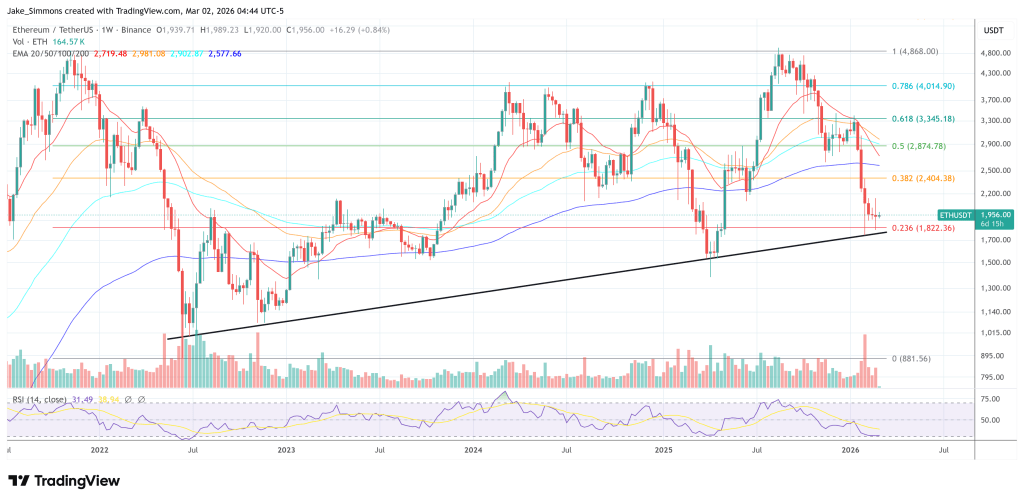
At press time, ETH traded at $1,956.
You May Also Like
States try out Obama-inspired public health plans during Trump admin

Tariff Refund Lawsuit: US Court Delivers Critical Blow to Trump Administration Delay Request
