JPMorgan Chase Statistics 2026: Growth Insights
JPMorgan Chase stands as the largest bank in the United States and one of the most influential financial institutions globally. Its operations span consumer banking, investment banking, asset management, and payments infrastructure that supports corporations, governments, and millions of retail customers. From financing large corporate mergers to enabling everyday digital payments through the Chase app, the bank plays a critical role in both Wall Street capital markets and Main Street banking services.
This article explores the latest JPMorgan Chase statistics, including assets, revenue growth, profitability trends, and recent strategic developments shaping the bank’s global leadership. Let’s dive into the numbers behind one of the world’s most powerful financial institutions.
Editor’s Choice
- The bank generated roughly $280.3 billion in total revenue in 2025, reflecting steady growth after a major jump in 2024.
- Total assets increased to about $4.56 trillion by late 2025, marking an 8% year-over-year increase.
- JPMorgan Chase serves more than 80 million consumer customers in the United States, making it one of the largest retail banks globally.
- JPMorgan held roughly $2.1 trillion in total deposits, the largest deposit base among U.S. banks.
- The company ranked #1 on the Forbes Global 2000 list in 2025 for the third consecutive year, reflecting its global financial strength.
Recent Developments
- In Q3 2025, JPMorgan reported revenue of $46.4 billion, highlighting strong performance in trading and payments businesses.
- The bank’s payments division generated $4.9 billion in revenue in Q3 2025, representing 13% year-over-year growth.
- JPMorgan’s Q1 2025 net income reached $14.6 billion, reflecting strong market activity and investment banking performance.
- The firm’s investment banking fees reached about $2.6 billion in a single quarter of 2025, rising 16% year over year.
- CEO Jamie Dimon received a compensation package of about $43 million in 2025, reflecting the bank’s strong financial performance.
- The company continued expanding digital banking and branch networks as part of its retail growth strategy in 2025.
- JPMorgan maintained leadership in global investment banking revenue, outperforming many Wall Street competitors.
JPMorgan Chase Stock Performance vs Market Benchmarks
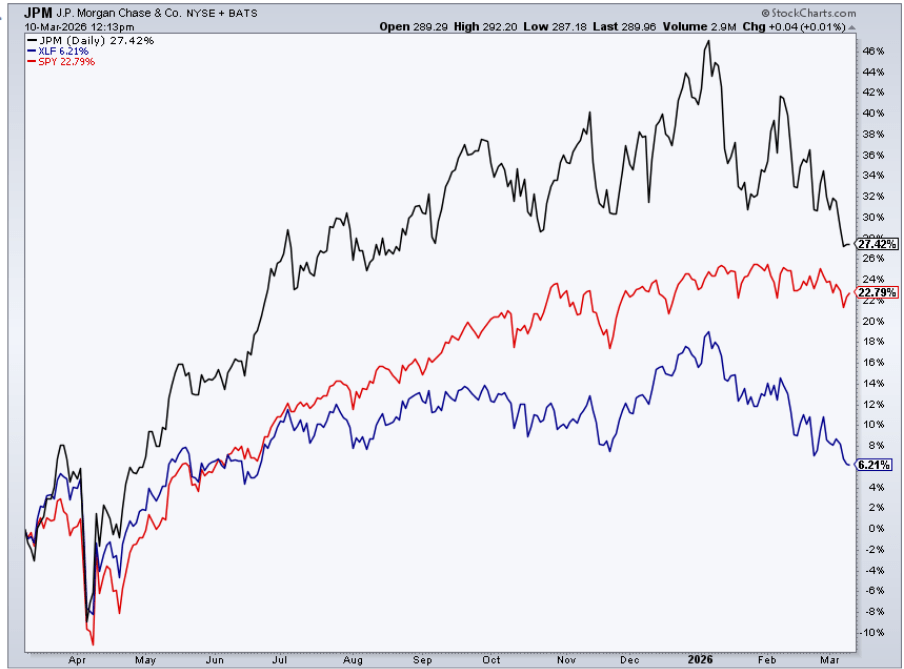
- JPMorgan Chase (JPM) delivered a 27.42% return during the period shown in the chart, leading the comparison.
- The S&P 500 (SPY) posted a 22.79% gain, trailing JPMorgan’s performance.
- The Financial Select Sector ETF (XLF) recorded only a 6.21% increase, showing weaker performance across the financial sector.
- JPMorgan outperformed the S&P 500 by 4.63 percentage points, highlighting stronger investor returns.
- Compared with the financial sector ETF, JPM beat XLF by 21.21 percentage points, showing a large performance gap.
- On March 10, 2026, JPMorgan stock opened at $289.29 and reached a daily high of $292.20.
- The stock touched a low of $287.18 during the same trading session.
- JPMorgan shares closed at $289.96, with a small daily gain of $0.04 (+0.01%).
- The trading session recorded 2.9 million shares in volume, reflecting active investor participation.
- Overall, the chart shows JPMorgan shares rising faster than both the broader market and the financial sector benchmark.
 (Reference: Seeking Alpha)
Total Assets and Market Capitalization
- JPMorgan Chase holds $4.4 trillion in total assets, ranking among the world’s largest banks.
- Total assets grew to approximately $4.56 trillion as of early 2026.
- The bank’s market capitalization stands at $802.6 billion.
- Total loans totaled $1.5 trillion with a 58% loan-to-deposit ratio.
- Available borrowing capacity was $449 billion.
- Cash and marketable securities amounted to $564 billion.
- Standardized CET1 ratio stood at 14.6%.
Revenue and Net Income Statistics
- Total revenue reached $287.9 billion, up 2.7% from 2025.
- Net income climbed to $52.4 billion, marking a 5.6% annual increase.
- Earnings per share rose to $5.34 in Q1, exceeding market forecasts.
- Trading revenue surpassed $9.4 billion in a strong capital markets quarter.
- Consumer & community banking contributed $78 billion in annual revenue.
- Corporate & investment bank revenue reached $62 billion, up 6%.
- Profit per week averaged $1.01 billion, maintaining JPMorgan’s record pace.
Top 5 Most Profitable Banks
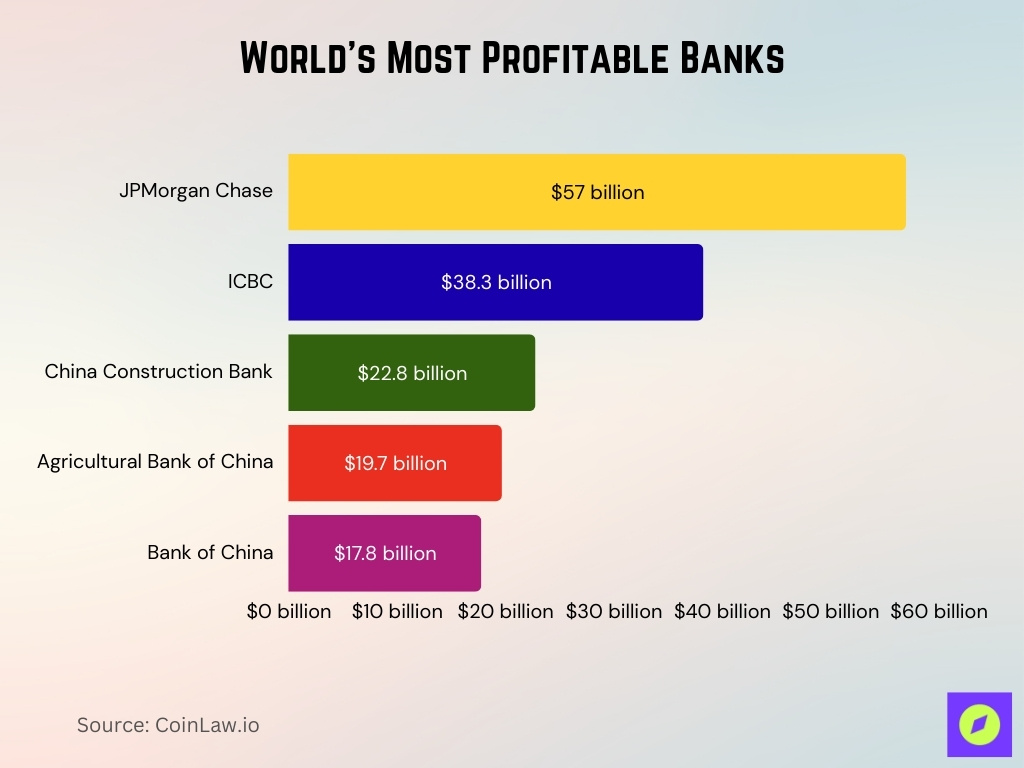
- JPMorgan Chase & Co. ranks as the most profitable bank in the world, generating $57.0 billion in profit.
- Industrial and Commercial Bank of China (ICBC) follows with $38.3 billion in annual profit.
- China Construction Bank reported $22.8 billion in profits, placing it third among global banks.
- Agricultural Bank of China generated $19.7 billion in net profit.
- Bank of China recorded $17.8 billion in profit, completing the top five list.
- The five banks together produced more than $160 billion in combined profits, showing the massive scale of global banking institutions.
- Four of the five most profitable banks are Chinese institutions, highlighting China’s strong presence in global banking.
 (Reference: the_enterprise_world)
Business Segment Financial Performance
- Consumer & Community Banking revenue rose to $78 billion, up 9.8% year over year.
- Corporate & Investment Bank generated $69 billion in revenue, remaining the top profit driver.
- Commercial Banking revenue reached $15.2 billion, boosted by stronger middle-market lending.
- Asset & Wealth Management produced $22.8 billion in revenue, supported by record client assets.
- Markets division earned $31.5 billion, reflecting robust trading and liquidity services.
- Investment banking fees have been broadly stable at roughly $8 billion annually, with growth driven mainly by improved deal volumes in later quarters of 2025.
- Treasury and Securities Services contributed $12.6 billion, aided by higher payment volumes.
- Consumer credit card revenue surpassed $24 billion, growing with the spending rebound.
- Home lending revenue increased to $9.1 billion, driven by refinancing and mortgages.
- Retail deposits within Consumer & Community Banking account for well over $1 trillion of the firm’s roughly $2.5 trillion total deposit base.
Geographic Presence and International Operations
- JPMorgan Chase operates in over 100 countries, serving corporate, institutional, and government clients globally.
- The bank employs more than 300,000 people worldwide, making it one of the largest financial employers globally.
- The company maintains major international hubs in London, Hong Kong, Singapore, and Tokyo.
- JPMorgan’s international revenue accounts for roughly 35% to 40% of total company revenue.
- The firm’s global payments network processes trillions of dollars in daily transactions across markets.
- JPMorgan’s investment bank consistently ranks #1 globally in investment banking fees and deal activity.
- The company operates thousands of ATMs and banking branches primarily across the United States, while global operations focus heavily on corporate clients.
- JPMorgan serves over 80% of Fortune 500 companies through its corporate and investment banking services.
- The bank continues expanding its digital international payments and cross-border banking platforms.
Profitability and Return Ratios
- Return on tangible common equity (ROTCE) reached 23%, showing stronger capital efficiency.
- Return on assets (ROA) held steady at 1.4%, reflecting sustained asset profitability.
- Net profit margin averaged 22.5%, maintaining consistency across business segments.
- The efficiency ratio declined to 55%, signaling improved cost control.
- Cost-to-income ratio stayed below 58%, reinforcing operational strength.
- Net interest margin stood at 2.7%, benefiting from higher lending yields.
- Pre-tax margin reached 29%, supported by trading and investment performance.
- The dividend payout ratio was 33%, consistent with prior returns.
- Economic value added (EVA) rose by 4.2%, highlighting continued shareholder value growth.
Customer Base and Client Segments
- The bank supports approximately 7 million small businesses, providing lending, payment processing, and treasury services.
- JPMorgan processes more than $10 trillion in payments daily through its global payment systems.
- The company’s credit card business includes tens of millions of active cardholders, making Chase one of the largest card issuers in the U.S.
- JPMorgan serves thousands of institutional investors and asset management clients worldwide.
- The bank provides banking services to 80% of Fortune 500 companies, demonstrating its strong corporate client base.
- Chase operates over 4,700 retail branches across the United States, giving it one of the largest banking networks.
- The bank’s digital banking platform has tens of millions of active mobile users, reflecting rapid growth in digital adoption.
- JPMorgan also manages relationships with governments, central banks, and financial institutions worldwide.
Deposits, Loans, and Credit Quality
- JPMorgan held approximately $2.1 trillion in total deposits in recent years, the highest among U.S. banks.
- Total loans reached roughly $1.3 trillion across consumer, commercial, and corporate lending portfolios.
- The bank’s consumer loan portfolio includes mortgages, auto loans, and credit cards.
- JPMorgan maintains hundreds of billions of dollars in corporate lending exposure through syndicated loans and credit facilities.
- The firm’s net charge-off rate remained below 1% in many recent periods, indicating strong credit quality.
- JPMorgan maintains one of the largest credit card portfolios in the United States, with billions in annual spending volume.
- The bank reported strong capital and liquidity buffers, exceeding regulatory requirements.
- JPMorgan’s loan loss reserves exceed tens of billions of dollars, providing protection against economic downturns.
- The bank consistently maintains a Common Equity Tier 1 capital ratio above 14%, reflecting strong financial stability.
Commercial Banking
- Segment revenue rose to $15.2 billion, driven by higher lending and fee income.
- Loan balances increased to $305 billion, up 7% year over year.
- Deposits from commercial clients totaled $520 billion, maintaining strong liquidity.
- Treasury services revenue climbed to $6.8 billion, supported by volume growth.
- Real estate banking portfolio reached $148 billion, led by industrial and multifamily assets.
- The middle market client base expanded to 32,000 active relationships globally.
- Investment banking revenue contribution grew 6%, reflecting stronger corporate advisory demand.
- Commercial card spending volume exceeded $220 billion, driven by increased B2B usage.
- Credit quality remained solid with net charge-offs below 0.2% of total loans.
- Return on equity for the segment improved to 17%, highlighting sustained profitability.
Asset and Wealth Management
- Segment revenue reached $22.8 billion, driven by advisory and investment gains.
- Net inflows totaled $145 billion, reflecting strong client acquisition and retention.
- Private Bank managed over $830 billion in client assets across global markets.
- Institutional clients accounted for 58% of total AUM, maintaining portfolio diversity.
- Fee-based assets represented 69% of total managed assets, emphasizing recurring income.
- Alternative investments grew 12%, led by private equity and real asset strategies.
- Digital wealth management users exceeded 2.3 million, expanding JPMorgan’s client reach.
- Pre-tax margin for the segment reached 33%, showing improved operational leverage.
Consumer and Community Banking
- The firm’s total retail customer base has continued to grow to well over 80 million accounts, reflecting steady expansion in checking, savings, and card relationships.
- Chase network operated 4,800 branches and 15,200 ATMs across the U.S.
- Segment revenue increased to $78 billion, up 9.8% from last year.
- Mortgage originations totaled $132 billion, supported by stable housing demand.
- Auto loan balances exceeded $80 billion, up 6% from the prior year.
- Digital banking users reached 64 million, accounting for over 75% of active clients.
- Mobile-only customers grew to 42 million, up 11% year over year.
- Customer satisfaction index rose to 83%, reflecting improved digital experiences.
Technology, Digital Banking, and AI Investments
- Annual technology spend reached $17.2 billion, reinforcing JPMorgan’s digital leadership.
- Over 57,000 technologists support global banking, data, and security operations.
- AI-driven risk and fraud systems monitor over $12 trillion in daily transaction flows.
- JPM Coin transaction volume exceeded $1.2 trillion, expanding institutional blockchain use.
- Onyx network processed more than $1.5 trillion in tokenized payments and settlements.
- Cloud migration covered 58% of core infrastructure, enhancing scalability and resilience.
- Cybersecurity investments totaled $3.4 billion, strengthening defense against threats.
- Machine learning models reduced false fraud alerts by 28%, improving detection accuracy.
- Digital payments API volume grew 22%, driving fintech and partner integrations globally.
Dividends, Share Buybacks, and Payout Ratios
- The bank’s dividend yield typically ranges between 2% and 3% annually, depending on market conditions.
- JPMorgan increased its quarterly dividend to $1.15 per share in recent years, reflecting strong earnings performance.
- The company regularly conducts multi-billion-dollar share repurchase programs.
- In some recent years, JPMorgan returned over $30 billion to shareholders through dividends and buybacks combined.
- The bank maintains a payout ratio generally between 25% and 35% of earnings.
- Share buybacks help improve earnings per share and shareholder value over time.
- JPMorgan’s strong capital position allows it to increase shareholder distributions while maintaining regulatory capital buffers.
- The company consistently ranks among the largest dividend payers in the U.S. banking sector.
Frequently Asked Questions (FAQs)
JPMorgan Chase employs about 317,000 employees worldwide, reflecting a workforce increase of over 23% in five years.
JPMorgan reported about 15.7% return on equity and a 31.3% net profit margin in 2025, indicating strong profitability for a global bank.
JPMorgan Chase had roughly 2.7 billion shares outstanding in 2025, after a 3.5% decline year-over-year due to buybacks.
The bank expects about $95 billion in net interest income for 2026, excluding market-related businesses.
Conclusion
JPMorgan Chase continues to dominate the global banking landscape through its massive balance sheet, diversified revenue streams, and strong profitability metrics. With trillions of dollars in assets, tens of millions of customers, and leadership across investment banking, consumer banking, and asset management, the institution plays a central role in the modern financial system.
The bank’s strategy increasingly focuses on technology investment, digital banking innovation, and global corporate services, allowing it to maintain competitive advantages over rivals. As financial markets evolve, JPMorgan’s scale, capital strength, and diversified business model position it to remain a major force in global finance for years to come.
The post JPMorgan Chase Statistics 2026: Growth Insights appeared first on CoinLaw.
You May Also Like

Philippines looks to regulate power market as LNG prices surge

X1 EcoChain and ZNS Connect Integration – Streamlining Web3 Onboarding with 7-in-1 Interaction Tools