The Artemis II crew will include Victor Glover, second from left, the first Black astronaut to fly to the Moon. NASA/Frank Michaux Craig Fehrman, Indiana University
In April 2026, four astronauts are scheduled to fly around the Moon. As part of NASA’s Artemis II mission, they will become the first humans to do so in half a century. One crew member, pilot Victor Glover, will become the first Black astronaut to ever orbit the Moon.
Glover’s achievement is worth celebrating. But it’s also worth remembering that he belongs to a long and underappreciated history. America’s first Black explorer didn’t fly an Apollo rocket or sail with the U.S. Exploring Expedition. He traveled with Lewis and Clark, and he was known by a single name: York.
I’m a historian who spent five years writing a book about Lewis and Clark, and I found new documents that show York was one of the most important people on their expedition. Even in a party that could number as many as 45 men, York stood out – for his courage, his skill and his sacrifices that helped the famous captains reach the Pacific Ocean.
York’s life as a slave
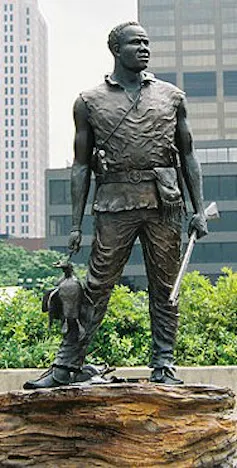
A statue of York stands at the Riverfront Plaza in Louisville, Ky. The statue is speculative, as there is no record of what York looked like. Lucky For You/Wikimedia Commons, CC BY-SA York was born in Virginia around 1770. Growing up, he was a creative and sociable child, unusually tall with dark hair and a dark complexion – “black as a bear,” a contemporary noted.
He was also enslaved by the Clarks. William Clark, who was around the same age, was also unusually tall, though his hair was a rusty red, and sometimes the boys played together. But the playing stopped once York turned 9 or 10. That’s when he joined the adult slaves in working full time. That’s also when he began to note the differences between his life and William’s – differences that became only clearer once William started ordering him around.
In the 1780s, the Clark household headed to Kentucky. York met a Black woman there and married her. He also became William’s “body servant.”
A body servant was a slave who stayed close to his owner and prioritized his comfort, laying out his clothes and serving his meals. When Meriwether Lewis asked Clark to join his expedition, in 1803, Clark ordered York to accompany him.
Perhaps York was excited for this adventure. Perhaps he was not – it would be punishing, and he would be separated from his wife.
Either way, York didn’t have a choice.
The Corps of Discovery
York proved his worth from the start. Once they reached St. Louis, the soldiers, later known as the Corps of Discovery, rushed to raise winter quarters. Working in hail and snow, York and the others built log huts. They needed rough planks for their tables and bunks, but the carpenters had only a single whipsaw to make them. They chose two men to operate this crucial tool. One of them was York.
On May 14, 1804, the corps began ascending the Missouri River. York helped row and tow the party’s barge, which was the size of a semi-truck trailer. He carried a rifle and hunted – according to the expedition’s journals, he was only the fifth named member to bring down a buffalo. York cooked for the captains. He collected scientific specimens. He nursed the sick, including several soldiers and, later on, Sacagawea, a Shoshone woman who would also prove essential to the expedition’s success.
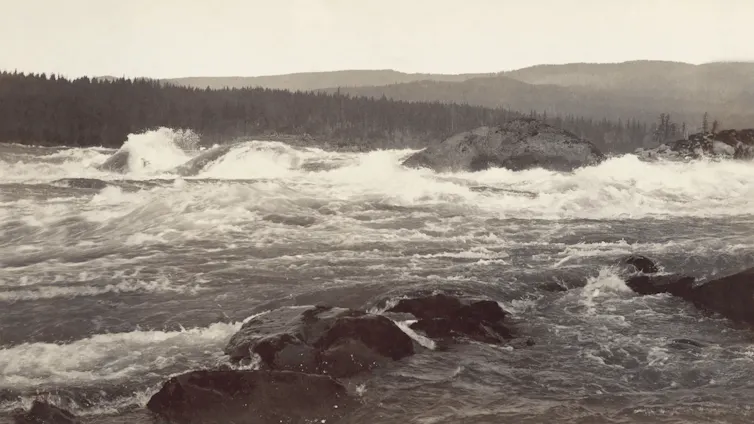
York helped Lewis and Clark’s expedition cross rapids in the Columbia River. Carleton Watkins/Oregon Historical Society
The soldiers were not always kind in return. During this period, officers rarely brought along enslaved body servants. York’s race probably made some of the men angry or uncomfortable. One day, someone threw so much sand in his face that it nearly blinded him. Clark claimed it was “in fun,” but he also wrote that York was “very near losing his eyes,” and no one else got cruelly sprayed with sand.
That fall, during councils with Native leaders, York played a surprising and vital role. The Arikara, Mandan and Hidatsa all crowded in to see him and to touch his skin. They had never met a Black person before, and York showed off his strength and played with the Native children. Later, the Arikara said York was “the most marvelous” thing about the corps.
The next year, the expedition crossed the Rockies and the Continental Divide. York’s most important – and most overlooked – contributions came soon after. On the Columbia River and its tributaries, the party had to dig out five new canoes and then paddle them through treacherous rapids.
Lewis and Clark allowed only their best rivermen on these foaming, rock-riven waters. One of them was almost certainly York. During my research, I found an unpublished letter in which Clark praised York’s ability to “manage the boats.”
Just as important, York was a strong swimmer, a rare thing in an era when many people never learned to swim.
York’s life as an explorer
On the Columbia River, the corps survived a series of terrifying choke points – soggy hazards they referred to as the “Long Narrows” and the “Great Chute.” After that came the ocean. They had traveled together for more than 4,000 miles (6,400 kilometers), and when the captains asked the men to vote on where to put their final winter quarters, they made sure to ask York, too.
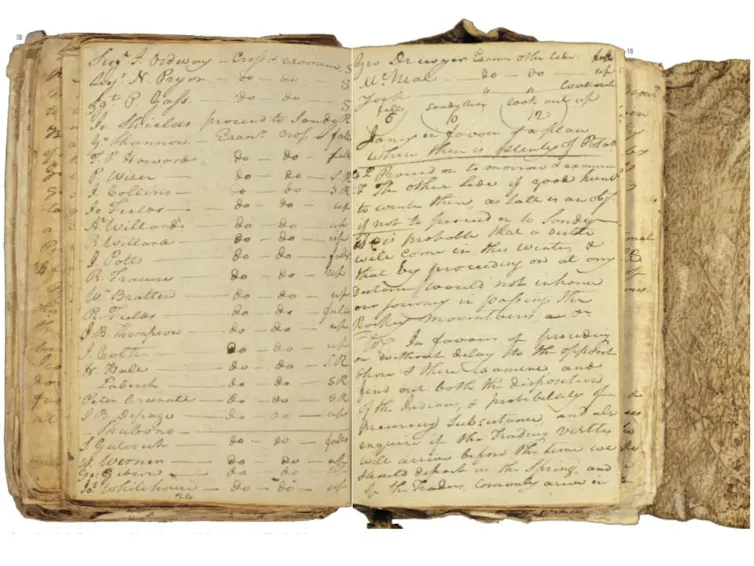
In his elk-skin journal, William Clark recorded York’s winter quarters vote. Missouri Historical Society
It was the latest sign that his role had changed during this epic journey. But those changes began with York. In the West, he found ways to make choices and assert himself. He sent a buffalo robe to his wife in Kentucky. When Clark told him to scale back his performances for Native people, York ignored him – because he wanted to, and because he could.
York’s vote was also evidence that, like Victor Glover today, he was an official American explorer, a key member of a sprawling, federally funded mission. From 1804 to 1806, the government devoted a larger percentage of its budget to the corps than it devotes to NASA today.
Part of that money was earmarked for York. The Army gave officers who brought along their slaves a monthly ration or its cash equivalent. When the corps made it home, the government paid US$274.57 for York’s labor, a sum similar to what the privates received. But that money didn’t go to York. It went to Clark.
The hidden history of Black explorers
There have been many Black explorers in American history. Thomas Jefferson launched other expeditions besides Lewis and Clark’s, and those expeditions also included enslaved people, though their names have not survived. Isaiah Brown served on the Wheeler Survey, which mapped the West in greater detail after the Civil War. Matthew Henson accompanied Robert Peary on his Arctic expeditions, which received some federal support. More recently, NASA has depended on Black astronauts such as Guy Bluford, Mae Jemison and Jeanette Epps, among others.
York and Victor Glover are, for now, the first and most recent examples of this inspiring tradition. But their contributions go beyond that. When the captains asked York to vote on the winter quarters, they were acknowledging in some small way that he’d proven he was more than a body servant.
Of course, York had always been more than that. It just took 4,000 miles for Lewis and Clark to see it.