Chainlink price is hovering near the top of its recent range with traders watching for a decisive move following the launch of the Bitwise Chainlink ETF. LINK wasChainlink price is hovering near the top of its recent range with traders watching for a decisive move following the launch of the Bitwise Chainlink ETF. LINK was

Chainlink price nears breakout as Bollinger Bands tighten after Bitwise LINK ETF launch

Chainlink price is hovering near the top of its recent range with traders watching for a decisive move following the launch of the Bitwise Chainlink ETF.

Summary
  • LINK is consolidating as volatility tightens and leverage cools.
  • ETF launch improves access despite short-term trading currently cautious.
  • Technical setup points to a sharp move once range breaks.

LINK was trading around $13.84 at press time, down 1.5% on the day. Despite the dip, the token is still up 3.7% over the past week and more than 8% over the last month, showing steady upward drift rather than sharp momentum.

Spot trading activity has cooled slightly. Daily volume slipped to about $618 million, down 0.4%. Derivatives data tells a similar story. CoinGlass data shows futures volume down 2.8% to $872 million, while open interest edged lower by 0.4% to $668.8 million.

When both metrics fall together, it usually points to traders reducing leverage and waiting for a clearer direction rather than pressing new bets.

ETF launch and fundamentals add context 

The Bitwise Chainlink ETF (CLNK) officially began trading on NYSE Arca on Jan. 14, making it the second U.S. spot ETF offering direct exposure to LINK after Grayscale’s GLNK launch in December.

The fund is physically backed by Chainlink (LINK) held with Coinbase Custody, with BNY Mellon handling cash operations. Bitwise set a 0.34% management fee, waived for the first three months on up to $500 million in assets to encourage early participation.

On its first day, the ETF recorded $2.59 million in net inflows, $3.24 million in trading volume, and a net asset value of $5.18 million. Staking is not supported at this stage.

While the initial inflows were modest, ETF launches often have a delayed impact. They lower the friction for institutions and advisors who cannot access tokens directly, which can slowly improve liquidity and reduce reactive selling during pullbacks.

Beyond the ETF, Chainlink has seen several supportive developments this month. A draft version of the U.S. Digital Asset Market Clarity Act proposes treating LINK as a network token under CFTC oversight, potentially easing long-term regulatory risk. 

Additionally, Chainlink recently introduced Confidential Compute at the protocol level, a feature targeted at institutional and enterprise use cases that permits private off-chain execution with on-chain settlement.

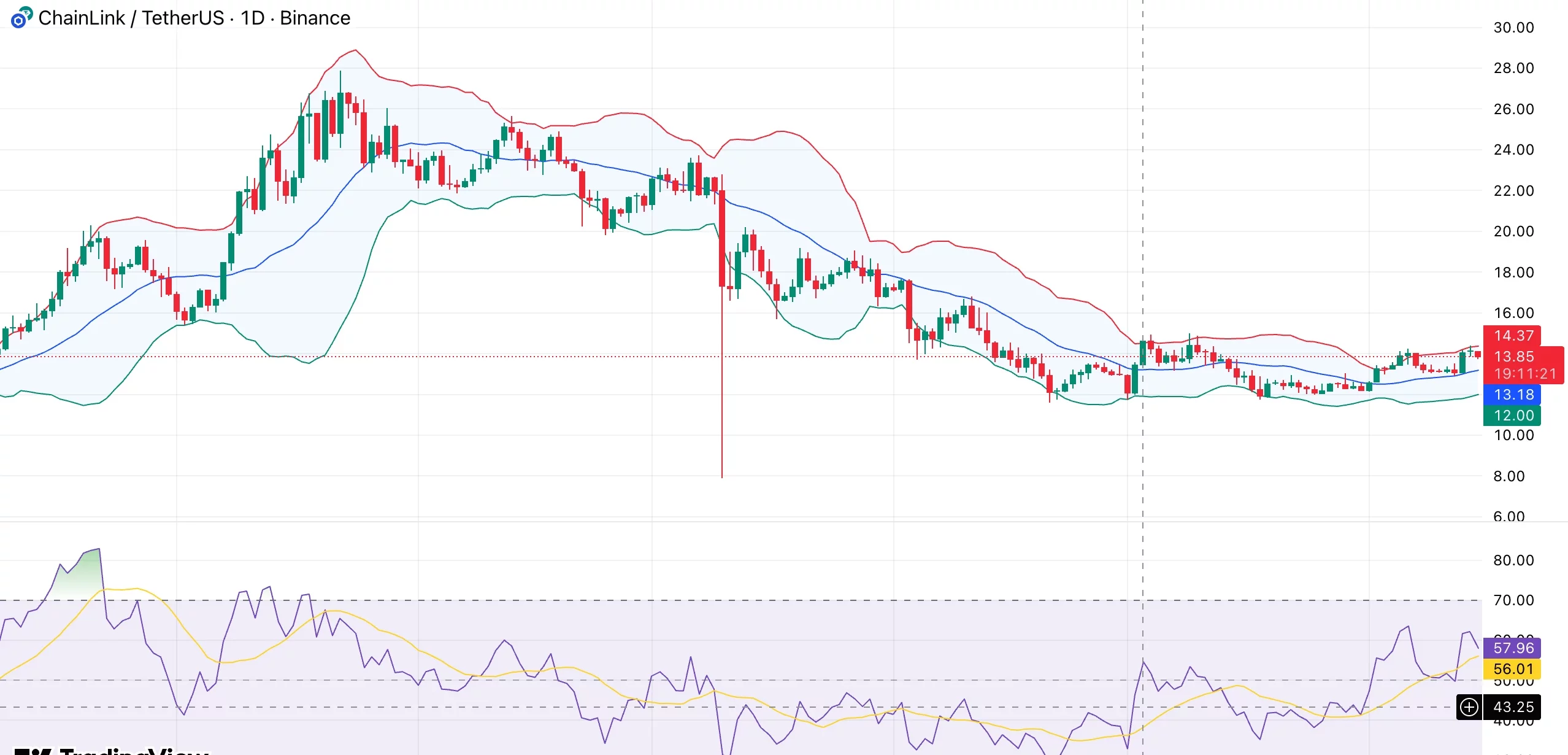
From a technical perspective, LINK is clearly in consolidation mode. Price has been holding between roughly $13.00 and $14.20, forming a tight base after the ETF launch.

Candles have smaller bodies and limited wicks, showing neither buyers nor sellers are pushing aggressively. This type of price action often appears before expansion.
Chainlink price nears breakout as Bollinger Bands tighten after Bitwise LINK ETF launch - 1

Bollinger Bands are now tightly compressed, confirming a low-volatility regime. Prices often move sharply when they break out of the band. 

Momentum indicators lean constructive but not stretched. There is space for follow-through as the relative strength index is close to 58. The average directional index indicates that trend strength is still developing rather than fully established, and the MACD is in positive territory.

Support is clearly defined between $13.00 and $13.20, which corresponds to the 20- and 30-day moving averages. The structure remains intact as long as the price stays above this range on daily closes. A clean break below $13 would likely invite a deeper pullback toward the $12.80 region.

On the upside, resistance sits at $14.00–$14.20. This level has  capped price multiple times and lines up with short-term horizontal supply. A daily close above $14.20, especially with rising volume, would open the door toward $15.00, where the 100-day moving average comes into view.


Market Opportunity
Chainlink Logo
Chainlink Price(LINK)
$10.8
$10.8$10.8
+0.27%
USD
Chainlink (LINK) Live Price Chart
Disclaimer: The articles reposted on this site are sourced from public platforms and are provided for informational purposes only. They do not necessarily reflect the views of MEXC. All rights remain with the original authors. If you believe any content infringes on third-party rights, please contact service@support.mexc.com for removal. MEXC makes no guarantees regarding the accuracy, completeness, or timeliness of the content and is not responsible for any actions taken based on the information provided. The content does not constitute financial, legal, or other professional advice, nor should it be considered a recommendation or endorsement by MEXC.

You May Also Like

The Channel Factories We’ve Been Waiting For

The Channel Factories We’ve Been Waiting For

The post The Channel Factories We’ve Been Waiting For appeared on BitcoinEthereumNews.com. Visions of future technology are often prescient about the broad strokes while flubbing the details. The tablets in “2001: A Space Odyssey” do indeed look like iPads, but you never see the astronauts paying for subscriptions or wasting hours on Candy Crush.  Channel factories are one vision that arose early in the history of the Lightning Network to address some challenges that Lightning has faced from the beginning. Despite having grown to become Bitcoin’s most successful layer-2 scaling solution, with instant and low-fee payments, Lightning’s scale is limited by its reliance on payment channels. Although Lightning shifts most transactions off-chain, each payment channel still requires an on-chain transaction to open and (usually) another to close. As adoption grows, pressure on the blockchain grows with it. The need for a more scalable approach to managing channels is clear. Channel factories were supposed to meet this need, but where are they? In 2025, subnetworks are emerging that revive the impetus of channel factories with some new details that vastly increase their potential. They are natively interoperable with Lightning and achieve greater scale by allowing a group of participants to open a shared multisig UTXO and create multiple bilateral channels, which reduces the number of on-chain transactions and improves capital efficiency. Achieving greater scale by reducing complexity, Ark and Spark perform the same function as traditional channel factories with new designs and additional capabilities based on shared UTXOs.  Channel Factories 101 Channel factories have been around since the inception of Lightning. A factory is a multiparty contract where multiple users (not just two, as in a Dryja-Poon channel) cooperatively lock funds in a single multisig UTXO. They can open, close and update channels off-chain without updating the blockchain for each operation. Only when participants leave or the factory dissolves is an on-chain transaction…
Share
BitcoinEthereumNews2025/09/18 00:09
Shanghai residents flock to sell gold as its price hit record highs

Shanghai residents flock to sell gold as its price hit record highs

The post Shanghai residents flock to sell gold as its price hit record highs appeared on BitcoinEthereumNews.com. Gold surged over the $5,500-per-ounce milestone
Share
BitcoinEthereumNews2026/01/31 01:48
Polygon Tops RWA Rankings With $1.1B in Tokenized Assets

Polygon Tops RWA Rankings With $1.1B in Tokenized Assets

The post Polygon Tops RWA Rankings With $1.1B in Tokenized Assets appeared on BitcoinEthereumNews.com. Key Notes A new report from Dune and RWA.xyz highlights Polygon’s role in the growing RWA sector. Polygon PoS currently holds $1.13 billion in RWA Total Value Locked (TVL) across 269 assets. The network holds a 62% market share of tokenized global bonds, driven by European money market funds. The Polygon POL $0.25 24h volatility: 1.4% Market cap: $2.64 B Vol. 24h: $106.17 M network is securing a significant position in the rapidly growing tokenization space, now holding over $1.13 billion in total value locked (TVL) from Real World Assets (RWAs). This development comes as the network continues to evolve, recently deploying its major “Rio” upgrade on the Amoy testnet to enhance future scaling capabilities. This information comes from a new joint report on the state of the RWA market published on Sept. 17 by blockchain analytics firm Dune and data platform RWA.xyz. The focus on RWAs is intensifying across the industry, coinciding with events like the ongoing Real-World Asset Summit in New York. Sandeep Nailwal, CEO of the Polygon Foundation, highlighted the findings via a post on X, noting that the TVL is spread across 269 assets and 2,900 holders on the Polygon PoS chain. The Dune and https://t.co/W6WSFlHoQF report on RWA is out and it shows that RWA is happening on Polygon. Here are a few highlights: – Leading in Global Bonds: Polygon holds 62% share of tokenized global bonds (driven by Spiko’s euro MMF and Cashlink euro issues) – Spiko U.S.… — Sandeep | CEO, Polygon Foundation (※,※) (@sandeepnailwal) September 17, 2025 Key Trends From the 2025 RWA Report The joint publication, titled “RWA REPORT 2025,” offers a comprehensive look into the tokenized asset landscape, which it states has grown 224% since the start of 2024. The report identifies several key trends driving this expansion. According to…
Share
BitcoinEthereumNews2025/09/18 00:40