Shiba Inu’s core team has issued a sweeping post-mortem update on the Shibarium bridge breach, detailing a multi-step attack that combined a flash-loan powered governance capture with compromised validator keys—followed by emergency protocol changes and a split bounty offer aimed at recovering user funds. Shiba Inu Devs Speak Out On Shibarium Bridge Exploit In an […]Shiba Inu’s core team has issued a sweeping post-mortem update on the Shibarium bridge breach, detailing a multi-step attack that combined a flash-loan powered governance capture with compromised validator keys—followed by emergency protocol changes and a split bounty offer aimed at recovering user funds. Shiba Inu Devs Speak Out On Shibarium Bridge Exploit In an […]

Shiba Inu Team Issues Explosive Update On Shibarium Bridge Exploit

2025/09/18 19:30
3 min read

Shiba Inu’s core team has issued a sweeping post-mortem update on the Shibarium bridge breach, detailing a multi-step attack that combined a flash-loan powered governance capture with compromised validator keys—followed by emergency protocol changes and a split bounty offer aimed at recovering user funds.

Shiba Inu Devs Speak Out On Shibarium Bridge Exploit

In an X post published on September 17, 2025, the official Shiba Inu account said the exploiter “executed a flash loan swap to acquire 4.6M BONE from ShibaSwap” and delegated them to “Ryoshi Validator 1,” which pushed their voting power “> 2/3 majority” across Shibarium validators. Using “compromised internal validators” to co-sign a malicious state, the attacker then drained assets from the L2’s canonical bridge. The team now pegs direct losses at $4.1 million.

The disclosure adds granular color on what left the bridge exposed and how responders moved. The Shiba Inu team says the “leading possibility for the root cause” was a compromise of internal validator keys—“either from the developer machine or the server’s KMS”—not a CCIP predicate path that “was unrelated.”

The team further says it suspended bridge operations, began forensic analysis, and initiated a hardening campaign: revoking root chain manager access on the PoS bridge, lengthening the half-exit time on the Plasma path, and removing a predicate burn-only entry from the Plasma registry to prevent withdrawals. “We have suspended bridge operations… there is a significant loss of user funds on Shibarium,” the update states.

According to the team’s accounting, 17 tokens were taken from the bridge, including roughly $1.0M in ETH, $1.3M in SHIB, $717K in KNINE, $680K in LEASH, and $260K in ROAR, alongside smaller balances of TREAT, USDC, USDT, BAD, SHIFU, FUND, DAI, LTD, xFUND, WBTC and OSCAR. The exploiter has so far sold only USDT and USDC into ETH; they attempted seven times to sell KNINE before the K9 Finance DAO blacklisted the attacker’s wallet. The rest of the assets remain under the attacker’s control and “at risk,” the team warned.

SHIB Team Ups Bounty To 50 ETH

The remediation push now includes two distinct bounty tracks. First, the bounty chronology began with K9 Finance DAO—the Shibarium-aligned liquid-staking project—publishing an on-chain 5 ETH offer to the attacker for the return of KNINE, structured to decay after seven days and expire after 30 days.

K9’s accompanying X posts stressed the “accept()” finality and “code-is-law” terms embedded in the escrow contract. The exploiter then replied publicly: “I can’t accept 5 ETH. The bounty I can accept is 50 ETH and I will not return KNINE for less.”

After that refusal did the Shiba Inu team transmit a separate, on-chain 50 ETH bounty message via its Deployer 2 address covering the non-KNINE assets, conditioned on full restitution and a whitehat disclosure, with a promise of a legal-action waiver upon verified return.

The Shiba Inu team’s on-chain message reads in part: “Offer: 50 ETH bounty via a new bounty smart contract escrow,” adding that the attacker must return WETH, SHIB, LEASH, ROAR, TREAT, USDC, USDT, BAD, SHIFU, FUND, DAI, LTD, xFUND, WBTC, and OSCAR, and submit a full technical disclosure; “upon complete restitution and accepted disclosure, we will issue a waiver of legal action (subject to applicable law).” Transaction records show the message was sent from shiba-swap.eth (Deployer 2) to the address labeled ShibaSwap Exploiter on September 17.

For now, bridge operations remain disabled, and users are cautioned that assets listed as “under attacker control” remain exposed until recovery or further containment.

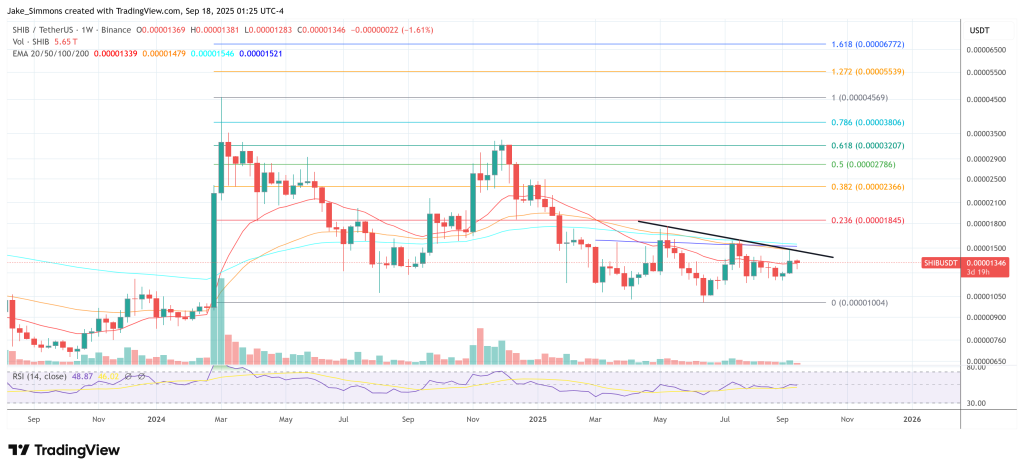
At press time, SHIB traded at $0.00001346.
Shiba Inu price
Market Opportunity
Hyperbridge Logo
Hyperbridge Price(BRIDGE)
$0.0147
$0.0147$0.0147
-0.40%
USD
Hyperbridge (BRIDGE) Live Price Chart
Disclaimer: The articles reposted on this site are sourced from public platforms and are provided for informational purposes only. They do not necessarily reflect the views of MEXC. All rights remain with the original authors. If you believe any content infringes on third-party rights, please contact service@support.mexc.com for removal. MEXC makes no guarantees regarding the accuracy, completeness, or timeliness of the content and is not responsible for any actions taken based on the information provided. The content does not constitute financial, legal, or other professional advice, nor should it be considered a recommendation or endorsement by MEXC.

You May Also Like

Thunderclap Review 2026: Is it the Best Social Media Service for Instant Gains?

Thunderclap Review 2026: Is it the Best Social Media Service for Instant Gains?

TLDR: Is Thunderclap legit? Yes, Thunderclap is a legitimate social media growth service designed to help users increase their followers, engagement, and overall
Share
AI Journal2026/02/20 21:10
The GENIUS Act Is Already Law. Banks Shouldn’t Try to Rewrite It Now
The GENIUS Act Is Already Law. Banks Shouldn’t Try to Rewrite It Now

The post The GENIUS Act Is Already Law. Banks Shouldn’t Try to Rewrite It Now appeared on BitcoinEthereumNews.com. Healthy competition drives innovation and better products for consumers; it is at the center of American economic leadership. Unfortunately, now that the bipartisan GENIUS Act has been signed into law, major legacy financial institutions seem to be having second thoughts about the innovations that stablecoins can bring to financial markets. Bank lobbying groups and public affairs teams have been peppering Congress with complaints about the law, urging members to reopen debate and introduce changes to the legislation that will ensure the stablecoin market doesn’t grow too quickly, protecting banks’ profits and stifling consumer choice. This reactionary response is both overblown and unnecessary. What legacy financial firms should do instead is embrace competition and offer exciting new products and services that consumers want, not try to kneecap emerging players through anti-innovation rules and regulations. The GENIUS Act was carefully designed with a thorough bipartisan process to strengthen consumer safeguards, ensure regulatory oversight, and preserve financial stability. Efforts to roll back its provisions are less about protecting families and more about protecting entrenched banking interests from the competition that helps ensure the U.S. banking system stays the strongest and most innovative in the world. Critics warn that allowing stablecoins to provide rewards could lead to massive deposit outflows from community banks, with figures as high as $6.6 trillion cited. But closer examination shows this fear is unfounded. A July 2025 analysis by consulting firm Charles River Associates found no statistically significant relationship between stablecoin adoption and community bank deposit outflows. In fact, the overwhelming majority of stablecoin reserves remain in the traditional financial system — either in commercial bank accounts or in short-term Treasuries — where they continue to support liquidity and credit in the broader U.S. economy. The dire estimates rely on unrealistic assumptions that every dollar of stablecoin issuance permanently…
Share
BitcoinEthereumNews2025/09/18 09:39
What next for XRP as volatility sinks to 2024 lows

What next for XRP as volatility sinks to 2024 lows

Markets Share Share this article
Copy linkX (Twitter)LinkedInFacebookEmail
What next for XRP as volatility sinks to 202
Share
Coindesk2026/02/20 21:08