The United Arab Emirates (UAE) has announced that it will roll out an automatic crypto tax reporting system by 2027 and has launched an industry consultation to finalize implementation details before official rollout. In an official government release, the UAE Ministry of Finance revealed that it has signed the Multilateral Competent Authority Agreement on the Automatic Exchange of Information under the Crypto-Asset Reporting Framework (CARF), following its announcement last November of its intention to implement the framework. CARF implementation in the UAE is now scheduled to go live in 2027, with the first tax information reporting expected in 2028.Source: UAE Ministry of Finance “The framework establishes a mechanism for the automatic exchange of tax-related information on crypto-asset activities, ensuring that the UAE provides certainty and clarity to the crypto-asset sector while upholding the principles of global tax transparency,” the Ministry said. The move builds on the UAE’s efforts to attract crypto businesses after exempting crypto transactions from VAT in 2024 and Dubai setting regulatory guidelines for digital asset companies. The Ministry is now seeking industry feedback before implementing the rules. All participants in the crypto sector, including exchanges, custodians, traders, and advisors, are invited to join the public consultation to share their concerns about potential impacts. The consultation has already opened on September 15 and is expected to close on November 8, 2025. For Crypto Investors: What Does the UAE Crypto Tax Reporting Agreement Means The UAE will begin automatically sharing information on crypto transactions and holdings with tax authorities in other countries starting in 2028. This means that crypto will no longer be treated as an opaque asset class for offshore investors. Investors who rely on the UAE as a low-tax or no-tax hub will need to ensure they report their crypto holdings correctly in their home jurisdictions. Authorities can cross-check disclosures with the data exchanged under CARF, making tax evasion much harder. UAE-based exchanges, custodians, and wallet providers will be required to collect and report customer data, similar to how banks and brokers report under FATCA/CRS. Crypto investors should expect stricter KYC and AML processes, as platforms prepare to comply with international reporting standards. Institutional investors may view this as a positive development, as it reduces reputational risk and regulatory uncertainty. However, privacy-focused investors who rely on crypto for tax avoidance or secrecy may feel uneasy as cross-border reporting reduces anonymity. There could be higher compliance costs, especially for traders using multiple wallets, custodians, or offshore entities. Non-compliant investors might face penalties, back taxes, or investigations in their home countries as the tax avoidance window closes by 2027–2028. UAE’s Local Tax Position Remains Unchanged It’s worth noting that the UAE’s signing the CARF does not mean it will start taxing crypto gains locally. What it does mean is that if you are a foreigner living in the UAE but remain tax-resident elsewhere, your home country can now receive details of your UAE crypto activity and tax you according to its laws. For UAE nationals and residents who are only tax-resident in the UAE, crypto will still be exempt from income tax, unless a new domestic law is introduced later. Currently in the UAE, there’s no personal income tax on individuals, whether from salary, business profits, or crypto gains. Similarly, the 5% VAT in the country only applies to goods and services, but not to investment gains (like profits from selling crypto). So until now, crypto trading by individuals has not been taxed in the UAE. However, a corporate tax of 9% was introduced in June 2023, but it mainly applies to companies with profits exceeding AED 375,000. Individuals trading crypto on their own are not subject to corporate tax. Who Should Worry Most About the Crypto Tax Reporting System? The first category includes expats in the UAE who are still tax residents in their home countries. Also, investors who have been under-reporting or not reporting crypto gains back home and high-net-worth individuals who moved assets into UAE exchanges for “privacy.” This means if you’re from the US, EU, UK, Canada, Australia, Japan, South Korea, or India, the new CARF agreement means your home tax authority will soon have a clear view of your UAE crypto accounts. But suppose you’re from countries like Saudi Arabia, Qatar, Singapore, or Switzerland, or you’re a UAE national/resident who is only tied to the UAE. In that case, there’s little change since your jurisdiction doesn’t currently tax crypto gainsThe United Arab Emirates (UAE) has announced that it will roll out an automatic crypto tax reporting system by 2027 and has launched an industry consultation to finalize implementation details before official rollout. In an official government release, the UAE Ministry of Finance revealed that it has signed the Multilateral Competent Authority Agreement on the Automatic Exchange of Information under the Crypto-Asset Reporting Framework (CARF), following its announcement last November of its intention to implement the framework. CARF implementation in the UAE is now scheduled to go live in 2027, with the first tax information reporting expected in 2028.Source: UAE Ministry of Finance “The framework establishes a mechanism for the automatic exchange of tax-related information on crypto-asset activities, ensuring that the UAE provides certainty and clarity to the crypto-asset sector while upholding the principles of global tax transparency,” the Ministry said. The move builds on the UAE’s efforts to attract crypto businesses after exempting crypto transactions from VAT in 2024 and Dubai setting regulatory guidelines for digital asset companies. The Ministry is now seeking industry feedback before implementing the rules. All participants in the crypto sector, including exchanges, custodians, traders, and advisors, are invited to join the public consultation to share their concerns about potential impacts. The consultation has already opened on September 15 and is expected to close on November 8, 2025. For Crypto Investors: What Does the UAE Crypto Tax Reporting Agreement Means The UAE will begin automatically sharing information on crypto transactions and holdings with tax authorities in other countries starting in 2028. This means that crypto will no longer be treated as an opaque asset class for offshore investors. Investors who rely on the UAE as a low-tax or no-tax hub will need to ensure they report their crypto holdings correctly in their home jurisdictions. Authorities can cross-check disclosures with the data exchanged under CARF, making tax evasion much harder. UAE-based exchanges, custodians, and wallet providers will be required to collect and report customer data, similar to how banks and brokers report under FATCA/CRS. Crypto investors should expect stricter KYC and AML processes, as platforms prepare to comply with international reporting standards. Institutional investors may view this as a positive development, as it reduces reputational risk and regulatory uncertainty. However, privacy-focused investors who rely on crypto for tax avoidance or secrecy may feel uneasy as cross-border reporting reduces anonymity. There could be higher compliance costs, especially for traders using multiple wallets, custodians, or offshore entities. Non-compliant investors might face penalties, back taxes, or investigations in their home countries as the tax avoidance window closes by 2027–2028. UAE’s Local Tax Position Remains Unchanged It’s worth noting that the UAE’s signing the CARF does not mean it will start taxing crypto gains locally. What it does mean is that if you are a foreigner living in the UAE but remain tax-resident elsewhere, your home country can now receive details of your UAE crypto activity and tax you according to its laws. For UAE nationals and residents who are only tax-resident in the UAE, crypto will still be exempt from income tax, unless a new domestic law is introduced later. Currently in the UAE, there’s no personal income tax on individuals, whether from salary, business profits, or crypto gains. Similarly, the 5% VAT in the country only applies to goods and services, but not to investment gains (like profits from selling crypto). So until now, crypto trading by individuals has not been taxed in the UAE. However, a corporate tax of 9% was introduced in June 2023, but it mainly applies to companies with profits exceeding AED 375,000. Individuals trading crypto on their own are not subject to corporate tax. Who Should Worry Most About the Crypto Tax Reporting System? The first category includes expats in the UAE who are still tax residents in their home countries. Also, investors who have been under-reporting or not reporting crypto gains back home and high-net-worth individuals who moved assets into UAE exchanges for “privacy.” This means if you’re from the US, EU, UK, Canada, Australia, Japan, South Korea, or India, the new CARF agreement means your home tax authority will soon have a clear view of your UAE crypto accounts. But suppose you’re from countries like Saudi Arabia, Qatar, Singapore, or Switzerland, or you’re a UAE national/resident who is only tied to the UAE. In that case, there’s little change since your jurisdiction doesn’t currently tax crypto gains

UAE Announces 2027 Rollout of Automatic Crypto Tax Reporting System – What Does it Mean for Investors?

The United Arab Emirates (UAE) has announced that it will roll out an automatic crypto tax reporting system by 2027 and has launched an industry consultation to finalize implementation details before official rollout.

In an official government release, the UAE Ministry of Finance revealed that it has signed the Multilateral Competent Authority Agreement on the Automatic Exchange of Information under the Crypto-Asset Reporting Framework (CARF), following its announcement last November of its intention to implement the framework.

CARF implementation in the UAE is now scheduled to go live in 2027, with the first tax information reporting expected in 2028.
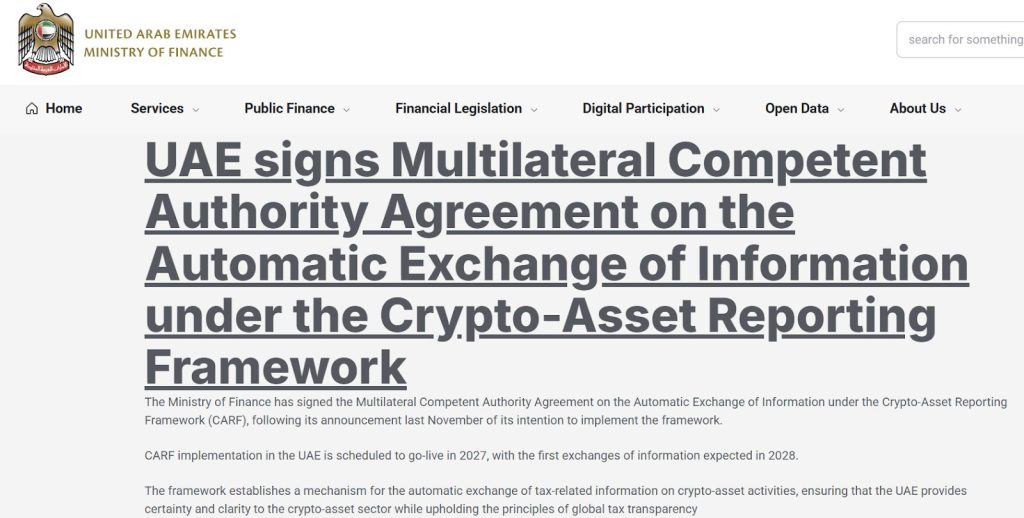
UAE Announces 2027 Rollout of Automatic Crypto Tax Reporting System – What Does it Mean for Investors?Source: UAE Ministry of Finance

The framework establishes a mechanism for the automatic exchange of tax-related information on crypto-asset activities, ensuring that the UAE provides certainty and clarity to the crypto-asset sector while upholding the principles of global tax transparency,” the Ministry said.

The move builds on the UAE’s efforts to attract crypto businesses after exempting crypto transactions from VAT in 2024 and Dubai setting regulatory guidelines for digital asset companies.

The Ministry is now seeking industry feedback before implementing the rules.

All participants in the crypto sector, including exchanges, custodians, traders, and advisors, are invited to join the public consultation to share their concerns about potential impacts.

The consultation has already opened on September 15 and is expected to close on November 8, 2025.

For Crypto Investors: What Does the UAE Crypto Tax Reporting Agreement Means

The UAE will begin automatically sharing information on crypto transactions and holdings with tax authorities in other countries starting in 2028.

This means that crypto will no longer be treated as an opaque asset class for offshore investors.

Investors who rely on the UAE as a low-tax or no-tax hub will need to ensure they report their crypto holdings correctly in their home jurisdictions.

Authorities can cross-check disclosures with the data exchanged under CARF, making tax evasion much harder.

UAE-based exchanges, custodians, and wallet providers will be required to collect and report customer data, similar to how banks and brokers report under FATCA/CRS.

Crypto investors should expect stricter KYC and AML processes, as platforms prepare to comply with international reporting standards.

Institutional investors may view this as a positive development, as it reduces reputational risk and regulatory uncertainty.

However, privacy-focused investors who rely on crypto for tax avoidance or secrecy may feel uneasy as cross-border reporting reduces anonymity.

There could be higher compliance costs, especially for traders using multiple wallets, custodians, or offshore entities.

Non-compliant investors might face penalties, back taxes, or investigations in their home countries as the tax avoidance window closes by 2027–2028.

UAE’s Local Tax Position Remains Unchanged

It’s worth noting that the UAE’s signing the CARF does not mean it will start taxing crypto gains locally.

What it does mean is that if you are a foreigner living in the UAE but remain tax-resident elsewhere, your home country can now receive details of your UAE crypto activity and tax you according to its laws.

For UAE nationals and residents who are only tax-resident in the UAE, crypto will still be exempt from income tax, unless a new domestic law is introduced later.

Currently in the UAE, there’s no personal income tax on individuals, whether from salary, business profits, or crypto gains.

Similarly, the 5% VAT in the country only applies to goods and services, but not to investment gains (like profits from selling crypto).

So until now, crypto trading by individuals has not been taxed in the UAE.

However, a corporate tax of 9% was introduced in June 2023, but it mainly applies to companies with profits exceeding AED 375,000. Individuals trading crypto on their own are not subject to corporate tax.

Who Should Worry Most About the Crypto Tax Reporting System?

The first category includes expats in the UAE who are still tax residents in their home countries.

Also, investors who have been under-reporting or not reporting crypto gains back home and high-net-worth individuals who moved assets into UAE exchanges for “privacy.”

This means if you’re from the US, EU, UK, Canada, Australia, Japan, South Korea, or India, the new CARF agreement means your home tax authority will soon have a clear view of your UAE crypto accounts.

But suppose you’re from countries like Saudi Arabia, Qatar, Singapore, or Switzerland, or you’re a UAE national/resident who is only tied to the UAE. In that case, there’s little change since your jurisdiction doesn’t currently tax crypto gains.

Disclaimer: The articles reposted on this site are sourced from public platforms and are provided for informational purposes only. They do not necessarily reflect the views of MEXC. All rights remain with the original authors. If you believe any content infringes on third-party rights, please contact service@support.mexc.com for removal. MEXC makes no guarantees regarding the accuracy, completeness, or timeliness of the content and is not responsible for any actions taken based on the information provided. The content does not constitute financial, legal, or other professional advice, nor should it be considered a recommendation or endorsement by MEXC.

You May Also Like

Wall Street Bets on XRP: Adoption-Driven Peak by 2026

Wall Street Bets on XRP: Adoption-Driven Peak by 2026

The post Wall Street Bets on XRP: Adoption-Driven Peak by 2026 appeared on BitcoinEthereumNews.com. XRP as Wall Street’s Financial Rails: Canary Capital CEO Sees
Share
BitcoinEthereumNews2025/12/23 15:58
How to earn from cloud mining: IeByte’s upgraded auto-cloud mining platform unlocks genuine passive earnings

How to earn from cloud mining: IeByte’s upgraded auto-cloud mining platform unlocks genuine passive earnings

The post How to earn from cloud mining: IeByte’s upgraded auto-cloud mining platform unlocks genuine passive earnings appeared on BitcoinEthereumNews.com. contributor Posted: September 17, 2025 As digital assets continue to reshape global finance, cloud mining has become one of the most effective ways for investors to generate stable passive income. Addressing the growing demand for simplicity, security, and profitability, IeByte has officially upgraded its fully automated cloud mining platform, empowering both beginners and experienced investors to earn Bitcoin, Dogecoin, and other mainstream cryptocurrencies without the need for hardware or technical expertise. Why cloud mining in 2025? Traditional crypto mining requires expensive hardware, high electricity costs, and constant maintenance. In 2025, with blockchain networks becoming more competitive, these barriers have grown even higher. Cloud mining solves this by allowing users to lease professional mining power remotely, eliminating the upfront costs and complexity. IeByte stands at the forefront of this transformation, offering investors a transparent and seamless path to daily earnings. IeByte’s upgraded auto-cloud mining platform With its latest upgrade, IeByte introduces: Full Automation: Mining contracts can be activated in just one click, with all processes handled by IeByte’s servers. Enhanced Security: Bank-grade encryption, cold wallets, and real-time monitoring protect every transaction. Scalable Options: From starter packages to high-level investment contracts, investors can choose the plan that matches their goals. Global Reach: Already trusted by users in over 100 countries. Mining contracts for 2025 IeByte offers a wide range of contracts tailored for every investor level. From entry-level plans with daily returns to premium high-yield packages, the platform ensures maximum accessibility. Contract Type Duration Price Daily Reward Total Earnings (Principal + Profit) Starter Contract 1 Day $200 $6 $200 + $6 + $10 bonus Bronze Basic Contract 2 Days $500 $13.5 $500 + $27 Bronze Basic Contract 3 Days $1,200 $36 $1,200 + $108 Silver Advanced Contract 1 Day $5,000 $175 $5,000 + $175 Silver Advanced Contract 2 Days $8,000 $320 $8,000 + $640 Silver…
Share
BitcoinEthereumNews2025/09/17 23:48
GCEX Group has acquired GlobalBlock, a crypto broker with over $60 million in assets under management.

GCEX Group has acquired GlobalBlock, a crypto broker with over $60 million in assets under management.

PANews reported on September 25th that GCEX Group has acquired GlobalBlock, a cryptocurrency broker specializing in serving high-net-worth clients with over $60 million in assets under management. This acquisition allows GCEX to expand its business beyond its core over-the-counter (OTC) trading services into wealth management for high-net-worth individuals. GCEX holds operating licenses from the UK Financial Conduct Authority, the Danish Financial Supervisory Authority, and the Dubai Virtual Assets Authority. The company plans to leverage these regulatory approvals to streamline the onboarding process for GlobalBlock's wealth management clients. The combined entity will directly compete with traditional financial giants such as Galaxy Digital, as well as emerging crypto wealth management firms.
Share
PANews2025/09/25 18:26