Pantera Capital founder Dan Morehead believes a geopolitical shift in reserve management will push adversaries of the United States into Bitcoin at massive scale, calling it “inevitable” that China and Russia eventually hold “trillions of dollars” worth of the asset. Speaking on Blockworks’ Empire podcast released this week, the billionaire framed the prediction as part of a longer-term rotation in global reserve assets and a response to sanction risk embedded in dollar-denominated holdings. “I think it’ll take a decade or two,” Morehead said, adding that the first movers will likely include US-aligned Gulf states before “the big one” arrives with countries “antagonistic to the United States, like China or Russia.” Why Russia And China Will Adopt Bitcoin Morehead anchored his argument in the historical cadence of reserve transitions and the vulnerability of holding claims on a rival’s financial system. “You gotta remember, the reserve currency’s changed every 80 or 100 years… no one’s ever really lasted for more than, let’s call it 100, 110 years,” he said. While calling it “inconceivable that the dollar will be supplanted” overnight, he warned that countries with large US Treasury positions face concentrated political risk. Citing China’s portfolio, he argued: “It’s really pretty crazy to have your entire country’s life savings in an asset that your potential adversary could literally just cancel.” In his view, that calculus makes it “inevitable” that such countries “will have started to save in Bitcoin and other cryptocurrencies” within the next decade. Related Reading: Bitcoin Dip-Buy Calls Spike: Why This Could Actually Be Bearish The provocation lands amid measurable changes in how major economies hold US debt. Official Treasury data for July 2025 show China’s reported Treasury holdings at $730.7 billion, the lowest since 2008 and down markedly over the past decade, a decline often read as gradual diversification of reserves rather than abrupt abandonment. JUST IN: BILLIONAIRE DAN MOREHEAD JUST SAID IT’S “INEVITABLE” CHINA AND RUSSIA WILL HOLD TRILLIONS OF DOLLARS IN #BITCOIN NATION STATE GAME THEORY. IT’S HERE 🚀 pic.twitter.com/tOQO9tHYNi — The Bitcoin Historian (@pete_rizzo_) September 23, 2025 Japan remains the largest holder at roughly $1.15 trillion, with the United Kingdom near $900 billion. The broader pool of foreign-held Treasuries nonetheless hit a record in July. These figures illustrate that while the dollar system remains deep and liquid, China’s share is slipping at the margin—the exact dynamic Morehead argues could accelerate alternative reserve strategies over time. Morehead’s timeline also intersects with a flurry of policy proposals that, if enacted, would normalize sovereign Bitcoin exposure. In March, US President Donald Trump signed an executive order establishing a Strategic Bitcoin Reserve and a national digital asset stockpile. Wyoming legislators separately advanced a bill to permit limited Bitcoin investments—capped at 3%—within certain state funds, an incremental step toward institutional reserve management in digital assets at the state level. Related Reading: Bitcoin Falls Below $113,000, But This Indicator Says It’s Time To Buy Outside the US, Gulf governments are already experimenting at the edges of sovereign crypto exposure—another plank in Morehead’s thesis. The United Arab Emirates’ has launched state-backed mining initiatives and disclosures suggesting several thousand BTC accumulated on the balance sheet via those operations. Skeptics will note that moving “trillions” of dollars into Bitcoin would require not only policy shifts but also market structure capable of absorbing sustained sovereign demand without disorderly volatility. Liquidity depth has improved with US spot ETF adoption and growing derivatives markets, yet Bitcoin’s free float, custody frameworks, and cross-border payment rails still face periodic stress. Morehead, however, situates the thesis in a long arc rather than a short-term trade. “I don’t think it’s gonna happen overnight,” he said, emphasizing a horizon of “a decade or two” and a phased path in which US-aligned adopters pave the way for politically non-aligned states that prize censorship resistance and sanction insulation. For China and Russia specifically, the impetus would be as much strategic as financial. China’s willingness to chip away at Treasuries aligns with its broader push to diversify reserves into gold and other assets, while Russia’s post-2014 and 2022 sanctions experience has already driven a dramatic reconfiguration of its reserve composition. At press time, Bitcoin traded at $112,639. Featured image created with DALL.E, chart from TradingView.comPantera Capital founder Dan Morehead believes a geopolitical shift in reserve management will push adversaries of the United States into Bitcoin at massive scale, calling it “inevitable” that China and Russia eventually hold “trillions of dollars” worth of the asset. Speaking on Blockworks’ Empire podcast released this week, the billionaire framed the prediction as part of a longer-term rotation in global reserve assets and a response to sanction risk embedded in dollar-denominated holdings. “I think it’ll take a decade or two,” Morehead said, adding that the first movers will likely include US-aligned Gulf states before “the big one” arrives with countries “antagonistic to the United States, like China or Russia.” Why Russia And China Will Adopt Bitcoin Morehead anchored his argument in the historical cadence of reserve transitions and the vulnerability of holding claims on a rival’s financial system. “You gotta remember, the reserve currency’s changed every 80 or 100 years… no one’s ever really lasted for more than, let’s call it 100, 110 years,” he said. While calling it “inconceivable that the dollar will be supplanted” overnight, he warned that countries with large US Treasury positions face concentrated political risk. Citing China’s portfolio, he argued: “It’s really pretty crazy to have your entire country’s life savings in an asset that your potential adversary could literally just cancel.” In his view, that calculus makes it “inevitable” that such countries “will have started to save in Bitcoin and other cryptocurrencies” within the next decade. Related Reading: Bitcoin Dip-Buy Calls Spike: Why This Could Actually Be Bearish The provocation lands amid measurable changes in how major economies hold US debt. Official Treasury data for July 2025 show China’s reported Treasury holdings at $730.7 billion, the lowest since 2008 and down markedly over the past decade, a decline often read as gradual diversification of reserves rather than abrupt abandonment. JUST IN: BILLIONAIRE DAN MOREHEAD JUST SAID IT’S “INEVITABLE” CHINA AND RUSSIA WILL HOLD TRILLIONS OF DOLLARS IN #BITCOIN NATION STATE GAME THEORY. IT’S HERE 🚀 pic.twitter.com/tOQO9tHYNi — The Bitcoin Historian (@pete_rizzo_) September 23, 2025 Japan remains the largest holder at roughly $1.15 trillion, with the United Kingdom near $900 billion. The broader pool of foreign-held Treasuries nonetheless hit a record in July. These figures illustrate that while the dollar system remains deep and liquid, China’s share is slipping at the margin—the exact dynamic Morehead argues could accelerate alternative reserve strategies over time. Morehead’s timeline also intersects with a flurry of policy proposals that, if enacted, would normalize sovereign Bitcoin exposure. In March, US President Donald Trump signed an executive order establishing a Strategic Bitcoin Reserve and a national digital asset stockpile. Wyoming legislators separately advanced a bill to permit limited Bitcoin investments—capped at 3%—within certain state funds, an incremental step toward institutional reserve management in digital assets at the state level. Related Reading: Bitcoin Falls Below $113,000, But This Indicator Says It’s Time To Buy Outside the US, Gulf governments are already experimenting at the edges of sovereign crypto exposure—another plank in Morehead’s thesis. The United Arab Emirates’ has launched state-backed mining initiatives and disclosures suggesting several thousand BTC accumulated on the balance sheet via those operations. Skeptics will note that moving “trillions” of dollars into Bitcoin would require not only policy shifts but also market structure capable of absorbing sustained sovereign demand without disorderly volatility. Liquidity depth has improved with US spot ETF adoption and growing derivatives markets, yet Bitcoin’s free float, custody frameworks, and cross-border payment rails still face periodic stress. Morehead, however, situates the thesis in a long arc rather than a short-term trade. “I don’t think it’s gonna happen overnight,” he said, emphasizing a horizon of “a decade or two” and a phased path in which US-aligned adopters pave the way for politically non-aligned states that prize censorship resistance and sanction insulation. For China and Russia specifically, the impetus would be as much strategic as financial. China’s willingness to chip away at Treasuries aligns with its broader push to diversify reserves into gold and other assets, while Russia’s post-2014 and 2022 sanctions experience has already driven a dramatic reconfiguration of its reserve composition. At press time, Bitcoin traded at $112,639. Featured image created with DALL.E, chart from TradingView.com
Bitcoin Will Soak Up Trillions From China And Russia, Billionaire Predicts

2025/09/24 16:00

Pantera Capital founder Dan Morehead believes a geopolitical shift in reserve management will push adversaries of the United States into Bitcoin at massive scale, calling it “inevitable” that China and Russia eventually hold “trillions of dollars” worth of the asset.

Speaking on Blockworks’ Empire podcast released this week, the billionaire framed the prediction as part of a longer-term rotation in global reserve assets and a response to sanction risk embedded in dollar-denominated holdings. “I think it’ll take a decade or two,” Morehead said, adding that the first movers will likely include US-aligned Gulf states before “the big one” arrives with countries “antagonistic to the United States, like China or Russia.”

Why Russia And China Will Adopt Bitcoin

Morehead anchored his argument in the historical cadence of reserve transitions and the vulnerability of holding claims on a rival’s financial system. “You gotta remember, the reserve currency’s changed every 80 or 100 years… no one’s ever really lasted for more than, let’s call it 100, 110 years,” he said.

While calling it “inconceivable that the dollar will be supplanted” overnight, he warned that countries with large US Treasury positions face concentrated political risk. Citing China’s portfolio, he argued: “It’s really pretty crazy to have your entire country’s life savings in an asset that your potential adversary could literally just cancel.” In his view, that calculus makes it “inevitable” that such countries “will have started to save in Bitcoin and other cryptocurrencies” within the next decade.

The provocation lands amid measurable changes in how major economies hold US debt. Official Treasury data for July 2025 show China’s reported Treasury holdings at $730.7 billion, the lowest since 2008 and down markedly over the past decade, a decline often read as gradual diversification of reserves rather than abrupt abandonment.

Japan remains the largest holder at roughly $1.15 trillion, with the United Kingdom near $900 billion. The broader pool of foreign-held Treasuries nonetheless hit a record in July. These figures illustrate that while the dollar system remains deep and liquid, China’s share is slipping at the margin—the exact dynamic Morehead argues could accelerate alternative reserve strategies over time.

Morehead’s timeline also intersects with a flurry of policy proposals that, if enacted, would normalize sovereign Bitcoin exposure. In March, US President Donald Trump signed an executive order establishing a Strategic Bitcoin Reserve and a national digital asset stockpile. Wyoming legislators separately advanced a bill to permit limited Bitcoin investments—capped at 3%—within certain state funds, an incremental step toward institutional reserve management in digital assets at the state level.

Outside the US, Gulf governments are already experimenting at the edges of sovereign crypto exposure—another plank in Morehead’s thesis. The United Arab Emirates’ has launched state-backed mining initiatives and disclosures suggesting several thousand BTC accumulated on the balance sheet via those operations.

Skeptics will note that moving “trillions” of dollars into Bitcoin would require not only policy shifts but also market structure capable of absorbing sustained sovereign demand without disorderly volatility. Liquidity depth has improved with US spot ETF adoption and growing derivatives markets, yet Bitcoin’s free float, custody frameworks, and cross-border payment rails still face periodic stress.

Morehead, however, situates the thesis in a long arc rather than a short-term trade. “I don’t think it’s gonna happen overnight,” he said, emphasizing a horizon of “a decade or two” and a phased path in which US-aligned adopters pave the way for politically non-aligned states that prize censorship resistance and sanction insulation.

For China and Russia specifically, the impetus would be as much strategic as financial. China’s willingness to chip away at Treasuries aligns with its broader push to diversify reserves into gold and other assets, while Russia’s post-2014 and 2022 sanctions experience has already driven a dramatic reconfiguration of its reserve composition.

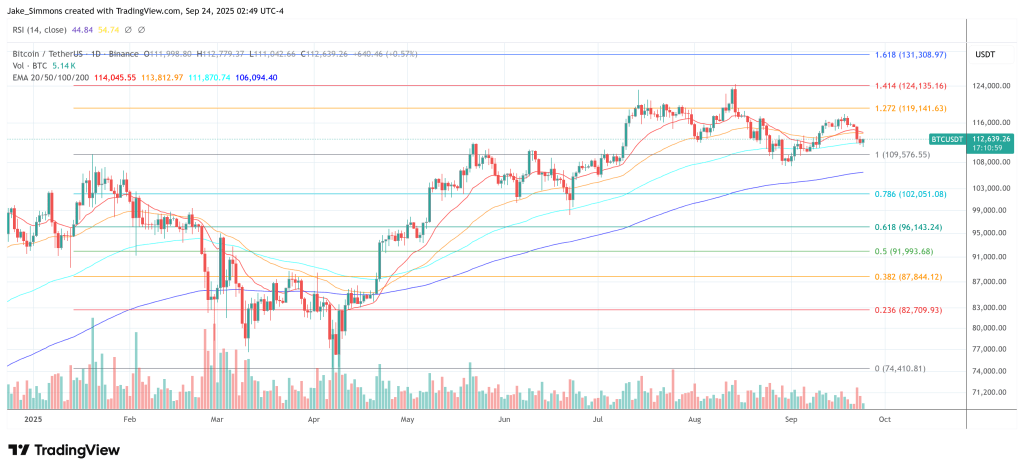
At press time, Bitcoin traded at $112,639.

Bitcoin price
Market Opportunity
NEAR Logo
NEAR Price(NEAR)
$1.504
$1.504$1.504
-3.52%
USD
NEAR (NEAR) Live Price Chart
Disclaimer: The articles reposted on this site are sourced from public platforms and are provided for informational purposes only. They do not necessarily reflect the views of MEXC. All rights remain with the original authors. If you believe any content infringes on third-party rights, please contact service@support.mexc.com for removal. MEXC makes no guarantees regarding the accuracy, completeness, or timeliness of the content and is not responsible for any actions taken based on the information provided. The content does not constitute financial, legal, or other professional advice, nor should it be considered a recommendation or endorsement by MEXC.

You May Also Like

BlackRock boosts AI and US equity exposure in $185 billion models

BlackRock boosts AI and US equity exposure in $185 billion models

The post BlackRock boosts AI and US equity exposure in $185 billion models appeared on BitcoinEthereumNews.com. BlackRock is steering $185 billion worth of model portfolios deeper into US stocks and artificial intelligence. The decision came this week as the asset manager adjusted its entire model suite, increasing its equity allocation and dumping exposure to international developed markets. The firm now sits 2% overweight on stocks, after money moved between several of its biggest exchange-traded funds. This wasn’t a slow shuffle. Billions flowed across multiple ETFs on Tuesday as BlackRock executed the realignment. The iShares S&P 100 ETF (OEF) alone brought in $3.4 billion, the largest single-day haul in its history. The iShares Core S&P 500 ETF (IVV) collected $2.3 billion, while the iShares US Equity Factor Rotation Active ETF (DYNF) added nearly $2 billion. The rebalancing triggered swift inflows and outflows that realigned investor exposure on the back of performance data and macroeconomic outlooks. BlackRock raises equities on strong US earnings The model updates come as BlackRock backs the rally in American stocks, fueled by strong earnings and optimism around rate cuts. In an investment letter obtained by Bloomberg, the firm said US companies have delivered 11% earnings growth since the third quarter of 2024. Meanwhile, earnings across other developed markets barely touched 2%. That gap helped push the decision to drop international holdings in favor of American ones. Michael Gates, lead portfolio manager for BlackRock’s Target Allocation ETF model portfolio suite, said the US market is the only one showing consistency in sales growth, profit delivery, and revisions in analyst forecasts. “The US equity market continues to stand alone in terms of earnings delivery, sales growth and sustainable trends in analyst estimates and revisions,” Michael wrote. He added that non-US developed markets lagged far behind, especially when it came to sales. This week’s changes reflect that position. The move was made ahead of the Federal…
Share
BitcoinEthereumNews2025/09/18 01:44
Alameda Research recovers 500 BTC, still holds over $1B in assets

Alameda Research recovers 500 BTC, still holds over $1B in assets

The post Alameda Research recovers 500 BTC, still holds over $1B in assets appeared on BitcoinEthereumNews.com. Alameda Research is sitting on over $1B in crypto assets, even after the latest repayment to creditors. The fund’s wallets received another 500 BTC valued at over $58M.  Alameda Research, the defunct quant and hedge firm linked to FTX, received another 500 BTC in one of its main wallets. Following the latest inflow, and with additional SOL unlocks, Alameda Research once again sits on over $1B in assets.  The BTC inflow came from an intermediary wallet, labeled ‘WBTC merchant deposit’, from Alameda’s involvement with the WBTC ecosystem. The 500 BTC were moved through a series of intermediary wallets, showing activity in the past few weeks.  The funds were tracked to deposits from QCP Capital, which started moving into Alameda’s wallets three weeks ago. The wallets also moved through Alameda’s WBTC Merchant addresses. During its activity period, Alameda Research had status as an official WBTC merchant, meaning it could accept BTC and mint WBTC tokens. The WBTC was still issued by BitGo, while Alameda was not the custodian.  The current tranche of 500 BTC returning to Alameda’s wallet may come from its own funds, unwrapped from the tokenized form. In any case, Alameda is now the full custodian of the 500 BTC.  The small transaction recalls previous episodes when Alameda withdrew assets from FTX in the days before its bankruptcy. WBTC was one of the main inflows, as Alameda used its status as WBTC merchant to unwrap the assets and switch to BTC. Due to the rising BTC market price, the recent inflow was even larger than the withdrawals at the time of the FTX bankruptcy.  Alameda inflows arrive just before the next FTX distribution The transfer into Alameda’s wallets has not been moved to another address, and may not become a part of the current FTX distribution at this stage. …
Share
BitcoinEthereumNews2025/09/30 18:39
White House Forms Crypto Team to Drive Regulation

White House Forms Crypto Team to Drive Regulation

The White House developed a "dream team" for U.S. cryptocurrency regulations. Continue Reading:White House Forms Crypto Team to Drive Regulation The post White
Share
Coinstats2025/12/23 04:10