Setting up development environments takes time. Doing this more than once is a time sink and prone to error. So how can we reduce setup complexity and quickly get to productively writing code? I’ve been looking at this problem and applying it to my own apps for AI with Google ADK and Python.Setting up development environments takes time. Doing this more than once is a time sink and prone to error. So how can we reduce setup complexity and quickly get to productively writing code? I’ve been looking at this problem and applying it to my own apps for AI with Google ADK and Python.

Stop Wasting Weeks on Dev Setup: Containers to the Rescue

Setting up development environments takes time. Doing this more than once is a time sink and prone to error. So how can we reduce setup complexity and quickly get to productively writing code ?

I’ve been looking at this problem and applying it to my own apps for AI with Google ADK and Python.

We need to talk about setup

Who has never heard ‘it works on my laptop’ when apps fail in production or on another developers laptop ?

Manually building development environments can be labour intensive and error prone. I’ve seen 2 week lead times set aside for this in some places. This being a part of what was seen as ‘induction’ or ‘familiarization’ exercises.

Surely we can do better. Containers I believe are a good starting point. Investing in workflows that employ them is in my opinion, time well spent.

inftools-cn

inftools-cn is a container that is built for rapid deployments of mvk, a minimal viable kubernetes environment/ It has a built in Python tooling for some AI workflows and development using pip and uv. It also has additional tooling needed for local and remote kubernetes administration such as kubectlk3d docker cli.

Without a container, each of these tools would need to be added to our environment manually. Each in turn need maintained, updated and security scanned. This takes precious time away from development and which can be automated.

inftools-cn is built with a pipeline that uses trivy to scan for and halt deployments that have critical CVE alerts. Using tooling like this takes yet another headache away.

inftools-cn is still early in its development and will have more tooling added over time. This will make it a part of my daily workflow using kubernetes, python and agentic AI.

Getting Started

Prerequisites

The following are pre-requisites for this article’ approach to container development workflows:

  • Docker
  • VSCode
  • VSCode Extensions
  • container tools
  • dev containers
  • python language support

I chose to use VSCode as it has well supported container support through extensions from Microsoft.

ADK setup

To get started with an environment for ADK development, make a new directory for a project and add a docker compose file.

Open this folder in VSCode:

mkdir -p ~/projects/adk cd ~/projects/adk wget https://codeberg.org/headshed/inftools-cn/raw/branch/main/docker-compose.yml code .

start the container stack

Click on Run All Services, then in the container view in VSCode ( find this in the left window ), Attach visual studio code VSCode container extension makes it easy to open a development environment within a running container
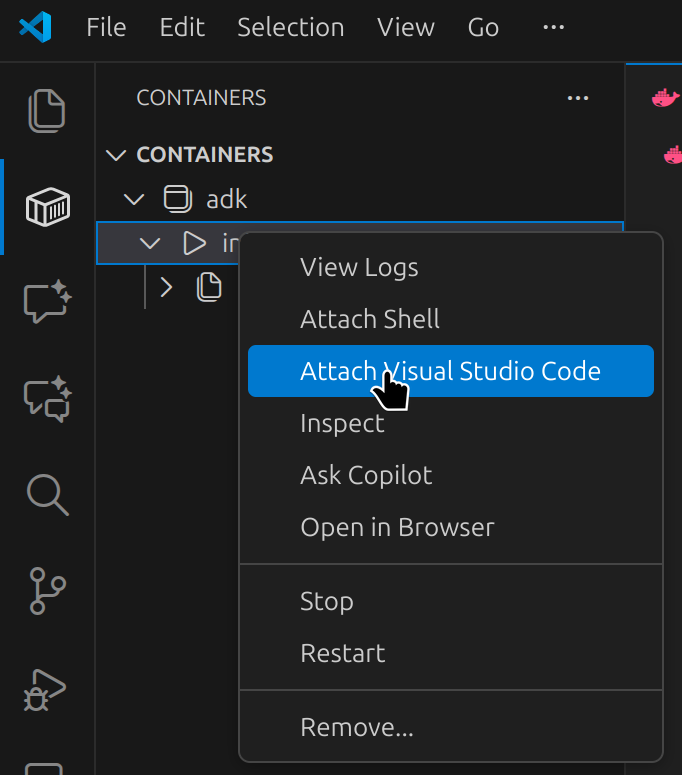
This will open another VSCode instance within the container we just started.

The 2nd VSCode instance is where we will work from and the first one can be closed.

Open a new terminal in VSCode

cntrl / command + shift + `

Which opens a console in the home directory of the container:

user@6bccffe008e0:~$ pwd /home/user

In this console, a new python virtual environment can be created:

user@6bccffe008e0:~$ uv venv Using CPython 3.13.11 interpreter at: /usr/bin/python3 Creating virtual environment at: .venv Activate with: source .venv/bin/activate

As suggested, running the source command in the current shell

source .venv/bin/activate

… activates a python virtual environment in this, current, shell however to apply globally in our project in VSCode

control / command + shift + p to enter command mode

Type and select: Python: Select interpreter

Add an interpreter path of:

/home/user/.venv/bin/python

When opening subsequent shells within VSCode, the .venv environment will be applied automatically

Following the ADK docs

The Python quickstart for ADK can be followed for the most part but for its initial installation we need to use uv:

uv pip install google-adk

This sets up google-adk within the uv environment

in the same article by google, create an agent project, a new agent can be created in our new container with

adk create my_agent

I accepted the first and default options for most questions asked by the adk cli and added a valid API token from google api keys

This creates a new agent stub.

We can update the agent to tell the time in cities around the world

Testing ADK commmand line

To test our agent in the command line:

adk run my_agent

Which yields a command line session in which we can converse with the agent:

Running agent root_agent, type exit to exit. [user]: what is the time in new york, USA [root_agent]: The current time in New York, USA is 10:30 AM.

Testing ADK Using its Web Console

We can interact with our models using a rich web console environment:

adk web --port 8000

This opens the web browser app of adk that vscode will proxy for us and shows a helper to open in a browser:

We can talk to our agent now in this browser and debug environment

Why bother with development containers ?

This simple workflow could have been achieved by manually installing all of the tools that come bundled with inftools-cn.

However, this would need at least to include a recent version of python where it is not already present. Windows users may find this to be necessary outside of Windows subsystem for Linux ( WSL ), Linux and Mac users perhaps not so much.

the uv command is a simple curl command to install and we needed to add vscode plugins to run vscode within our container and initially to start the container up

We could conclude inftools-ci is over engineered, however, even these few steps, once done have to be done again and again on every new environment and each can have subtle differences.

As more tools are added, this will increase the operational load of our environment setup.

Any creature comforts we add in to our environment to give enhanced shell experience can quickly add to an array of manual steps that need to be repeated for every single laptop, workstation or virtual desktop we need to use.

Without pinned container versions, python and uv can vary across our environments and saying ‘it works on my laptop’ to someone telling us our code doesn't work in theirs is cold comfort and a bad developer experience.

As our projects become more complex, more tooling will be required and using a container with all dependencies built in aids our workflow and reduces the risk of incompatibilities being introduced and resulting in broken code for other developers.

If we run several development environments, be it just a couple of laptops or develop on a laptop to deploy to the cloud, we can experience differences in build and production environments that become critical, harmful even to our user’s experience.

The inftools-cn container has its own build pipeline that we can check to see if it is recent and up to date.

It’s pipeline is configured to block releases if critical CVE vulnerabilities are present and even gives us a software bill of materials for compliance and security checks.

The benefits of using containers for development become more evident as we add build infrastructure and pipelines that support such a container workflow.

Now, If my laptop blows up, is stolen or lost in any other kind of disaster, how do I get up and running as quickly as possible ?

Containers like inftools-ci can play a part in having our own business continuity plan.

Of course, you don’t have to use this particular container. You can build your own and inftools-ci may be used as a template to do so.

Understanding the build process for your own containers, based on the above would be the subject of another article.

If you are interested in de-mystifying the dark arts of building containers for development, stay tuned as this is planned to be a follow up article soon, or find me on socials and lets talk about what your building.

\

Market Opportunity
LETSTOP Logo
LETSTOP Price(STOP)
$0.02435
$0.02435$0.02435
+20.66%
USD
LETSTOP (STOP) Live Price Chart
Disclaimer: The articles reposted on this site are sourced from public platforms and are provided for informational purposes only. They do not necessarily reflect the views of MEXC. All rights remain with the original authors. If you believe any content infringes on third-party rights, please contact service@support.mexc.com for removal. MEXC makes no guarantees regarding the accuracy, completeness, or timeliness of the content and is not responsible for any actions taken based on the information provided. The content does not constitute financial, legal, or other professional advice, nor should it be considered a recommendation or endorsement by MEXC.

You May Also Like

XRP faces far more negative social media commentary than average

XRP faces far more negative social media commentary than average

The post XRP faces far more negative social media commentary than average appeared on BitcoinEthereumNews.com. XRP is drawing unusually high levels of negative
Share
BitcoinEthereumNews2025/12/23 19:23
Xcimer Energy Delivers Technical Update to U.S. Energy Sec. Chris Wright and U.S. Rep. Gabe Evans in Denver Laser Bay

Xcimer Energy Delivers Technical Update to U.S. Energy Sec. Chris Wright and U.S. Rep. Gabe Evans in Denver Laser Bay

High-level visit, also including Chancellor of Colorado State University System Dr. Tony Frank, comes after Xcimer begins testing of one of the highest-energy KrF
Share
AI Journal2025/12/23 19:16
Crucial US Stock Market Update: What Wednesday’s Mixed Close Reveals

Crucial US Stock Market Update: What Wednesday’s Mixed Close Reveals

BitcoinWorld Crucial US Stock Market Update: What Wednesday’s Mixed Close Reveals The financial world often keeps us on our toes, and Wednesday was no exception. Investors watched closely as the US stock market concluded the day with a mixed performance across its major indexes. This snapshot offers a crucial glimpse into current investor sentiment and economic undercurrents, prompting many to ask: what exactly happened? Understanding the Latest US Stock Market Movements On Wednesday, the closing bell brought a varied picture for the US stock market. While some indexes celebrated gains, others registered slight declines, creating a truly mixed bag for investors. The Dow Jones Industrial Average showed resilience, climbing by a notable 0.57%. This positive movement suggests strength in some of the larger, more established companies. Conversely, the S&P 500, a broader benchmark often seen as a barometer for the overall market, experienced a modest dip of 0.1%. The technology-heavy Nasdaq Composite also saw a slight retreat, sliding by 0.33%. This particular index often reflects investor sentiment towards growth stocks and the tech sector. These divergent outcomes highlight the complex dynamics currently at play within the American economy. It’s not simply a matter of “up” or “down” for the entire US stock market; rather, it’s a nuanced landscape where different sectors and company types are responding to unique pressures and opportunities. Why Did the US Stock Market See Mixed Results? When the US stock market delivers a mixed performance, it often points to a tug-of-war between various economic factors. Several elements could have contributed to Wednesday’s varied closings. For instance, positive corporate earnings reports from certain industries might have bolstered the Dow. At the same time, concerns over inflation, interest rate policies by the Federal Reserve, or even global economic uncertainties could have pressured growth stocks, affecting the S&P 500 and Nasdaq. Key considerations often include: Economic Data: Recent reports on employment, manufacturing, or consumer spending can sway market sentiment. Corporate Announcements: Strong or weak earnings forecasts from influential companies can significantly impact their respective sectors. Interest Rate Expectations: The prospect of higher or lower interest rates directly influences borrowing costs for businesses and consumer spending, affecting future profitability. Geopolitical Events: Global tensions or trade policies can introduce uncertainty, causing investors to become more cautious. Understanding these underlying drivers is crucial for anyone trying to make sense of daily market fluctuations in the US stock market. Navigating Volatility in the US Stock Market A mixed close, while not a dramatic downturn, serves as a reminder that market volatility is a constant companion for investors. For those involved in the US stock market, particularly individuals managing their portfolios, these days underscore the importance of a well-thought-out strategy. It’s important not to react impulsively to daily movements. Instead, consider these actionable insights: Diversification: Spreading investments across different sectors and asset classes can help mitigate risk when one area underperforms. Long-Term Perspective: Focusing on long-term financial goals rather than short-term gains can help weather daily market swings. Stay Informed: Keeping abreast of economic news and company fundamentals provides context for market behavior. Consult Experts: Financial advisors can offer personalized guidance based on individual risk tolerance and objectives. Even small movements in major indexes can signal shifts that require attention, guiding future investment decisions within the dynamic US stock market. What’s Next for the US Stock Market? Looking ahead, investors will be keenly watching for further economic indicators and corporate announcements to gauge the direction of the US stock market. Upcoming inflation data, statements from the Federal Reserve, and quarterly earnings reports will likely provide more clarity. The interplay of these factors will continue to shape investor confidence and, consequently, the performance of the Dow, S&P 500, and Nasdaq. Remaining informed and adaptive will be key to understanding the market’s trajectory. Conclusion: Wednesday’s mixed close in the US stock market highlights the intricate balance of forces influencing financial markets. While the Dow showed strength, the S&P 500 and Nasdaq experienced slight declines, reflecting a nuanced economic landscape. This reminds us that understanding the ‘why’ behind these movements is as important as the movements themselves. As always, a thoughtful, informed approach remains the best strategy for navigating the complexities of the market. Frequently Asked Questions (FAQs) Q1: What does a “mixed close” mean for the US stock market? A1: A mixed close indicates that while some major stock indexes advanced, others declined. It suggests that different sectors or types of companies within the US stock market are experiencing varying influences, rather than a uniform market movement. Q2: Which major indexes were affected on Wednesday? A2: On Wednesday, the Dow Jones Industrial Average gained 0.57%, while the S&P 500 edged down 0.1%, and the Nasdaq Composite slid 0.33%, illustrating the mixed performance across the US stock market. Q3: What factors contribute to a mixed stock market performance? A3: Mixed performances in the US stock market can be influenced by various factors, including specific corporate earnings, economic data releases, shifts in interest rate expectations, and broader geopolitical events that affect different market segments uniquely. Q4: How should investors react to mixed market signals? A4: Investors are generally advised to maintain a long-term perspective, diversify their portfolios, stay informed about economic news, and avoid impulsive decisions. Consulting a financial advisor can also provide personalized guidance for navigating the US stock market. Q5: What indicators should investors watch for future US stock market trends? A5: Key indicators to watch include upcoming inflation reports, statements from the Federal Reserve regarding monetary policy, and quarterly corporate earnings reports. These will offer insights into the future direction of the US stock market. Did you find this analysis of the US stock market helpful? Share this article with your network on social media to help others understand the nuances of current financial trends! To learn more about the latest stock market trends, explore our article on key developments shaping the US stock market‘s future performance. This post Crucial US Stock Market Update: What Wednesday’s Mixed Close Reveals first appeared on BitcoinWorld.
Share
Coinstats2025/09/18 05:30