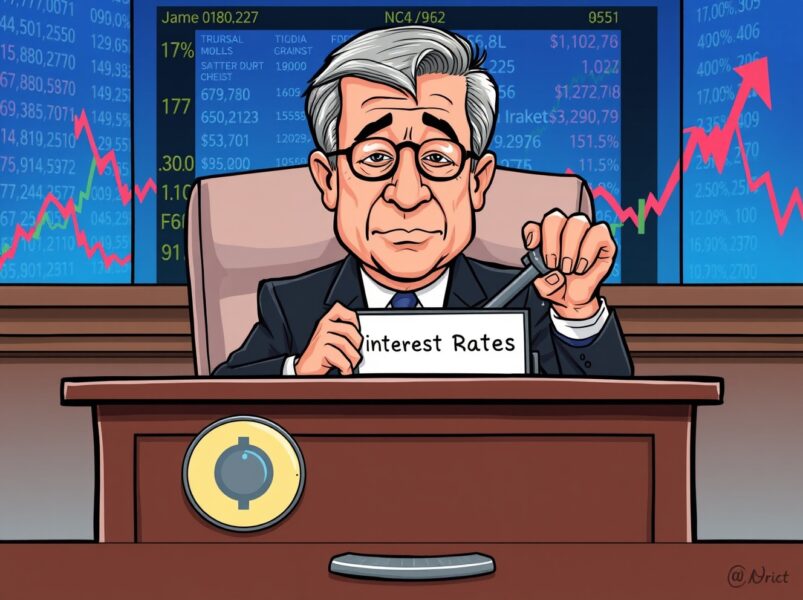
Top officials at the Federal Reserve are now taking into account how artificial intelligence might boost worker output as they map out future economic conditionsTop officials at the Federal Reserve are now taking into account how artificial intelligence might boost worker output as they map out future economic conditions

The Fed is now factoring AI into interest rate decisions, marking a major policy shift

Top officials at the Federal Reserve are now taking into account how artificial intelligence might boost worker output as they map out future economic conditions, a shift that could reshape how the central bank approaches interest rates and employment targets.

Fed Chair Jerome Powell touched on this issue during his press briefing in December. Looking back at previous technology waves, he noted that past innovations brought more jobs and better pay despite initial concerns. However, he said the outcome with AI remains unknown.

Research suggests these new AI tools, especially those that generate content, could significantly change both how much workers produce and the makeup of the job market itself. Two economists studying this issue created different models to see what might happen. Ping Wang from Washington University in St. Louis and Tsz-Nga Wong from the Richmond Federal Reserve Bank mapped out several possibilities.

Dramatic productivity scenarios take shape

Their most dramatic scenario assumes AI reaches full development over several decades. Under those conditions, about 23% of workers would lose their jobs, but those still working would produce three to four times more than they do now.

Wang explained that over the coming ten years, output per worker might climb roughly 7 percent each year. He stressed this represents one possible path, not a guaranteed outcome. The technology’s ability to learn and improve as people use it drives these potential gains, he said. Workers can also figure out better ways to use AI and customize it for their specific needs, leading to major productivity jumps.

These changes could affect how the Fed pursues its two main goals: keeping people employed and preventing prices from rising too fast. In December, the committee that sets interest rates predicted the benchmark rate would settle around 3 percent in the long term. Economists at the Cleveland Fed said this would be somewhat loose compared to a neutral rate of 3.7 percent.

Data center investment boom draws comparisons to 1990s

Some market watchers see parallels between today’s rush to build data centers and the 1990s spending spree on network equipment. Dan Tolomay, who oversees investments at Trust Company of the South, said rising valuations make him more cautious about returns going forward.

Vice Chair Philip Jefferson addressed college students in Germany this November about AI’s rapid spread. He said ChatGPT now has 800 million people using it each week, up from 500 million at the end of March. A recent study found that 45.9 percent of American workers were using generative AI at their jobs by June and July, compared to 30.1 percent last December. About one-third of those who adopted the tools use them daily.

The study showed AI use is highest among younger workers with more education and higher pay. Those workers saw substantial productivity increases when they used the tools.

Research by Stanford economist Erik Brynjolfsson found AI tools helped customer support workers resolve 14 percent more issues per hour. The gains were even larger for newer employees with less experience.

In scientific work, an AI system called AlphaFold changed protein research dramatically. Five years ago, scientists understood the structures of only 17 percent of the roughly 20,000 proteins in human bodies. Each discovery took months or years and could cost tens of thousands of dollars. AlphaFold now predicts structures for all human proteins plus 200 million more.

AI could match historic innovations

Jefferson said AI might prove as transformative as the printing press, steam engine, or internet. But he cautioned that figuring out AI’s effect on jobs and prices remains difficult. While the technology could replace some workers, it might also create new job types and boost overall economic growth.

On prices, Jefferson said increased productivity could lower costs and reduce inflation. But AI could also push certain prices higher as companies compete for skilled workers and build energy-hungry data centers.

If you're reading this, you’re already ahead. Stay there with our newsletter.

Market Opportunity
Nowchain Logo
Nowchain Price(NOW)
$0.0017
$0.0017$0.0017
-1.16%
USD
Nowchain (NOW) Live Price Chart
Disclaimer: The articles reposted on this site are sourced from public platforms and are provided for informational purposes only. They do not necessarily reflect the views of MEXC. All rights remain with the original authors. If you believe any content infringes on third-party rights, please contact service@support.mexc.com for removal. MEXC makes no guarantees regarding the accuracy, completeness, or timeliness of the content and is not responsible for any actions taken based on the information provided. The content does not constitute financial, legal, or other professional advice, nor should it be considered a recommendation or endorsement by MEXC.

You May Also Like

Crucial Fed Rate Cut: Powell’s Bold Risk Management Move Explained

Crucial Fed Rate Cut: Powell’s Bold Risk Management Move Explained

BitcoinWorld Crucial Fed Rate Cut: Powell’s Bold Risk Management Move Explained In a significant development for global financial markets, Federal Reserve Chair Jerome Powell recently described the latest Fed rate cut as a critical risk management measure. This statement immediately captured the attention of investors, economists, and especially those in the dynamic cryptocurrency space. Understanding Powell’s rationale and the potential implications of this move is essential for navigating today’s complex economic landscape. What Exactly is a Fed Rate Cut and Why Does it Matter? A Fed rate cut refers to the Federal Reserve lowering the target range for the federal funds rate. This is the interest rate at which commercial banks borrow and lend their excess reserves to each other overnight. When the Fed lowers this rate, it typically makes borrowing cheaper across the entire economy. This decision impacts everything from mortgage rates to business loans. The Fed uses interest rates as a primary tool to influence economic activity, aiming to achieve maximum employment and stable prices. A lower rate often stimulates spending and investment, but it can also signal concerns about economic slowdown. Key reasons for a rate cut often include: Slowing economic growth or recession fears. Low inflation or deflationary pressures. Global economic instability impacting domestic markets. A desire to provide more liquidity to the financial system. Powell’s emphasis on ‘risk management’ suggests a proactive approach. The Fed is not just reacting to current data but also anticipating potential future challenges. They are essentially trying to prevent a worse economic outcome by adjusting policy now. How Does a Fed Rate Cut Influence the Broader Economy? When the Federal Reserve implements a Fed rate cut, it sends ripples throughout the financial world. For traditional markets, lower interest rates generally mean: Boost for Stocks: Companies can borrow more cheaply, potentially increasing profits and stock valuations. Investors might also move money from lower-yielding bonds into equities. Cheaper Borrowing: Consumers and businesses enjoy lower rates on loans, from mortgages to credit cards, encouraging spending and investment. Weaker Dollar: Lower rates can make a country’s currency less attractive to foreign investors, potentially leading to a weaker dollar. Bond Market Shifts: Existing bonds with higher yields become more attractive, while newly issued bonds will have lower yields. This shift in monetary policy aims to inject confidence and liquidity into the system, countering potential economic headwinds. However, there’s always a delicate balance to strike, as too much stimulus can lead to inflationary pressures down the line. What Does This Fed Rate Cut Mean for Cryptocurrency Investors? The impact of a Fed rate cut on the cryptocurrency market is often a topic of intense discussion. While crypto assets operate independently of central banks, they are not immune to broader macroeconomic forces. Here’s how a rate cut can play out: Increased Risk Appetite: With traditional savings and bond yields potentially lower, investors might seek higher returns in riskier assets, including cryptocurrencies like Bitcoin and Ethereum. Inflation Hedge Narrative: Some view cryptocurrencies, particularly Bitcoin, as a hedge against inflation and traditional currency debasement. If a rate cut leads to concerns about inflation, this narrative could gain traction. Liquidity Influx: A more accommodative monetary policy can increase overall liquidity in the financial system, some of which may flow into digital assets. Dollar Weakness: A weaker dollar, a potential consequence of rate cuts, can sometimes make dollar-denominated assets like crypto more appealing to international investors. However, it’s crucial to remember that the crypto market also has its unique drivers, including technological developments, regulatory news, and market sentiment. While a Fed rate cut can provide a tailwind, it’s not the sole determinant of crypto performance. Navigating the New Landscape: Actionable Insights for Crypto Investors Given the Federal Reserve’s stance on risk management through a Fed rate cut, what steps can crypto investors consider? Stay Informed: Keep a close watch on further Fed announcements and economic data. Understanding the broader macroeconomic picture is vital. Diversify Your Portfolio: While a rate cut might favor risk assets, a balanced portfolio that includes a mix of traditional and digital assets can help mitigate volatility. Long-Term Perspective: Focus on the fundamental value and long-term potential of your chosen cryptocurrencies rather than short-term fluctuations driven by macro news. Assess Risk Tolerance: Re-evaluate your personal risk tolerance in light of potential market shifts. Lower rates can encourage speculation, but prudence remains key. Powell’s description of the Fed rate cut as a risk management measure highlights the central bank’s commitment to maintaining economic stability. For cryptocurrency enthusiasts, this move underscores the increasing interconnectedness of traditional finance and the digital asset world. While a rate cut can create opportunities, a thoughtful and informed approach is always the best strategy. Frequently Asked Questions (FAQs) What exactly is a Fed rate cut? A Fed rate cut is when the Federal Reserve lowers its target for the federal funds rate, which is the benchmark interest rate banks charge each other for overnight lending. This action makes borrowing cheaper across the economy, aiming to stimulate economic activity. Why did Powell emphasize “risk management” for this Fed rate cut? Jerome Powell emphasized “risk management” to indicate that the Fed was proactively addressing potential economic slowdowns or other future challenges. It suggests a preventative measure to safeguard against adverse economic conditions rather than merely reacting to existing problems. How does a Fed rate cut typically affect the crypto market? A Fed rate cut can make traditional investments less attractive due to lower yields, potentially driving investors towards higher-risk, higher-reward assets like cryptocurrencies. It can also increase overall market liquidity and strengthen the narrative of crypto as an inflation hedge. Should crypto investors change their strategy after a rate cut? While a rate cut can influence market dynamics, crypto investors should primarily focus on their long-term strategy, fundamental research, and risk tolerance. It’s wise to stay informed about macroeconomic trends but avoid making impulsive decisions based solely on a single policy change. What are the potential downsides of a Fed rate cut? Potential downsides include increased inflationary pressures if the economy overheats, a weaker national currency, and the possibility of creating asset bubbles as investors chase higher returns in riskier markets. It can also signal underlying concerns about economic health. Did you find this article insightful? Share your thoughts and help others understand the implications of the Fed’s latest move! Follow us on social media for more real-time updates and expert analysis. To learn more about the latest crypto market trends, explore our article on key developments shaping Bitcoin’s price action. This post Crucial Fed Rate Cut: Powell’s Bold Risk Management Move Explained first appeared on BitcoinWorld.
Share
Coinstats2025/09/18 16:40
Motive Files Registration Statement for Proposed Initial Public Offering

Motive Files Registration Statement for Proposed Initial Public Offering

SAN FRANCISCO–(BUSINESS WIRE)–Motive Technologies, Inc., the AI platform for physical operations, today announced that it has filed a registration statement on
Share
AI Journal2025/12/24 07:00
New Gold Protocol's NGP token was exploited and attacked, resulting in a loss of approximately $2 million.

New Gold Protocol's NGP token was exploited and attacked, resulting in a loss of approximately $2 million.

PANews reported on September 18th that according to Paidun monitoring, New Gold Protocol's NGP token was exploited in an attack, resulting in a loss of approximately $2 million. The NGP token plummeted 88% in an hour, and the attacker deposited the stolen funds (443.8 ETH) into TornadoCash.
Share
PANews2025/09/18 11:10