

Davos 2026: Why India’s Built Environment Is the Next CX Growth Engine
India’s Built Environment Moment: Why CX and EX Leaders Must Rethink Urban Experience Strategy After Davos 2026
Imagine this.
A global investor lands in Mumbai at midnight.
A startup founder boards a metro in Bengaluru at dawn.
A logistics manager tracks freight moving seamlessly from port to corridor to warehouse.
Each moment feels ordinary.
Each moment is a customer experience.
As the curtains closed on World Economic Forum (WEF) Davos 2026, India reframed its global pitch. Not as a fast-growing economy alone—but as the world’s largest greenfield built-environment opportunity.
For CX and EX leaders, this is not a real estate story.
It is a systems-of-experience story.
Urban India is becoming the largest living CX platform on the planet.
What Is India’s “Built Environment” Pitch—and Why Should CX Teams Care?
India positioned its built environment as the largest greenfield investment opportunity globally, redefining cities as experience ecosystems shaping productivity, trust, and long-term value.
With nearly 500 million Indians already urbanized and another 100 million expected by 2036, Indian cities are projected to generate 70% of national GDP. Unlike mature Western cities, India’s urban systems are still being written.
That makes this moment rare.
When infrastructure, land use, mobility, energy, and digital systems evolve together, experience design becomes economic strategy.
Why Urban Infrastructure Is Now a CX Problem, Not a Policy Footnote
CX leaders often focus on touchpoints inside organizations.
Cities operate at a different scale—but follow the same logic.
Every city delivers journeys:
- Commutes
- Energy access
- Housing transitions
- Work-life rhythms
- Digital connectivity
- Climate resilience moments
At Davos, India’s message was blunt:
Urban development now determines climate resilience, energy security, and productivity.
Those are experience outcomes.
When journeys break at city scale, businesses inherit the friction.
How India’s States Are Pitching Experience-Led Growth
Under the India Pavilion, states including Maharashtra, Karnataka, Gujarat, Telangana, Uttar Pradesh, Kerala, and Andhra Pradesh showcased investment opportunities.
What unified them was not ideology.
It was geography.
Ports.
Corridors.
Industrial clusters.
Data centres.
Urban districts.
Each eventually becomes:
- Land use decisions
- Built form
- Mobility patterns
- Everyday lived experience
From a CX lens, states are now competing as experience platforms, not just destinations.
Why This Pitch Is Credible Now (Execution Finally Matters)
India has shifted from planning to execution.
That matters deeply for trust.
Over the last decade:
- Metro networks expanded across 15+ cities
- Expressways compressed intercity travel times
- Bus rapid transit systems scaled
- Non-motorized mobility projects reshaped cores
- Coastal shipping and waterways improved freight efficiency
India now operates the world’s third-largest metro network, according to CREDAI.
Infrastructure delivery has become visible—and verifiable.
For CX leaders, this reduces experience volatility, the silent killer of long-term trust.
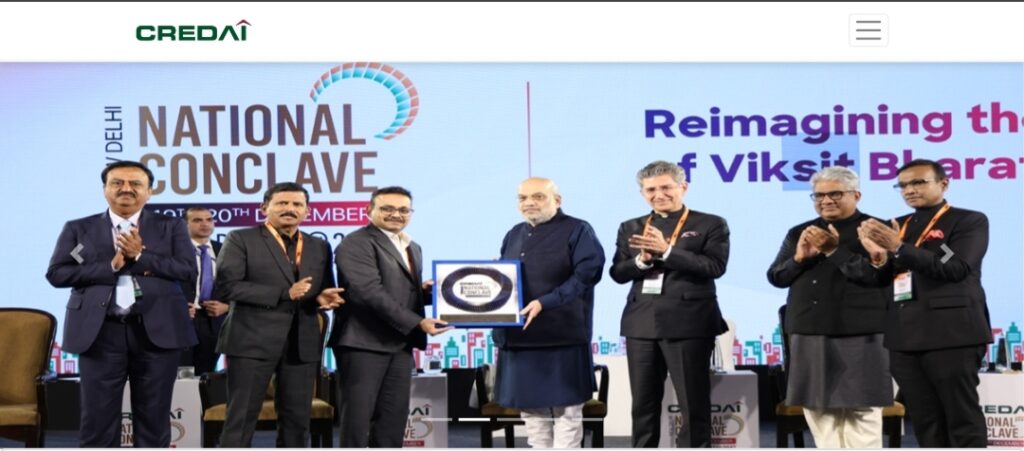
What CREDAI’s Message Signals to CX and EX Leaders
According to Dipakbhai B. Patel, National Convenor, CREDAI:
That line matters.
It signals a shift from asset-centric thinking to ecosystem-centric thinking.
Developers are no longer optimizing buildings in isolation.
They are designing complete, livable urban ecosystems.
This mirrors a mature CX truth:
Optimizing touchpoints without fixing systems always fails.
Why Global Capital Now Evaluates Cities Like Long-Term CX Programs
Hiren Parmar, Convenor – International Forums, CREDAI, made the subtext explicit:
Performance depends on:
- Governance reliability
- Infrastructure continuity
- Journey predictability
- Climate resilience
- Talent experience
Cities now face the same scrutiny as enterprise platforms.
Broken journeys repel capital.
Coherent experiences attract it.
What Is the “Leapfrog” Opportunity—and Why It Matters for Experience Design?
Leapfrogging means skipping the car-dependent, high-emission urban mistakes of the 20th century.
India has the rare chance to design cities:
- Around transit-oriented development (TOD) like Tokyo
- With nature-based flood management like Copenhagen
- Prioritizing walkability, density, and resilience
States like Maharashtra and Karnataka are pitching innovation districts, not sprawl.
This matters because:
- Car-centric cities fragment journeys
- Fragmented journeys destroy experience equity
- Experience inequity erodes social trust
Leapfrogging is not about technology.
It is about experience coherence.
Why the Built Environment Is Becoming a CX + EX Convergence Layer
Modern CX frameworks increasingly overlap with EX.
Cities amplify that overlap.
Consider this stack:
- Commute reliability impacts employee engagement
- Housing proximity shapes talent retention
- Public space safety influences brand trust
- Energy resilience affects operational continuity
Urban experience now directly shapes:
- Employer brand
- Customer patience
- Workforce productivity
- Service reliability
Cities are no longer background context.
They are experience infrastructure.
How Clean Energy and Digital Infrastructure Change the Experience Equation
India’s built environment is becoming a hybrid physical-digital system.
Key signals:
- Data centres integrated with solar and wind grids
- Logistics hubs connected to clean energy corridors
- Over 15 billion sq. ft. of green-certified buildings
- Institutional capital inflows of USD 6.5–8.9 billion annually
This creates a new CX baseline:
Customers and employees increasingly expect:
- Lower disruption
- Higher reliability
- Visible sustainability
- Measurable accountability
Experience without resilience no longer scales.
What CX Leaders Can Learn from The Urban Vision’s Framing
Prathima Manohar, Chair of The Urban Vision, captured the emotional core:
That sentence should stop every CX leader.
Because CX is always a contract.
- Between promise and delivery
- Between time invested and value returned
- Between effort and dignity
Cities now write those contracts at scale.
Infrastructure is not just about assets.
It is about lives and livelihoods.
A Practical Framework: The Urban Experience Stack for CX Leaders
Use this five-layer lens to evaluate any city, corridor, or district.
1. Mobility Experience
- Predictability
- Multimodal access
- Last-mile coherence
2. Built Form Experience
- Density without congestion
- Walkability
- Mixed-use livability
3. Energy and Climate Experience
- Reliability
- Heat resilience
- Flood mitigation
4. Digital Experience
- Connectivity
- Data center proximity
- Smart governance
5. Human Experience
- Dignity
- Safety
- Everyday well-being
When one layer fails, the journey fractures.
Common Pitfalls CX Leaders Should Watch For
Even promising urban transformations carry risk.
Watch out for:
- Siloed infrastructure planning
- Smart-city tech without behavior change
- Transit systems disconnected from housing
- Sustainability metrics without lived outcomes
- Experience claims without governance follow-through
Cities fail like companies do—through fragmentation.
Davos 2026: Why This Matters for CXQuest’s Global Audience
CXQuest readers operate at intersections:
- Business and policy
- Technology and trust
- Experience and outcomes
India’s built environment moment shows what happens when experience becomes national strategy.
This is not India-specific.
Every emerging market city faces the same question:
Will growth feel livable—or exhausting?
Frequently Asked Questions (FAQ)
How does urban infrastructure impact customer experience?
Urban infrastructure shapes reliability, access, and emotional trust across daily journeys that influence brand perception indirectly.
Why are global investors focusing on city-level experience now?
Because long-term returns depend on governance stability, resilience, and predictable human journeys.
What is transit-oriented development (TOD) in simple terms?
Designing dense, walkable neighborhoods around public transport to reduce car dependence and emissions.
How does the built environment affect employee experience?
Commute time, housing access, safety, and energy reliability directly influence engagement and retention.
What role does sustainability play in future CX?
Sustainability now signals reliability, not just ethics, shaping trust and patience during disruptions.
Davos 2026: Actionable Takeaways for CX and EX Leaders
- Map your city as a journey, not a backdrop.
- Audit mobility friction affecting employees and customers.
- Align workplace strategy with transit ecosystems, not parking availability.
- Integrate climate resilience into CX risk planning.
- Evaluate partners and locations using experience coherence metrics.
- Track governance delivery, not announcements.
- Design for dignity, not just efficiency.
- Treat cities as long-term CX platforms, not cost centers.
India’s pitch at Davos 2026 was not about buildings.
It was about how the world will live, move, and work next.
For CX leaders, the message is unmistakable:
The future of experience will be built—literally—city by city.
The post Davos 2026: Why India’s Built Environment Is the Next CX Growth Engine appeared first on CX Quest.
You May Also Like

Ethereum unveils roadmap focusing on scaling, interoperability, and security at Japan Dev Conference

XRPR and DOJE ETFs debut on American Cboe exchange
