Highlights: Nubank is driving innovation by introducing stablecoin payments on its credit cards. Roberto Campos Neto explains that banks face hurdles using tokenized deposits for safe lending. Stablecoins are transforming Latin America as people seek protection against currency and inflation risks. Nubank, Latin America’s largest digital bank, is set to introduce dollar-pegged stablecoins into its payment system, starting with credit cards. The move was revealed by vice-chairman and former Central Bank of Brazil governor, Roberto Campos Neto, during the Meridian 2025 event, where he highlighted blockchain’s potential to connect digital assets with traditional banking. Nubank is testing stablecoin credit cards! Accept dollar-pegged stablecoins for payments Enable tokenized deposits & lending Faster, dollar-linked payments across Latin America #Crypto #Stablecoins #FinTech #Nubank pic.twitter.com/vZjjmGATyb — PrincipeCripto (@PrincipeCripto) September 19, 2025 Stablecoin Payments Pilot and Banking Challenges Neto told local media that Nubank will start testing stablecoin payments with its credit cards later this year. The initiative aims to bring digital assets closer to mainstream banking. The company has not shared an exact timeline or launch date for the pilot yet. Campos Neto said that most people buy cryptocurrencies to keep their value, not to use them for daily payments. He added that it is important to understand why this is happening, even if the trend is slowly changing. He also explained that banks face a challenge in accepting tokenized deposits and using them to give credit to clients. According to him, central banks are concerned about the rapid growth of digital assets and how to manage them without disrupting traditional credit. “The main problem is finding a solution in which the bank can take a deposit in the form of a token and carry out a credit operation on top of it,” he said. He also talked about the fast adoption of stablecoins, especially in emerging markets. He explained that they provide easier access to the U.S. dollar and help protect against local currency losses and economic uncertainty. Stablecoins in Latin America and Nubank’s Crypto Expansion Nubank started in São Paulo in 2013 and now serves over 100 million customers across Brazil, Mexico, and Colombia. The bank began working with digital assets about three years ago. It invested 1% of its net assets in Bitcoin and let customers trade crypto. In March, Nubank added four new altcoins for customers. These are Cardano, Cosmos, Near Protocol, and Algorand. This gave people more ways to buy and trade digital assets. Latin America's fintech giant Nubank starts offering services with Cardano, Algorand https://t.co/YQpHmqWOH8 — Cardano Feed ($ADA) (@CardanoFeed) March 26, 2025 In key Latin American markets, remittances are important for many households, and stablecoin use has grown in recent years. In Brazil, stablecoins now account for the majority of crypto transactions. The Central Bank president noted at a Bank for International Settlements event in February that 90% of crypto activity in the country involves stablecoins. Meanwhile, in Argentina, people are increasingly using USDt and USDC as inflation surged into triple digits. In Venezuela, dollar-pegged tokens are beginning to replace the bolívar in everyday transactions. Neighboring countries are witnessing growing stablecoin use. The GENIUS Act, recently signed by President Trump, seeks to strengthen the dollar’s global dominance by supporting dollar-backed stablecoins. The Treasury Department forecasts the stablecoin market will exceed $2 trillion by 2028. This growth highlights the need for better liquidity, smoother interoperability, and clearer regulatory frameworks. US Treasury Secretary: "Stablecoins could reach $2 trillion by 2028" During a hearing before the US Senate, Treasury Secretary Scott Bessent predicted that the market for dollar-backed stablecoins could surpass $2 trillion within three years. The GENIUS Act, the stablecoin… pic.twitter.com/iLWYnYN3gU — Atlas21 (@Atlas21_news) June 12, 2025 eToro Platform Best Crypto Exchange Over 90 top cryptos to trade Regulated by top-tier entities User-friendly trading app 30+ million users 9.9 Visit eToro eToro is a multi-asset investment platform. The value of your investments may go up or down. Your capital is at risk. Don’t invest unless you’re prepared to lose all the money you invest. This is a high-risk investment, and you should not expect to be protected if something goes wrong. Highlights: Nubank is driving innovation by introducing stablecoin payments on its credit cards. Roberto Campos Neto explains that banks face hurdles using tokenized deposits for safe lending. Stablecoins are transforming Latin America as people seek protection against currency and inflation risks. Nubank, Latin America’s largest digital bank, is set to introduce dollar-pegged stablecoins into its payment system, starting with credit cards. The move was revealed by vice-chairman and former Central Bank of Brazil governor, Roberto Campos Neto, during the Meridian 2025 event, where he highlighted blockchain’s potential to connect digital assets with traditional banking. Nubank is testing stablecoin credit cards! Accept dollar-pegged stablecoins for payments Enable tokenized deposits & lending Faster, dollar-linked payments across Latin America #Crypto #Stablecoins #FinTech #Nubank pic.twitter.com/vZjjmGATyb — PrincipeCripto (@PrincipeCripto) September 19, 2025 Stablecoin Payments Pilot and Banking Challenges Neto told local media that Nubank will start testing stablecoin payments with its credit cards later this year. The initiative aims to bring digital assets closer to mainstream banking. The company has not shared an exact timeline or launch date for the pilot yet. Campos Neto said that most people buy cryptocurrencies to keep their value, not to use them for daily payments. He added that it is important to understand why this is happening, even if the trend is slowly changing. He also explained that banks face a challenge in accepting tokenized deposits and using them to give credit to clients. According to him, central banks are concerned about the rapid growth of digital assets and how to manage them without disrupting traditional credit. “The main problem is finding a solution in which the bank can take a deposit in the form of a token and carry out a credit operation on top of it,” he said. He also talked about the fast adoption of stablecoins, especially in emerging markets. He explained that they provide easier access to the U.S. dollar and help protect against local currency losses and economic uncertainty. Stablecoins in Latin America and Nubank’s Crypto Expansion Nubank started in São Paulo in 2013 and now serves over 100 million customers across Brazil, Mexico, and Colombia. The bank began working with digital assets about three years ago. It invested 1% of its net assets in Bitcoin and let customers trade crypto. In March, Nubank added four new altcoins for customers. These are Cardano, Cosmos, Near Protocol, and Algorand. This gave people more ways to buy and trade digital assets. Latin America's fintech giant Nubank starts offering services with Cardano, Algorand https://t.co/YQpHmqWOH8 — Cardano Feed ($ADA) (@CardanoFeed) March 26, 2025 In key Latin American markets, remittances are important for many households, and stablecoin use has grown in recent years. In Brazil, stablecoins now account for the majority of crypto transactions. The Central Bank president noted at a Bank for International Settlements event in February that 90% of crypto activity in the country involves stablecoins. Meanwhile, in Argentina, people are increasingly using USDt and USDC as inflation surged into triple digits. In Venezuela, dollar-pegged tokens are beginning to replace the bolívar in everyday transactions. Neighboring countries are witnessing growing stablecoin use. The GENIUS Act, recently signed by President Trump, seeks to strengthen the dollar’s global dominance by supporting dollar-backed stablecoins. The Treasury Department forecasts the stablecoin market will exceed $2 trillion by 2028. This growth highlights the need for better liquidity, smoother interoperability, and clearer regulatory frameworks. US Treasury Secretary: "Stablecoins could reach $2 trillion by 2028" During a hearing before the US Senate, Treasury Secretary Scott Bessent predicted that the market for dollar-backed stablecoins could surpass $2 trillion within three years. The GENIUS Act, the stablecoin… pic.twitter.com/iLWYnYN3gU — Atlas21 (@Atlas21_news) June 12, 2025 eToro Platform Best Crypto Exchange Over 90 top cryptos to trade Regulated by top-tier entities User-friendly trading app 30+ million users 9.9 Visit eToro eToro is a multi-asset investment platform. The value of your investments may go up or down. Your capital is at risk. Don’t invest unless you’re prepared to lose all the money you invest. This is a high-risk investment, and you should not expect to be protected if something goes wrong.

Nubank to Launch Stablecoin Pilot for Credit Card Users
2025/09/19 17:36
3 min read

Highlights:

  • Nubank is driving innovation by introducing stablecoin payments on its credit cards.
  • Roberto Campos Neto explains that banks face hurdles using tokenized deposits for safe lending.
  • Stablecoins are transforming Latin America as people seek protection against currency and inflation risks.

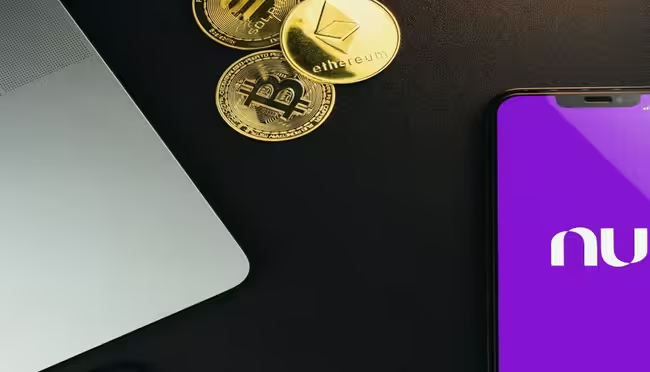
Nubank, Latin America’s largest digital bank, is set to introduce dollar-pegged stablecoins into its payment system, starting with credit cards. The move was revealed by vice-chairman and former Central Bank of Brazil governor, Roberto Campos Neto, during the Meridian 2025 event, where he highlighted blockchain’s potential to connect digital assets with traditional banking.

Stablecoin Payments Pilot and Banking Challenges

Neto told local media that Nubank will start testing stablecoin payments with its credit cards later this year. The initiative aims to bring digital assets closer to mainstream banking. The company has not shared an exact timeline or launch date for the pilot yet.

Campos Neto said that most people buy cryptocurrencies to keep their value, not to use them for daily payments. He added that it is important to understand why this is happening, even if the trend is slowly changing. He also explained that banks face a challenge in accepting tokenized deposits and using them to give credit to clients. According to him, central banks are concerned about the rapid growth of digital assets and how to manage them without disrupting traditional credit. “The main problem is finding a solution in which the bank can take a deposit in the form of a token and carry out a credit operation on top of it,” he said.

He also talked about the fast adoption of stablecoins, especially in emerging markets. He explained that they provide easier access to the U.S. dollar and help protect against local currency losses and economic uncertainty.

Stablecoins in Latin America and Nubank’s Crypto Expansion

Nubank started in São Paulo in 2013 and now serves over 100 million customers across Brazil, Mexico, and Colombia. The bank began working with digital assets about three years ago. It invested 1% of its net assets in Bitcoin and let customers trade crypto. In March, Nubank added four new altcoins for customers. These are Cardano, Cosmos, Near Protocol, and Algorand. This gave people more ways to buy and trade digital assets.

In key Latin American markets, remittances are important for many households, and stablecoin use has grown in recent years. In Brazil, stablecoins now account for the majority of crypto transactions. The Central Bank president noted at a Bank for International Settlements event in February that 90% of crypto activity in the country involves stablecoins.

Meanwhile, in Argentina, people are increasingly using USDt and USDC as inflation surged into triple digits. In Venezuela, dollar-pegged tokens are beginning to replace the bolívar in everyday transactions. Neighboring countries are witnessing growing stablecoin use.

The GENIUS Act, recently signed by President Trump, seeks to strengthen the dollar’s global dominance by supporting dollar-backed stablecoins. The Treasury Department forecasts the stablecoin market will exceed $2 trillion by 2028. This growth highlights the need for better liquidity, smoother interoperability, and clearer regulatory frameworks.

eToro Platform

Best Crypto Exchange

  • Over 90 top cryptos to trade
  • Regulated by top-tier entities
  • User-friendly trading app
  • 30+ million users
9.9

5 Stars

Visit eToro

eToro is a multi-asset investment platform. The value of your investments may go up or down. Your capital is at risk. Don’t invest unless you’re prepared to lose all the money you invest. This is a high-risk investment, and you should not expect to be protected if something goes wrong.

Market Opportunity
NEAR Logo
NEAR Price(NEAR)
$1.043
$1.043$1.043
-1.32%
USD
NEAR (NEAR) Live Price Chart
Disclaimer: The articles reposted on this site are sourced from public platforms and are provided for informational purposes only. They do not necessarily reflect the views of MEXC. All rights remain with the original authors. If you believe any content infringes on third-party rights, please contact service@support.mexc.com for removal. MEXC makes no guarantees regarding the accuracy, completeness, or timeliness of the content and is not responsible for any actions taken based on the information provided. The content does not constitute financial, legal, or other professional advice, nor should it be considered a recommendation or endorsement by MEXC.

You May Also Like

CEO Sandeep Nailwal Shared Highlights About RWA on Polygon

CEO Sandeep Nailwal Shared Highlights About RWA on Polygon

The post CEO Sandeep Nailwal Shared Highlights About RWA on Polygon appeared on BitcoinEthereumNews.com. Polygon CEO Sandeep Nailwal highlighted Polygon’s lead in global bonds, Spiko US T-Bill, and Spiko Euro T-Bill. Polygon published an X post to share that its roadmap to GigaGas was still scaling. Sentiments around POL price were last seen to be bearish. Polygon CEO Sandeep Nailwal shared key pointers from the Dune and RWA.xyz report. These pertain to highlights about RWA on Polygon. Simultaneously, Polygon underlined its roadmap towards GigaGas. Sentiments around POL price were last seen fumbling under bearish emotions. Polygon CEO Sandeep Nailwal on Polygon RWA CEO Sandeep Nailwal highlighted three key points from the Dune and RWA.xyz report. The Chief Executive of Polygon maintained that Polygon PoS was hosting RWA TVL worth $1.13 billion across 269 assets plus 2,900 holders. Nailwal confirmed from the report that RWA was happening on Polygon. The Dune and https://t.co/W6WSFlHoQF report on RWA is out and it shows that RWA is happening on Polygon. Here are a few highlights: – Leading in Global Bonds: Polygon holds 62% share of tokenized global bonds (driven by Spiko’s euro MMF and Cashlink euro issues) – Spiko U.S.… — Sandeep | CEO, Polygon Foundation (※,※) (@sandeepnailwal) September 17, 2025 The X post published by Polygon CEO Sandeep Nailwal underlined that the ecosystem was leading in global bonds by holding a 62% share of tokenized global bonds. He further highlighted that Polygon was leading with Spiko US T-Bill at approximately 29% share of TVL along with Ethereum, adding that the ecosystem had more than 50% share in the number of holders. Finally, Sandeep highlighted from the report that there was a strong adoption for Spiko Euro T-Bill with 38% share of TVL. He added that 68% of returns were on Polygon across all the chains. Polygon Roadmap to GigaGas In a different update from Polygon, the community…
Share
BitcoinEthereumNews2025/09/18 01:10
SHIB Price Analysis for February 8

SHIB Price Analysis for February 8

The post SHIB Price Analysis for February 8 appeared on BitcoinEthereumNews.com. Original U.Today article Can traders expect SHIB to test the $0.0000070 range soon
Share
BitcoinEthereumNews2026/02/09 00:26
Solana’s Long-Term Upside Tied to Upgrades, Short-Term Structure Still Weak

Solana’s Long-Term Upside Tied to Upgrades, Short-Term Structure Still Weak

Solana remains caught between strong long-term fundamentals and a fragile short-term technical structure. While the network’s upgrade roadmap points to meaningful
Share
Coinstats2026/02/09 00:28