Bitcoin didn’t reach a $2.2T market cap without providing some incredible advantages for investors, namely security, decentralization, and the blockchain itself.Bitcoin didn’t reach a $2.2T market cap without providing some incredible advantages for investors, namely security, decentralization, and the blockchain itself.

Whales Bought $418K Bitcoin Hyper in 18 Days: Hype Builds to Over $16.9M in Presale

Whales Bought $418K Bitcoin Hyper in 18 Days: Hype Builds to Over $16.9M in Presale

However, it still has limitations when it comes to scaling and programmability.

And as the crypto economy has grown and smart contracts have developed ever-more-complicated applications and utility, Bitcoin risks being left behind, or pigeonholed as a mere store of value.

Bitcoin Hyper Presale

But Bitcoin Hyper could just change the game entirely with a blazing-fast Bitcoin Layer 2 – here’s how.

Bitcoin’s Built-In Restrictions

Bitcoin’s architecture intentionally limited some of the blockchain’s flexibility, prioritizing security and stability with simple smart contracts.
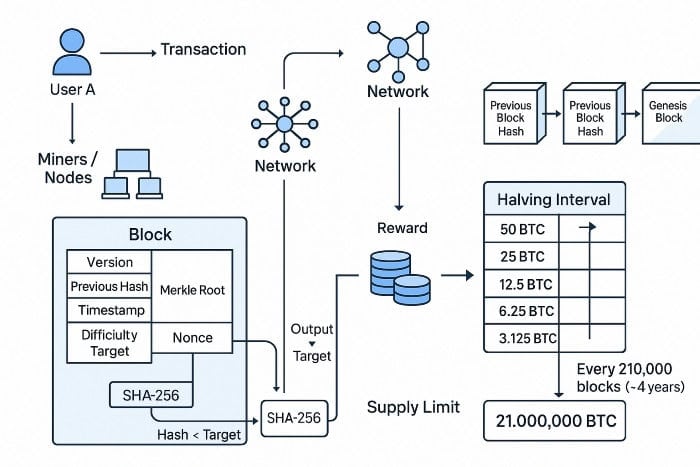
Bitcoin Architecture Illustration

While elegant, that architecture leads to some natural restrictions:

Transaction Throughput, Speed

Bitcoin’s base layer (Layer 1) can manage only 3-7 transactions per second (TPS) in normal conditions. Block confirmation times are slow (on average 10 minutes per block), which means delays during congested periods.

High Fees During Congestion

As demand increases, transaction fees rise since blocks are limited in size. This makes small or micro-transactions economically impractical.

Lack of Smart Contract and Programmability Support

Bitcoin’s native scripting is limited; many advanced DeFi, NFT, dApp use-cases need more expressive and flexible smart contracts. Other blockchains, such as Solana, Base, and Ethereum, have ecosystems built around that flexibility.

Scalability to Modern Demand

With growing demand arising from NFTs, ordinals, BRC-20 tokens, possible DeFi activity, and more global usage, the base Bitcoin network struggles to keep up.

Users want near-instant, low-fee transactions and interoperable use cases – and that’s where Bitcoin Hyper ($HYPER) comes in.

Hyper’s Hybrid Solution

Bitcoin Hyper ($HYPER) is a Layer-2 (L2) network built on top of Bitcoin, designed to overcome Bitcoin’s inherent limitations. Key features include:

  • Layer-2 scaling: Create a secondary chain or network (Layer 2) where many transactions happen off the Bitcoin mainnet, but final settlement happens on Bitcoin’s base layer. The structure provides much higher throughput, lower latency, and lower fees.
  • Canonical Bridge: A canonical bridge means that when you deposit $BTC, it’s locked on Bitcoin L1, and an equivalent wrapped $BTC (or token representing that $BTC) is minted on the Hyper L2. Withdrawals reverse the process. Users can move value into the L2 to transact, then back to L1, ensuring liquidity and trust that value is preserved 1:1.
  • Solana Virtual Machine (SVM) Integration: Hyper uses Solana’s VM for the L2 environment to enable fast and programmable smart contracts. This allows developers to build dApps, DeFi, NFTs, etc., more easily and with better performance.
  • Decentralized Validator: The L2 will run its own validator network rather than Bitcoin’s proof-of-work. Final settlement on the L1 periodically will preserve Bitcoin’s security guarantees.
  • Lower Fees and Faster Transactions: Because operations happen off the main chain, fees should be lower and transactions much faster. Batching of transactions and bridging help reduce cost overhead. The end result is a better user experience that’s more feasible for smaller payments and more usable as everyday money.
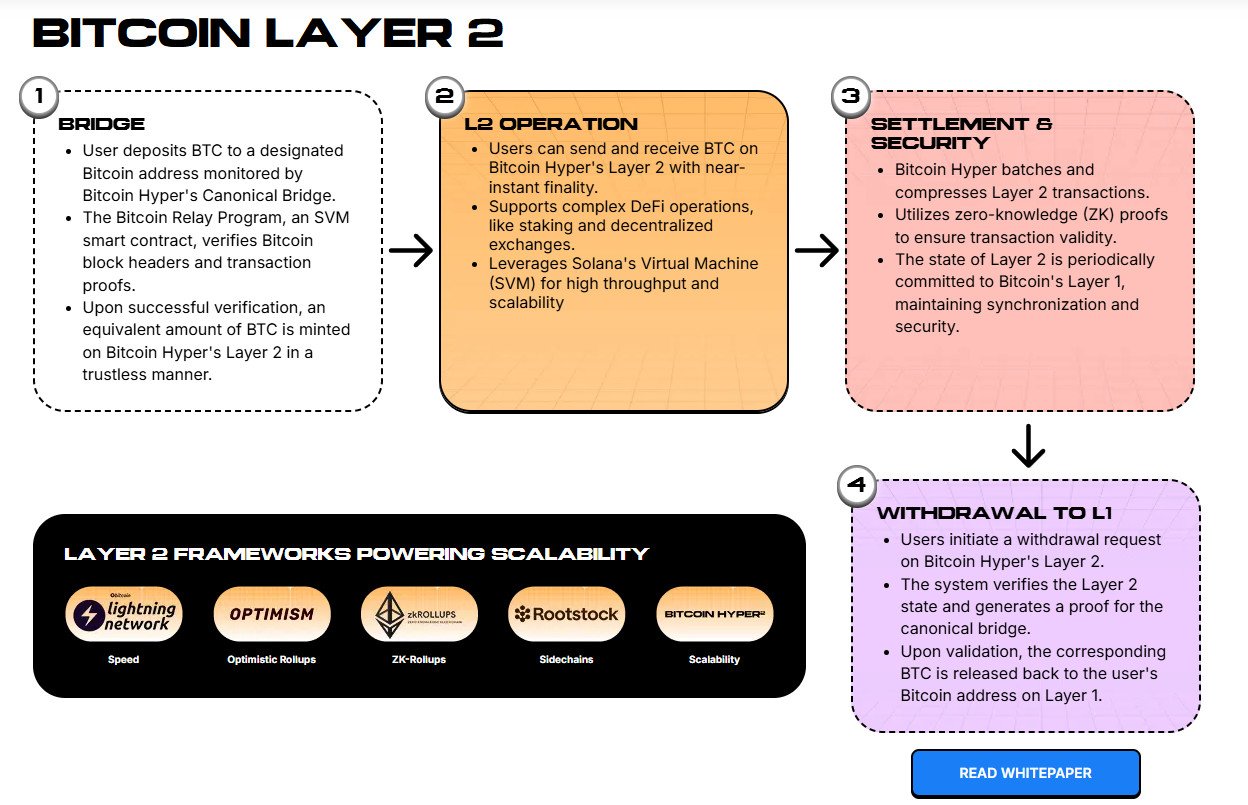
Bitcoin Hyper Layer 2

How Hyper’s Layer-2 Could Help Bitcoin Rise Even More

Faster, cheaper transactions mean more use cases, including micropayments and remittances, which are currently limited by fees and speed. This helps Bitcoin move beyond being just a digital gold and store of value.

And with smart contract capabilities, developers can build financial services, games, and NFTs directly tied to Bitcoin (via the L2). That could attract new users, capital, and innovation, reinforcing Bitcoin’s utility.

If the L2 commits to Bitcoin’s Layer-1 regularly, then Bitcoin’s rock-solid security and reliability can protect the L2 operations. If more apps and users use Bitcoin via Hyper, more value flows through Bitcoin, increasing its relevance, not just as a speculative asset but as infrastructure.

$HYPER Presale Enters Overdrive

One way to judge the project’s utility is to examine how investors have responded to the ongoing token presale. And so far, that response has been overwhelmingly positive:

  • Total funds raised: $16.9M
  • $418K in whale buys in September alone:
    • $85K on 17th September
    • $18.2K on 17th September
    • $31.5K on 15th September
    • $50K on 4 September
  • Token price: $0.012945

The token price will continue to increase as the presale progresses, making now the best time to buy $HYPER.

Bitcoin Hyper’s premise seems a little outlandish – why fix what isn’t broken? Bitcoin is already massive and secure. But Bitcoin Hyper looks beyond what Bitcoin is now, to see what Bitcoin Hyper could unlock for Bitcoin’s next state of evolution.

Bitcoin Hyper is a bridge in more ways than one. Positioning itself between Bitcoin’s strength and modern blockchain demands for speed, programmability, and low fees, Hyper could help push Bitcoin’s dominance into a new phase.

Market Opportunity
Threshold Logo
Threshold Price(T)
$0.0094
$0.0094$0.0094
-0.52%
USD
Threshold (T) Live Price Chart
Disclaimer: The articles reposted on this site are sourced from public platforms and are provided for informational purposes only. They do not necessarily reflect the views of MEXC. All rights remain with the original authors. If you believe any content infringes on third-party rights, please contact service@support.mexc.com for removal. MEXC makes no guarantees regarding the accuracy, completeness, or timeliness of the content and is not responsible for any actions taken based on the information provided. The content does not constitute financial, legal, or other professional advice, nor should it be considered a recommendation or endorsement by MEXC.

You May Also Like

MoneyGram launches stablecoin-powered app in Colombia

MoneyGram launches stablecoin-powered app in Colombia

The post MoneyGram launches stablecoin-powered app in Colombia appeared on BitcoinEthereumNews.com. MoneyGram has launched a new mobile application in Colombia that uses USD-pegged stablecoins to modernize cross-border remittances. According to an announcement on Wednesday, the app allows customers to receive money instantly into a US dollar balance backed by Circle’s USDC stablecoin, which can be stored, spent, or cashed out through MoneyGram’s global retail network. The rollout is designed to address the volatility of local currencies, particularly the Colombian peso. Built on the Stellar blockchain and supported by wallet infrastructure provider Crossmint, the app marks MoneyGram’s most significant move yet to integrate stablecoins into consumer-facing services. Colombia was selected as the first market due to its heavy reliance on inbound remittances—families in the country receive more than 22 times the amount they send abroad, according to Statista. The announcement said future expansions will target other remittance-heavy markets. MoneyGram, which has nearly 500,000 retail locations globally, has experimented with blockchain rails since partnering with the Stellar Development Foundation in 2021. It has since built cash on and off ramps for stablecoins, developed APIs for crypto integration, and incorporated stablecoins into its internal settlement processes. “This launch is the first step toward a world where every person, everywhere, has access to dollar stablecoins,” CEO Anthony Soohoo stated. The company emphasized compliance, citing decades of regulatory experience, though stablecoin oversight remains fluid. The US Congress passed the GENIUS Act earlier this year, establishing a framework for stablecoin regulation, which MoneyGram has pointed to as providing clearer guardrails. This is a developing story. This article was generated with the assistance of AI and reviewed by editor Jeffrey Albus before publication. Get the news in your inbox. Explore Blockworks newsletters: Source: https://blockworks.co/news/moneygram-stablecoin-app-colombia
Share
BitcoinEthereumNews2025/09/18 07:04
WIF Price Prediction: Targeting $0.48 Recovery Within 2 Weeks as MACD Shows Bullish Divergence

WIF Price Prediction: Targeting $0.48 Recovery Within 2 Weeks as MACD Shows Bullish Divergence

The post WIF Price Prediction: Targeting $0.48 Recovery Within 2 Weeks as MACD Shows Bullish Divergence appeared on BitcoinEthereumNews.com. James Ding Dec 16
Share
BitcoinEthereumNews2025/12/17 17:32
Tokyo’s Metaplanet Launches Miami Subsidiary to Amplify Bitcoin Income

Tokyo’s Metaplanet Launches Miami Subsidiary to Amplify Bitcoin Income

Metaplanet Inc., the Japanese public company known for its bitcoin treasury, is launching a Miami subsidiary to run a dedicated derivatives and income strategy aimed at turning holdings into steady, U.S.-based cash flow. Japanese Bitcoin Treasury Player Metaplanet Opens Miami Outpost The new entity, Metaplanet Income Corp., sits under Metaplanet Holdings, Inc. and is based […]
Share
Coinstats2025/09/18 00:32