

Crypto markets are massively underpricing Clarity Act passing – Hashdex warns
The Senate Banking Committee meets in executive session later today, May 14, to consider the CLARITY Act, a bill that already cleared the House 294-134 in July 2025 and needs at least 7 Democratic votes to advance in the full Senate.
Hashdex CIO Samir Kerbage reads the current crypto price action as confirmation that the market is pricing the odds of a committee vote, leaving the capital flow scenario of a signed bill entirely out of current valuations.
Kerbage told CryptoSlate:
He added that Hashdex is optimistic that the bill will reach President Donald Trump's desk this summer.
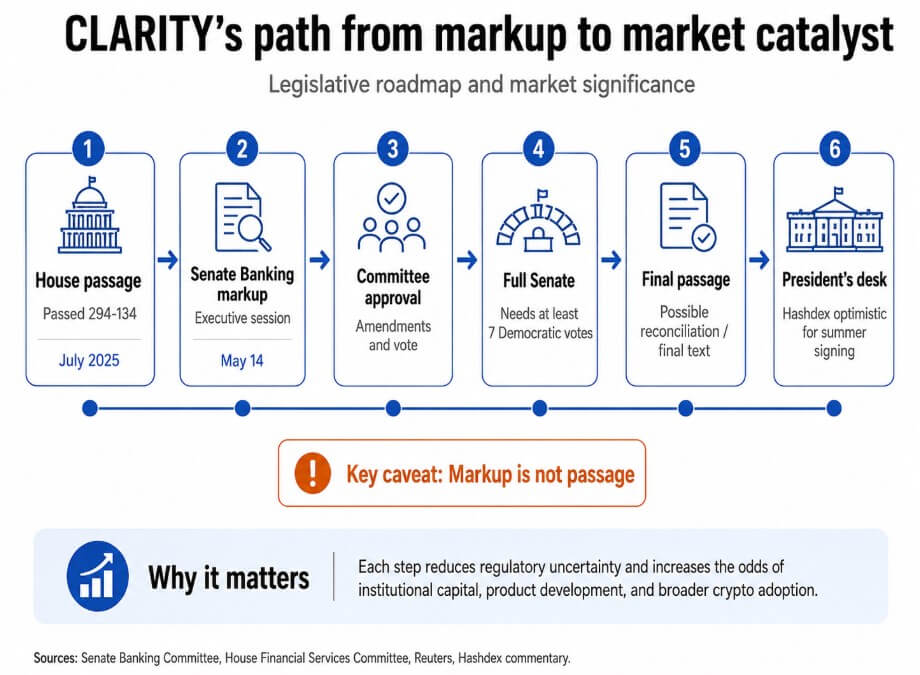 The CLARITY Act faces six steps from its July 2025 House passage to the president's desk, with the Senate requiring at least seven Democratic votes.
What the Clarity Act establishes
CLARITY covers stablecoin rewards, anti-money-laundering rules, SEC fundraising exemptions, DeFi treatment, and tokenization.
The stablecoin provision is the most contentious, as the bill bans rewards on idle stablecoin balances that resemble bank deposits while permitting transaction-based rewards and requires the SEC, CFTC, and Treasury to issue joint rules.
Banks have pushed back against deposit flight risk, while crypto firms argue that restricting third-party rewards is anti-competitive.
The bill would bring digital commodity exchanges, brokers, and dealers under Bank Secrecy Act treatment as financial institutions, adding AML, customer identification, and due diligence obligations.
For institutions sitting on the sidelines, that framework is a prerequisite, as it gives compliance teams a rulebook to defend internally and investment committees a structure they can approve.
Kerbage said:
Institutions need policy clarity, investment committee approval, product wrappers, and fiduciary justification before they can allocate at scale. If signed, the CLARITY Act provides the policy layer that unlocks the rest of that chain.
Kerbage expects the bulk of that institutional capital to flow through ETFs and index-based crypto products, giving demand a durable, reportable structure.
Farside Investors data shows that US-traded Ethereum ETFs have accumulated approximately $12 billion in cumulative net flows since launch, and Solana ETFs have surpassed $1 billion.
Both are well below the Bitcoin ETF scale, accumulating in a market where CLARITY would, for the first time, establish the regulatory status of their underlying assets.
The Bitcoin ETF comparison
Kerbage's benchmark for CLARITY's potential is the SEC's January 2024 approval of spot Bitcoin ETF listings, which converted latent demand into packaged, committee-approved flows at a far larger scale than pre-approval consensus had projected.
He argued:
CLARITY would give the broader crypto asset class a definitional framework, determining when tokens are securities, commodities, or otherwise, and the products issuers need to build and institutions need to buy.
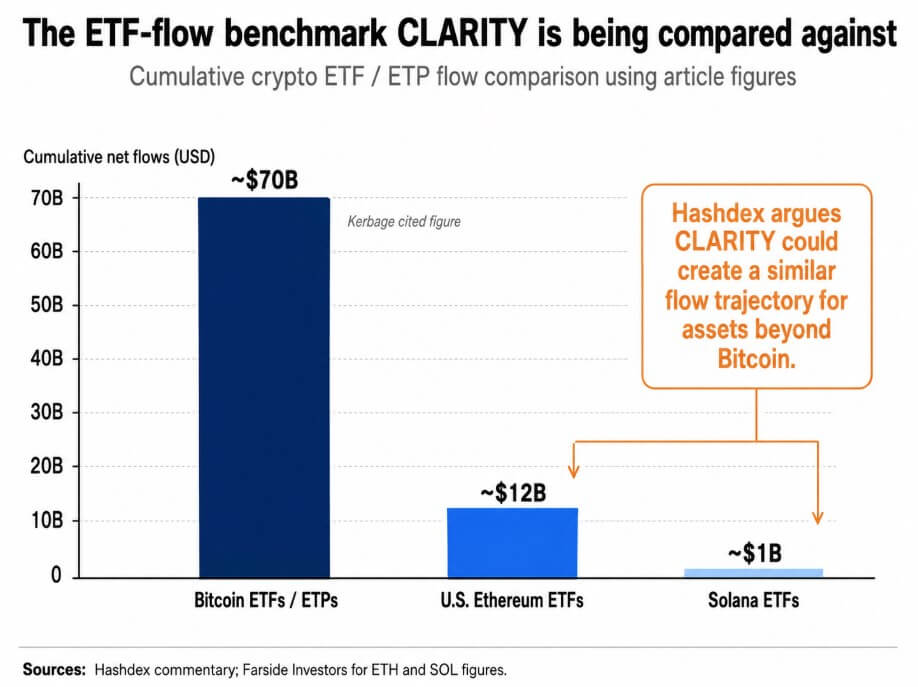 Bitcoin ETFs have drawn roughly $70 billion in cumulative flows since launch, dwarfing Ethereum ETFs at $12 billion and Solana ETFs at $1 billion.
Kerbage points to new product creation as the mechanism through which capital enters the market once legislation clears, building through a pipeline of ETFs and wrappers that institutions can use.
He expects issuers to build around the unique attributes of crypto, such as staking-based initiatives, index-based broad exposure, and income strategies that exploit crypto market liquidity and improve financial infrastructure.
Kerbage said:
The Senate bill text includes a Regulation Crypto exemption allowing companies to raise up to $50 million per year and $200 million in total, disclosure rules for ancillary assets, DeFi cybersecurity standards, and banking-law clarifications for digital asset activities.
Repricing Clarity Act asset class vs. amendment friction
If the Banking Committee advances the bill and bipartisan momentum builds toward enactment, Kerbage sees a credible path to repricing the whole asset class.
Bitcoin's base case trades between $74,000 and $85,000 in the coming weeks, absent a major catalyst.
He said:
Smart contract platforms, staking assets, tokenization infrastructure, and index-based crypto ETFs all carry a larger regulatory uncertainty discount than Bitcoin, which already cleared its access event in 2024.
A signed CLARITY Act compresses that discount across the asset class simultaneously, making the bull case for beyond Bitcoin assets more directly tied to the bill's fate than BTC itself.
| Scenario | Policy outcome | Market interpretation | Likely impact |
|---|---|---|---|
| Base case | Markup advances, but no near-term signing | Market prices process, not certainty | BTC stays in Kerbage’s $74k-$85k range |
| Bull case | Bipartisan momentum builds toward summer signing | CLARITY becomes a capital-flow catalyst | BTC moves toward recent ATHs; beyond-BTC assets outperform |
| Delay case | Stablecoin rewards, AML, ethics, or bank lobbying slow the bill | Regulatory discount remains | ETF/product development delayed |
| Dilution case | Final text loses key market-structure provisions | Signing matters less than expected | Institutional unlock is weaker than Hashdex expects |
The legislative path carries real friction, as full Senate passage requires at least seven Democratic votes, and the stablecoin rewards provision, banking-sector opposition, ethics considerations, and AML implementation details all create amendment risk that could delay or dilute the final text.
A drawn-out markup fight would leave uncertainty in the crypto pricing process, keeping the regulatory discount intact and limiting the institutional capital unlock Kerbage describes.
Kerbage concluded by calling CLARITY “the most significant piece of legislation in this industry's history.”
The post Crypto markets are massively underpricing Clarity Act passing – Hashdex warns appeared first on CryptoSlate.


You May Also Like

The 2022 Playbook Says Bitcoin Fails Here. On-Chain Data Says This Cycle Is Different

Covéa Chooses Shift Technology as Strategic Partner for Fraud and Risk Management




