Senate Panel Advances Crypto Market Structure Bill
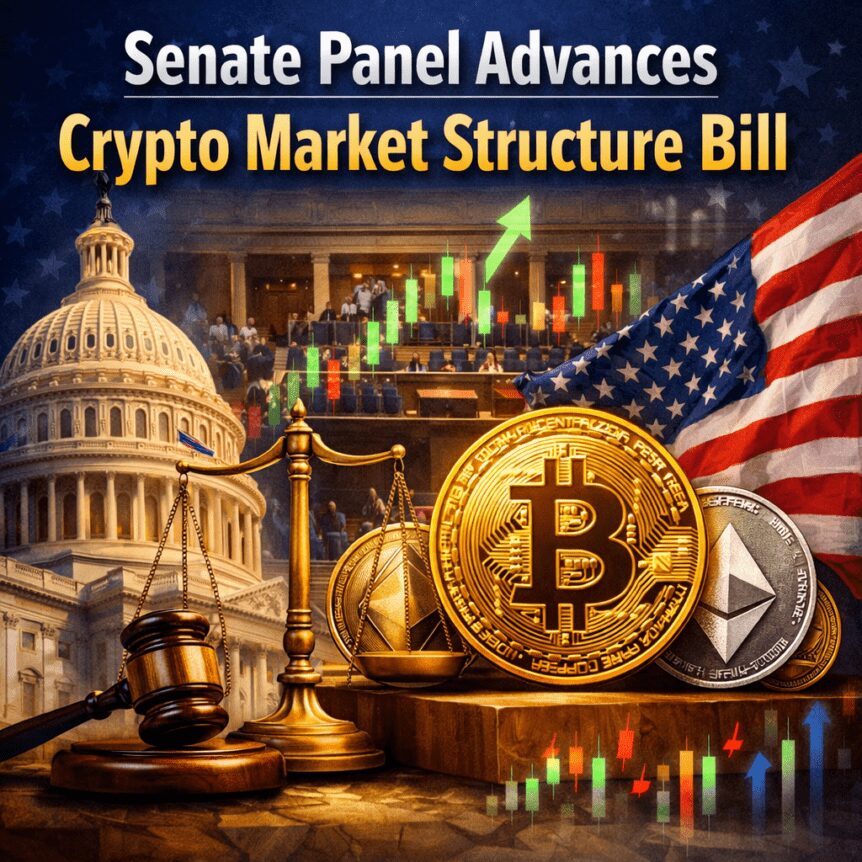
US lawmakers on the Senate Banking Committee advanced the Digital Asset Market Clarity Act (CLARITY) in a markup session, marking a significant step in Congress’ bid to establish regulatory clarity for digital asset companies and markets. The vote underscored a consequential, though tightly contested, path toward settling how the United States governs crypto markets, exchanges, and associated services.
In the Thursday session, all 13 Republican members and two Democrats voted to move CLARITY forward, while nine Democrats opposed the bill. Senators Ruben Gallego and Angela Alsobrooks joined the Republican bloc in voting yes. The markup followed a flurry of proposed amendments aimed at reshaping various facets of crypto regulation, including stablecoin yields and ethics restrictions. According to Cointelegraph, lawmakers proposed more than 100 amendments to the crypto bill ahead of the markup.
During opening remarks, committee chair Tim Scott framed the measure as a balance between consumer protection, US innovation, and national security in the digital asset space. In contrast, ranking member Elizabeth Warren argued the bill would be “written by the crypto industry for the crypto industry,” suggesting it would facilitate a political-friendly path for the administration’s crypto agenda. “Nothing made it into this bill that wasn’t approved by the crypto industry,” Warren contended.
Senator Jack Reed, a Democrat, characterized the process as lacking bipartisan parity, noting that Scott had repeatedly curtailed consideration of Democratic amendments. The exchange highlighted deep partisan fault lines surrounding the bill’s scope and its approach to enforcement, consumer protections, and industry oversight.
As CLARITY moved through the process, discussions touched on several high-profile amendments, including proposals to establish AI sandboxes, address tokenization loopholes, and strengthen anti-money-laundering provisions. Notably, lawmakers debated regulatory approaches to crypto mixers and the tracing of illicit flows, with supporters arguing that the bill would clarify enforcement authority, while critics warned of gaps that could hamper consumer protection and market integrity.
In a separate debate, Democrats floated provisions to expand law-enforcement capabilities in crypto cases, while Republicans defended the bill’s balance between oversight and innovation. Several amendments related to stablecoins, digital dollars, and the role of banking regulators were introduced and voted on along partisan lines, with many failing to advance.
Additionally, the committee weighed concerns about ethics and potential conflicts of interest within the executive and legislative branches. Democratic Senator Chris Van Hollen pressed for an amendment addressing potential conflicts tied to the Trump administration and related crypto ventures, but the measure did not pass. Republican supporters argued that the governance framework should not be distorted by extraneous political entanglements.
Key takeaways
- CLARITY advanced from the Senate Banking Committee with a partisan vote: all Republicans and two Democrats in favor, nine Democrats opposed.
- Senators Ruben Gallego and Angela Alsobrooks joined Republicans in voting yes; chair Tim Scott framed the bill as a consumer-protective measure that preserves US innovation and national security.
- Dozens of amendments were proposed, reflecting a broad debate over stablecoins, AML/CFT controls, AI use in markets, and ethics considerations; several amendments were debated and either adopted or rejected along party lines.
- Progress now hinges on a Senate floor vote (requiring 60 votes) and subsequent House approval of the amended language before any presidential signature.
- The regulatory architecture remains a focal point, with ongoing implications for the SEC, CFTC, and broader licensing, AML/KYC, and banking-backbone requirements for crypto firms and related financial institutions.
Regulatory context and implications for markets
The CLARITY debate sits at the intersection of multiple regulatory streams seeking to harmonize oversight for a rapidly evolving sector. Supporters frame the bill as a needed framework to reduce uncertainty for digital asset issuers, exchanges, and custodians while strengthening protections for investors and consumers. Critics, however, warn that the bill could entrench industry-friendly provisions and delay comprehensive, codified standards from the SEC and CFTC, potentially creating regulatory arbitrage across jurisdictions.
The measure contemplates cross-agency alignment, with consideration of SEC and CFTC roles, and signals ongoing congressional interest in clarifying which activities trigger securities, commodities, or other regulatory regimes. Observers note that the outcome could influence licensing pathways, anti-money-laundering controls, customer due diligence, and the integration of crypto services with traditional banking rails, including stablecoin settlements and on/off-ramp facilities.
Industry participants have stressed the practical significance of a clear statutory framework. Kristin Smith, president of the Solana Policy Institute, told Cointelegraph prior to the markup that floor passage would depend on sufficient Senate support and eventual alignment with the House’s stance on identical language. The comments underscore the central question: will CLARITY provide a lasting, enforceable baseline that reduces legal ambiguity for market participants, or will it remain a negotiating platform for a broader regulatory settlement?
Ethics, oversight, and the path forward
Ethics and governance remained a recurring theme for Democratic lawmakers, who raised concerns about potential conflicts of interest and the influence of political actors on crypto policy. While some amendments targeted enforcement powers or supervisory discretion, others probed whether the administration’s broader crypto strategy would withstand legislative scrutiny. Republicans countered that robust oversight and clear standards would strengthen governance without stifling innovation.
Experts emphasize that the bill’s ultimate impact will depend on the text that emerges from the committee and the compatibility of House and Senate versions. If a floor vote in the Senate yields passage, the amended legislation would advance to the House for approval, where political dynamics and alignment with the White House would shape the likelihood of enactment. Until then, the regulatory timetable remains fluid, with ongoing debates likely to influence subsequent drafting and enforcement priorities.
As the process unfolds, industry and policy observers will monitor how CLARITY interacts with broader regulatory efforts, including MiCA in the European Union and evolving US AML/KYC standards, as well as the cross-border implications for stablecoins, banking integration, and enforcement actions by the DOJ and other agencies.
Closing perspective
With the markup marking a milestone in congressional consideration, CLARITY’s trajectory will depend on continued bipartisan buy-in and the ability to reconcile divergent views on enforcement, ethics, and consumer protections. The next steps—floor debates in the Senate, House harmonization, and potential presidential engagement—will determine whether the United States achieves a durable regulatory framework for the digital asset economy or enters another round of regulatory negotiation.
This article was originally published as Senate Panel Advances Crypto Market Structure Bill on Crypto Breaking News – your trusted source for crypto news, Bitcoin news, and blockchain updates.


You May Also Like
Trump-voting C-SPAN caller throws away MAGA hat: 'I apologize to all of America'

Strive (ASST) Stock: Surge as Daily Dividend Plan Fuels Bitcoin Treasury Buzz