A threat actor stole eight Hypurr NFTs worth approximately $400,000 within hours of the collection’s launch by compromising wallets that received the airdropped tokens on Hyperliquid’s HyperEVM layer. Blockchain investigator ZachXBT first reported the sophisticated theft targeting early Genesis Event participants who had opted to receive the free digital collectibles.Source: ZachXTB The Hyper Foundation distributed 4,600 unique cat-themed NFTs on September 28 to reward early supporters from the November 2024 Genesis Event. The collection immediately achieved a floor price of $68,900, with total trading volume reaching $45 million within 24 hours on OpenSea. At the time of writing, the floor price has surpassed $70K. The most expensive sale involved Hypurr #21, which featured rare “Knight Ghost Armor” traits, selling for 9,999 HYPE tokens, worth approximately $470,000. Some NFTs had traded over-the-counter for $88,000 before the official launch through DripTrade’s collateralized pre-sale system. The theft compounds security concerns plaguing Hyperliquid’s ecosystem following the $773,000 HyperDrive exploit and $3.6 million HyperVault rug pull within the same week. The rapid succession of attacks has intensified scrutiny of security practices across projects building on the decentralized exchange platform. Digital Cats Command Six-Figure Prices Despite Global Economic Pressures The Hypurr collection features generative art depicting cartoon cats with various traits, including sunglasses, wizard robes, and armor elements. Distribution allocated 4,313 NFTs to Genesis Event participants, 144 to the Hyper Foundation, and 143 to core contributors, including developers and artists. According to OpenSea data, over 1.3 million HYPE tokens were traded in the past 24 hours, equivalent to $61 million at current prices. The collection maintained 92.8% of supply held by 4,270 unique owners. Community reactions varied widely, with some celebrating life-changing windfalls while others criticized the wealth disparity. Creative director Alex Obymuralex praised the Hypurr design language as “timeless” rather than trend-driven, noting the collection’s simple forms and saturated colors lower intimidation barriers for mainstream adoption. He argued that recognizable silhouettes and joyful palettes create lasting brand equity beyond speculation cycles. Early adopters who participated in November’s Genesis Event received the NFTs at no cost beyond their initial platform engagement. The event centered on the launch of Hyperliquid’s native HYPE token and HyperEVM programmability layer. Notably, DripTrade’s over-the-counter system enabled pre-launch trading through collateralized agreements requiring sellers to fulfill transactions within seven days of receiving NFTs or forfeit deposited security. This mechanism allowed price discovery even before official distribution. Security Breaches Threaten Ecosystem Credibility The Hypurr NFT theft follows three major security incidents targeting Hyperliquid projects within one week. HyperDrive DeFi lost $773,000 through router contract vulnerabilities that enabled arbitrary function calls, while HyperVault developers executed a $3.6 million exit scam after ignoring community warnings about fabricated audit claims. Previous exploits include the March JELLY token manipulation, which cost $13.5 million, and the “ETH 50x Big Guy” trader, who netted a $1.8 million profit while causing $4 million in vault losses. This incident prompted a reduction in maximum leverage limits from 40x to 25x for major cryptocurrencies. Competition intensifies as ASTER DEX processes over $13 billion in daily perpetual futures volume, compared to Hyperliquid’s reduced activity. ASTER’s Trust Wallet integration provides 100 million users with direct access to perpetual contracts, challenging Hyperliquid’s market dominance. Arthur Hayes exited his entire HYPE position with a $823,000 profit, citing the massive token unlocks worth $11.9 billion that were set to start on November 29. He recently polled followers about re-entering after HYPE dropped 23% weekly to $35.50. However, community members have proposed blacklisting Hayes from purchasing HYPE, with some labeling his trades as the “ultimate sell signal.” Despite security challenges, Hyperliquid launched its USDH stablecoin, generating $2.2 million in early volume, while Native Markets secured the issuance mandate through a competitive governance voting process. The platform also activated HYPE/USDH spot trading following Native Markets’ commitment to stake 200,000 tokens for a period of three years. HYPE traded up 4.65% following the Hypurr launch, reaching $47.14 as community enthusiasm temporarily overshadowed ongoing security concerns and competition threats across the broader ecosystemA threat actor stole eight Hypurr NFTs worth approximately $400,000 within hours of the collection’s launch by compromising wallets that received the airdropped tokens on Hyperliquid’s HyperEVM layer. Blockchain investigator ZachXBT first reported the sophisticated theft targeting early Genesis Event participants who had opted to receive the free digital collectibles.Source: ZachXTB The Hyper Foundation distributed 4,600 unique cat-themed NFTs on September 28 to reward early supporters from the November 2024 Genesis Event. The collection immediately achieved a floor price of $68,900, with total trading volume reaching $45 million within 24 hours on OpenSea. At the time of writing, the floor price has surpassed $70K. The most expensive sale involved Hypurr #21, which featured rare “Knight Ghost Armor” traits, selling for 9,999 HYPE tokens, worth approximately $470,000. Some NFTs had traded over-the-counter for $88,000 before the official launch through DripTrade’s collateralized pre-sale system. The theft compounds security concerns plaguing Hyperliquid’s ecosystem following the $773,000 HyperDrive exploit and $3.6 million HyperVault rug pull within the same week. The rapid succession of attacks has intensified scrutiny of security practices across projects building on the decentralized exchange platform. Digital Cats Command Six-Figure Prices Despite Global Economic Pressures The Hypurr collection features generative art depicting cartoon cats with various traits, including sunglasses, wizard robes, and armor elements. Distribution allocated 4,313 NFTs to Genesis Event participants, 144 to the Hyper Foundation, and 143 to core contributors, including developers and artists. According to OpenSea data, over 1.3 million HYPE tokens were traded in the past 24 hours, equivalent to $61 million at current prices. The collection maintained 92.8% of supply held by 4,270 unique owners. Community reactions varied widely, with some celebrating life-changing windfalls while others criticized the wealth disparity. Creative director Alex Obymuralex praised the Hypurr design language as “timeless” rather than trend-driven, noting the collection’s simple forms and saturated colors lower intimidation barriers for mainstream adoption. He argued that recognizable silhouettes and joyful palettes create lasting brand equity beyond speculation cycles. Early adopters who participated in November’s Genesis Event received the NFTs at no cost beyond their initial platform engagement. The event centered on the launch of Hyperliquid’s native HYPE token and HyperEVM programmability layer. Notably, DripTrade’s over-the-counter system enabled pre-launch trading through collateralized agreements requiring sellers to fulfill transactions within seven days of receiving NFTs or forfeit deposited security. This mechanism allowed price discovery even before official distribution. Security Breaches Threaten Ecosystem Credibility The Hypurr NFT theft follows three major security incidents targeting Hyperliquid projects within one week. HyperDrive DeFi lost $773,000 through router contract vulnerabilities that enabled arbitrary function calls, while HyperVault developers executed a $3.6 million exit scam after ignoring community warnings about fabricated audit claims. Previous exploits include the March JELLY token manipulation, which cost $13.5 million, and the “ETH 50x Big Guy” trader, who netted a $1.8 million profit while causing $4 million in vault losses. This incident prompted a reduction in maximum leverage limits from 40x to 25x for major cryptocurrencies. Competition intensifies as ASTER DEX processes over $13 billion in daily perpetual futures volume, compared to Hyperliquid’s reduced activity. ASTER’s Trust Wallet integration provides 100 million users with direct access to perpetual contracts, challenging Hyperliquid’s market dominance. Arthur Hayes exited his entire HYPE position with a $823,000 profit, citing the massive token unlocks worth $11.9 billion that were set to start on November 29. He recently polled followers about re-entering after HYPE dropped 23% weekly to $35.50. However, community members have proposed blacklisting Hayes from purchasing HYPE, with some labeling his trades as the “ultimate sell signal.” Despite security challenges, Hyperliquid launched its USDH stablecoin, generating $2.2 million in early volume, while Native Markets secured the issuance mandate through a competitive governance voting process. The platform also activated HYPE/USDH spot trading following Native Markets’ commitment to stake 200,000 tokens for a period of three years. HYPE traded up 4.65% following the Hypurr launch, reaching $47.14 as community enthusiasm temporarily overshadowed ongoing security concerns and competition threats across the broader ecosystem

Hyperliquid’s Hypurr NFTs Hit $76K Floor Price, But Hacker Steals 8 for $400K Profit

2025/09/29 17:36
4 min read

A threat actor stole eight Hypurr NFTs worth approximately $400,000 within hours of the collection’s launch by compromising wallets that received the airdropped tokens on Hyperliquid’s HyperEVM layer.

Blockchain investigator ZachXBT first reported the sophisticated theft targeting early Genesis Event participants who had opted to receive the free digital collectibles.
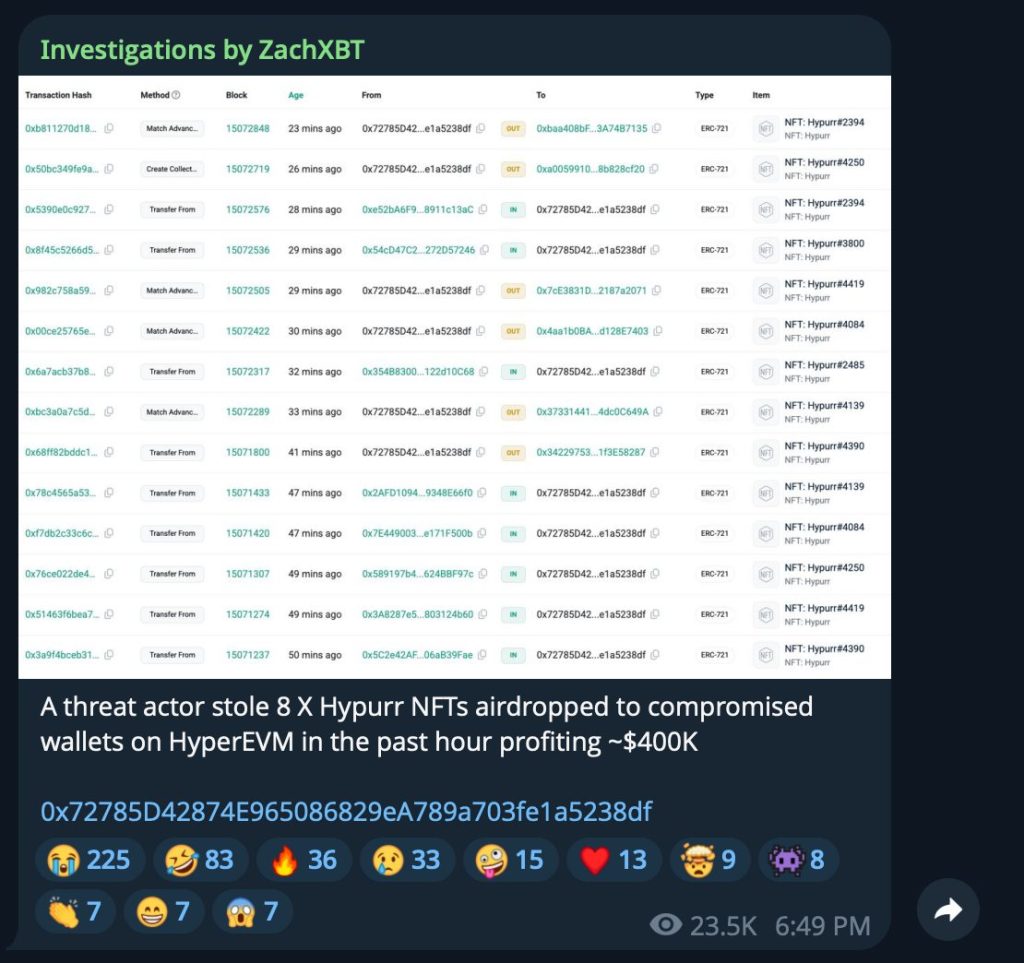
Hyperliquid's Hypurr NFTs Hit $76K Floor Price, But Hacker Steals 8 for $400K ProfitSource: ZachXTB

The Hyper Foundation distributed 4,600 unique cat-themed NFTs on September 28 to reward early supporters from the November 2024 Genesis Event.

The collection immediately achieved a floor price of $68,900, with total trading volume reaching $45 million within 24 hours on OpenSea. At the time of writing, the floor price has surpassed $70K.

The most expensive sale involved Hypurr #21, which featured rare “Knight Ghost Armor” traits, selling for 9,999 HYPE tokens, worth approximately $470,000.

Some NFTs had traded over-the-counter for $88,000 before the official launch through DripTrade’s collateralized pre-sale system.

The theft compounds security concerns plaguing Hyperliquid’s ecosystem following the $773,000 HyperDrive exploit and $3.6 million HyperVault rug pull within the same week.

The rapid succession of attacks has intensified scrutiny of security practices across projects building on the decentralized exchange platform.

Digital Cats Command Six-Figure Prices Despite Global Economic Pressures

The Hypurr collection features generative art depicting cartoon cats with various traits, including sunglasses, wizard robes, and armor elements.

Distribution allocated 4,313 NFTs to Genesis Event participants, 144 to the Hyper Foundation, and 143 to core contributors, including developers and artists.

According to OpenSea data, over 1.3 million HYPE tokens were traded in the past 24 hours, equivalent to $61 million at current prices.

The collection maintained 92.8% of supply held by 4,270 unique owners.

Community reactions varied widely, with some celebrating life-changing windfalls while others criticized the wealth disparity.

Creative director Alex Obymuralex praised the Hypurr design language as “timeless” rather than trend-driven, noting the collection’s simple forms and saturated colors lower intimidation barriers for mainstream adoption.

He argued that recognizable silhouettes and joyful palettes create lasting brand equity beyond speculation cycles.

Early adopters who participated in November’s Genesis Event received the NFTs at no cost beyond their initial platform engagement.

The event centered on the launch of Hyperliquid’s native HYPE token and HyperEVM programmability layer.

Notably, DripTrade’s over-the-counter system enabled pre-launch trading through collateralized agreements requiring sellers to fulfill transactions within seven days of receiving NFTs or forfeit deposited security.

This mechanism allowed price discovery even before official distribution.

Security Breaches Threaten Ecosystem Credibility

The Hypurr NFT theft follows three major security incidents targeting Hyperliquid projects within one week.

HyperDrive DeFi lost $773,000 through router contract vulnerabilities that enabled arbitrary function calls, while HyperVault developers executed a $3.6 million exit scam after ignoring community warnings about fabricated audit claims.

Previous exploits include the March JELLY token manipulation, which cost $13.5 million, and the “ETH 50x Big Guy” trader, who netted a $1.8 million profit while causing $4 million in vault losses.

This incident prompted a reduction in maximum leverage limits from 40x to 25x for major cryptocurrencies.

Competition intensifies as ASTER DEX processes over $13 billion in daily perpetual futures volume, compared to Hyperliquid’s reduced activity.

ASTER’s Trust Wallet integration provides 100 million users with direct access to perpetual contracts, challenging Hyperliquid’s market dominance.

Arthur Hayes exited his entire HYPE position with a $823,000 profit, citing the massive token unlocks worth $11.9 billion that were set to start on November 29.

He recently polled followers about re-entering after HYPE dropped 23% weekly to $35.50.

However, community members have proposed blacklisting Hayes from purchasing HYPE, with some labeling his trades as the “ultimate sell signal.”

Despite security challenges, Hyperliquid launched its USDH stablecoin, generating $2.2 million in early volume, while Native Markets secured the issuance mandate through a competitive governance voting process.

The platform also activated HYPE/USDH spot trading following Native Markets’ commitment to stake 200,000 tokens for a period of three years.

HYPE traded up 4.65% following the Hypurr launch, reaching $47.14 as community enthusiasm temporarily overshadowed ongoing security concerns and competition threats across the broader ecosystem.

Disclaimer: The articles reposted on this site are sourced from public platforms and are provided for informational purposes only. They do not necessarily reflect the views of MEXC. All rights remain with the original authors. If you believe any content infringes on third-party rights, please contact service@support.mexc.com for removal. MEXC makes no guarantees regarding the accuracy, completeness, or timeliness of the content and is not responsible for any actions taken based on the information provided. The content does not constitute financial, legal, or other professional advice, nor should it be considered a recommendation or endorsement by MEXC.

You May Also Like

Peter Schiff Net Worth: Financial Expert’s Wealth

Peter Schiff Net Worth: Financial Expert’s Wealth

Cryptsy - Latest Cryptocurrency News and Predictions Cryptsy - Latest Cryptocurrency News and Predictions - Experts in Crypto Casinos Did you know Peter Schiff
Share
Cryptsy2026/02/15 07:52
FF Technical Analysis Feb 15

FF Technical Analysis Feb 15

The post FF Technical Analysis Feb 15 appeared on BitcoinEthereumNews.com. FF is stuck at the 0.08 dollar level with a slight 1.61% rise on the daily chart; however
Share
BitcoinEthereumNews2026/02/15 08:34
Is Patrick Schwarzenegger In ‘Gen V’ Season 2? Why He Doesn’t Return

Is Patrick Schwarzenegger In ‘Gen V’ Season 2? Why He Doesn’t Return

The post Is Patrick Schwarzenegger In ‘Gen V’ Season 2? Why He Doesn’t Return appeared on BitcoinEthereumNews.com. Patrick Schwarzenegger as Luke Riordan/Golden Boy and Maddie Phillips as Cate Dunlap on season one of “Gen V.” Brooke Palmer/Prime Video Warning: Spoilers ahead for season two, episodes one through three of Gen V. Gen V is back for season two, and fans of Patrick Schwarzenegger’s Golden Boy might be disappointed to learn that he’s not part of the latest installment. Schwarzenegger starred as Luke Riordan/Golden Boy, the No.1 student at Godolkin University, on season one of the college-set spinoff of The Boys. His powers included manipulating fire, engulfing his body in flames, superhuman strength and flying. He had a promising future ahead of him and was even poised to be part of the premier supe group known as The Seven. But in a twist, at the end of the first episode, Luke flamed up and flew into the sky, committing suicide by using his powers and exploding. Still, Schwarzenegger appeared throughout the remainder of the season in flashbacks, a video message, his younger brother Sam Riordan’s (Asa Germann) hallucinations and in Cate Dunlap’s (Maddie Phillips) memories during episode six. It’s natural to wonder if Schwarzenegger would reprise the role in some capacity in season two, but the actor already explained why fans wouldn’t see him this time around. Schwarzengger Missed Out On Season 2 Of Gen V Because Of Scheduling Conflicts With The White Lotus Patrick Schwarzenegger as Luke Riordan/Golden Boy and Jaz Sinclair as Marie Moreau on season one of “Gen V.” Brooke Palmer/Prime Video Long before the release of season two of Gen V, Schwarzengger revealed that he couldn’t return because he was filming season three of HBO’s The White Lotus. Schwarzenegger starred as Saxon Ratliff, the eldest child of a wealthy family from North Carolina, in the Thailand-set season of Mike White’s anthology series. “No, I…
Share
BitcoinEthereumNews2025/09/18 12:44