A new Galaxy Research report finds that the primary beneficiaries of the meme coins are not the traders, but the infrastructure providers.  Platforms such as launchpads, decentralized exchanges (DEXs), and automated trading bots capture substantial revenues. Meanwhile, the majority of individual participants incur losses in what is called a zero-sum game with negative expected value (EV). The Meme Coin Paradox: Mass Participation, Concentrated Profits  Meme coins, often described as tokens created around internet jokes or cultural trends with no utility, have been around for over a decade. Notably, the surge in popularity and ease of creation has sparked a full-scale boom. Millions of new tokens have flooded the market in the past few years. Traders are frequently drawn to this space by the promise of quick profits. Nonetheless, Galaxy Digital noted that,  “Trading them is less about fundamentals and more about what can be described as ‘cultural arbitrage’: predicting or front-running attention cycles, e.g., buying the token for a viral TikTok trend before the market recognizes it is viral. In the long run, the vast majority of market participants end up losing money trading meme coins, and in many respects, it’s just plain gambling.” In the latest report, Galaxy Digital’s research analyst Will Owens explained that the meme coin ecosystem functions as a stack. Here, the flow of money is mostly concentrated in the infrastructure that supports creation and trading. Meme Coin Ecosystem Structure. Source: Galaxy Digital At the base level, blockchains like Solana dominate. It hosts over 32 million tokens, a more than 300% increase since early 2024. The blockchain accounts for 56% of the 57 million meme coins across major chains, including Ethereum, Base, and BNB Chain.  “Base and BSC also host significant activity, while Ethereum hosts bigger tokens and a less cutthroat culture,” the report reads. Solana’s low fees and high throughput have made it the preferred venue, with meme coins accounting for approximately 20- 30% of its DEX trading volume, down from 60% in January. Next, launchpads form a critical layer, enabling rapid token deployment. Solana’s Pump.fun, which debuted in early 2024, exemplifies this trend by industrializing the process through bonding curves that guarantee liquidity at minimal cost.  The platform has created about 12.9 million tokens, which make up 40.31% of the total 32 million Solana tokens. Tokens launched on Pump.fun boast an aggregated fully diluted market cap (FDMC) exceeding $4.8 billion, though this peaked above $10 billion earlier in the year.  “The power-law distribution of value among Pump.fun tokens is astonishing. Out of nearly 12.9 million tokens launched on the platform, just 12 account for more than half of all fully diluted market cap (FDMC). Those dozen tokens collectively represent $2.69 billion, or 56% of the total $4.8 billion FDMC, while the other 44% is split among the remaining millions of tokens,” Owens noted. Furthermore, Pump.fun has generated significant fees from creation and trading. In summer 2024, it briefly lost ground to competitors like LetsBonk. Nonetheless, the launchpad reclaimed dominance through innovations such as Project Ascend, which introduces dynamic fee models for creators, and integrations with streamers for interactive launches. Meanwhile, DEX aggregators and automated market makers (AMMs) like Jupiter, Raydium, Orca, and Pump.fun’s in-house PumpSwap further extract value by handling immediate post-launch trading. These platforms benefit from high volumes, with meme coins fueling user acquisition and ecosystem growth. Trading bots, including Axiom, BONKbot, and Trojan, enhance this by enabling sniping—purchasing tokens at inception—and rapid execution, contributing to a hyper-competitive, player-versus-player (PvP) environment.  “Axiom, for example, has broken $200 million in cumulative revenue with a team of less than 10 individuals,” the report highlighted. Lastly, token deployers, insiders, and key opinion leaders (KOLs) also reap rewards. Developers and insiders often retain large supply portions in hidden wallets, dumping into retail liquidity for gains. KOLs on platforms like X amplify narratives through coordinated campaigns. “X (formerly Twitter) communities and Telegram groups amplify memes and coordinate shilling campaigns. Communities are incentivized to push their token higher, with collective belief substituting for fundamentals. KOLs are a huge part of this layer,” the analyst wrote. Key Crypto KOLs on X. Source: Galaxy Digital Are Retail Traders the Biggest Losers in the Meme Coin Boom?  In contrast, most traders face structural disadvantages. The report revealed that the median hold time for Solana meme coins is around 100 seconds. This is quite a drop from 300 seconds a year prior. “This means that the average participant isn’t ‘holding’ a token for hours, let alone days. Instead, they’re rotating rapidly, scalping a few percent profit against other traders in what is essentially a PvP trading game,” Owens detailed. Risks abound, including honeypots—tokens that allow buys but block sells—rug pulls, where insiders withdraw liquidity, and vamping, where copycats siphon value from originals. High-profile incidents, such as the LIBRA token incident, have resulted in millions in trader losses while insiders profited.  This ecosystem paradox highlights a broader trend: while meme coins serve as onramps to cryptocurrency, drawing new users into wallets and DEXs, the speculative frenzy primarily enriches a concentrated group of infrastructure owners.  For most participants, trading remains negative EV. Thus, meme coins may look like a casino, but it’s the house — not the players — that always wins.A new Galaxy Research report finds that the primary beneficiaries of the meme coins are not the traders, but the infrastructure providers.  Platforms such as launchpads, decentralized exchanges (DEXs), and automated trading bots capture substantial revenues. Meanwhile, the majority of individual participants incur losses in what is called a zero-sum game with negative expected value (EV). The Meme Coin Paradox: Mass Participation, Concentrated Profits  Meme coins, often described as tokens created around internet jokes or cultural trends with no utility, have been around for over a decade. Notably, the surge in popularity and ease of creation has sparked a full-scale boom. Millions of new tokens have flooded the market in the past few years. Traders are frequently drawn to this space by the promise of quick profits. Nonetheless, Galaxy Digital noted that,  “Trading them is less about fundamentals and more about what can be described as ‘cultural arbitrage’: predicting or front-running attention cycles, e.g., buying the token for a viral TikTok trend before the market recognizes it is viral. In the long run, the vast majority of market participants end up losing money trading meme coins, and in many respects, it’s just plain gambling.” In the latest report, Galaxy Digital’s research analyst Will Owens explained that the meme coin ecosystem functions as a stack. Here, the flow of money is mostly concentrated in the infrastructure that supports creation and trading. Meme Coin Ecosystem Structure. Source: Galaxy Digital At the base level, blockchains like Solana dominate. It hosts over 32 million tokens, a more than 300% increase since early 2024. The blockchain accounts for 56% of the 57 million meme coins across major chains, including Ethereum, Base, and BNB Chain.  “Base and BSC also host significant activity, while Ethereum hosts bigger tokens and a less cutthroat culture,” the report reads. Solana’s low fees and high throughput have made it the preferred venue, with meme coins accounting for approximately 20- 30% of its DEX trading volume, down from 60% in January. Next, launchpads form a critical layer, enabling rapid token deployment. Solana’s Pump.fun, which debuted in early 2024, exemplifies this trend by industrializing the process through bonding curves that guarantee liquidity at minimal cost.  The platform has created about 12.9 million tokens, which make up 40.31% of the total 32 million Solana tokens. Tokens launched on Pump.fun boast an aggregated fully diluted market cap (FDMC) exceeding $4.8 billion, though this peaked above $10 billion earlier in the year.  “The power-law distribution of value among Pump.fun tokens is astonishing. Out of nearly 12.9 million tokens launched on the platform, just 12 account for more than half of all fully diluted market cap (FDMC). Those dozen tokens collectively represent $2.69 billion, or 56% of the total $4.8 billion FDMC, while the other 44% is split among the remaining millions of tokens,” Owens noted. Furthermore, Pump.fun has generated significant fees from creation and trading. In summer 2024, it briefly lost ground to competitors like LetsBonk. Nonetheless, the launchpad reclaimed dominance through innovations such as Project Ascend, which introduces dynamic fee models for creators, and integrations with streamers for interactive launches. Meanwhile, DEX aggregators and automated market makers (AMMs) like Jupiter, Raydium, Orca, and Pump.fun’s in-house PumpSwap further extract value by handling immediate post-launch trading. These platforms benefit from high volumes, with meme coins fueling user acquisition and ecosystem growth. Trading bots, including Axiom, BONKbot, and Trojan, enhance this by enabling sniping—purchasing tokens at inception—and rapid execution, contributing to a hyper-competitive, player-versus-player (PvP) environment.  “Axiom, for example, has broken $200 million in cumulative revenue with a team of less than 10 individuals,” the report highlighted. Lastly, token deployers, insiders, and key opinion leaders (KOLs) also reap rewards. Developers and insiders often retain large supply portions in hidden wallets, dumping into retail liquidity for gains. KOLs on platforms like X amplify narratives through coordinated campaigns. “X (formerly Twitter) communities and Telegram groups amplify memes and coordinate shilling campaigns. Communities are incentivized to push their token higher, with collective belief substituting for fundamentals. KOLs are a huge part of this layer,” the analyst wrote. Key Crypto KOLs on X. Source: Galaxy Digital Are Retail Traders the Biggest Losers in the Meme Coin Boom?  In contrast, most traders face structural disadvantages. The report revealed that the median hold time for Solana meme coins is around 100 seconds. This is quite a drop from 300 seconds a year prior. “This means that the average participant isn’t ‘holding’ a token for hours, let alone days. Instead, they’re rotating rapidly, scalping a few percent profit against other traders in what is essentially a PvP trading game,” Owens detailed. Risks abound, including honeypots—tokens that allow buys but block sells—rug pulls, where insiders withdraw liquidity, and vamping, where copycats siphon value from originals. High-profile incidents, such as the LIBRA token incident, have resulted in millions in trader losses while insiders profited.  This ecosystem paradox highlights a broader trend: while meme coins serve as onramps to cryptocurrency, drawing new users into wallets and DEXs, the speculative frenzy primarily enriches a concentrated group of infrastructure owners.  For most participants, trading remains negative EV. Thus, meme coins may look like a casino, but it’s the house — not the players — that always wins.

Who Really Profits From Meme Coins? Galaxy Says It’s Not the Traders

4 min read

A new Galaxy Research report finds that the primary beneficiaries of the meme coins are not the traders, but the infrastructure providers. 

Platforms such as launchpads, decentralized exchanges (DEXs), and automated trading bots capture substantial revenues. Meanwhile, the majority of individual participants incur losses in what is called a zero-sum game with negative expected value (EV).

The Meme Coin Paradox: Mass Participation, Concentrated Profits 

Meme coins, often described as tokens created around internet jokes or cultural trends with no utility, have been around for over a decade. Notably, the surge in popularity and ease of creation has sparked a full-scale boom. Millions of new tokens have flooded the market in the past few years.

Traders are frequently drawn to this space by the promise of quick profits. Nonetheless, Galaxy Digital noted that, 

In the latest report, Galaxy Digital’s research analyst Will Owens explained that the meme coin ecosystem functions as a stack. Here, the flow of money is mostly concentrated in the infrastructure that supports creation and trading.
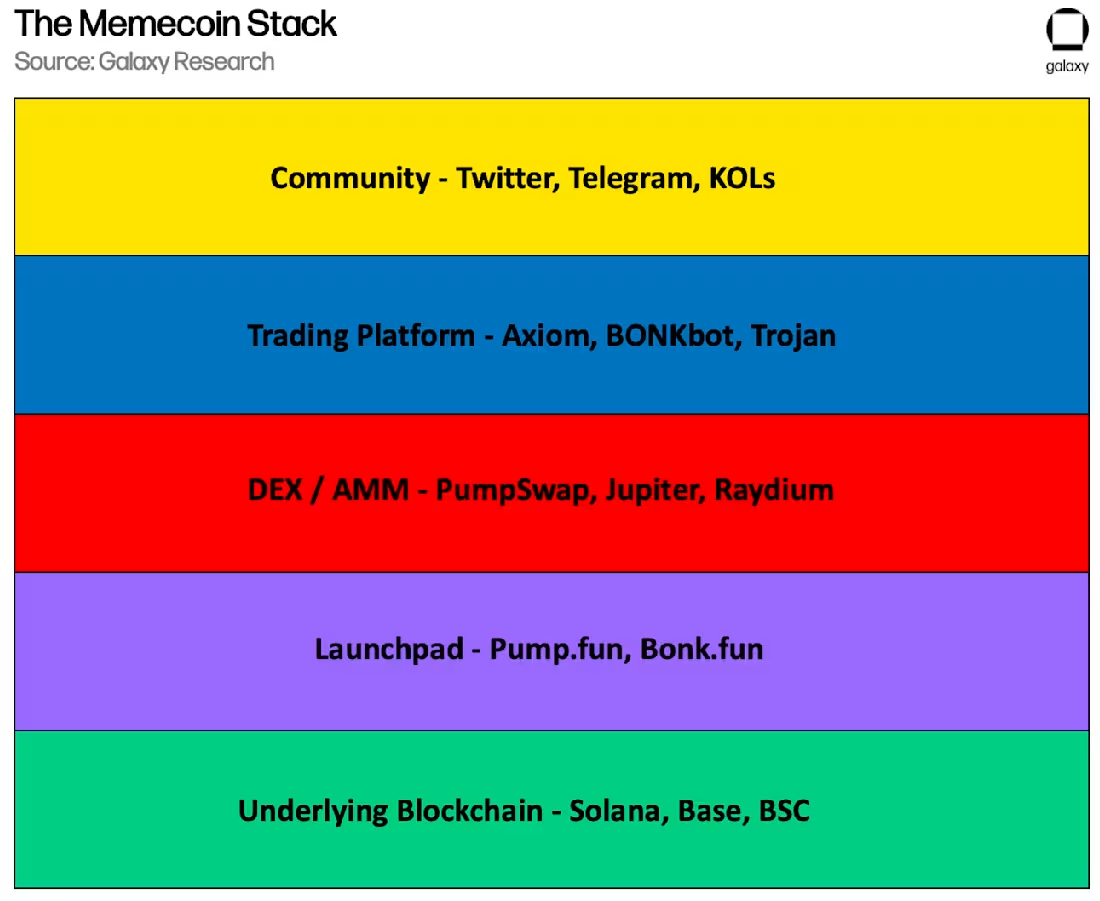
Meme Coin Ecosystem Structure. Meme Coin Ecosystem Structure. Source: Galaxy Digital

At the base level, blockchains like Solana dominate. It hosts over 32 million tokens, a more than 300% increase since early 2024. The blockchain accounts for 56% of the 57 million meme coins across major chains, including Ethereum, Base, and BNB Chain. 

Solana’s low fees and high throughput have made it the preferred venue, with meme coins accounting for approximately 20- 30% of its DEX trading volume, down from 60% in January.

Next, launchpads form a critical layer, enabling rapid token deployment. Solana’s Pump.fun, which debuted in early 2024, exemplifies this trend by industrializing the process through bonding curves that guarantee liquidity at minimal cost. 

The platform has created about 12.9 million tokens, which make up 40.31% of the total 32 million Solana tokens. Tokens launched on Pump.fun boast an aggregated fully diluted market cap (FDMC) exceeding $4.8 billion, though this peaked above $10 billion earlier in the year. 

Furthermore, Pump.fun has generated significant fees from creation and trading. In summer 2024, it briefly lost ground to competitors like LetsBonk. Nonetheless, the launchpad reclaimed dominance through innovations such as Project Ascend, which introduces dynamic fee models for creators, and integrations with streamers for interactive launches.

Meanwhile, DEX aggregators and automated market makers (AMMs) like Jupiter, Raydium, Orca, and Pump.fun’s in-house PumpSwap further extract value by handling immediate post-launch trading. These platforms benefit from high volumes, with meme coins fueling user acquisition and ecosystem growth.

Trading bots, including Axiom, BONKbot, and Trojan, enhance this by enabling sniping—purchasing tokens at inception—and rapid execution, contributing to a hyper-competitive, player-versus-player (PvP) environment. 

Lastly, token deployers, insiders, and key opinion leaders (KOLs) also reap rewards. Developers and insiders often retain large supply portions in hidden wallets, dumping into retail liquidity for gains. KOLs on platforms like X amplify narratives through coordinated campaigns.
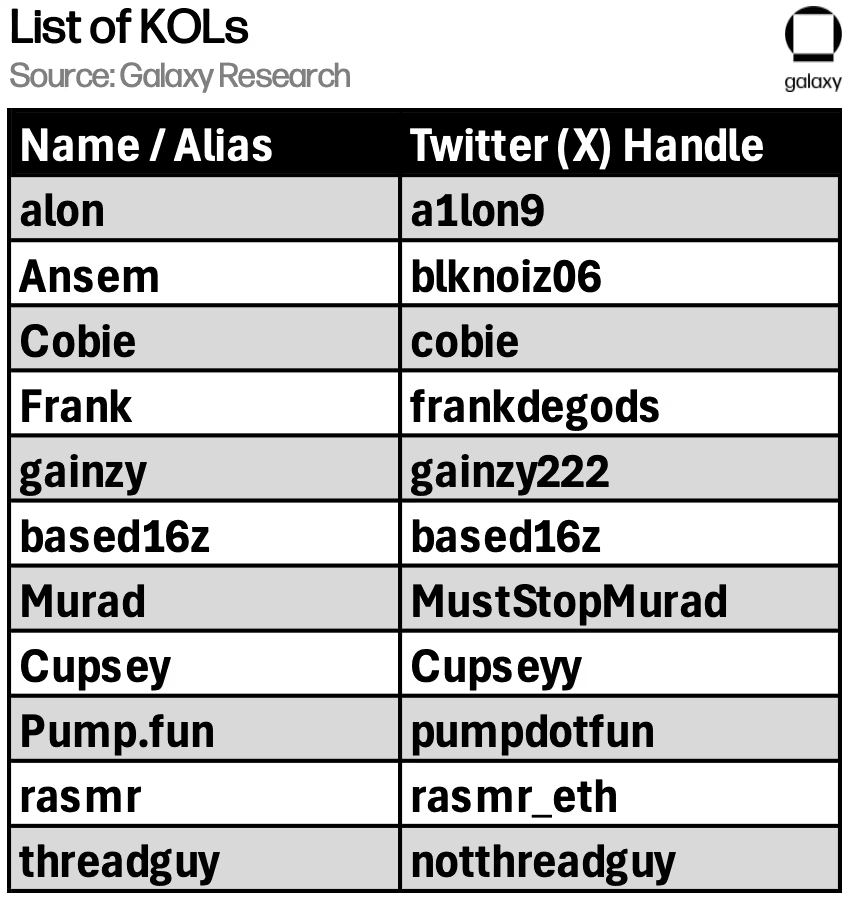
Key Crypto KOLs on XKey Crypto KOLs on X. Source: Galaxy Digital

Are Retail Traders the Biggest Losers in the Meme Coin Boom? 

In contrast, most traders face structural disadvantages. The report revealed that the median hold time for Solana meme coins is around 100 seconds. This is quite a drop from 300 seconds a year prior.

Risks abound, including honeypots—tokens that allow buys but block sells—rug pulls, where insiders withdraw liquidity, and vamping, where copycats siphon value from originals. High-profile incidents, such as the LIBRA token incident, have resulted in millions in trader losses while insiders profited. 

This ecosystem paradox highlights a broader trend: while meme coins serve as onramps to cryptocurrency, drawing new users into wallets and DEXs, the speculative frenzy primarily enriches a concentrated group of infrastructure owners. 

For most participants, trading remains negative EV. Thus, meme coins may look like a casino, but it’s the house — not the players — that always wins.

Market Opportunity
Memecoin Logo
Memecoin Price(MEME)
$0.0007287
$0.0007287$0.0007287
-0.30%
USD
Memecoin (MEME) Live Price Chart
Disclaimer: The articles reposted on this site are sourced from public platforms and are provided for informational purposes only. They do not necessarily reflect the views of MEXC. All rights remain with the original authors. If you believe any content infringes on third-party rights, please contact service@support.mexc.com for removal. MEXC makes no guarantees regarding the accuracy, completeness, or timeliness of the content and is not responsible for any actions taken based on the information provided. The content does not constitute financial, legal, or other professional advice, nor should it be considered a recommendation or endorsement by MEXC.

You May Also Like

Top Solana Treasury Firm Forward Industries Unveils $4 Billion Capital Raise To Buy More SOL ⋆ ZyCrypto
Top Solana Treasury Firm Forward Industries Unveils $4 Billion Capital Raise To Buy More SOL ⋆ ZyCrypto

The post Top Solana Treasury Firm Forward Industries Unveils $4 Billion Capital Raise To Buy More SOL ⋆ ZyCrypto appeared on BitcoinEthereumNews.com. Advertisement &nbsp &nbsp Forward Industries, the largest publicly traded Solana treasury company, has filed a $4 billion at-the-market (ATM) equity offering program with the U.S. SEC  to raise more capital for additional SOL accumulation. Forward Strategies Doubles Down On Solana Strategy In a Wednesday press release, Forward Industries revealed that the 4 billion ATM equity offering program will allow the company to issue and sell common stock via Cantor Fitzgerald under a sales agreement dated Sept. 16, 2025. Forward said proceeds will go toward “general corporate purposes,” including the pursuit of its Solana balance sheet and purchases of income-generating assets. The sales of the shares are covered by an automatic shelf registration statement filed with the US Securities and Exchange Commission that is already effective – meaning the shares will be tradable once they’re sold. An automatic shelf registration allows certain publicly listed companies to raise capital with flexibility swiftly.  Kyle Samani, Forward’s chairman, astutely described the ATM offering as “a flexible and efficient mechanism” to raise and deploy capital for the company’s Solana strategy and bolster its balance sheet.  Advertisement &nbsp Though the maximum amount is listed as $4 billion, the firm indicated that sales may or may not occur depending on existing market conditions. “The ATM Program enhances our ability to continue scaling that position, strengthen our balance sheet, and pursue growth initiatives in alignment with our long-term vision,” Samani said. Forward Industries kicked off its Solana treasury strategy on Sept. 8. The Wednesday S-3 form follows Forward’s $1.65 billion private investment in public equity that closed last week, led by crypto heavyweights like Galaxy Digital, Jump Crypto, and Multicoin Capital. The company started deploying that capital this week, announcing it snatched up 6.8 million SOL for approximately $1.58 billion at an average price of $232…
Share
BitcoinEthereumNews2025/09/18 03:42
Fed Lowers Rates By 25bps: How Bitcoin And Crypto Prices Responded And What’s Next

Fed Lowers Rates By 25bps: How Bitcoin And Crypto Prices Responded And What’s Next

The Federal Reserve (Fed) announced its first interest rate cut of the year, leading to an immediate reaction in the cryptocurrency market. Bitcoin (BTC) experienced a notable decline, dropping below the $115,000 threshold shortly after the announcement.  Expert Predicts Crypto Rally Fed Chair Jerome Powell addressed the current economic landscape, noting that while inflation has […]
Share
Bitcoinist2025/09/18 03:11
XRP Price Outlook As Peter Brandt Predicts BTC Price Might Crash to $42k

XRP Price Outlook As Peter Brandt Predicts BTC Price Might Crash to $42k

The post XRP Price Outlook As Peter Brandt Predicts BTC Price Might Crash to $42k appeared on BitcoinEthereumNews.com. XRP price led cryptocurrency losses on Friday
Share
BitcoinEthereumNews2026/02/06 19:06