📑 Table of Contents Polkadot: A Network of Networks The Vision Behind Polkadot’s Creation How Polkadot’s Modular Technology Works Governance and Community Power Polkadot in Action: Examples and Partners DOT Tokenomics Explained Polkadot’s Roadmap and Future Outlook FAQ: 10 Unanswered Questions About Polkadot 🌐 Polkadot: A Network of Networks Polkadot is one of the most [...]]]>📑 Table of Contents Polkadot: A Network of Networks The Vision Behind Polkadot’s Creation How Polkadot’s Modular Technology Works Governance and Community Power Polkadot in Action: Examples and Partners DOT Tokenomics Explained Polkadot’s Roadmap and Future Outlook FAQ: 10 Unanswered Questions About Polkadot 🌐 Polkadot: A Network of Networks Polkadot is one of the most [...]]]>

Polkadot (DOT) in 2025: The Network of Networks Powering Interoperable Web3

📑 Table of Contents

  • Polkadot: A Network of Networks
  • The Vision Behind Polkadot’s Creation
  • How Polkadot’s Modular Technology Works
  • Governance and Community Power
  • Polkadot in Action: Examples and Partners
  • DOT Tokenomics Explained
  • Polkadot’s Roadmap and Future Outlook
  • FAQ: 10 Unanswered Questions About Polkadot

🌐 Polkadot: A Network of Networks

Polkadot is one of the most promising innovations in blockchain technology. Unlike traditional single-chain blockchains such as Bitcoin or Ethereum, Polkadot is designed as a network of blockchains. Through its modular architecture, it enables a wide range of specialized applications to run in parallel while benefiting from shared security and interoperability.

The native token DOT functions as a cryptocurrency, governance tool, and utility token. Its goal is to build an interoperable Web3 ecosystem where blockchains can communicate securely and efficiently. This design allows projects to develop custom solutions without compromising network stability or scalability.

🚀 The Vision Behind Polkadot’s Creation

Polkadot was conceived by Dr. Gavin Wood, one of Ethereum’s co-founders, in 2016. His vision was to overcome the limitations of existing blockchains. The development is led by the Web3 Foundation and Parity Technologies. The mission: to build a decentralized internet free from gatekeepers, where users retain full control over their data and applications.

⚙ How Polkadot’s Modular Technology Works

Polkadot is built on a modular architecture with three key components:

  • Relay Chain: The central chain providing security, governance, and transaction validation.
  • Parachains: Independent blockchains that run in parallel, customized for specific applications like DeFi, gaming, or identity management.
  • Bridges: Connect Polkadot with external blockchains such as Ethereum and Bitcoin, enhancing interoperability.

This design allows scalability, specialization, and seamless communication between blockchains.

🏛 Governance and Community Power

Unlike off-chain governance models, Polkadot implements on-chain governance. DOT holders directly vote on protocol upgrades, parameter adjustments, and feature integrations. This democratic model empowers the community and promotes transparency. A notable example is Parachain Auctions, where projects compete for relay chain slots, and the community votes on which projects are integrated.

💡 Polkadot in Action: Examples and Partner Projects

Polkadot supports a wide variety of applications, including:

  • DeFi: Acala (stablecoins, financial products) and Parallel Finance (lending, staking, trading).
  • Smart Contracts: Moonbeam, offering Ethereum compatibility for developers.
  • Digital Identity: KILT Protocol, providing verifiable credentials.
  • Other Sectors: Energy, logistics, and sustainability through collaborations with companies and NGOs.

ProjectFocus AreaRole within Polkadot
AcalaDeFi / StablecoinsFinancial hub for decentralized services
MoonbeamSmart ContractsEthereum-compatible environment
KILT ProtocolDigital IdentityIdentity verification and data management

💰 DOT Tokenomics Explained

The DOT token underpins the economic model of Polkadot. Unlike capped-supply cryptocurrencies, DOT uses an inflation-based model to ensure continuous network incentives. Key functions include:

  • Governance: Voting on protocol changes and new features.
  • Staking: Securing the network by rewarding validators and nominators.
  • Parachain Auctions: Funding slots on the relay chain for project integration.
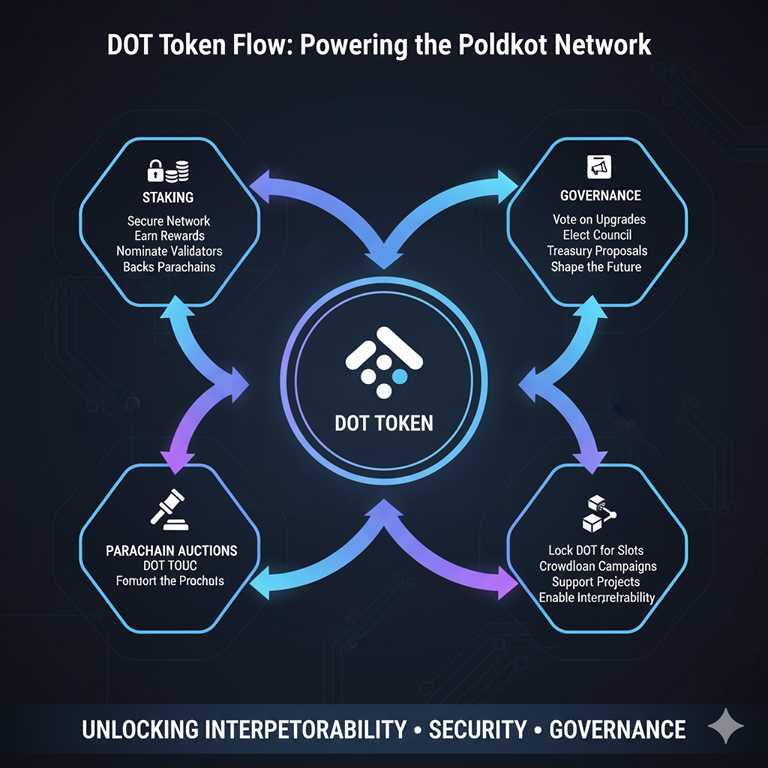
infographic showing the DOT Token flow, including staking, governance, and parachain auctions

🔮 Polkadot’s Roadmap and Future Outlook

In 2025, Polkadot is focused on expanding its parachain ecosystem and building additional bridges to external networks. Regulatory clarity could accelerate institutional adoption. With its multi-chain architecture, Polkadot is becoming a key infrastructure provider for Web3.

The development of Polkadot 2.0 will transform the platform into a global computing environment. Its JAM architecture (Join-Accumulate Machine) introduces vertical scalability and service-oriented design, aiming to support decentralized Web3 cloud functions.
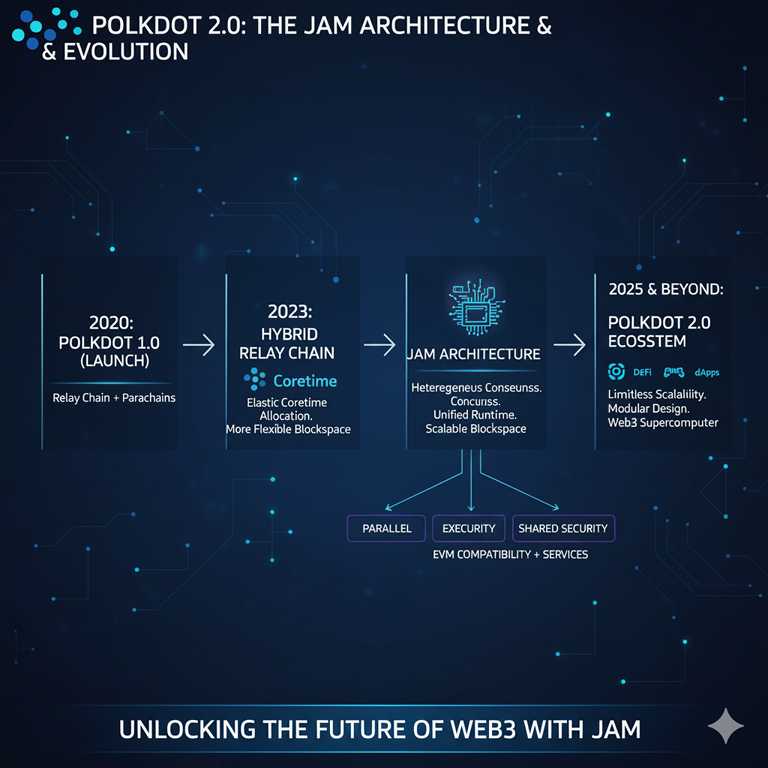
image of the Polkadot 2.0 roadmap timeline, including JAM architecture features

❓ FAQ: 10 Unanswered Questions About Polkadot

1. How will Polkadot 2.0 impact developers?
Polkadot 2.0 will expand opportunities for developers by introducing the JAM (Join-Accumulate Machine) architecture. This enables vertical scalability, more flexible runtime environments, and a service-oriented infrastructure, allowing developers to build Web3 apps with greater efficiency and customizability.
2. Can Polkadot surpass Ethereum in adoption?
Polkadot could surpass Ethereum in specific niches like interoperability, parachain customization, and enterprise blockchain use cases. However, Ethereum’s dominant ecosystem and first-mover advantage in DeFi and NFTs make it difficult to overtake on a broad scale.
3. How secure are Polkadot’s parachains?
Parachains benefit from shared security provided by the relay chain. However, individual parachains can still face risks such as vulnerabilities in their own smart contract code or governance decisions. Shared security reduces systemic risk, but not all parachain-level risks.
4. Will regulatory changes affect Polkadot’s growth?
Yes, regulation will play a major role. Stricter frameworks could limit adoption in some regions, while clear guidelines might accelerate institutional and enterprise integration. Polkadot’s flexibility and governance model position it well to adapt to evolving compliance requirements.
5. What role do bridges play in Polkadot’s success?
Bridges are essential to Polkadot’s interoperability. They allow data and assets to flow between Polkadot and external blockchains like Ethereum and Bitcoin. Successful bridge deployment will determine Polkadot’s ability to become a true hub in the multi-chain ecosystem.
6. Can DOT tokenomics remain sustainable long-term?
DOT’s inflationary model incentivizes validators and nominators to secure the network. Over the long term, governance may adjust inflation parameters to balance rewards, security, and scarcity. The model is flexible but depends on active and responsible community governance.
7. How does Polkadot compare to Cosmos?
Both Polkadot and Cosmos aim to solve interoperability. Polkadot emphasizes shared security and a unified relay chain, while Cosmos prioritizes chain sovereignty with independent blockchains connected by the IBC protocol. The choice depends on whether projects value independence or pooled security.
8. Could Polkadot attract more enterprises?
Yes, Polkadot’s customizable parachains, regulatory adaptability, and strong developer community make it attractive to enterprises seeking tailored blockchain solutions. Its compliance-friendly approach and focus on interoperability also appeal to institutional use cases.
9. How active is the Polkadot developer community?
Polkadot consistently ranks among the top blockchain projects in GitHub commits and developer activity. Its community is one of the most active, with continuous contributions to core protocol upgrades, parachain development, and tooling for Web3.
10. What’s next for parachain auctions?
Parachain auctions will likely evolve with new models, such as shorter leasing terms, dynamic pricing, or alternative allocation mechanisms. These changes aim to increase accessibility for projects and further decentralize participation in the ecosystem.
]]>
Market Opportunity
Polkadot Logo
Polkadot Price(DOT)
$1.279
$1.279$1.279
-0.31%
USD
Polkadot (DOT) Live Price Chart
Disclaimer: The articles reposted on this site are sourced from public platforms and are provided for informational purposes only. They do not necessarily reflect the views of MEXC. All rights remain with the original authors. If you believe any content infringes on third-party rights, please contact service@support.mexc.com for removal. MEXC makes no guarantees regarding the accuracy, completeness, or timeliness of the content and is not responsible for any actions taken based on the information provided. The content does not constitute financial, legal, or other professional advice, nor should it be considered a recommendation or endorsement by MEXC.

You May Also Like

The Channel Factories We’ve Been Waiting For

The Channel Factories We’ve Been Waiting For

The post The Channel Factories We’ve Been Waiting For appeared on BitcoinEthereumNews.com. Visions of future technology are often prescient about the broad strokes while flubbing the details. The tablets in “2001: A Space Odyssey” do indeed look like iPads, but you never see the astronauts paying for subscriptions or wasting hours on Candy Crush.  Channel factories are one vision that arose early in the history of the Lightning Network to address some challenges that Lightning has faced from the beginning. Despite having grown to become Bitcoin’s most successful layer-2 scaling solution, with instant and low-fee payments, Lightning’s scale is limited by its reliance on payment channels. Although Lightning shifts most transactions off-chain, each payment channel still requires an on-chain transaction to open and (usually) another to close. As adoption grows, pressure on the blockchain grows with it. The need for a more scalable approach to managing channels is clear. Channel factories were supposed to meet this need, but where are they? In 2025, subnetworks are emerging that revive the impetus of channel factories with some new details that vastly increase their potential. They are natively interoperable with Lightning and achieve greater scale by allowing a group of participants to open a shared multisig UTXO and create multiple bilateral channels, which reduces the number of on-chain transactions and improves capital efficiency. Achieving greater scale by reducing complexity, Ark and Spark perform the same function as traditional channel factories with new designs and additional capabilities based on shared UTXOs.  Channel Factories 101 Channel factories have been around since the inception of Lightning. A factory is a multiparty contract where multiple users (not just two, as in a Dryja-Poon channel) cooperatively lock funds in a single multisig UTXO. They can open, close and update channels off-chain without updating the blockchain for each operation. Only when participants leave or the factory dissolves is an on-chain transaction…
Share
BitcoinEthereumNews2025/09/18 00:09
Top AI Crypto Presales 2026: IPO Genie Crushes the Competition with Pre-IPO Deal Intelligence and Massive Upside

Top AI Crypto Presales 2026: IPO Genie Crushes the Competition with Pre-IPO Deal Intelligence and Massive Upside

As the 2026 crypto bull run heats up, investors are chasing the next big AI-powered opportunity. But with so many […] The post Top AI Crypto Presales 2026: IPO
Share
Coindoo2026/02/11 05:02
IP Hits $11.75, HYPE Climbs to $55, BlockDAG Surpasses Both with $407M Presale Surge!

IP Hits $11.75, HYPE Climbs to $55, BlockDAG Surpasses Both with $407M Presale Surge!

The post IP Hits $11.75, HYPE Climbs to $55, BlockDAG Surpasses Both with $407M Presale Surge! appeared on BitcoinEthereumNews.com. Crypto News 17 September 2025 | 18:00 Discover why BlockDAG’s upcoming Awakening Testnet launch makes it the best crypto to buy today as Story (IP) price jumps to $11.75 and Hyperliquid hits new highs. Recent crypto market numbers show strength but also some limits. The Story (IP) price jump has been sharp, fueled by big buybacks and speculation, yet critics point out that revenue still lags far behind its valuation. The Hyperliquid (HYPE) price looks solid around the mid-$50s after a new all-time high, but questions remain about sustainability once the hype around USDH proposals cools down. So the obvious question is: why chase coins that are either stretched thin or at risk of retracing when you could back a network that’s already proving itself on the ground? That’s where BlockDAG comes in. While other chains are stuck dealing with validator congestion or outages, BlockDAG’s upcoming Awakening Testnet will be stress-testing its EVM-compatible smart chain with real miners before listing. For anyone looking for the best crypto coin to buy, the choice between waiting on fixes or joining live progress feels like an easy one. BlockDAG: Smart Chain Running Before Launch Ethereum continues to wrestle with gas congestion, and Solana is still known for network freezes, yet BlockDAG is already showing a different picture. Its upcoming Awakening Testnet, set to launch on September 25, isn’t just a demo; it’s a live rollout where the chain’s base protocols are being stress-tested with miners connected globally. EVM compatibility is active, account abstraction is built in, and tools like updated vesting contracts and Stratum integration are already functional. Instead of waiting for fixes like other networks, BlockDAG is proving its infrastructure in real time. What makes this even more important is that the technology is operational before the coin even hits exchanges. That…
Share
BitcoinEthereumNews2025/09/18 00:32