Chainlink has announced a collaboration with FTSE Russell to bring the index provider’s benchmarks on-chain via DataLink, Chainlink’s institutional-grade data publishing service. In a press release shared with CryptoNews, the firm explains that this move marks the first time FTSE Russell’s data—including the Russell 1000, Russell 2000, Russell 3000, and FTSE 100 indexes, alongside WMR FX benchmarks and FTSE Digital Asset Indices—will be available directly on blockchain networks. With over $18 trillion in assets under management benchmarked against its indices, FTSE Russell’s entry into the blockchain space represents a major step in bridging traditional finance and decentralized ecosystems. The data will now be accessible across more than 50 public and private blockchains to 2,000+ Chainlink ecosystem applications, opening the door to new tokenized financial products. Accelerating Institutional Adoption of Tokenized Assets FTSE Russell’s decision to publish its index data on-chain reflects the growing demand among financial institutions for trusted, regulated data sources in digital markets. By using Chainlink’s oracle infrastructure, institutions and developers can build tokenized assets, ETFs, and next-generation financial products. “We’re excited to bring our index data on-chain using Chainlink’s institutional-grade infrastructure,” said Fiona Bassett, CEO at FTSE Russell, an LSEG business. “This marks a major step in enabling innovation around tokenized assets and next-generation financial products. DataLink allows FTSE Russell to securely distribute trusted benchmarks across global on-chain markets,” adds Bassett. DataLink: A Bridge Between Traditional and Decentralized Markets Chainlink’s DataLink serves as a turnkey solution, allowing data providers to publish information directly onto blockchains without building or maintaining new infrastructure. It uses Chainlink’s oracle technology, which has allowed over $25 trillion in transaction value and actively secures nearly $100 billion in DeFi total value locked (TVL). The service ensures that data from established providers like FTSE Russell is authenticated, tamper-proof, and accessible 24/7, allowing DeFi protocols to reference the same high-quality data that powers traditional financial systems. A Defining Moment for On-chain Finance Chainlink co-founder Sergey Nazarov described the collaboration as a “landmark moment” for both industries. “FTSE Russell bringing its trusted benchmarks to blockchains via Chainlink is a critical step toward enabling the next generation of data-driven financial products and tokenized assets,” Nazarov said. With this integration, blockchain developers and financial institutions can verify, reference, and build with FTSE Russell’s data across multiple blockchains, setting the stage for broader adoption of regulated, data-backed financial instruments in decentralized markets. U.S. Commerce Dept Partners with Chainlink to Bring Data On-chain In August, the United States Department of Commerce (DOC) said it has teamed up with Chainlink to bring macroeconomic data from the Bureau of Economic Analysis (BEA) on-chain. Chainlink shared that through its oracle infrastructure, key indicators such as Real Gross Domestic Product (GDP), the Personal Consumption Expenditures (PCE) Price Index, and Real Final Sales to Private Domestic Purchasers are now available across ten blockchain systems. This move also marked the first time U.S. government economic data has been published on-chain in a verifiable way. According to the firm, developers can immediately integrate the Chainlink Data Feeds into decentralized applications (dApps), unlocking use cases such as automated trading strategies, composable tokenized assets, prediction markets, and risk management tools for DeFi protocols. Chainlink Price Action Chainlink’s native token, LINK, fell sharply over the past 24 hours, sliding 11.22% to $15.29 at the time of writing, according to data from CryptoNews. The LINK/USD pair, trading on Coinbase, recorded a daily high of $17.65 and a low of $14.54, closing at $15.31—a drop of nearly 13% on the day. Trading volume surged to 1.95 million LINK, indicating strong sell-side activity. Chainlink currently ranks #20 by market capitalization, with a total supply of 1 billion tokensChainlink has announced a collaboration with FTSE Russell to bring the index provider’s benchmarks on-chain via DataLink, Chainlink’s institutional-grade data publishing service. In a press release shared with CryptoNews, the firm explains that this move marks the first time FTSE Russell’s data—including the Russell 1000, Russell 2000, Russell 3000, and FTSE 100 indexes, alongside WMR FX benchmarks and FTSE Digital Asset Indices—will be available directly on blockchain networks. With over $18 trillion in assets under management benchmarked against its indices, FTSE Russell’s entry into the blockchain space represents a major step in bridging traditional finance and decentralized ecosystems. The data will now be accessible across more than 50 public and private blockchains to 2,000+ Chainlink ecosystem applications, opening the door to new tokenized financial products. Accelerating Institutional Adoption of Tokenized Assets FTSE Russell’s decision to publish its index data on-chain reflects the growing demand among financial institutions for trusted, regulated data sources in digital markets. By using Chainlink’s oracle infrastructure, institutions and developers can build tokenized assets, ETFs, and next-generation financial products. “We’re excited to bring our index data on-chain using Chainlink’s institutional-grade infrastructure,” said Fiona Bassett, CEO at FTSE Russell, an LSEG business. “This marks a major step in enabling innovation around tokenized assets and next-generation financial products. DataLink allows FTSE Russell to securely distribute trusted benchmarks across global on-chain markets,” adds Bassett. DataLink: A Bridge Between Traditional and Decentralized Markets Chainlink’s DataLink serves as a turnkey solution, allowing data providers to publish information directly onto blockchains without building or maintaining new infrastructure. It uses Chainlink’s oracle technology, which has allowed over $25 trillion in transaction value and actively secures nearly $100 billion in DeFi total value locked (TVL). The service ensures that data from established providers like FTSE Russell is authenticated, tamper-proof, and accessible 24/7, allowing DeFi protocols to reference the same high-quality data that powers traditional financial systems. A Defining Moment for On-chain Finance Chainlink co-founder Sergey Nazarov described the collaboration as a “landmark moment” for both industries. “FTSE Russell bringing its trusted benchmarks to blockchains via Chainlink is a critical step toward enabling the next generation of data-driven financial products and tokenized assets,” Nazarov said. With this integration, blockchain developers and financial institutions can verify, reference, and build with FTSE Russell’s data across multiple blockchains, setting the stage for broader adoption of regulated, data-backed financial instruments in decentralized markets. U.S. Commerce Dept Partners with Chainlink to Bring Data On-chain In August, the United States Department of Commerce (DOC) said it has teamed up with Chainlink to bring macroeconomic data from the Bureau of Economic Analysis (BEA) on-chain. Chainlink shared that through its oracle infrastructure, key indicators such as Real Gross Domestic Product (GDP), the Personal Consumption Expenditures (PCE) Price Index, and Real Final Sales to Private Domestic Purchasers are now available across ten blockchain systems. This move also marked the first time U.S. government economic data has been published on-chain in a verifiable way. According to the firm, developers can immediately integrate the Chainlink Data Feeds into decentralized applications (dApps), unlocking use cases such as automated trading strategies, composable tokenized assets, prediction markets, and risk management tools for DeFi protocols. Chainlink Price Action Chainlink’s native token, LINK, fell sharply over the past 24 hours, sliding 11.22% to $15.29 at the time of writing, according to data from CryptoNews. The LINK/USD pair, trading on Coinbase, recorded a daily high of $17.65 and a low of $14.54, closing at $15.31—a drop of nearly 13% on the day. Trading volume surged to 1.95 million LINK, indicating strong sell-side activity. Chainlink currently ranks #20 by market capitalization, with a total supply of 1 billion tokens

FTSE Russell Brings Its Indices Onchain Through Chainlink’s DataLink – Turning Point for Institutional Finance?

4 min read

Chainlink has announced a collaboration with FTSE Russell to bring the index provider’s benchmarks on-chain via DataLink, Chainlink’s institutional-grade data publishing service.

In a press release shared with CryptoNews, the firm explains that this move marks the first time FTSE Russell’s data—including the Russell 1000, Russell 2000, Russell 3000, and FTSE 100 indexes, alongside WMR FX benchmarks and FTSE Digital Asset Indices—will be available directly on blockchain networks.

With over $18 trillion in assets under management benchmarked against its indices, FTSE Russell’s entry into the blockchain space represents a major step in bridging traditional finance and decentralized ecosystems.

The data will now be accessible across more than 50 public and private blockchains to 2,000+ Chainlink ecosystem applications, opening the door to new tokenized financial products.

Accelerating Institutional Adoption of Tokenized Assets

FTSE Russell’s decision to publish its index data on-chain reflects the growing demand among financial institutions for trusted, regulated data sources in digital markets. By using Chainlink’s oracle infrastructure, institutions and developers can build tokenized assets, ETFs, and next-generation financial products.

“We’re excited to bring our index data on-chain using Chainlink’s institutional-grade infrastructure,” said Fiona Bassett, CEO at FTSE Russell, an LSEG business.

“This marks a major step in enabling innovation around tokenized assets and next-generation financial products. DataLink allows FTSE Russell to securely distribute trusted benchmarks across global on-chain markets,” adds Bassett.

Chainlink’s DataLink serves as a turnkey solution, allowing data providers to publish information directly onto blockchains without building or maintaining new infrastructure.

It uses Chainlink’s oracle technology, which has allowed over $25 trillion in transaction value and actively secures nearly $100 billion in DeFi total value locked (TVL).

The service ensures that data from established providers like FTSE Russell is authenticated, tamper-proof, and accessible 24/7, allowing DeFi protocols to reference the same high-quality data that powers traditional financial systems.

A Defining Moment for On-chain Finance

Chainlink co-founder Sergey Nazarov described the collaboration as a “landmark moment” for both industries. “FTSE Russell bringing its trusted benchmarks to blockchains via Chainlink is a critical step toward enabling the next generation of data-driven financial products and tokenized assets,” Nazarov said.

With this integration, blockchain developers and financial institutions can verify, reference, and build with FTSE Russell’s data across multiple blockchains, setting the stage for broader adoption of regulated, data-backed financial instruments in decentralized markets.

In August, the United States Department of Commerce (DOC) said it has teamed up with Chainlink to bring macroeconomic data from the Bureau of Economic Analysis (BEA) on-chain.

Chainlink shared that through its oracle infrastructure, key indicators such as Real Gross Domestic Product (GDP), the Personal Consumption Expenditures (PCE) Price Index, and Real Final Sales to Private Domestic Purchasers are now available across ten blockchain systems.

This move also marked the first time U.S. government economic data has been published on-chain in a verifiable way. According to the firm, developers can immediately integrate the Chainlink Data Feeds into decentralized applications (dApps), unlocking use cases such as automated trading strategies, composable tokenized assets, prediction markets, and risk management tools for DeFi protocols.

Chainlink’s native token, LINK, fell sharply over the past 24 hours, sliding 11.22% to $15.29 at the time of writing, according to data from CryptoNews.
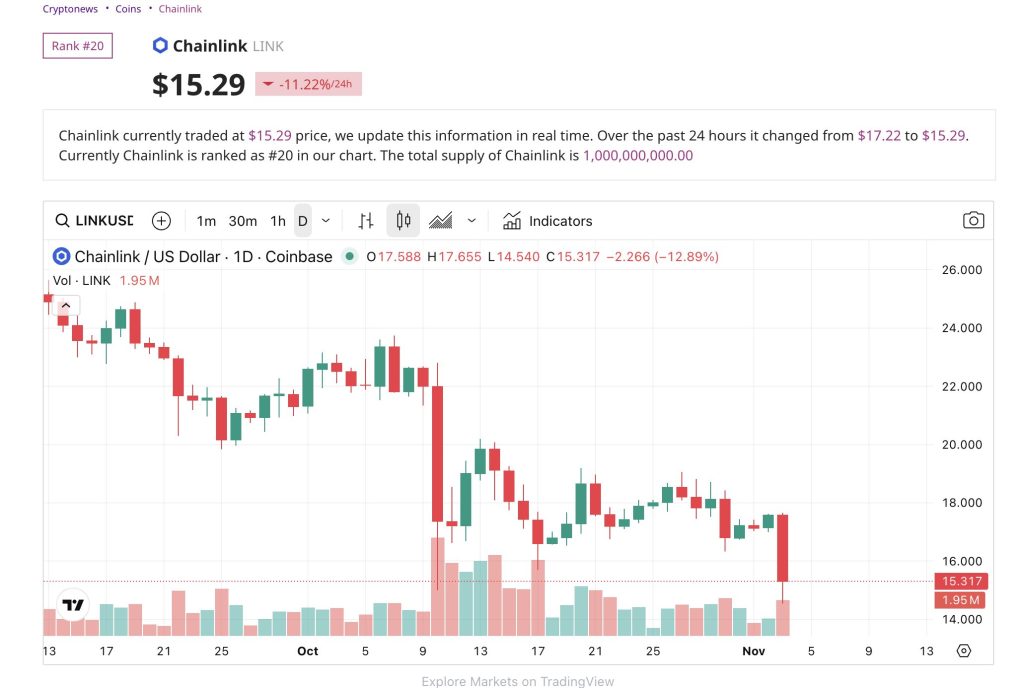
The LINK/USD pair, trading on Coinbase, recorded a daily high of $17.65 and a low of $14.54, closing at $15.31—a drop of nearly 13% on the day. Trading volume surged to 1.95 million LINK, indicating strong sell-side activity. Chainlink currently ranks #20 by market capitalization, with a total supply of 1 billion tokens.

Disclaimer: The articles reposted on this site are sourced from public platforms and are provided for informational purposes only. They do not necessarily reflect the views of MEXC. All rights remain with the original authors. If you believe any content infringes on third-party rights, please contact service@support.mexc.com for removal. MEXC makes no guarantees regarding the accuracy, completeness, or timeliness of the content and is not responsible for any actions taken based on the information provided. The content does not constitute financial, legal, or other professional advice, nor should it be considered a recommendation or endorsement by MEXC.

You May Also Like

eurosecurity.net Expands Cryptocurrency Asset Recovery Capabilities Amid Rising Investor Losses

eurosecurity.net Expands Cryptocurrency Asset Recovery Capabilities Amid Rising Investor Losses

New York, NY/ GlobePRWire / Feb 6, 2026 – eurosecurity.net announces the expansion of its cryptocurrency asset recovery services, reflecting increased demand from
Share
CryptoReporter2026/02/06 17:24
Ethereum to boost scalability and roll out Fusaka upgrade on Dec 3

Ethereum to boost scalability and roll out Fusaka upgrade on Dec 3

Ethereum's Fusaka update may happen on December 3, based on the date set in the latest developer call.
Share
Cryptopolitan2025/09/19 17:00
Google Cloud taps EigenLayer to bring trust to agentic payments

Google Cloud taps EigenLayer to bring trust to agentic payments

The post Google Cloud taps EigenLayer to bring trust to agentic payments appeared on BitcoinEthereumNews.com. Two days after unveiling AP2 — a universal payment layer for AI agents that supports everything from credit cards to stablecoins — Google and EigenLayer have released details of their partnership to bring verifiability and restaking security to the stack, using Ethereum. In addition to enabling verifiable compute and slashing-backed payment coordination, EigenCloud will support insured and sovereign AI agents, which introduce consequences for failure or deviation from specified behavior. Sovereign agents are positioned as autonomous actors that can own property, make decisions, and execute actions independently — think smart contracts with embedded intelligence. From demos to dollars AP2 extends Google’s agent-to-agent (A2A) protocol using the HTTP 402 status code — long reserved for “payment required” — to standardize payment requests between agents across different networks. It already supports stablecoins like USDC, and Coinbase has demoed an agent checkout using its Wallet-as-a-Service. Paired with a system like Lit Protocol’s Vincent — which enforces per-action policies and key custody at signing — Google’s AP2 with EigenCloud’s verifiability and cross-chain settlement could form an end-to-end trust loop. Payments between agents aren’t as simple as they are often made to sound by “Crypto x AI” LARPs. When an AI agent requests a payment in USDC on Base and the payer’s funds are locked in ETH on Arbitrum, the transaction stalls — unless something abstracts the bridging, swapping and delivery. That’s where EigenCloud comes in. Sreeram Kannan, founder of EigenLayer, said the integration will create agents that not only run on-chain verifiable compute, but are also economically incentivized to behave within programmable bounds. Through restaked operators, EigenCloud powers a verifiable payment service that handles asset routing and chain abstraction, with dishonest behavior subject to slashing. It also introduces cryptographic accountability to the agents themselves, enabling proofs that an agent actually executed the task it…
Share
BitcoinEthereumNews2025/09/19 03:52