Market intelligence platform Glassnode has buttressed the importance of the $2 psychological price mark to XRP investors. XRP recovered to close above $2 last week after a push below. The fourth-largest cryptocurrency by market cap dropped to a low of $1.82 in the previous week, but ETF momentum and a broader market recovery saw it […]Market intelligence platform Glassnode has buttressed the importance of the $2 psychological price mark to XRP investors. XRP recovered to close above $2 last week after a push below. The fourth-largest cryptocurrency by market cap dropped to a low of $1.82 in the previous week, but ETF momentum and a broader market recovery saw it […]

Glassnode Explains Why $2 Is a Critical Zone for XRP

Market intelligence platform Glassnode has buttressed the importance of the $2 psychological price mark to XRP investors.

XRP recovered to close above $2 last week after a push below. The fourth-largest cryptocurrency by market cap dropped to a low of $1.82 in the previous week, but ETF momentum and a broader market recovery saw it bounce to close at $2.04.

This momentum has spilled into the new week, spurring a near 7% increase. Notably, XRP reached an intra-week high of $2.28 before relinquishing some of its upside today.

The $2 Mark Is Crucial for XRP

Meanwhile, XRP is still trading above the $2 zone at the time of writing, an area Glassnode believes is essential to XRP investors’ psychology. The platform identified how holders have reacted to XRP reaching the price mark since early 2025.

For context, the November 24 report shows that investors have realized losses of between $500 million and $1.28 billion per week each time XRP drops to the psychological level since March. An accompanying chart shows that when XRP fell to $1.90 in early March, holders realized losses slightly above $1.2 billion per week.
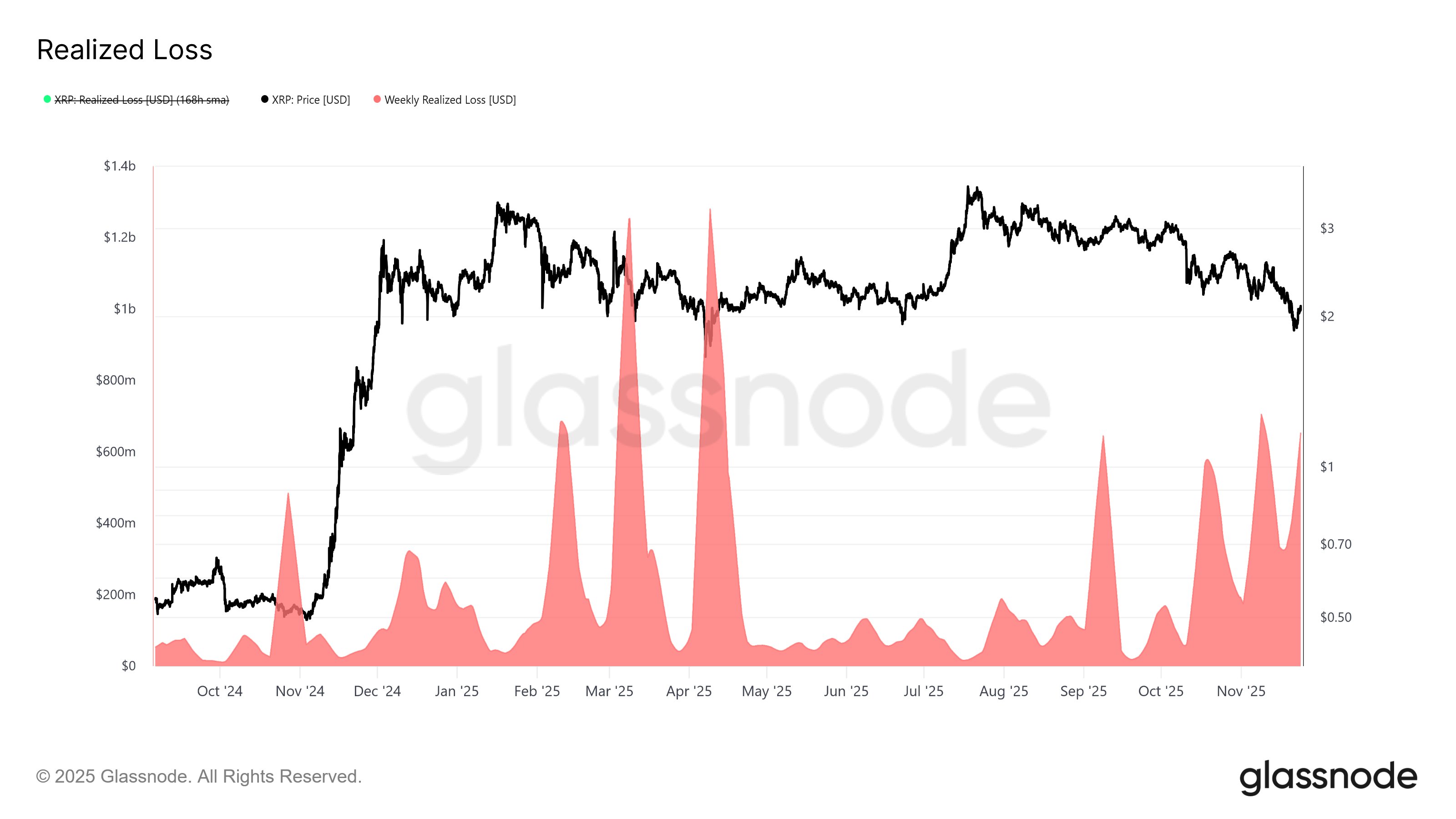
XRP Realized Losses/GlassnodeXRP Realized Losses/Glassnode

A similar scenario happened during the April drop to $1.61. Investors also sold their holdings at a combined loss of nearly $1.3 billion per week. Glassnode highlighted that this emphasizes how investors behave towards the $2 price level. Specifically, a drop below raises skepticism, resulting in the sales even at a loss, while holders remain optimistic above the zone.

Notably, this builds on an earlier report showing that XRP’s daily realized losses have spiked to $75 million daily, the highest level since April. They increased their selling spree from $50 million per day in early October.

Whales Take Profit Amid 17% Rally

In a parallel social media post, analyst Ali Martinez noted that whales are taking profit amid the price rebound. Notably, XRP has rallied over 17% in the last 72 hours, outperforming most major cryptocurrencies.

While it showed signs of recovery, whales holding between 1 million and 10 million XRP locked in profits, selling over 180 million tokens in the process. Further analysis shows that the selloff campaign brought these whales’ new stash to 4.74 billion XRP.

Despite these, XRP seems to be standing strong. The token remains well above $2, specifically changing hands at $2.20, spurred by the ETF buzz. For perspective, the Franklin Templeton and Grayscale XRP ETFs launched yesterday in the US market and had an immediate impact.

They attracted a combined $130 million in positive flow, bringing the net inflow into US XRP ETFs on Monday to $164 million. This institutional lure has absorbed selling pressure, fostering its over 7% 24-hour growth.

Market Opportunity
WHY Logo
WHY Price(WHY)
$0.00000001515
$0.00000001515$0.00000001515
-0.19%
USD
WHY (WHY) Live Price Chart
Disclaimer: The articles reposted on this site are sourced from public platforms and are provided for informational purposes only. They do not necessarily reflect the views of MEXC. All rights remain with the original authors. If you believe any content infringes on third-party rights, please contact service@support.mexc.com for removal. MEXC makes no guarantees regarding the accuracy, completeness, or timeliness of the content and is not responsible for any actions taken based on the information provided. The content does not constitute financial, legal, or other professional advice, nor should it be considered a recommendation or endorsement by MEXC.

You May Also Like

Cashing In On University Patents Means Giving Up On Our Innovation Future

Cashing In On University Patents Means Giving Up On Our Innovation Future

The post Cashing In On University Patents Means Giving Up On Our Innovation Future appeared on BitcoinEthereumNews.com. “It’s a raid on American innovation that would deliver pennies to the Treasury while kneecapping the very engine of our economic and medical progress,” writes Pipes. Getty Images Washington is addicted to taxing success. Now, Commerce Secretary Howard Lutnick is floating a plan to skim half the patent earnings from inventions developed at universities with federal funding. It’s being sold as a way to shore up programs like Social Security. In reality, it’s a raid on American innovation that would deliver pennies to the Treasury while kneecapping the very engine of our economic and medical progress. Yes, taxpayer dollars support early-stage research. But the real payoff comes later—in the jobs created, cures discovered, and industries launched when universities and private industry turn those discoveries into real products. By comparison, the sums at stake in patent licensing are trivial. Universities collectively earn only about $3.6 billion annually in patent income—less than the federal government spends on Social Security in a single day. Even confiscating half would barely register against a $6 trillion federal budget. And yet the damage from such a policy would be anything but trivial. The true return on taxpayer investment isn’t in licensing checks sent to Washington, but in the downstream economic activity that federally supported research unleashes. Thanks to the bipartisan Bayh-Dole Act of 1980, universities and private industry have powerful incentives to translate early-stage discoveries into real-world products. Before Bayh-Dole, the government hoarded patents from federally funded research, and fewer than 5% were ever licensed. Once universities could own and license their own inventions, innovation exploded. The result has been one of the best returns on investment in government history. Since 1996, university research has added nearly $2 trillion to U.S. industrial output, supported 6.5 million jobs, and launched more than 19,000 startups. Those companies pay…
Share
BitcoinEthereumNews2025/09/18 03:26
Trump Reviews Candidates to Succeed Fed Chair Powell

Trump Reviews Candidates to Succeed Fed Chair Powell

The post Trump Reviews Candidates to Succeed Fed Chair Powell appeared on BitcoinEthereumNews.com. Key Points: Trump evaluates Fed Chair candidates, considering
Share
BitcoinEthereumNews2025/12/19 08:34
Will XRP Price Increase In September 2025?

Will XRP Price Increase In September 2025?

Ripple XRP is a cryptocurrency that primarily focuses on building a decentralised payments network to facilitate low-cost and cross-border transactions. It’s a native digital currency of the Ripple network, which works as a blockchain called the XRP Ledger (XRPL). It utilised a shared, distributed ledger to track account balances and transactions. What Do XRP Charts Reveal? […]
Share
Tronweekly2025/09/18 00:00