

Must Read
META. Small toy figures are seen in front of Meta's logo in this illustration taken, October 28, 2021.META. Small toy figures are seen in front of Meta's logo in this illustration taken, October 28, 2021.
24th Jaime V. Ongpin lecture focuses on fighting disinformation in the age of AI
MANILA, Philippines – Artificial intelligence (AI) can both be a potential vector for spreading and a means of fighting disinformation, according to experts who spoke at the 24th Jaime V. Ongpin Annual Memorial Lecture at the Ateneo Professional Schools on Monday, November 24
In her keynote speech, Professor Maria Mercedes Rodrigo, head of the Ateneo Laboratory for the Learning Sciences, said that “AI has accelerated and democratized the capacity to create deepfakes — synthetic text, images, audio, video of events that never took place.”
She added, “Generative AI has the potential to inundate media with deepfakes, misinformation, and synthetic content, and the Philippines has been designated patient zero in the context of global disinformation largely attributable to the significant prevalence of misinformation during the 2016 Philippine elections.”
The study said 14 experts — six industry professionals, three academics, three civil society members, and two members of the media — were gathered in a series of interviews for the purpose of the study.
Within the industry, the two most common applications of AI were fraud detection and anti-money laundering campaigns, as well as personalized marketing campaigns.
In her speech, Rodrigo cited the need for regulatory policies and a code of ethics governing AI use. Industry and academic key informants, she said, affirmed the need for ethical and regulatory policies to ensure AI safety.
Meanwhile, “users and creators of AI applications need to be cognizant of safety, security, and intellectual property implications.”
“Based on our interviews, we can see that we as a country have the internal capacity and expertise. We have the education and the awareness, What we seem to lack is scale, and what we need is scale,” Rodrigo said.
To cap off her speech, Rodrigo mentioned some of the proposed remedies in the study, which focused on combating disinformation through effective implementation of governance structures, policy adaptations, and collaboration across sectors.
These included a call for a national AI governance framework, aligning with the Department of Trade and Industry’s National AI Strategy Roadmap 2.0, as well as promoting media literacy and public awareness regarding AI as a tool and a means of spreading disinformation to the unwary.
Play Video 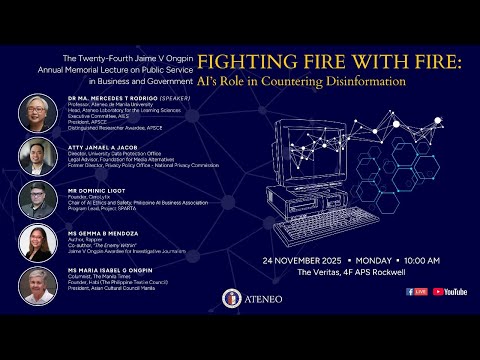
Panel of reactors
A panel of reactors was also on hand to give remarks regarding the possibilities and pitfalls of artificial intelligence. Alongside Rodrigo were lawyer Jamael Jacob, director of the university’s data protection office; Dominic Ligot, the founder of Cirrolytix and the chair of AI ethics and safety at the Philippine AI Business Association; and, Gemma Mendoza, Rappler’s head of digital services and lead researcher on disinformation and platforms.
According to Jacob, critics and proponents of AI both readily admit that AI isn’t perfect, and makes mistakes or “hallucinates.” As such, the jury is still out on using AI to combat the bad uses of AI.
He added that transparency was crucial to ascribing responsibility for AI’s uses and any potential missteps, though calls for transparency and accountability are often rejected as AI’s algorithms are treated as trade secrets by big technology companies.
For Ligot, meanwhile, his position is that AI is neither a savior nor a villain, and that we must treat deepfakes as a present operational threat rather than a distant one. Ligot also stood for limiting the reach of bad actors rather than policing free expression by detecting the coordinated spread of falsehoods. The reach of paid disinformation, he explained, vastly outpaces truth, with disinformation amplified by design and more readily going viral.
Mendoza discussed the accountability of tech companies to labeling fake content. She mentioned how a rise in synthetic content and AI slop — especially deepfakes like hyperrealistic video content — has drowned out real content on social media feeds. This is made worse by the existence of well-used but still little-known AI tools to generate deepfakes.
She mentioned how platforms profit from the spread of deepfakes, with a Reuters report mentioning that, based on internal documents, Meta earns a fortune on fraudulent ads by charging suspected fraudsters more to be amplified rather than investigating the source of the fraud.
Mendoza added, “While innovation should be welcomed, guard rails should be in place and platforms should not be allowed to profit from content theft. This will ultimately kill that rich marketplace of information, art, and culture that AI is currently benefiting from.”
The study by Rodrigo, Rommel Jude Ong, Karen Claire Garcia, Charisse Erinn Flores, and Johanna Marion Torres is available to download for free on this page. It was funded by the Konrad Adenauer Stiftung Foundation. – Rappler.com
Market Opportunity
Sleepless AI Price(AI)
$0.03596
$0.03596$0.03596
USD
Sleepless AI (AI) Live Price Chart
Disclaimer: The articles reposted on this site are sourced from public platforms and are provided for informational purposes only. They do not necessarily reflect the views of MEXC. All rights remain with the original authors. If you believe any content infringes on third-party rights, please contact service@support.mexc.com for removal. MEXC makes no guarantees regarding the accuracy, completeness, or timeliness of the content and is not responsible for any actions taken based on the information provided. The content does not constitute financial, legal, or other professional advice, nor should it be considered a recommendation or endorsement by MEXC.
You May Also Like

Shocking OpenVPP Partnership Claim Draws Urgent Scrutiny
The post Shocking OpenVPP Partnership Claim Draws Urgent Scrutiny appeared on BitcoinEthereumNews.com. The cryptocurrency world is buzzing with a recent controversy surrounding a bold OpenVPP partnership claim. This week, OpenVPP (OVPP) announced what it presented as a significant collaboration with the U.S. government in the innovative field of energy tokenization. However, this claim quickly drew the sharp eye of on-chain analyst ZachXBT, who highlighted a swift and official rebuttal that has sent ripples through the digital asset community. What Sparked the OpenVPP Partnership Claim Controversy? The core of the issue revolves around OpenVPP’s assertion of a U.S. government partnership. This kind of collaboration would typically be a monumental endorsement for any private cryptocurrency project, especially given the current regulatory climate. Such a partnership could signify a new era of mainstream adoption and legitimacy for energy tokenization initiatives. OpenVPP initially claimed cooperation with the U.S. government. This alleged partnership was said to be in the domain of energy tokenization. The announcement generated considerable interest and discussion online. ZachXBT, known for his diligent on-chain investigations, was quick to flag the development. He brought attention to the fact that U.S. Securities and Exchange Commission (SEC) Commissioner Hester Peirce had directly addressed the OpenVPP partnership claim. Her response, delivered within hours, was unequivocal and starkly contradicted OpenVPP’s narrative. How Did Regulatory Authorities Respond to the OpenVPP Partnership Claim? Commissioner Hester Peirce’s statement was a crucial turning point in this unfolding story. She clearly stated that the SEC, as an agency, does not engage in partnerships with private cryptocurrency projects. This response effectively dismantled the credibility of OpenVPP’s initial announcement regarding their supposed government collaboration. Peirce’s swift clarification underscores a fundamental principle of regulatory bodies: maintaining impartiality and avoiding endorsements of private entities. Her statement serves as a vital reminder to the crypto community about the official stance of government agencies concerning private ventures. Moreover, ZachXBT’s analysis…
Share
BitcoinEthereumNews2025/09/18 02:13

Why Is Crypto Up Today? – September 23, 2025
The crypto market is steady today, with the global cryptocurrency market capitalization ticking up by 0.1% to $3.99 trillion.
Share
Coinstats2025/09/23 20:37

Zoetis to Participate in the 44th Annual J.P. Morgan Healthcare Conference
PARSIPPANY, N.J.–(BUSINESS WIRE)–$ZTS #animalhealth—Zoetis Inc. (NYSE:ZTS) will participate in the 44th Annual J.P. Morgan Healthcare Conference on Monday, January
Share
AI Journal2025/12/18 21:36