Bitcoin miner revenues have fallen to their lowest levels in two months, according to analysts at on-chain and market data CryptoQuant . On June 22, daily earnings dropped to $34 million, a level not seen since April 20, 2025. The downturn is mainly being attributed to reduced transaction fees and a decline in the market price of Bitcoin. The combination of these factors is leading to an environment where miners are experiencing some of the lowest compensation rates recorded in the past year. As reported in CryptoQuant’s weekly analysis, miners are currently “the most underpaid they have been in the last year.” Bitcoin miners just saw their worst payday in a year. Daily revenue slipped to $34 million in June, the lowest since April. Falling fees and Bitcoin’s price drop are crushing margins. pic.twitter.com/TXdN06CU1F — CryptoQuant.com (@cryptoquant_com) June 26, 2025 Hashrate Falls, But Miner Selling Stays Low Despite the drop in revenue, miners have not responded with increased selling. CryptoQuant reports that Bitcoin outflows from miner wallets have steadily decreased, falling from a peak of 23,000 BTC per day in February to around 6,000 BTC today. This represents a significant reduction in selling activity, especially given the recent price volatility. Notably, the network’s hashrate has experienced a 3.5% drawdown since June 16, marking the largest decline in nearly a year. However, this drop in computational power has not translated into heightened liquidations by miners. In addition, so-called “Satoshi-era” miners have sold only 150 BTC so far in 2025, compared to nearly 10,000 BTC in 2024. Miner Reserves Grow Despite Lower Income CryptoQuant analysts also note that instead of selling, miners are increasing their reserves. Addresses holding between 100 and 1,000 BTC have grown their combined holdings from 61,000 BTC on March 31 to 65,000 BTC as of late June. This is the highest level of reserve accumulation by this group of miners since November 2024. The steady accumulation trend suggests that most miners are not facing immediate financial stress, even amid falling revenues. Their continued reserve growth indicates a long-term outlook and confidence in future price recovery, rather than capitulation under current market conditions. Overall, while Bitcoin miner revenues have declined to a two-month low, there is no evidence of widespread selling pressure in response. CryptoQuant’s findings portray a mining sector that, though underpaid by recent standards, remains resilient and strategically focused on long-term accumulation.Bitcoin miner revenues have fallen to their lowest levels in two months, according to analysts at on-chain and market data CryptoQuant . On June 22, daily earnings dropped to $34 million, a level not seen since April 20, 2025. The downturn is mainly being attributed to reduced transaction fees and a decline in the market price of Bitcoin. The combination of these factors is leading to an environment where miners are experiencing some of the lowest compensation rates recorded in the past year. As reported in CryptoQuant’s weekly analysis, miners are currently “the most underpaid they have been in the last year.” Bitcoin miners just saw their worst payday in a year. Daily revenue slipped to $34 million in June, the lowest since April. Falling fees and Bitcoin’s price drop are crushing margins. pic.twitter.com/TXdN06CU1F — CryptoQuant.com (@cryptoquant_com) June 26, 2025 Hashrate Falls, But Miner Selling Stays Low Despite the drop in revenue, miners have not responded with increased selling. CryptoQuant reports that Bitcoin outflows from miner wallets have steadily decreased, falling from a peak of 23,000 BTC per day in February to around 6,000 BTC today. This represents a significant reduction in selling activity, especially given the recent price volatility. Notably, the network’s hashrate has experienced a 3.5% drawdown since June 16, marking the largest decline in nearly a year. However, this drop in computational power has not translated into heightened liquidations by miners. In addition, so-called “Satoshi-era” miners have sold only 150 BTC so far in 2025, compared to nearly 10,000 BTC in 2024. Miner Reserves Grow Despite Lower Income CryptoQuant analysts also note that instead of selling, miners are increasing their reserves. Addresses holding between 100 and 1,000 BTC have grown their combined holdings from 61,000 BTC on March 31 to 65,000 BTC as of late June. This is the highest level of reserve accumulation by this group of miners since November 2024. The steady accumulation trend suggests that most miners are not facing immediate financial stress, even amid falling revenues. Their continued reserve growth indicates a long-term outlook and confidence in future price recovery, rather than capitulation under current market conditions. Overall, while Bitcoin miner revenues have declined to a two-month low, there is no evidence of widespread selling pressure in response. CryptoQuant’s findings portray a mining sector that, though underpaid by recent standards, remains resilient and strategically focused on long-term accumulation.

Bitcoin Miner Revenues Hit Two-Month Low, Selling Activity Remains Muted: CryptoQuant

2 min read

Bitcoin miner revenues have fallen to their lowest levels in two months, according to analysts at on-chain and market data CryptoQuant.

On June 22, daily earnings dropped to $34 million, a level not seen since April 20, 2025. The downturn is mainly being attributed to reduced transaction fees and a decline in the market price of Bitcoin.
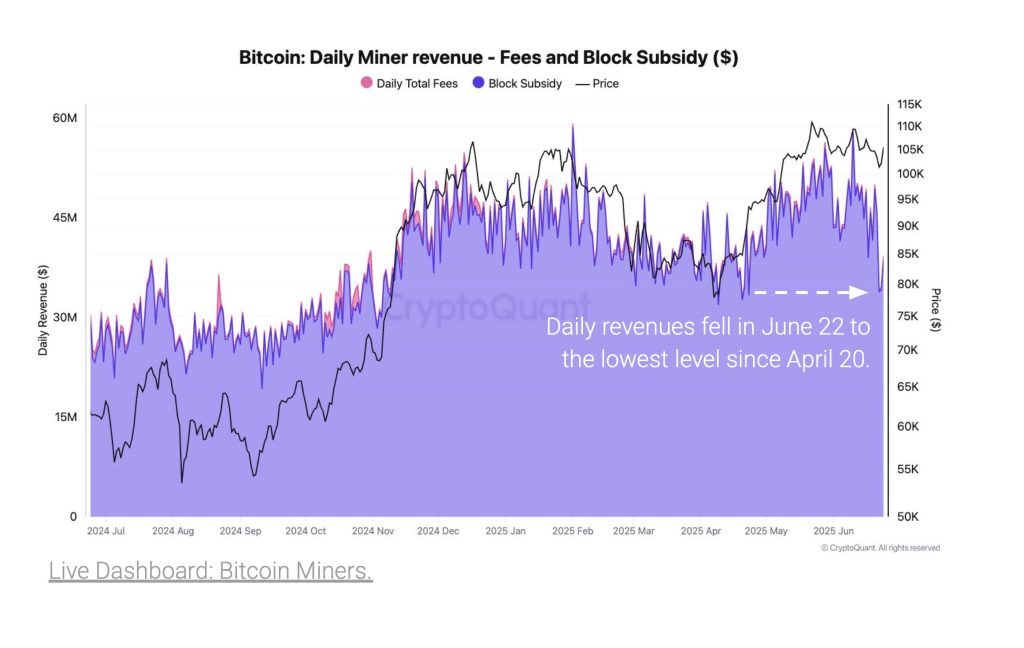
The combination of these factors is leading to an environment where miners are experiencing some of the lowest compensation rates recorded in the past year. As reported in CryptoQuant’s weekly analysis, miners are currently “the most underpaid they have been in the last year.”

Hashrate Falls, But Miner Selling Stays Low

Despite the drop in revenue, miners have not responded with increased selling. CryptoQuant reports that Bitcoin outflows from miner wallets have steadily decreased, falling from a peak of 23,000 BTC per day in February to around 6,000 BTC today.

This represents a significant reduction in selling activity, especially given the recent price volatility. Notably, the network’s hashrate has experienced a 3.5% drawdown since June 16, marking the largest decline in nearly a year.

However, this drop in computational power has not translated into heightened liquidations by miners. In addition, so-called “Satoshi-era” miners have sold only 150 BTC so far in 2025, compared to nearly 10,000 BTC in 2024.

Miner Reserves Grow Despite Lower Income

CryptoQuant analysts also note that instead of selling, miners are increasing their reserves. Addresses holding between 100 and 1,000 BTC have grown their combined holdings from 61,000 BTC on March 31 to 65,000 BTC as of late June. This is the highest level of reserve accumulation by this group of miners since November 2024.

The steady accumulation trend suggests that most miners are not facing immediate financial stress, even amid falling revenues. Their continued reserve growth indicates a long-term outlook and confidence in future price recovery, rather than capitulation under current market conditions.

Overall, while Bitcoin miner revenues have declined to a two-month low, there is no evidence of widespread selling pressure in response. CryptoQuant’s findings portray a mining sector that, though underpaid by recent standards, remains resilient and strategically focused on long-term accumulation.

Market Opportunity
Bitcoin Logo
Bitcoin Price(BTC)
$76,483.72
$76,483.72$76,483.72
-2.10%
USD
Bitcoin (BTC) Live Price Chart
Disclaimer: The articles reposted on this site are sourced from public platforms and are provided for informational purposes only. They do not necessarily reflect the views of MEXC. All rights remain with the original authors. If you believe any content infringes on third-party rights, please contact service@support.mexc.com for removal. MEXC makes no guarantees regarding the accuracy, completeness, or timeliness of the content and is not responsible for any actions taken based on the information provided. The content does not constitute financial, legal, or other professional advice, nor should it be considered a recommendation or endorsement by MEXC.

You May Also Like

Polygon: Bulls defend $0.10 demand zone – Can POL rally 15%?

Polygon: Bulls defend $0.10 demand zone – Can POL rally 15%?

The $0.13 local supply zone and the short-term Bitcoin bearish momentum threaten POL bulls' potential this week.
Share
Coinstats2026/02/04 09:00
Headwind Helps Best Wallet Token

Headwind Helps Best Wallet Token

The post Headwind Helps Best Wallet Token appeared on BitcoinEthereumNews.com. Google has announced the launch of a new open-source protocol called Agent Payments Protocol (AP2) in partnership with Coinbase, the Ethereum Foundation, and 60 other organizations. This allows AI agents to make payments on behalf of users using various methods such as real-time bank transfers, credit and debit cards, and, most importantly, stablecoins. Let’s explore in detail what this could mean for the broader cryptocurrency markets, and also highlight a presale crypto (Best Wallet Token) that could explode as a result of this development. Google’s Push for Stablecoins Agent Payments Protocol (AP2) uses digital contracts known as ‘Intent Mandates’ and ‘Verifiable Credentials’ to ensure that AI agents undertake only those payments authorized by the user. Mandates, by the way, are cryptographically signed, tamper-proof digital contracts that act as verifiable proof of a user’s instruction. For example, let’s say you instruct an AI agent to never spend more than $200 in a single transaction. This instruction is written into an Intent Mandate, which serves as a digital contract. Now, whenever the AI agent tries to make a payment, it must present this mandate as proof of authorization, which will then be verified via the AP2 protocol. Alongside this, Google has also launched the A2A x402 extension to accelerate support for the Web3 ecosystem. This production-ready solution enables agent-based crypto payments and will help reshape the growth of cryptocurrency integration within the AP2 protocol. Google’s inclusion of stablecoins in AP2 is a massive vote of confidence in dollar-pegged cryptocurrencies and a huge step toward making them a mainstream payment option. This widens stablecoin usage beyond trading and speculation, positioning them at the center of the consumption economy. The recent enactment of the GENIUS Act in the U.S. gives stablecoins more structure and legal support. Imagine paying for things like data crawls, per-task…
Share
BitcoinEthereumNews2025/09/18 01:27
Vertical Aerospace Wins Proof-Of-Concept Grant To Advance Emergency Medical Services Capabilities For Singapore

Vertical Aerospace Wins Proof-Of-Concept Grant To Advance Emergency Medical Services Capabilities For Singapore

Grant will support real-world EMS mission development for Valo in Singapore Collaboration with Hatch – Singapore’s HTX innovation centre, to trial and validate
Share
AI Journal2026/02/04 09:15
