Vitalik Buterin said that the Ethereum gas futures market would allow developers, traders, and institutions to hedge against fee volatility. The proposal comes as Ethereum prepares for major scaling upgrades, including a 5x increase in the gas limit. Vitalik Buterin, the co-founder of Ethereum blockchain, shared a new idea on having an on-chain futures market [...]]]>Vitalik Buterin said that the Ethereum gas futures market would allow developers, traders, and institutions to hedge against fee volatility. The proposal comes as Ethereum prepares for major scaling upgrades, including a 5x increase in the gas limit. Vitalik Buterin, the co-founder of Ethereum blockchain, shared a new idea on having an on-chain futures market [...]]]>

Vitalik Buterin Proposes Onchain Gas Futures to Stabilize Ethereum Fees

2025/12/08 15:43
  • Vitalik Buterin said that the Ethereum gas futures market would allow developers, traders, and institutions to hedge against fee volatility.
  • The proposal comes as Ethereum prepares for major scaling upgrades, including a 5x increase in the gas limit.

Vitalik Buterin, the co-founder of Ethereum blockchain, shared a new idea on having an on-chain futures market for gas. Buterin said that this will help users get some clarity over transaction fees, amid a wide network adoption.

The proposal from Buterin came while responding to questions on whether the current roadmap can ensure low gas fee. In a post on X on Saturday, Vitalik Buterin said the Ethereum ecosystem needs a “trustless on-chain gas futures market.”

He suggested that one solution would be to allow users to lock in gas prices for future periods. Buterin noted that this could be achieved through a market for Ethereum’s base fees, which form the foundation of overall transaction costs.

Vitalik Buterin Explains How Ethereum Futures Market Would Work

In the traditional futures market, participants can buy and sell assets like Gold, stocks, oil, etc., through contracts, for a predetermined price in the future. This allows for both, speculation as well as risk hedging. Bringing a similar mechanism to Ethereum would allow users to lock in gas fees for specific future time windows. This would help in preventing any potential price surges.

Vitalik Buterin believes that a reliable and mature on-chain gas futures market would be beneficial for the ecosystem. This puts a clear benchmark for planning, forecasting, and building around expected network costs. In his message on the X platform, Vitalik Buterin wrote:

Such a gas-free prediction market would offer a crucial tool for high-volume network participants such as developers, traders, applications, and institutions. Also, users can forecast and manage their operational expenses with better cost certainty.

Last month, Vitalik Buterin assured that the Ethereum blockchain would undergo a 5x surge in gas limit, as mentioned in our previous story, as part of the team’s effort to accelerate scaling and optimization. According to Ethereum Foundation researcher Toni Wahrstätter, the upgrade will increase mainnet throughput substantially.

With the gas limit rising to 60 million, each block will be able to process more transactions, on-chain activity, and smart contract executions. This shows that the network is ready to handle more complex applications.

The Drop In ETH Gas Fee

Throughout this year in 2025, the average ETH gas fee has remained low and volatile. Basic Ethereum transactions currently cost around 0.474 gwei i.e. $0.01, according to Etherscan data.

More complex operations, including token swaps, NFT trades, and cross-chain bridging, carry higher costs, averaging approximately $0.16, $0.27, and $0.05, respectively. As said, the ETH gas fee has remained fluctuating throughout 2025.

Ycharts data indicates that average transaction costs began the year at $1 before falling to around $0.30. Throughout the year, fees have moved between highs of $2.60 and lows of $0.18, underscoring the persistent volatility Buterin aims to address.
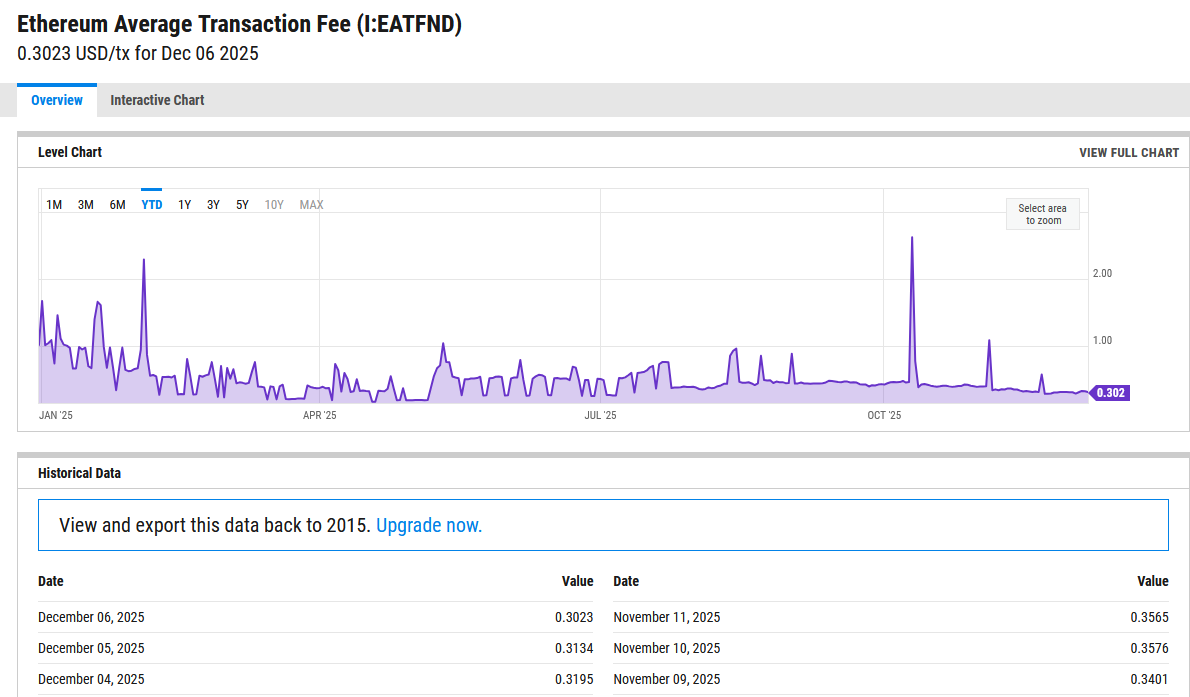
Vitalik Buterin Proposes Onchain Gas Futures to Stabilize Ethereum FeesSource: YCharts ]]>
Disclaimer: The articles reposted on this site are sourced from public platforms and are provided for informational purposes only. They do not necessarily reflect the views of MEXC. All rights remain with the original authors. If you believe any content infringes on third-party rights, please contact service@support.mexc.com for removal. MEXC makes no guarantees regarding the accuracy, completeness, or timeliness of the content and is not responsible for any actions taken based on the information provided. The content does not constitute financial, legal, or other professional advice, nor should it be considered a recommendation or endorsement by MEXC.

You May Also Like

What Every Platform Eventually Learns About Handling User Payments Across Borders

What Every Platform Eventually Learns About Handling User Payments Across Borders

There is a moment almost every global platform hits. It rarely shows up in dashboards or board meetings. It reveals itself quietly, one payout del
Share
Medium2025/12/10 21:54
U.S. AI leaders form foundation to compete with China

U.S. AI leaders form foundation to compete with China

The post U.S. AI leaders form foundation to compete with China appeared on BitcoinEthereumNews.com. A group of leading U.S. artificial intelligence firms has formed a new foundation to establish open standards for “agentic” AI. The founding members, OpenAI, Anthropic, and Block, have pooled their proprietary agent- and AI-related technologies into a new open-source project called the Agentic AI Foundation (AAIF), under the auspices of the Linux Foundation. This development follows tensions in the global race for dominance in artificial intelligence, leading U.S. AI firms and policymakers to unite around a new push to preserve American primacy. Open standards like MCP drive innovation and cross-platform collaboration Cloudflare CTO Dane Knecht noted that open standards and protocols, such as MCP, are critical for establishing an evolving developer ecosystem for building agents. He added, “They ensure anyone can build agents across platforms without the fear of vendor lock-in.” American companies face a dilemma because they are seeking continuous income from closed APIs, even as they are falling behind in fundamental AI development, risking long-term irrelevance to China. And that means American companies must standardize their approach for MCP and agentic AI, allowing them to focus on building better models rather than being locked into an ecosystem. The foundation establishes both a practical partnership and a milestone for community open-sourcing, with adversaries uniting around a single goal of standardization rather than fragmentation. It also makes open-source development easier and more accessible for users worldwide, including those in China. Anthropic donated its Model Context Protocol (MCP), a library that allows AIs to utilize tools creatively outside API calls, to the Linux Foundation. Since its introduction a year ago, MCP has gained traction, with over 10,000 active servers, best-in-class support from platforms including ChatGPT, Gemini, Microsoft Copilot, and VS Code, as well as 97 million monthly SDK downloads. “Open-source software is key to creating a world with secure and innovative AI tools for…
Share
BitcoinEthereumNews2025/12/10 22:10