Crypto markets are stabilizing after the Federal Reserve’s latest rate cut, with traders reassessing how a more data-dependent policy path may influence liquidityCrypto markets are stabilizing after the Federal Reserve’s latest rate cut, with traders reassessing how a more data-dependent policy path may influence liquidity

BTC Recalibrates After Fed Cut as AI Correlation Deepens, Says Nansen

3 min read

Crypto markets are stabilizing after the Federal Reserve’s latest rate cut, with traders reassessing how a more data-dependent policy path may influence liquidity conditions heading into early 2026.

According to a new note from on-chain analytics firm Nansen, the combination of revised forward guidance, fresh liquidity tools, and shifting cross-asset dynamics has created a more complex environment for digital assets.

Earlier today, Bitcoin briefly rallied above $92,000 before retreating, mirroring broader volatility across risk markets following the Federal Open Market Committee (FOMC) meeting.

Aurelie Barthere, Principal Research Analyst at Nansen, said markets were braced for a rate cut paired with hawkish messaging but instead received a cut accompanied by “uncertain, data-dependent” guidance. The Fed’s introduction of T-bill purchases and removal of the cap on the standing repo facility added to the perception of a potential liquidity boost in the first quarter of 2026.

AI Stocks Drive BTC’s Latest Pullback

Bitcoin’s post-FOMC dip occurred alongside sharp moves in large U.S. AI names following Oracle’s earnings release. Barthere notes that while the AI sector continues to post strong earnings and capex growth, valuations have climbed to levels that are increasingly difficult to justify as 2026 approaches.

She added that BTC has shown rising correlation with AI-themed equities—a relationship she expects to persist. “I expect that relationship to continue until we see a more meaningful sell-off that fully ‘cleans’ valuations in the sector,” she said. As long as AI stocks react sharply to earnings surprises or guidance revisions, BTC is likely to echo those swings.

Key Resistance at $91K as Positioning Stays Stretched

From a technical and market-structure perspective, Barthere emphasized $91,000 as the dominant resistance level for BTC. Sustained trading above that mark for several weeks would be needed to confirm a renewed uptrend.
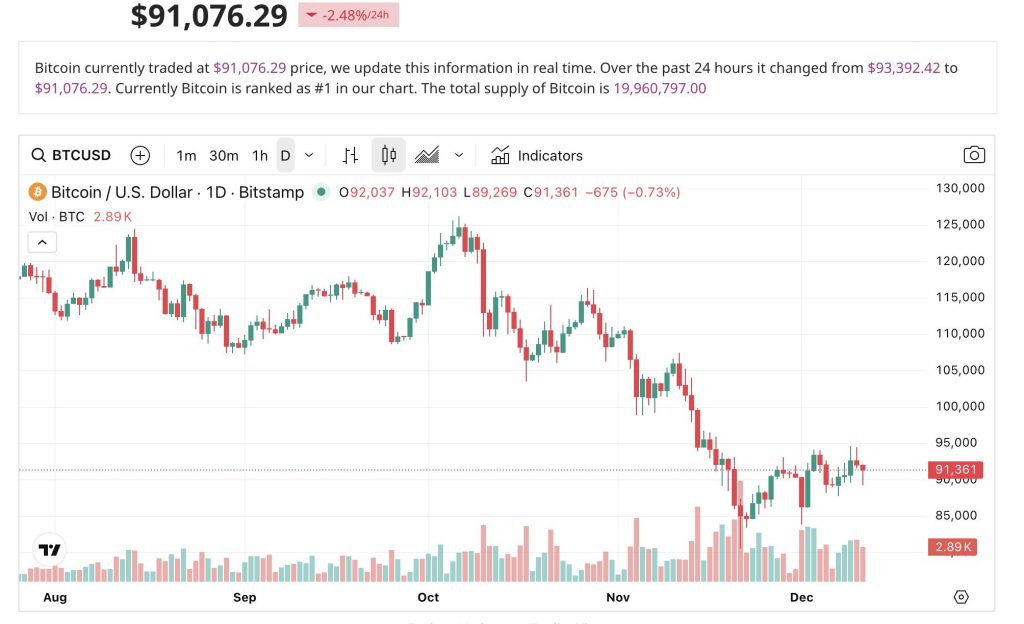
However, the derivatives markets are showing stretched positioning with open interest in both futures and options at record highs. Elevated leverage increases the risk of abrupt moves if sentiment shifts or liquidity thins.

Heading into year-end, traders are holding considerable downside protection. Options imply a 48% probability that BTC reclaims $91,000, and futures funding rates remain only mildly positive, suggesting leveraged longs are not aggressively dominating.

2026 Outlook: Bullish Options, Risk of Disappointment

Looking further ahead, Nansen notes that options markets are structurally bullish for 2026, reflecting expectations for improved liquidity, macro stability, and continued institutional inflows.

However, Barthere cautioned that such positioning could prove vulnerable if economic data or earnings trends fail to meet optimistic assumptions. With markets recalibrating, traders will be watching how liquidity dynamics evolve and whether BTC can break cleanly above resistance to regain upward momentum.

In September, Nansen announced the launch of Nansen AI, a mobile agent designed to transform how investors and traders interact with blockchain data.

Market Opportunity
Bitcoin Logo
Bitcoin Price(BTC)
$66,312
$66,312$66,312
-1.75%
USD
Bitcoin (BTC) Live Price Chart
Disclaimer: The articles reposted on this site are sourced from public platforms and are provided for informational purposes only. They do not necessarily reflect the views of MEXC. All rights remain with the original authors. If you believe any content infringes on third-party rights, please contact service@support.mexc.com for removal. MEXC makes no guarantees regarding the accuracy, completeness, or timeliness of the content and is not responsible for any actions taken based on the information provided. The content does not constitute financial, legal, or other professional advice, nor should it be considered a recommendation or endorsement by MEXC.

You May Also Like

eurosecurity.net Expands Cryptocurrency Asset Recovery Capabilities Amid Rising Investor Losses

eurosecurity.net Expands Cryptocurrency Asset Recovery Capabilities Amid Rising Investor Losses

New York, NY/ GlobePRWire / Feb 6, 2026 – eurosecurity.net announces the expansion of its cryptocurrency asset recovery services, reflecting increased demand from
Share
CryptoReporter2026/02/06 17:24
Ethereum to boost scalability and roll out Fusaka upgrade on Dec 3

Ethereum to boost scalability and roll out Fusaka upgrade on Dec 3

Ethereum's Fusaka update may happen on December 3, based on the date set in the latest developer call.
Share
Cryptopolitan2025/09/19 17:00
Google Cloud taps EigenLayer to bring trust to agentic payments

Google Cloud taps EigenLayer to bring trust to agentic payments

The post Google Cloud taps EigenLayer to bring trust to agentic payments appeared on BitcoinEthereumNews.com. Two days after unveiling AP2 — a universal payment layer for AI agents that supports everything from credit cards to stablecoins — Google and EigenLayer have released details of their partnership to bring verifiability and restaking security to the stack, using Ethereum. In addition to enabling verifiable compute and slashing-backed payment coordination, EigenCloud will support insured and sovereign AI agents, which introduce consequences for failure or deviation from specified behavior. Sovereign agents are positioned as autonomous actors that can own property, make decisions, and execute actions independently — think smart contracts with embedded intelligence. From demos to dollars AP2 extends Google’s agent-to-agent (A2A) protocol using the HTTP 402 status code — long reserved for “payment required” — to standardize payment requests between agents across different networks. It already supports stablecoins like USDC, and Coinbase has demoed an agent checkout using its Wallet-as-a-Service. Paired with a system like Lit Protocol’s Vincent — which enforces per-action policies and key custody at signing — Google’s AP2 with EigenCloud’s verifiability and cross-chain settlement could form an end-to-end trust loop. Payments between agents aren’t as simple as they are often made to sound by “Crypto x AI” LARPs. When an AI agent requests a payment in USDC on Base and the payer’s funds are locked in ETH on Arbitrum, the transaction stalls — unless something abstracts the bridging, swapping and delivery. That’s where EigenCloud comes in. Sreeram Kannan, founder of EigenLayer, said the integration will create agents that not only run on-chain verifiable compute, but are also economically incentivized to behave within programmable bounds. Through restaked operators, EigenCloud powers a verifiable payment service that handles asset routing and chain abstraction, with dishonest behavior subject to slashing. It also introduces cryptographic accountability to the agents themselves, enabling proofs that an agent actually executed the task it…
Share
BitcoinEthereumNews2025/09/19 03:52