This article was first published on The Bit Journal. Hyperliquid valuation has quietly become one of the most serious debates in crypto finance. What started asThis article was first published on The Bit Journal. Hyperliquid valuation has quietly become one of the most serious debates in crypto finance. What started as

Hyperliquid Valuation Is Drawing Comparisons to Solana: Here is Why

This article was first published on The Bit Journal.

Hyperliquid valuation has quietly become one of the most serious debates in crypto finance. What started as a decentralized trading protocol is now being discussed in the same breath as large financial infrastructure platforms. That shift alone says something important about where the market may be heading next.

The discussion gained momentum after a major institutional research report framed Hyperliquid as infrastructure rather than speculative DeFi. According to the source, the protocol’s fee design, validator economics, and capital flows resemble those of a platform business more than those of a typical token project. That framing has caught the attention of analysts who usually avoid DeFi narratives.

A DeFi Platform Built Around Real Usage

The Hyperliquid DeFi ecosystem stands out because it earns revenue the old-fashioned way. It charges fees on real trades. CoinMarketCap data shows that crypto perpetual futures reached $60 trillion in total volume in 2025. Most of that activity still flows through centralized exchanges.

Hyperliquid targets the existing market instead of chasing new demand. That matters. History shows platforms grow faster when they pull users from established venues. One well-cited market study notes that “liquidity follows execution quality, not incentives.” That idea sits at the heart of Hyperliquid’s strategy.
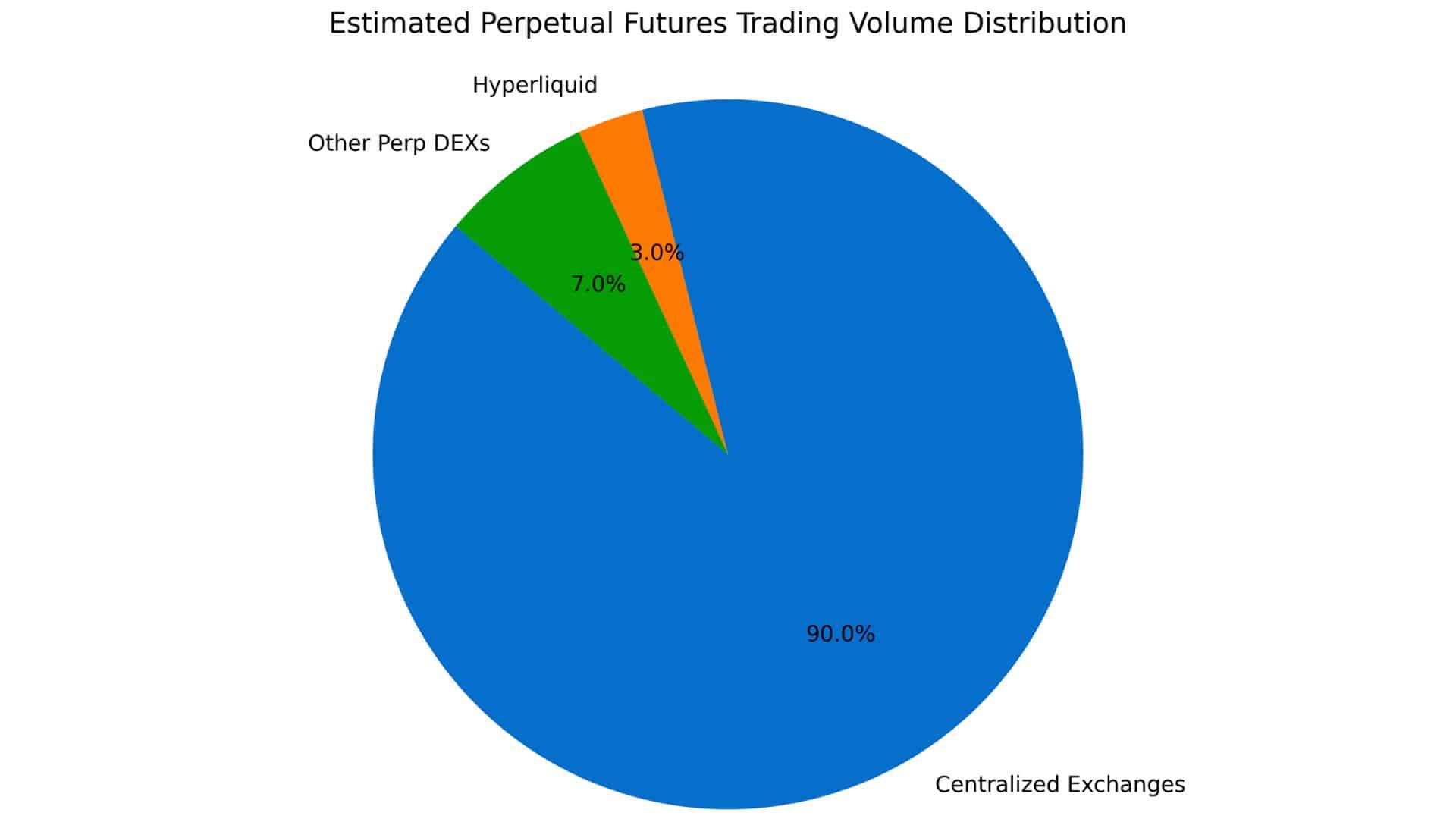
Hyperliquid DeFiCEXs Still Dominate Perp Trading as Hyperliquid Emerges

Why Hyperliquid Valuation Keeps Getting Compared to Solana

The Hyperliquid valuation debate often circles back to Solana’s last major cycle. Early Solana investors focused on speed and throughput. Over time, the conversation shifted toward cash flow, developer stickiness, and settlement value.

A similar change is now happening with Hyperliquid DeFi. Instead of emissions, nearly all protocol revenue is allocated to token buybacks. That means growth reduces supply. Analysts view this structure as closer to traditional equity logic than typical DeFi reward models.

Fees That Change the Long-Term Equation

The fee model sits at the center of the Hyperliquid valuation thesis. When trading volume rises, buybacks increase. This creates a clear link between usage and value. Financial studies on market design suggest buyback-driven systems tend to attract longer-term capital because they reduce dilution risk.

CoinMarketCap figures show that even modest gains in market share from centralized exchanges could generate hundreds of millions in annual fees. That scale explains why institutional desks now take the model seriously.

Competition Exists, but Liquidity Has Memory

Rival platforms have challenged Hyperliquid, including incentive-heavy derivatives exchanges. Some briefly posted higher monthly volume. Analysts noticed unusually high volume-to-open-interest ratios. That often signals reward-driven activity rather than conviction trading.

As incentives fade, traders usually return to platforms with deeper liquidity and tighter spreads. Research on exchange competition shows this pattern repeating across markets. That behavior continues to support the Hyperliquid DeFi growth outlook.

A Valuation Model Still Under Debate

A 50x multiple remains controversial. Critics question whether a leverage-driven trading network deserves infrastructure-style pricing. Supporters argue that decentralized trading systems with sustainable fees should be analyzed using the same analytical framework as payment rails.

This tension now defines the Hyperliquid valuation conversation. It is no longer about hype cycles. It is about whether decentralized finance can produce durable, predictable revenue.

Conclusion: A Signal Bigger Than One Protocol

The real story behind Hyperliquid valuation goes beyond price targets. It signals how markets may value DeFi platforms in the future. If fee-based models continue to outperform incentive-driven systems, Hyperliquid DeFi could become a reference point for future projects. That shift would reshape how crypto infrastructure is built and priced.

Glossary of Key Terms

Perpetual Futures: Derivatives with no expiration date.

Token Buyback: Using revenue to reduce circulating supply.

Open Interest: Total active derivative positions.

DeFi Infrastructure: Blockchain systems supporting financial activity.

FAQs About Hyperliquid Valuation

1. What is Hyperliquid?

A decentralized perpetual futures trading platform.

2. Why is Hyperliquid valuation important?

It reflects a shift toward infrastructure-style pricing in DeFi.

3. Is Hyperliquid DeFi profitable?

It generates real trading fees linked to usage.

4. How can readers track Hyperliquid’s market performance?

Price data, volume trends, and market rankings can be followed through regularly updated listings on CoinMarketCap.

Sources & References

Coinmarketcap

Bisorg

Cfainstitute

Read More: Hyperliquid Valuation Is Drawing Comparisons to Solana: Here is Why">Hyperliquid Valuation Is Drawing Comparisons to Solana: Here is Why

Market Opportunity
WHY Logo
WHY Price(WHY)
$0.00000001515
$0.00000001515$0.00000001515
-0.19%
USD
WHY (WHY) Live Price Chart
Disclaimer: The articles reposted on this site are sourced from public platforms and are provided for informational purposes only. They do not necessarily reflect the views of MEXC. All rights remain with the original authors. If you believe any content infringes on third-party rights, please contact service@support.mexc.com for removal. MEXC makes no guarantees regarding the accuracy, completeness, or timeliness of the content and is not responsible for any actions taken based on the information provided. The content does not constitute financial, legal, or other professional advice, nor should it be considered a recommendation or endorsement by MEXC.

You May Also Like

U.S. Court Finds Pastor Found Guilty in $3M Crypto Scam

U.S. Court Finds Pastor Found Guilty in $3M Crypto Scam

The post U.S. Court Finds Pastor Found Guilty in $3M Crypto Scam appeared on BitcoinEthereumNews.com. Crime 18 September 2025 | 04:05 A Colorado judge has brought closure to one of the state’s most unusual cryptocurrency scandals, declaring INDXcoin to be a fraudulent operation and ordering its founders, Denver pastor Eli Regalado and his wife Kaitlyn, to repay $3.34 million. The ruling, issued by District Court Judge Heidi L. Kutcher, came nearly two years after the couple persuaded hundreds of people to invest in their token, promising safety and abundance through a Christian-branded platform called the Kingdom Wealth Exchange. The scheme ran between June 2022 and April 2023 and drew in more than 300 participants, many of them members of local church networks. Marketing materials portrayed INDXcoin as a low-risk gateway to prosperity, yet the project unraveled almost immediately. The exchange itself collapsed within 24 hours of launch, wiping out investors’ money. Despite this failure—and despite an auditor’s damning review that gave the system a “0 out of 10” for security—the Regalados kept presenting it as a solid opportunity. Colorado regulators argued that the couple’s faith-based appeal was central to the fraud. Securities Commissioner Tung Chan said the Regalados “dressed an old scam in new technology” and used their standing within the Christian community to convince people who had little knowledge of crypto. For him, the case illustrates how modern digital assets can be exploited to replicate classic Ponzi-style tactics under a different name. Court filings revealed where much of the money ended up: luxury goods, vacations, jewelry, a Range Rover, high-end clothing, and even dental procedures. In a video that drew worldwide attention earlier this year, Eli Regalado admitted the funds had been spent, explaining that a portion went to taxes while the remainder was used for a home renovation he claimed was divinely inspired. The judgment not only confirms that INDXcoin qualifies as a…
Share
BitcoinEthereumNews2025/09/18 09:14
MSCI’s Proposal May Trigger $15B Crypto Outflows

MSCI’s Proposal May Trigger $15B Crypto Outflows

MSCI's plan to exclude crypto-treasury companies could cause $15B outflows, impacting major firms.
Share
CoinLive2025/12/19 13:17
This U.S. politician’s suspicious stock trade just returned over 200% in weeks

This U.S. politician’s suspicious stock trade just returned over 200% in weeks

The post This U.S. politician’s suspicious stock trade just returned over 200% in weeks appeared on BitcoinEthereumNews.com. United States Representative Cloe Fields has seen his stake in Opendoor Technologies (NASDAQ: OPEN) stock return over 200% in just a matter of weeks. According to congressional trade filings, the lawmaker purchased a stake in the online real estate company on July 21, 2025, investing between $1,001 and $15,000. At the time, the stock was trading around $2 and had been largely stagnant for months. Receive Signals on US Congress Members’ Stock Trades Stocks Stay up-to-date on the trading activity of US Congress members. The signal triggers based on updates from the House disclosure reports, notifying you of their latest stock transactions. Enable signal The trade has since paid off, with Opendoor surging to $10, a gain of nearly 220% in under two months. By comparison, the broader S&P 500 index rose less than 5% during the same period. OPEN one-week stock price chart. Source: Finbold Assuming he invested a minimum of $1,001, the purchase would now be worth about $3,200, while a $15,000 stake would have grown to nearly $48,000, generating profits of roughly $2,200 and $33,000, respectively. OPEN’s stock rally Notably, Opendoor’s rally has been fueled by major corporate shifts and market speculation. For instance, in August, the company named former Shopify COO Kaz Nejatian as CEO, while co-founders Keith Rabois and Eric Wu rejoined the board, moves seen as a return to the company’s early innovative spirit.  Outgoing CEO Carrie Wheeler’s resignation and sale of millions in stock reinforced the sense of a new chapter. Beyond leadership changes, Opendoor’s surge has taken on meme-stock characteristics. In this case, retail investors piled in as shares climbed, while short sellers scrambled to cover, pushing prices higher.  However, the stock is still not without challenges, where its iBuying model is untested at scale, margins are thin, and debt tied to…
Share
BitcoinEthereumNews2025/09/18 04:02
