A long-dormant Shiba Inu wallet that on-chain watchers have tracked since the meme coin’s early days just pinged the market again — this time by sending a chunkyA long-dormant Shiba Inu wallet that on-chain watchers have tracked since the meme coin’s early days just pinged the market again — this time by sending a chunky

Shiba Inu Whale With 16.4% Of Total Supply Breaks Multi-Year Silence

A long-dormant Shiba Inu wallet that on-chain watchers have tracked since the meme coin’s early days just pinged the market again — this time by sending a chunky clip of SHIB to an exchange.

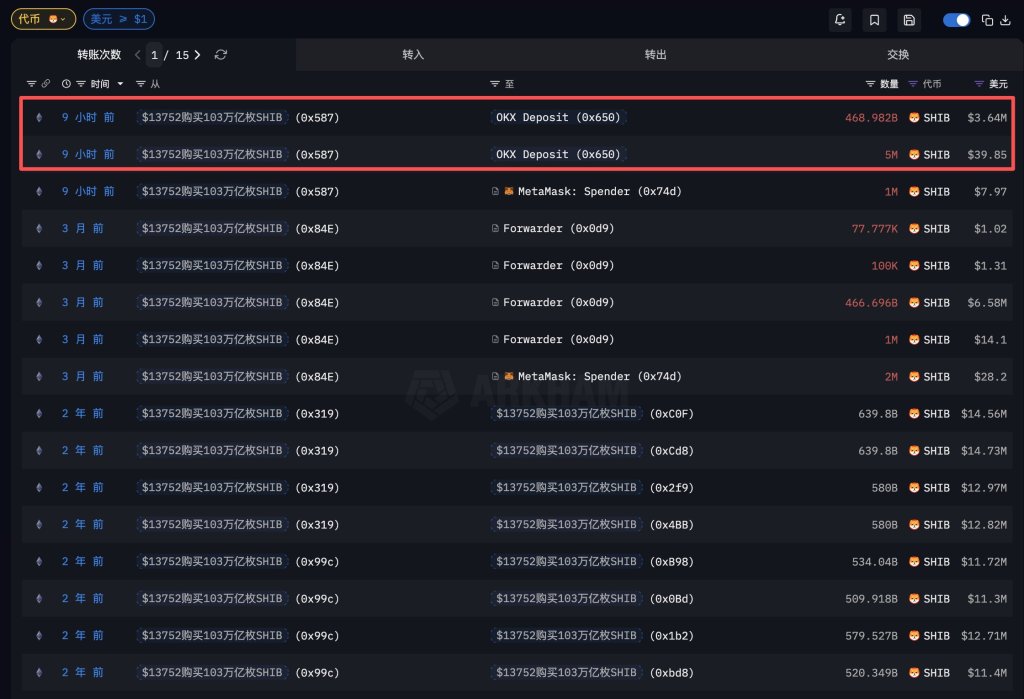
According to posts from on-chain analyst 余烬 (@EmberCN), the address moved roughly 469 billion SHIB (about $3.64 million) into OKX roughly nine hours before the post hit X on Dec. 18, 2025.
Shiba Inu top whale

Mega Whale Stuns Shiba Inu Community

In 2020, the “top whale” who bought 1.03 trillion $SHIB (17.4% of the total supply) using only 37.8 ETH ($13.7K), transferred 469 billion SHIB ($3.64 million) into #OKX 9 hours ago,” EmberCN wrote.

That “top whale” label is doing a lot of work here. The wallet is known for an almost absurd entry: buying roughly 103 trillion SHIB back in 2020 for just 37.8 ETH. Then the 2021 mania happened. At the cycle peak, that stake would have been worth around $9.1 billion. And the whale, famously, didn’t cash most of it.

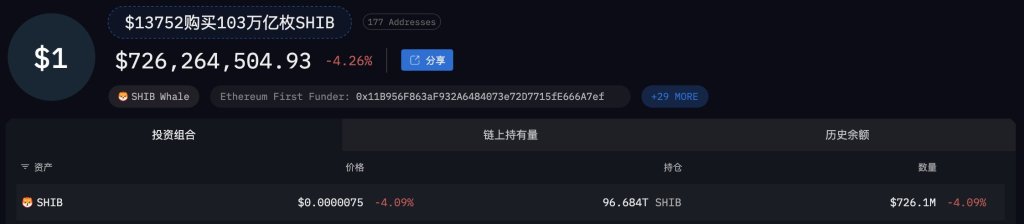
EmberCN says the address still controls about 96.684 trillion SHIB, or roughly 16.4% of total supply, valued around $722–$726 million depending on the price snapshot used. “At the 2021 price peak, his 1.03 trillion SHIB was worth $9.1 billion. He has not sold the vast majority of these coins yet, and currently still holds up to 96.684 trillion SHIB (16.4% of the total supply), worth $726 million,” @EmberCN explained.
Shiba Inu top whale

The reason traders care about “to OKX” is obvious: deposits to exchanges can be a prelude to selling, collateralizing, or rotating into something else. Still, a deposit is not a sale. Overall, it’s unclear whether the SHIB has been dumped yet.

Zoom out and it’s not the first time the wallet has stirred. EmberCN previously flagged activity in July 2023, describing transfers of 1.5 trillion SHIB split across three addresses (500 billion each) after a long dormant stretch.

On July 12, already alerted the Shiba Inu community when he posted: “After being dormant for 610 days, he made another move: 4 hours ago, he transferred 1.5 trillion SHIB to 3 addresses, with 500 billion SHIB ($3.75M) to each address. He bought 1.03 quadrillion $SHIB, and only sold 1.9 trillion SHIB ($18.79M) in 2021 at a price of 0.0000098. The remaining 1.01 quadrillion (17.2% of the total SHIB supply) is distributed across 17 addresses and held to this day, with a current total value of $760 million.”

So, is this “the” sell signal? Maybe. Maybe not. But when an entity sitting on 16.4% of supply starts routing size toward an exchange again, the market tends to stop scrolling.

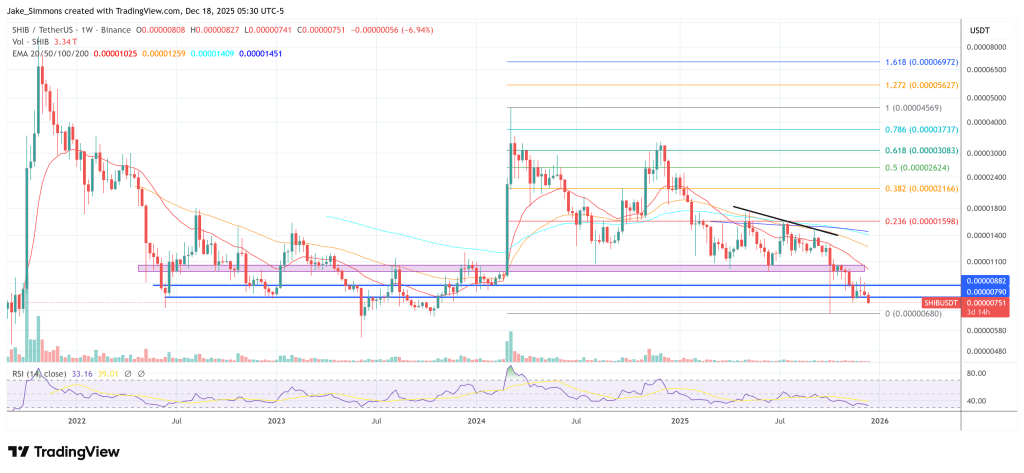
At press time, SHIB was down 3.9% over the past 24 hours, more or less tracking the broader market wide pullback in the same window. On the chart, it’s not pretty: the current weekly candle has broken below a key support zone around $0.00000790.

That puts the Oct. 10 low at $0.00000680 back in play as the next obvious downside check. If that level gives way, traders will likely start eyeing the June 2023 low near $0.00000543 as the next major reference point.
Shiba Inu price chart
Market Opportunity
BitShiba Logo
BitShiba Price(SHIBA)
$0.0000000003927
$0.0000000003927$0.0000000003927
-3.77%
USD
BitShiba (SHIBA) Live Price Chart
Disclaimer: The articles reposted on this site are sourced from public platforms and are provided for informational purposes only. They do not necessarily reflect the views of MEXC. All rights remain with the original authors. If you believe any content infringes on third-party rights, please contact service@support.mexc.com for removal. MEXC makes no guarantees regarding the accuracy, completeness, or timeliness of the content and is not responsible for any actions taken based on the information provided. The content does not constitute financial, legal, or other professional advice, nor should it be considered a recommendation or endorsement by MEXC.

You May Also Like

Cashing In On University Patents Means Giving Up On Our Innovation Future

Cashing In On University Patents Means Giving Up On Our Innovation Future

The post Cashing In On University Patents Means Giving Up On Our Innovation Future appeared on BitcoinEthereumNews.com. “It’s a raid on American innovation that would deliver pennies to the Treasury while kneecapping the very engine of our economic and medical progress,” writes Pipes. Getty Images Washington is addicted to taxing success. Now, Commerce Secretary Howard Lutnick is floating a plan to skim half the patent earnings from inventions developed at universities with federal funding. It’s being sold as a way to shore up programs like Social Security. In reality, it’s a raid on American innovation that would deliver pennies to the Treasury while kneecapping the very engine of our economic and medical progress. Yes, taxpayer dollars support early-stage research. But the real payoff comes later—in the jobs created, cures discovered, and industries launched when universities and private industry turn those discoveries into real products. By comparison, the sums at stake in patent licensing are trivial. Universities collectively earn only about $3.6 billion annually in patent income—less than the federal government spends on Social Security in a single day. Even confiscating half would barely register against a $6 trillion federal budget. And yet the damage from such a policy would be anything but trivial. The true return on taxpayer investment isn’t in licensing checks sent to Washington, but in the downstream economic activity that federally supported research unleashes. Thanks to the bipartisan Bayh-Dole Act of 1980, universities and private industry have powerful incentives to translate early-stage discoveries into real-world products. Before Bayh-Dole, the government hoarded patents from federally funded research, and fewer than 5% were ever licensed. Once universities could own and license their own inventions, innovation exploded. The result has been one of the best returns on investment in government history. Since 1996, university research has added nearly $2 trillion to U.S. industrial output, supported 6.5 million jobs, and launched more than 19,000 startups. Those companies pay…
Share
BitcoinEthereumNews2025/09/18 03:26
Trump Reviews Candidates to Succeed Fed Chair Powell

Trump Reviews Candidates to Succeed Fed Chair Powell

The post Trump Reviews Candidates to Succeed Fed Chair Powell appeared on BitcoinEthereumNews.com. Key Points: Trump evaluates Fed Chair candidates, considering
Share
BitcoinEthereumNews2025/12/19 08:34
Will XRP Price Increase In September 2025?

Will XRP Price Increase In September 2025?

Ripple XRP is a cryptocurrency that primarily focuses on building a decentralised payments network to facilitate low-cost and cross-border transactions. It’s a native digital currency of the Ripple network, which works as a blockchain called the XRP Ledger (XRPL). It utilised a shared, distributed ledger to track account balances and transactions. What Do XRP Charts Reveal? […]
Share
Tronweekly2025/09/18 00:00