BitcoinWorld Revealing the Coinbase Negative Premium: Why U.S. Institutional Demand is Weakening Have you checked the Coinbase negative premium lately? A criticalBitcoinWorld Revealing the Coinbase Negative Premium: Why U.S. Institutional Demand is Weakening Have you checked the Coinbase negative premium lately? A critical

Revealing the Coinbase Negative Premium: Why U.S. Institutional Demand is Weakening

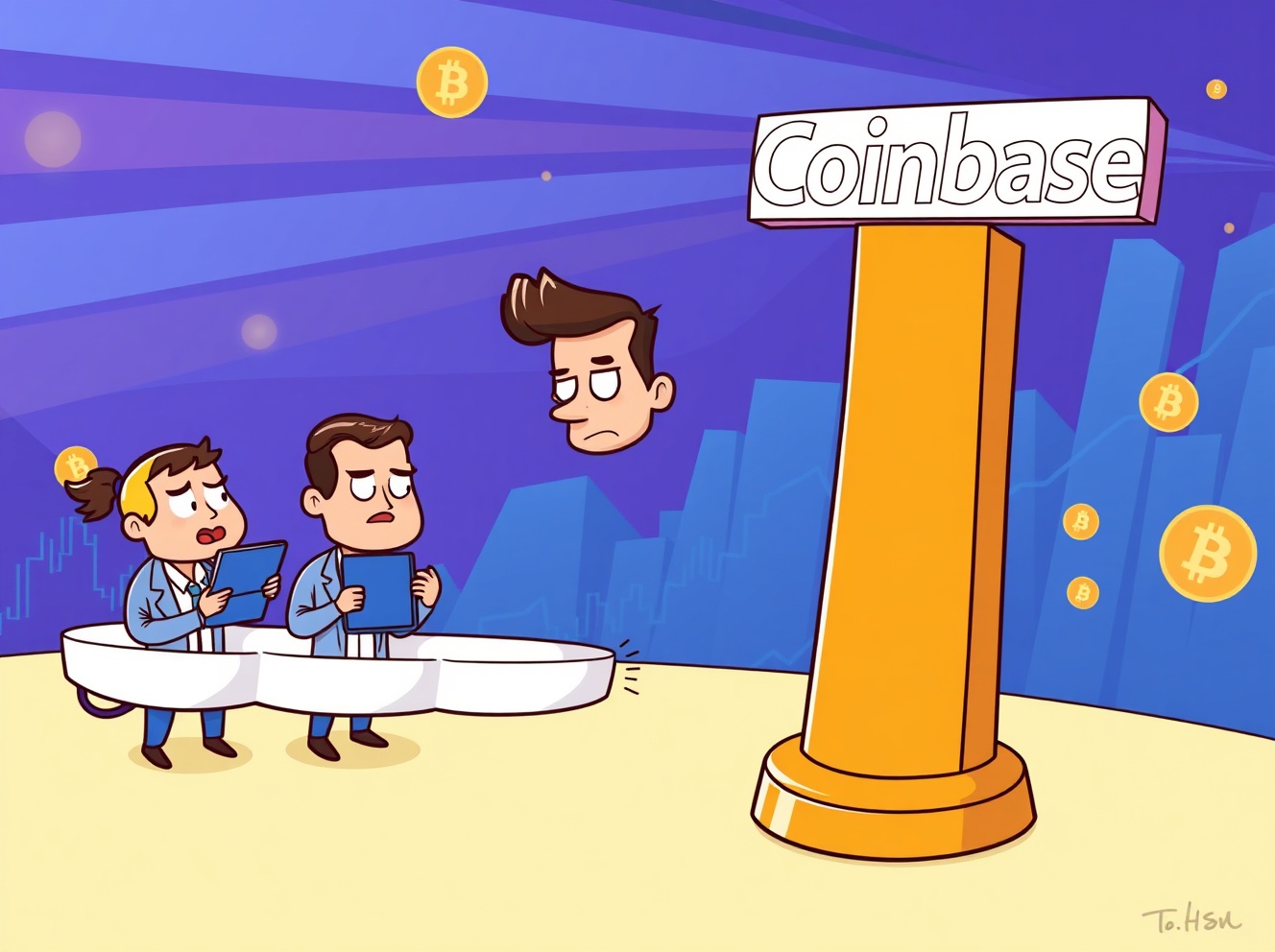
Cartoon illustration of the widening Coinbase negative premium signaling weak institutional Bitcoin demand.

BitcoinWorld

Revealing the Coinbase Negative Premium: Why U.S. Institutional Demand is Weakening

Have you checked the Coinbase negative premium lately? A critical market signal just flashed red, with the premium widening to a concerning -$57. This development reveals weakening appetite from a key player: U.S. institutional investors. Understanding this metric is crucial for anyone tracking Bitcoin’s true momentum.

What Exactly is the Coinbase Negative Premium?

The Coinbase negative premium is a simple but powerful gauge. It measures the price difference for Bitcoin between the U.S.-based Coinbase exchange and major global platforms like Binance. When this number turns negative, it means BTC is trading at a discount on Coinbase. This typically signals that selling pressure from U.S. entities outweighs buying pressure. The recent plunge to -$57, as reported by CryptoQuant, is a significant move that demands our attention.

Why is U.S. Institutional Demand Weakening Now?

This widening Coinbase negative premium doesn’t happen in a vacuum. Analysts point to a perfect storm of factors driving institutional money to the sidelines. Let’s break down the key reasons:

  • Year-End Portfolio Management: Institutions often rebalance and de-risk their holdings as the fiscal year closes.
  • Profit-Taking Activity: After periods of gains, large players secure profits, creating sell-side pressure.
  • Tax-Loss Harvesting and Selling: Strategic selling for tax purposes can increase market supply.
  • Spot BTC ETF Outflows: Recent net outflows from these popular funds directly reduce institutional buying power.

This combination suggests institutions are currently in an exit phase, preferring liquidity over exposure.

What Does This Mean for Bitcoin’s Price Trajectory?

The implications of a sustained Coinbase negative premium are clear for Bitcoin’s near-term path. The analysis concludes that upward momentum will likely remain limited until this premium returns to positive territory. Essentially, the market lacks a major engine for growth without strong, consistent institutional buying from the United States. While retail sentiment or international demand can provide support, a true bullish breakout often requires institutional conviction, which this metric shows is currently absent.

How Can Traders and Investors Use This Insight?

This isn’t just a data point; it’s an actionable signal. The widening Coinbase negative premium serves as a caution flag. For traders, it suggests adopting a more defensive stance or waiting for the premium to stabilize before expecting significant rallies. For long-term investors, it highlights the importance of monitoring institutional flows alongside other fundamentals. Remember, this metric is one piece of the puzzle, but a vital one for gauging professional market sentiment.

The Bottom Line on the Current Market Signal

The message from the -$57 Coinbase negative premium is unambiguous: institutional demand is weak. This creates a headwind for Bitcoin’s price. However, markets are cyclical. Monitoring when this premium narrows or turns positive will be the first sign of institutional money returning. Until then, the market narrative is one of caution and consolidation, driven by a key group stepping back.

Frequently Asked Questions (FAQs)

What is the Coinbase Premium?
The Coinbase Premium is the price difference for a cryptocurrency, like Bitcoin, between the Coinbase Pro exchange (favored by U.S. institutions) and other major global exchanges. A negative premium means it’s cheaper on Coinbase.

Why does a negative premium suggest weak institutional demand?
Coinbase is a primary gateway for U.S. institutional investors. When Bitcoin trades at a discount there, it indicates higher selling pressure from these large players compared to buyers, signaling reduced demand.

Is a negative premium always bad for Bitcoin’s price?
While it often acts as a near-term headwind, it’s not a permanent predictor. It reflects current sentiment. A return to a positive premium is typically needed for sustained upward momentum driven by institutional inflows.

How often does this premium data update?
The premium is calculated in real-time based on live order book data from exchanges. Analytics platforms like CryptoQuant track and report it continuously.

Can retail buying overcome weak institutional demand?
Retail buying can provide support, but institutional capital volumes are typically much larger. Strong, sustained rallies often require participation from both groups.

Where can I track the Coinbase Premium myself?
You can monitor this metric on cryptocurrency data analytics websites such as CryptoQuant, which provide charts and analysis of the exchange premium.

Share This Insight

Did this breakdown of the Coinbase negative premium help you understand the market’s current pulse? If you found this analysis valuable, share it with your network on Twitter, LinkedIn, or your favorite crypto community. Helping others decode complex signals strengthens the entire ecosystem.

To learn more about the latest Bitcoin market trends, explore our article on key developments shaping Bitcoin institutional adoption and price action.

This post Revealing the Coinbase Negative Premium: Why U.S. Institutional Demand is Weakening first appeared on BitcoinWorld.

Market Opportunity
WHY Logo
WHY Price(WHY)
$0.00000001515
$0.00000001515$0.00000001515
0.00%
USD
WHY (WHY) Live Price Chart
Disclaimer: The articles reposted on this site are sourced from public platforms and are provided for informational purposes only. They do not necessarily reflect the views of MEXC. All rights remain with the original authors. If you believe any content infringes on third-party rights, please contact service@support.mexc.com for removal. MEXC makes no guarantees regarding the accuracy, completeness, or timeliness of the content and is not responsible for any actions taken based on the information provided. The content does not constitute financial, legal, or other professional advice, nor should it be considered a recommendation or endorsement by MEXC.

You May Also Like

Huawei goes public with chip ambitions, boosting China’s tech autonomy post-Nvidia

Huawei goes public with chip ambitions, boosting China’s tech autonomy post-Nvidia

The post Huawei goes public with chip ambitions, boosting China’s tech autonomy post-Nvidia appeared on BitcoinEthereumNews.com. Huawei publicly revealed its full chip roadmap on Thursday during its annual Connect conference in Shanghai, confirming it would begin releasing some of the world’s most powerful computing systems in a push to reduce China’s reliance on Nvidia and other foreign chipmakers, according to Reuters. Eric Xu, Huawei’s rotating chairman, disclosed that the company had developed its own high-bandwidth memory, a technology previously led by Samsung and SK Hynix. Xu said, “We will follow a 1-year release cycle and double compute with each release,” making it clear Huawei now intends to release next-gen chips and hardware annually with increased processing capabilities. The announcement came just days before U.S. President Donald Trump and Chinese President Xi Jinping are expected to meet on Friday, following trade talks between both countries earlier in the week. The move is widely seen as an attempt by Beijing to project confidence in its tech ecosystem as U.S.-China tensions continue to grow. Huawei releases full schedule for Ascend, Kunpeng chips, and computing clusters Huawei detailed the timeline for its AI chip series Ascend, starting with the 910C, which was released earlier this year. The Ascend 950 will launch in 2026 with two variants. The 960 will follow in 2027, and the 970 is scheduled for 2028. Huawei also confirmed its Kunpeng server chips will receive updates in 2026 and 2028. China’s chip war with the U.S. escalated this week as Nvidia was accused of violating China’s anti-monopoly law, and several large Chinese tech firms were ordered to cancel Nvidia AI chip orders. Financial Times reported that government regulators had also instructed distributors to stop placing new Nvidia orders. One executive in China’s chip distribution industry said his company was told verbally to stop buying Nvidia chips and was only allowed to sell current inventory. That executive declined…
Share
BitcoinEthereumNews2025/09/18 21:20
Whales keep selling XRP despite ETF success — Data signals deeper weakness

Whales keep selling XRP despite ETF success — Data signals deeper weakness

The post Whales keep selling XRP despite ETF success — Data signals deeper weakness appeared on BitcoinEthereumNews.com. XRP ETFs have crossed $1 billion in assets
Share
BitcoinEthereumNews2025/12/20 02:55
Foreigner’s Lou Gramm Revisits The Band’s Classic ‘4’ Album, Now Reissued

Foreigner’s Lou Gramm Revisits The Band’s Classic ‘4’ Album, Now Reissued

The post Foreigner’s Lou Gramm Revisits The Band’s Classic ‘4’ Album, Now Reissued appeared on BitcoinEthereumNews.com. American-based rock band Foreigner performs onstage at the Rosemont Horizon, Rosemont, Illinois, November 8, 1981. Pictured are, from left, Mick Jones, on guitar, and vocalist Lou Gramm. (Photo by Paul Natkin/Getty Images) Getty Images Singer Lou Gramm has a vivid memory of recording the ballad “Waiting for a Girl Like You” at New York City’s Electric Lady Studio for his band Foreigner more than 40 years ago. Gramm was adding his vocals for the track in the control room on the other side of the glass when he noticed a beautiful woman walking through the door. “She sits on the sofa in front of the board,” he says. “She looked at me while I was singing. And every now and then, she had a little smile on her face. I’m not sure what that was, but it was driving me crazy. “And at the end of the song, when I’m singing the ad-libs and stuff like that, she gets up,” he continues. “She gives me a little smile and walks out of the room. And when the song ended, I would look up every now and then to see where Mick [Jones] and Mutt [Lange] were, and they were pushing buttons and turning knobs. They were not aware that she was even in the room. So when the song ended, I said, ‘Guys, who was that woman who walked in? She was beautiful.’ And they looked at each other, and they went, ‘What are you talking about? We didn’t see anything.’ But you know what? I think they put her up to it. Doesn’t that sound more like them?” “Waiting for a Girl Like You” became a massive hit in 1981 for Foreigner off their album 4, which peaked at number one on the Billboard chart for 10 weeks and…
Share
BitcoinEthereumNews2025/09/18 01:26