Bitcoin exchange-traded funds (ETFs) dominated institutional flows, with a massive $407.78 million in daily net inflows on July 2, bringing cumulative inflows to $49.04 billion . In contrast, Ethereum ETFs faced modest $1.8 million outflows, according to data from SosoValue . The stark difference resulted from Bitcoin’s continued institutional appeal as BTC reached weekly highs of $109,000 on July 2, positioning it for potential breakouts toward $112,000 targets. Source: Cryptonews Fidelity’s FBTC led Bitcoin ETF inflows with $183.96 million , followed by ARK21Shares’ ARKB at $83 million and Bitwise’s BITB contributing $64.94 million . BlackRock’s IBIT, despite recording zero inflows on the day, maintains its dominant position with $76.31 billion in net assets and $52.42 billion in cumulative inflows since launch. Source: SosoValue The performance disparity between Bitcoin and Ethereum ETFs followed the broader market trend, as Bitcoin maintains psychological support above the $100,000 level defended since early May. Total Bitcoin ETF assets under management reached $136.68 billion , representing 6.30% of Bitcoin’s total market capitalization. This indicates a significant level of institutional adoption. Trading volumes also surged to $5.22 billion across Bitcoin ETFs, with IBIT alone generating $4.08 billion in daily trading activity. Institutional Momentum Drives Record Bitcoin ETF Adoption Bitcoin ETF inflows demonstrate sustained institutional conviction, despite broader market volatility, with the latest inflows representing the continuation of aggressive accumulation patterns seen so far in 2025. Particularly, Fidelity’s FBTC leadership, with $183.96 million in inflows, resulted from the growing competition among major asset managers for Bitcoin market share, following BlackRock’s early dominance. The growing competition has led to a broad-based institutional adoption, rather than concentrated buying from a single entity. Interestingly, corporate treasury strategies are increasingly embracing ETF structures over direct ownership of Bitcoin. Design giant, Figma, recently revealed in its IPO filing that it has $69.5 million in Bitcoin ETF holdings , plus $30 million earmarked for future cryptocurrency investments. 🚀 Design giant @figma goes public revealing $70M Bitcoin ETF holdings and $30M ready to buy more as corporate Bitcoin adoption explodes to 141 public companies holding $91 billion. #Figma #IPO #Bitcoin https://t.co/Q9CtjTalum — Cryptonews.com (@cryptonews) July 2, 2025 This pattern is becoming increasingly adopted, and public companies that can’t hold directly prefer regulated exposure through established financial products. Regionally, European expansion is also accelerating through structured products, such as the recent UniCredit’s Bitcoin ETF certificate , designed for Italian professional clients. The five-year instrument offers capital protection with 85% upside participation. Moreover, the regulatory landscape continues to evolve favorably with the SEC’s July 1 guidance streamlining token-based ETF approvals and enabling a 75-day review process. The new guidance establishes clearer pathways for crypto ETF approvals by implementing standardized disclosure frameworks that encompass custody practices, conflicts of interest, and creation and redemption mechanisms. Ethereum ETFs Face Headwinds Despite Previous Momentum Ethereum ETFs experienced modest $1.8 million outflows on July 2, contrasting sharply with their previous dominance, as they had recorded $240.29 million in daily inflows during June , surpassing Bitcoin ETFs’ performance at that time. The June surge represented the strongest performance of Ethereum ETFs in four months, coinciding with ETH climbing above $2,800 for the first time since February. Source: Cryptonews BlackRock’s ETHA led that momentum with $163.6 million in single-day inflows, maintaining a 23-day streak without outflows while managing over 1.55 million ETH valued at $4.23 billion. Current outflows may result from profit-taking following Ethereum’s technical breakout above multi-year descending trendlines. The asset completed an inverse head-and-shoulders pattern with projected targets around $3,300, but recent rejection from $2,834 highs suggests consolidation phases before continued advances. Ethereum staking also reached an all-time high of 34.65 million ETH locked on the Beacon Chain, representing nearly 29% of the circulating supply. Long-term holders are holding on through staking despite short-term ETF flow volatility. They’re prioritizing yield generation over immediate liquidity. Regulatory developments further support the growth of multi-asset crypto ETFs, as seen in Grayscale’s Digital Large Cap Fund conversion , which holds Bitcoin (79.9%), Ethereum (11.3%), and also XRP, Solana, and Cardano. Similarly, the REX Osprey Solana Staking ETF was launched on Wednesday as the first US-listed fund to incorporate crypto staking. This regulatory development could enable similar Ethereum staking products that combine institutional access with yield generation.Bitcoin exchange-traded funds (ETFs) dominated institutional flows, with a massive $407.78 million in daily net inflows on July 2, bringing cumulative inflows to $49.04 billion . In contrast, Ethereum ETFs faced modest $1.8 million outflows, according to data from SosoValue . The stark difference resulted from Bitcoin’s continued institutional appeal as BTC reached weekly highs of $109,000 on July 2, positioning it for potential breakouts toward $112,000 targets. Source: Cryptonews Fidelity’s FBTC led Bitcoin ETF inflows with $183.96 million , followed by ARK21Shares’ ARKB at $83 million and Bitwise’s BITB contributing $64.94 million . BlackRock’s IBIT, despite recording zero inflows on the day, maintains its dominant position with $76.31 billion in net assets and $52.42 billion in cumulative inflows since launch. Source: SosoValue The performance disparity between Bitcoin and Ethereum ETFs followed the broader market trend, as Bitcoin maintains psychological support above the $100,000 level defended since early May. Total Bitcoin ETF assets under management reached $136.68 billion , representing 6.30% of Bitcoin’s total market capitalization. This indicates a significant level of institutional adoption. Trading volumes also surged to $5.22 billion across Bitcoin ETFs, with IBIT alone generating $4.08 billion in daily trading activity. Institutional Momentum Drives Record Bitcoin ETF Adoption Bitcoin ETF inflows demonstrate sustained institutional conviction, despite broader market volatility, with the latest inflows representing the continuation of aggressive accumulation patterns seen so far in 2025. Particularly, Fidelity’s FBTC leadership, with $183.96 million in inflows, resulted from the growing competition among major asset managers for Bitcoin market share, following BlackRock’s early dominance. The growing competition has led to a broad-based institutional adoption, rather than concentrated buying from a single entity. Interestingly, corporate treasury strategies are increasingly embracing ETF structures over direct ownership of Bitcoin. Design giant, Figma, recently revealed in its IPO filing that it has $69.5 million in Bitcoin ETF holdings , plus $30 million earmarked for future cryptocurrency investments. 🚀 Design giant @figma goes public revealing $70M Bitcoin ETF holdings and $30M ready to buy more as corporate Bitcoin adoption explodes to 141 public companies holding $91 billion. #Figma #IPO #Bitcoin https://t.co/Q9CtjTalum — Cryptonews.com (@cryptonews) July 2, 2025 This pattern is becoming increasingly adopted, and public companies that can’t hold directly prefer regulated exposure through established financial products. Regionally, European expansion is also accelerating through structured products, such as the recent UniCredit’s Bitcoin ETF certificate , designed for Italian professional clients. The five-year instrument offers capital protection with 85% upside participation. Moreover, the regulatory landscape continues to evolve favorably with the SEC’s July 1 guidance streamlining token-based ETF approvals and enabling a 75-day review process. The new guidance establishes clearer pathways for crypto ETF approvals by implementing standardized disclosure frameworks that encompass custody practices, conflicts of interest, and creation and redemption mechanisms. Ethereum ETFs Face Headwinds Despite Previous Momentum Ethereum ETFs experienced modest $1.8 million outflows on July 2, contrasting sharply with their previous dominance, as they had recorded $240.29 million in daily inflows during June , surpassing Bitcoin ETFs’ performance at that time. The June surge represented the strongest performance of Ethereum ETFs in four months, coinciding with ETH climbing above $2,800 for the first time since February. Source: Cryptonews BlackRock’s ETHA led that momentum with $163.6 million in single-day inflows, maintaining a 23-day streak without outflows while managing over 1.55 million ETH valued at $4.23 billion. Current outflows may result from profit-taking following Ethereum’s technical breakout above multi-year descending trendlines. The asset completed an inverse head-and-shoulders pattern with projected targets around $3,300, but recent rejection from $2,834 highs suggests consolidation phases before continued advances. Ethereum staking also reached an all-time high of 34.65 million ETH locked on the Beacon Chain, representing nearly 29% of the circulating supply. Long-term holders are holding on through staking despite short-term ETF flow volatility. They’re prioritizing yield generation over immediate liquidity. Regulatory developments further support the growth of multi-asset crypto ETFs, as seen in Grayscale’s Digital Large Cap Fund conversion , which holds Bitcoin (79.9%), Ethereum (11.3%), and also XRP, Solana, and Cardano. Similarly, the REX Osprey Solana Staking ETF was launched on Wednesday as the first US-listed fund to incorporate crypto staking. This regulatory development could enable similar Ethereum staking products that combine institutional access with yield generation.

Bitcoin ETFs Pull $408M—Fidelity & ARK Spark the Next BTC Wave As ETH Struggles

4 min read

Bitcoin exchange-traded funds (ETFs) dominated institutional flows, with a massive $407.78 million in daily net inflows on July 2, bringing cumulative inflows to $49.04 billion.

In contrast, Ethereum ETFs faced modest $1.8 million outflows, according to data from SosoValue.

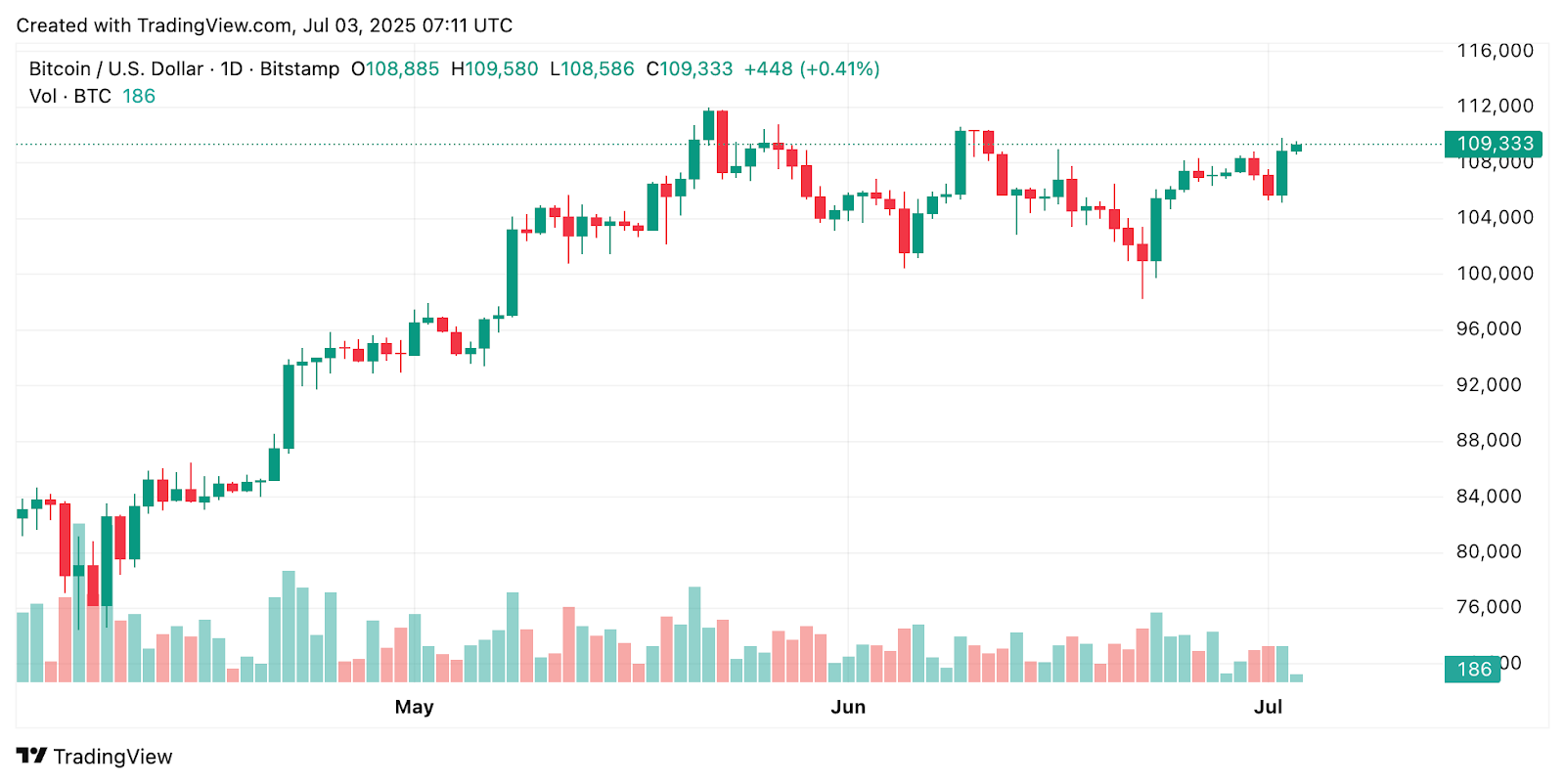
The stark difference resulted from Bitcoin’s continued institutional appeal as BTC reached weekly highs of $109,000 on July 2, positioning it for potential breakouts toward $112,000 targets.
Bitcoin ETFs Explode with $408M Inflows While Ethereum ETFs Struggle with $1.8M OutflowsSource: Cryptonews

Fidelity’s FBTC led Bitcoin ETF inflows with $183.96 million, followed by ARK21Shares’ ARKB at $83 million and Bitwise’s BITB contributing $64.94 million.

BlackRock’s IBIT, despite recording zero inflows on the day, maintains its dominant position with $76.31 billion in net assets and $52.42 billion in cumulative inflows since launch.

Bitcoin ETFs Explode with $408M Inflows While Ethereum ETFs Struggle with $1.8M OutflowsSource: SosoValue

The performance disparity between Bitcoin and Ethereum ETFs followed the broader market trend, as Bitcoin maintains psychological support above the $100,000 level defended since early May.

Total Bitcoin ETF assets under management reached $136.68 billion, representing 6.30% of Bitcoin’s total market capitalization. This indicates a significant level of institutional adoption.

Trading volumes also surged to $5.22 billion across Bitcoin ETFs, with IBIT alone generating $4.08 billion in daily trading activity.

Institutional Momentum Drives Record Bitcoin ETF Adoption

Bitcoin ETF inflows demonstrate sustained institutional conviction, despite broader market volatility, with the latest inflows representing the continuation of aggressive accumulation patterns seen so far in 2025.

Particularly, Fidelity’s FBTC leadership, with $183.96 million in inflows, resulted from the growing competition among major asset managers for Bitcoin market share, following BlackRock’s early dominance.

The growing competition has led to a broad-based institutional adoption, rather than concentrated buying from a single entity.

Interestingly, corporate treasury strategies are increasingly embracing ETF structures over direct ownership of Bitcoin.

Design giant, Figma, recently revealed in its IPO filing that it has $69.5 million in Bitcoin ETF holdings, plus $30 million earmarked for future cryptocurrency investments.

This pattern is becoming increasingly adopted, and public companies that can’t hold directly prefer regulated exposure through established financial products.

Regionally, European expansion is also accelerating through structured products, such as the recent UniCredit’s Bitcoin ETF certificate, designed for Italian professional clients. The five-year instrument offers capital protection with 85% upside participation.

Moreover, the regulatory landscape continues to evolve favorably with the SEC’s July 1 guidance streamlining token-based ETF approvals and enabling a 75-day review process.

The new guidance establishes clearer pathways for crypto ETF approvals by implementing standardized disclosure frameworks that encompass custody practices, conflicts of interest, and creation and redemption mechanisms.

Ethereum ETFs Face Headwinds Despite Previous Momentum

Ethereum ETFs experienced modest $1.8 million outflows on July 2, contrasting sharply with their previous dominance, as they had recorded $240.29 million in daily inflows during June, surpassing Bitcoin ETFs’ performance at that time.

The June surge represented the strongest performance of Ethereum ETFs in four months, coinciding with ETH climbing above $2,800 for the first time since February.

Bitcoin ETFs Explode with $408M Inflows While Ethereum ETFs Struggle with $1.8M OutflowsSource: Cryptonews

BlackRock’s ETHA led that momentum with $163.6 million in single-day inflows, maintaining a 23-day streak without outflows while managing over 1.55 million ETH valued at $4.23 billion.

Current outflows may result from profit-taking following Ethereum’s technical breakout above multi-year descending trendlines.

The asset completed an inverse head-and-shoulders pattern with projected targets around $3,300, but recent rejection from $2,834 highs suggests consolidation phases before continued advances.

Ethereum staking also reached an all-time high of 34.65 million ETH locked on the Beacon Chain, representing nearly 29% of the circulating supply.

Long-term holders are holding on through staking despite short-term ETF flow volatility. They’re prioritizing yield generation over immediate liquidity.

Regulatory developments further support the growth of multi-asset crypto ETFs, as seen in Grayscale’s Digital Large Cap Fund conversion, which holds Bitcoin (79.9%), Ethereum (11.3%), and also XRP, Solana, and Cardano.

Similarly, the REX Osprey Solana Staking ETF was launched on Wednesday as the first US-listed fund to incorporate crypto staking.

This regulatory development could enable similar Ethereum staking products that combine institutional access with yield generation.

Market Opportunity
Threshold Logo
Threshold Price(T)
$0.007671
$0.007671$0.007671
-0.49%
USD
Threshold (T) Live Price Chart
Disclaimer: The articles reposted on this site are sourced from public platforms and are provided for informational purposes only. They do not necessarily reflect the views of MEXC. All rights remain with the original authors. If you believe any content infringes on third-party rights, please contact service@support.mexc.com for removal. MEXC makes no guarantees regarding the accuracy, completeness, or timeliness of the content and is not responsible for any actions taken based on the information provided. The content does not constitute financial, legal, or other professional advice, nor should it be considered a recommendation or endorsement by MEXC.
Tags:

You May Also Like

Is Doge Losing Steam As Traders Choose Pepeto For The Best Crypto Investment?
Is Doge Losing Steam As Traders Choose Pepeto For The Best Crypto Investment?

The post Is Doge Losing Steam As Traders Choose Pepeto For The Best Crypto Investment? appeared on BitcoinEthereumNews.com. Crypto News 17 September 2025 | 17:39 Is dogecoin really fading? As traders hunt the best crypto to buy now and weigh 2025 picks, Dogecoin (DOGE) still owns the meme coin spotlight, yet upside looks capped, today’s Dogecoin price prediction says as much. Attention is shifting to projects that blend culture with real on-chain tools. Buyers searching “best crypto to buy now” want shipped products, audits, and transparent tokenomics. That frames the true matchup: dogecoin vs. Pepeto. Enter Pepeto (PEPETO), an Ethereum-based memecoin with working rails: PepetoSwap, a zero-fee DEX, plus Pepeto Bridge for smooth cross-chain moves. By fusing story with tools people can use now, and speaking directly to crypto presale 2025 demand, Pepeto puts utility, clarity, and distribution in front. In a market where legacy meme coin leaders risk drifting on sentiment, Pepeto’s execution gives it a real seat in the “best crypto to buy now” debate. First, a quick look at why dogecoin may be losing altitude. Dogecoin Price Prediction: Is Doge Really Fading? Remember when dogecoin made crypto feel simple? In 2013, DOGE turned a meme into money and a loose forum into a movement. A decade on, the nonstop momentum has cooled; the backdrop is different, and the market is far more selective. With DOGE circling ~$0.268, the tape reads bearish-to-neutral for the next few weeks: hold the $0.26 shelf on daily closes and expect choppy range-trading toward $0.29–$0.30 where rallies keep stalling; lose $0.26 decisively and momentum often bleeds into $0.245 with risk of a deeper probe toward $0.22–$0.21; reclaim $0.30 on a clean daily close and the downside bias is likely neutralized, opening room for a squeeze into the low-$0.30s. Source: CoinMarketcap / TradingView Beyond the dogecoin price prediction, DOGE still centers on payments and lacks native smart contracts; ZK-proof verification is proposed,…
Share
BitcoinEthereumNews2025/09/18 00:14
XRPL Validator Reveals Why He Just Vetoed New Amendment

XRPL Validator Reveals Why He Just Vetoed New Amendment

Vet has explained that he has decided to veto the Token Escrow amendment to prevent breaking things
Share
Coinstats2025/09/18 00:28
US Senate Democrats plan to restart discussions on a cryptocurrency market structure bill later today.

US Senate Democrats plan to restart discussions on a cryptocurrency market structure bill later today.

PANews reported on February 4th that, according to Crypto In America, US Senate Democrats plan to reconvene on the afternoon of February 4th to discuss legislation
Share
PANews2026/02/04 23:12