IA2 uses the TD3-TD-SWAR model and DRL to optimize index selection, reducing TPC-H workload runtime by 40% via adaptive action masking.IA2 uses the TD3-TD-SWAR model and DRL to optimize index selection, reducing TPC-H workload runtime by 40% via adaptive action masking.

Reducing TPC-H Workload Runtime by 40% with IA2 Deep Reinforcement Learning

Abstract and 1. Introduction

  1. Related Works

    2.1 Traditional Index Selection Approaches

    2.2 RL-based Index Selection Approaches

  2. Index Selection Problem

  3. Methodology

    4.1 Formulation of the DRL Problem

    4.2 Instance-Aware Deep Reinforcement Learning for Efficient Index Selection

  4. System Framework of IA2

    5.1 Preprocessing Phase

    5.2 RL Training and Application Phase

  5. Experiments

    6.1 Experimental Setting

    6.2 Experimental Results

    6.3 End-to-End Performance Comparison

    6.4 Key Insights

  6. Conclusion and Future Work, and References

Abstract

This study introduces the Instance-Aware Index Advisor (IA2), a novel deep reinforcement learning (DRL)-based approach for optimizing index selection in databases facing large action spaces of potential candidates. IA2 introduces the Twin Delayed Deep Deterministic Policy Gradient - Temporal Difference State-Wise Action Refinery (TD3-TD-SWAR) model, enabling efficient index selection by understanding workload-index dependencies and employing adaptive action masking. This method includes a comprehensive workload model, enhancing its ability to adapt to unseen workloads and ensuring robust performance across diverse database environments. Evaluation on benchmarks such as TPCH reveals IA2’s suggested indexes’ performance in enhancing runtime, securing a 40% reduction in runtime for complex TPC-H workloads compared to scenarios without indexes, and delivering a 20% improvement over existing state-of-theart DRL-based index advisors.

1 Introduction

For more than five decades, the pursuit of optimal index selection has been a key focus in database research, leading to significant advancements in index selection methodologies [8]. However, despite these developments, current strategies frequently struggle to provide both high-quality solutions and efficient selection processes [5].

\ The Index Selection Problem (ISP), detailed in Section 3, involves choosing the best subset of index candidates, considering multi-attribute indexes, from a specific workload, dataset, and under given constraints, such as storage capacity or a maximum number of indexes. This task, aimed at enhancing workload performance, is recognized as NP-hard, highlighting the complexities, especially when dealing with multi-attribute indexes, in achieving optimal index configurations [7].

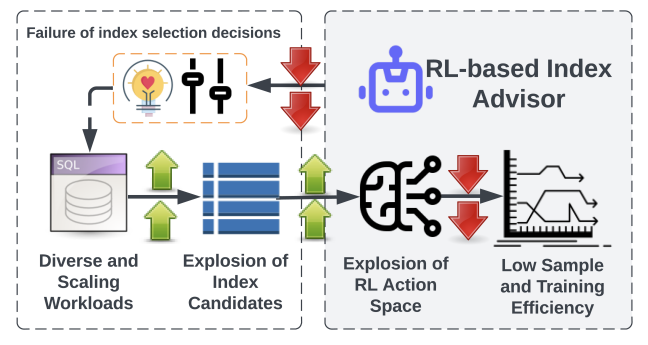
\ Reinforcement Learning (RL) offers a promising solution for navigating the complex decision spaces involved in index selection [6, 7, 10]. Yet, the broad spectrum of index options and the complexity of workload structures complicate the process, leading to prolonged training periods and challenges in achieving optimal configurations. This situation highlights the critical need for advanced solutions adept at efficiently managing the complexities of multi-attribute index selection [6]. Figure 1 illustrates the difficulties encountered with RL in index selection, stemming from the combinatorial complexity and vast action spaces. Our approach improves DRL agent efficiency via adaptive action selection, significantly refining the learning process. This enables rapid identification of advantageous indexes across varied database schemas and workloads, thereby addressing the intricate challenges of database optimization more effectively.

\ Our contributions are threefold: (i) modeling index selection as a reinforcement learning problem, characterized by a thorough system designed to support comprehensive workload representation and implement state-wise action pruning methods, distinguishing our approach from existing literature. (ii) employing TD3-TD-SWAR for efficient training and adaptive action space navigation; (iii) outperforming stateof-the-art methods in selecting optimal index configurations for diverse and even unseen workloads. Evaluated on the TPC-H Benchmark, IA2 demonstrates significant training efficiency, runtime improvements, and adaptability, marking a significant advancement in database optimization for diverse workloads.

\ Figure 1. Unique challenges to RL-based Index Advisors due to diverse and complex workloads
\

:::info This paper is available on arxiv under CC BY-NC-SA 4.0 Deed (Attribution-Noncommercial-Sharelike 4.0 International) license.

:::

\

Market Opportunity
Humanity Logo
Humanity Price(H)
$0.15078
$0.15078$0.15078
-3.85%
USD
Humanity (H) Live Price Chart
Disclaimer: The articles reposted on this site are sourced from public platforms and are provided for informational purposes only. They do not necessarily reflect the views of MEXC. All rights remain with the original authors. If you believe any content infringes on third-party rights, please contact service@support.mexc.com for removal. MEXC makes no guarantees regarding the accuracy, completeness, or timeliness of the content and is not responsible for any actions taken based on the information provided. The content does not constitute financial, legal, or other professional advice, nor should it be considered a recommendation or endorsement by MEXC.

You May Also Like

The Channel Factories We’ve Been Waiting For

The Channel Factories We’ve Been Waiting For

The post The Channel Factories We’ve Been Waiting For appeared on BitcoinEthereumNews.com. Visions of future technology are often prescient about the broad strokes while flubbing the details. The tablets in “2001: A Space Odyssey” do indeed look like iPads, but you never see the astronauts paying for subscriptions or wasting hours on Candy Crush.  Channel factories are one vision that arose early in the history of the Lightning Network to address some challenges that Lightning has faced from the beginning. Despite having grown to become Bitcoin’s most successful layer-2 scaling solution, with instant and low-fee payments, Lightning’s scale is limited by its reliance on payment channels. Although Lightning shifts most transactions off-chain, each payment channel still requires an on-chain transaction to open and (usually) another to close. As adoption grows, pressure on the blockchain grows with it. The need for a more scalable approach to managing channels is clear. Channel factories were supposed to meet this need, but where are they? In 2025, subnetworks are emerging that revive the impetus of channel factories with some new details that vastly increase their potential. They are natively interoperable with Lightning and achieve greater scale by allowing a group of participants to open a shared multisig UTXO and create multiple bilateral channels, which reduces the number of on-chain transactions and improves capital efficiency. Achieving greater scale by reducing complexity, Ark and Spark perform the same function as traditional channel factories with new designs and additional capabilities based on shared UTXOs.  Channel Factories 101 Channel factories have been around since the inception of Lightning. A factory is a multiparty contract where multiple users (not just two, as in a Dryja-Poon channel) cooperatively lock funds in a single multisig UTXO. They can open, close and update channels off-chain without updating the blockchain for each operation. Only when participants leave or the factory dissolves is an on-chain transaction…
Share
BitcoinEthereumNews2025/09/18 00:09
Egypt to invite investors for projects in ‘golden triangle’

Egypt to invite investors for projects in ‘golden triangle’

Egypt is preparing a list of projects to show potential investors in its promising “golden triangle” area, home to nearly half the Arab country’s gold deposits.
Share
Agbi2025/12/25 04:09
OpenVPP accused of falsely advertising cooperation with the US government; SEC commissioner clarifies no involvement

OpenVPP accused of falsely advertising cooperation with the US government; SEC commissioner clarifies no involvement

PANews reported on September 17th that on-chain sleuth ZachXBT tweeted that OpenVPP ( $OVPP ) announced this week that it was collaborating with the US government to advance energy tokenization. SEC Commissioner Hester Peirce subsequently responded, stating that the company does not collaborate with or endorse any private crypto projects. The OpenVPP team subsequently hid the response. Several crypto influencers have participated in promoting the project, and the accounts involved have been questioned as typical influencer accounts.
Share
PANews2025/09/17 23:58