

Zora's coin issuance encountered a wave of negative reviews on the chain: early users were backstabbed, and the average airdrop per user was only $37
Author: Nancy, PANews
After years of "PUA", Zora finally issued a coin, but the community users who had been waiting for a long time did not get the "big result" they wished for. When they opened their wallets, they only saw a "reward" that could not even cover the gas fee, not to mention that the token itself was useless. For a time, the community's emotions were completely "broken", and the on-chain reputation protocol Ethos unexpectedly became an outlet for users to vent their dissatisfaction. Zora's "rollover scene" was also permanently recorded on the chain, becoming a mark of the collapse of trust.
Airdrops "slap" early users in the face, token distribution is accused of betraying the community
Last month, Zora announced that it would soon launch its native token ZORA, raising the expectations of the community that had been waiting for years. On the eve of the token launch, Base officials released a series of tweets to promote Zora , which successfully attracted a lot of attention, and various memes were flying around, and many data soared.
However, this airdrop turned out to be a disappointing "turnaround of the century". On April 23, Zora opened the airdrop application and stated that the airdrop will distribute 1 billion ZORA tokens to 2,415,024 addresses. Among them, most of the airdrop tokens are based on the first snapshot allocation (8:00 on January 1, 2020 to 22:00 on March 3, 2025), and the second snapshot allocation accounts for a smaller proportion (22:00 on March 3, 2025 to 8:00 on April 20, 2025), and covers the Coins activity on Zora's latest protocol. The specific allocation amount is calculated based on the user's activity on Zora and the overall participation in the current protocol and its old versions, including but not limited to minting, casting, trading and recommendation.
At the same time, the token ZORA landed on Binance Alpha, and eligible users will receive 4276 ZORA airdrops. However, the result of this airdrop angered many users who have participated in the Zora ecosystem for a long time. They only received a small amount of tokens, which was not even enough to pay the gas fee.
However, speculators and Binance Alpha users who recently participated in the token distribution easily took away a large number of tokens. This seriously unbalanced distribution method not only aroused widespread anger in the community, but was also considered a betrayal of early supporters. What made the community even more dissatisfied was that the Zora airdrop snapshot was divided into two parts, but the specific distribution criteria had never been made public, and the whole process lacked due transparency.
Not only that, Zora has also aroused strong doubts from the community due to its highly centralized and opaque distribution ratio. According to the token economic model disclosed by ZORA, the community airdrop accounts for only 10%, while the team, treasury and strategic contributors are allocated up to 65%, and it only takes 6 months to unlock the position, and the specific unlocking rhythm is also not clearly stated.
In addition, Zora officially stated that ZORA tokens are just "just for fun" MEME coins, which do not carry any technical or governance functions and are mainly used for community rewards and ecological incentives. This positioning has triggered a series of questions from the community: Since the tokens have no substantive use, why do teams still need to occupy such a high proportion? Why do the community believe that ZORA has long-term value?
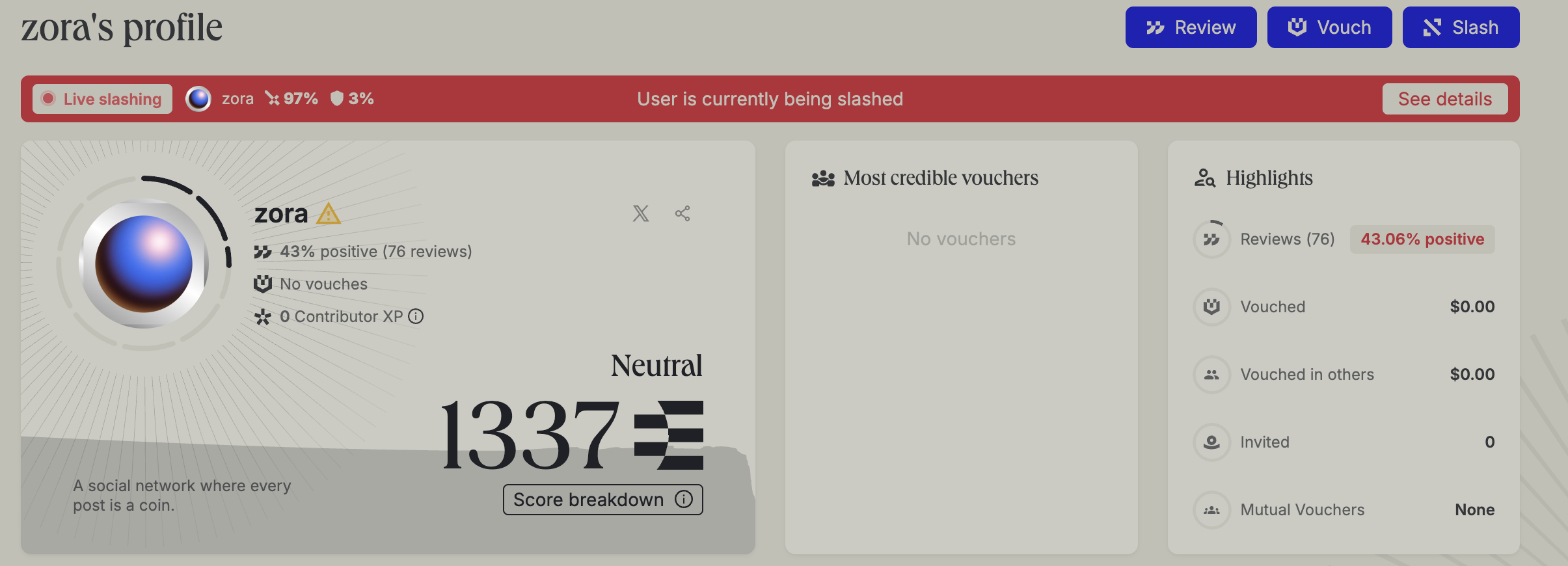
With multiple disappointments, Ethos' negative review function was seen as a channel for venting emotional values. Community users left negative reviews one after another, causing Zora's credibility score to drop rapidly. Many users bluntly said, "The records on the chain cannot be changed, and the evil projects will be recorded in history."
The airdrop progress has reached halfway , and the user collection rate is less than 20%, with an average of only 37 US dollars per person
Judging from the price performance, Binance data showed that ZORA briefly surged to $0.0466 after its launch, and then fell to a low of $0.0172 the next day. The maximum decline was close to 63%, and the market enthusiasm quickly cooled.
Dune data shows that as of press time, more than 514 million tokens have been successfully claimed by users in the ZORA airdrop. Among them, the top 50 addresses have claimed more than 190 million tokens, with an average of about 3.931 million tokens per address. Based on the current price (about $0.0235), the value is about $92,000, accounting for 36.9% of the total number of tokens claimed. This shows that the airdrop distribution is clearly dominated by the top addresses.
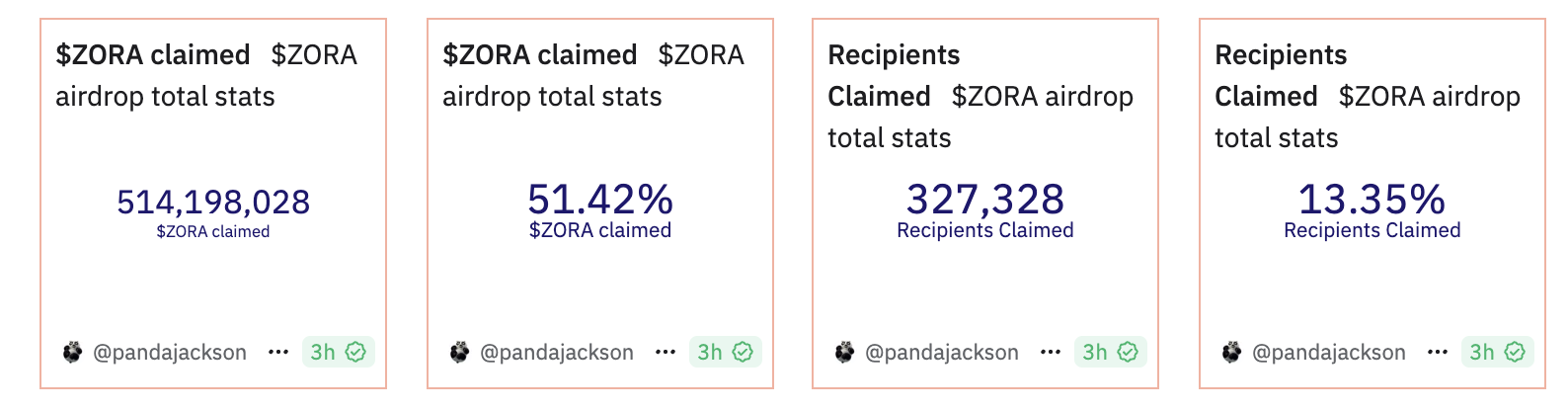
At the same time, from the perspective of the number of participating users, more than 320,000 users have participated in the collection, but each person has only received 1,571.1 ZORA, equivalent to about $37. This sharp contrast highlights the extreme imbalance in the distribution structure - large users have received huge airdrops, while ordinary users have received very limited distribution.
Judging from the progress of the collection, about 51.42% of the total tokens have been collected, but only 13.35% of eligible users have actually completed the collection. This further shows that the proportion of users who actually take the initiative to collect the tokens is very low, and most users prefer to give up collecting the tokens.
User participation has dropped significantly, and the transition to on- chain social networking has caused controversy
Founded in 2020, Zora was initially positioned as an NFT market protocol. Public data shows that the project has received at least $52 million in financing, with investors including Coinbase Ventures, Paradigm, Haun Ventures, etc., with the valuation of the last round of financing reaching $600 million. However, as the NFT market cooled and market competition intensified, Zora gradually evolved into a focus on on-chain social and creator economic ecosystems, including the launch of the "Coins" function, which automatically casts each piece of social content (such as pictures, videos, and text) into an ERC-20 token, and launched its own Layer2 network, Zora Network.
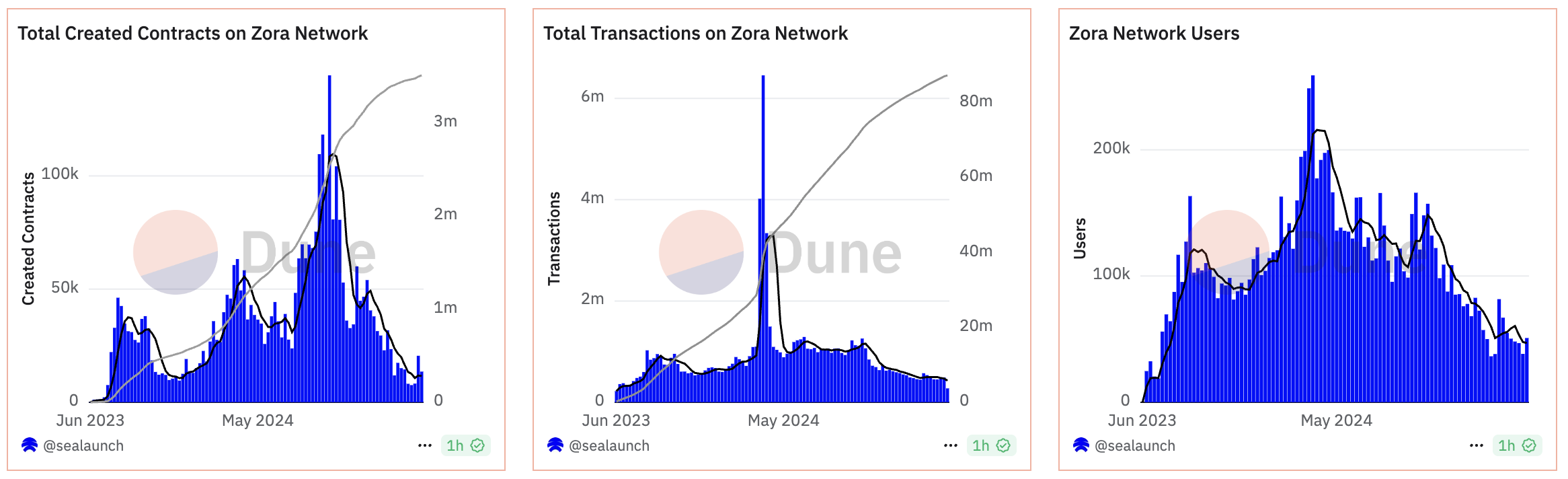
Despite the continuous exploration of new narrative directions, the overall ecological activity of Zora has declined significantly. According to Dune data, as of April 24, the cumulative number of smart contracts created on the Zora network has exceeded 3.51 million, but in terms of the number of daily contract creation, the data has dropped from the early peak of 144,000 to about 13,000, which is less than 10% of the peak; similarly, the cumulative transaction volume of the Zora network has exceeded 87.4 million, but the daily transaction volume has also dropped from the historical high of 3.338 million to the current approximately 428,000; although the total number of active addresses has reached 470,000, compared with the peak of about 259,000 daily active users last year, it is now only 50,900, indicating that user participation has declined.
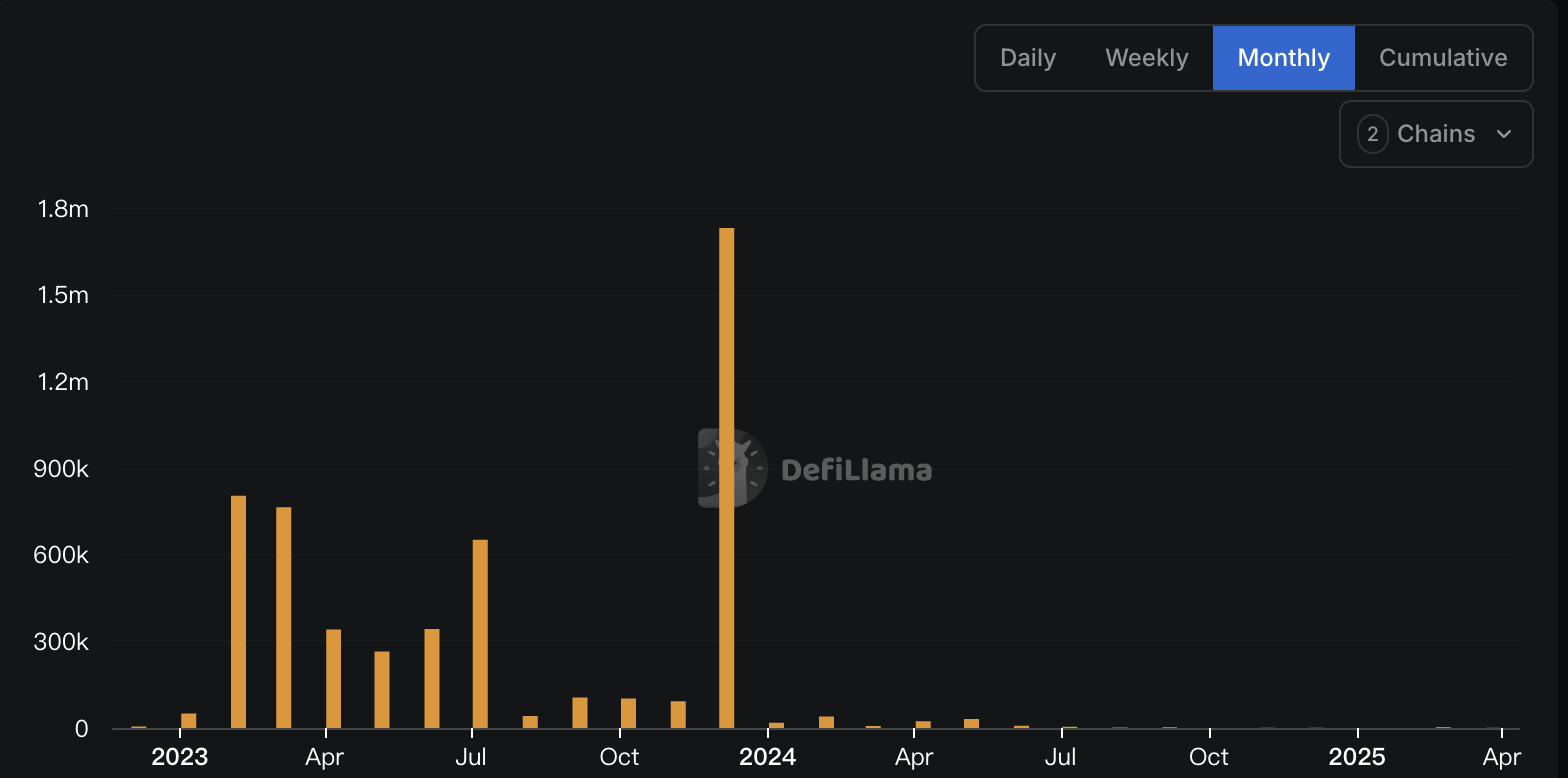
In terms of revenue, DeFiLlama and Dune data show that Zora's cumulative revenue is only 5.4 million US dollars, and Zora Network's profit is only 527.74 ETH. It is also believed by the community that it is far less than the market expectation corresponding to its 600 million US dollars valuation.
In addition, although Zora claims to have brought tens of millions of dollars in revenue to creators, its on-chain experimentalism and tokenized narratives are still controversial. For example, Jesse Pollak, head of the Base protocol, recently praised Zora Coins for a record high in active users, but ZachXBT criticized these tokens as "viral" with a market value of less than $5 million. In response, Jesse admitted that most content is almost worthless, and a few are of great value, but ZachXBT questioned why creators would issue a large number of tokens to dilute the brand. Jesse countered that on-chain creation will not dilute the brand, good content will spread naturally, and the market and algorithms determine its value.
In general, Zora is trying to reshape itself with on-chain social and tokenized narratives, but the inflated valuation and the increasingly cooling ecological activity have already laid the hidden dangers of a trust crisis, and this insincere airdrop may be the last straw that breaks the camel's back for the community's confidence.
You May Also Like

Vitalik Buterin Challenges Ethereum’s Layer 2 Paradigm

USAA Names Dan Griffiths Chief Information Officer to Drive Secure, Simplified Digital Member Experiences
