Ethereum ended the past year as one of the leading blockchain systems and essential global infrastructure. By lowering costs and offering improved technical upgradesEthereum ended the past year as one of the leading blockchain systems and essential global infrastructure. By lowering costs and offering improved technical upgrades

Ethereum 2025 Round Up: How the Network Cemented Its Role as Global Digital Infrastructure

2026/01/10 04:00
4 min read

Ethereum ended the past year as one of the leading blockchain systems and essential global infrastructure. By lowering costs and offering improved technical upgrades, the network has further staked its claim in the global finance sector. Activity from institutions, developers, and consumers showed Ethereum moving beyond experimentation into regular economic use. Reports published Tuesday by the Ethereum Foundation provide a detailed view of Ethereum’s progress over the past year.

Ethereum Emerges as a Liquidity Hub for DeFi and Regulated Finance

As per the disclosure, Ethereum posted high liquidity figures in 2025. Total value locked in DeFi exceeded $99 billion, more than nine times higher than any other Layer 1 network. Stablecoins played a central role, settling over $18.8 trillion in volume during the year. 

Adding to these liquidity numbers, traditional financial services also adopted Ethereum-based infrastructure. Regulated crypto neobanks launched cards, rewards, and payment programs that reached millions of users. 

Tokenized stocks launched through platforms such as Robinhood, Gemini, and Kraken, giving users extended-hours access to U.S. equities through Ethereum-based systems. Robinhood also announced plans to build its own Layer 2 network using Arbitrum’s Orbit stack, signaling a long-term commitment to the ecosystem.

Smart wallets entered production following the Pectra upgrade in May. Accounts gained built-in security controls and programmable logic, making wallets easier to use and safer for both individuals and institutions. Prediction markets also expanded, processing $20 billion in volume and becoming a widely used indicator for global events.

Institutional adoption accelerated as Ethereum-based projects showed clear economic value. Public companies began holding ETH as part of digital asset treasuries, while ETFs and strategic reserves together held more than $35 billion in ETH. 

Large institutions used smart contracts to manage capital directly onchain, allocating funds across DeFi strategies and issuing more than $12 billion in real-world assets. Major banks, asset issuers, and payment processors increasingly relied on Ethereum Layer 2 networks for continuous settlement and transparent accounting.

Scaling Advances Support Rising Network Activity

Notably, this growth was backed by scaling progress within the network’s ecosystem. For instance, Layer 2 activity increased sharply, as combined throughput across rollups hit 5,600 transactions per second for the first time. 

Celo also completed its transition to an Ethereum Layer 2, while networks such as Ronin and Nillion announced plans to follow. December’s Fusaka upgrade introduced PeerDAS, increasing blob capacity and reducing Layer 2 data costs. A higher Layer 1 gas limit also raised base settlement capacity by roughly one-third.

Interoperability improved alongside scaling efforts. Shared standards allowed smoother interaction between Layer 1 and Layer 2 networks. ERC-7683 unified order and settlement formats, while the Open Intents Framework reduced costs and complexity for cross-chain actions. Ethereum Interop Layer reached testnet, laying the groundwork for trust-minimized transactions across multiple rollups using a single signature.

The growth in onchain activity also brought with it an increase in privacy-centered projects on the network. In fact, these protocols saw value locked rise more than 60% in the past year.

More than 750 projects now operate across the web3 privacy ecosystem, including wallets, identity tools, DeFi, storage, and applications. Sovereign identity systems and privacy-preserving design became core areas of development rather than niche use cases.

Artificial intelligence agents became active participants in onchain economies. These agents operated without bank accounts, relying instead on Ethereum wallets and cryptographic proofs. Internet-native payment standards enabled direct machine-to-machine payments for compute, data, and services. 

New smart account controls allowed spending limits and permissions at the wallet level. ERC-8004 moved closer to production as a standard for agent discovery and reputation, with thousands of agents already registered on test networks.

Ethereum’s Role Expands Beyond Finance as On-chain Use Grows in 2025

Beyond the corridors of finance, the platform supported disaster relief donations, global aid programs, and community-led initiatives. Pop-up cities such as ETH Enugu used the network’s infrastructure for funding as well as other key operations. 

Bhutan migrated its national digital identity system to Ethereum, anchoring more than 200,000 citizen IDs on a public blockchain and improving individual control over credentials. Proof-of-personhood systems advanced, supporting more reliable voting and funding processes.

Several key shifts from 2025 stood out:

  • Ethereum’s community remained global through hackathons and local events.
  • Developer participation reached record levels during the year.
  • More than 32,000 developers were active across the Ethereum ecosystem.
  • The blockchain recorded 88 million deployed smart contracts and 1.74 million daily transactions.

Decentralized apps on the network posted over 244 million unique active wallets in 2025. Ethereum also led trends in the NFT sector, with higher volume and creator royalties. After a decade of uninterrupted operation, Ethereum stands as a trusted infrastructure shaped by sustained real-world use.

The post Ethereum 2025 Round Up: How the Network Cemented Its Role as Global Digital Infrastructure appeared first on Live Bitcoin News.

Market Opportunity
SecondLive Logo
SecondLive Price(LIVE)
$0.00004489
$0.00004489$0.00004489
+6.85%
USD
SecondLive (LIVE) Live Price Chart
Disclaimer: The articles reposted on this site are sourced from public platforms and are provided for informational purposes only. They do not necessarily reflect the views of MEXC. All rights remain with the original authors. If you believe any content infringes on third-party rights, please contact service@support.mexc.com for removal. MEXC makes no guarantees regarding the accuracy, completeness, or timeliness of the content and is not responsible for any actions taken based on the information provided. The content does not constitute financial, legal, or other professional advice, nor should it be considered a recommendation or endorsement by MEXC.

You May Also Like

Fed Acts on Economic Signals with Rate Cut

Fed Acts on Economic Signals with Rate Cut

In a significant pivot, the Federal Reserve reduced its benchmark interest rate following a prolonged ten-month hiatus. This decision, reflecting a strategic response to the current economic climate, has captured attention across financial sectors, with both market participants and policymakers keenly evaluating its potential impact.Continue Reading:Fed Acts on Economic Signals with Rate Cut
Share
Coinstats2025/09/18 02:28
Ray Dalio Raises Alarms on Potential State Overreach with Digital Currencies
Ray Dalio Raises Alarms on Potential State Overreach with Digital Currencies

The post Ray Dalio Raises Alarms on Potential State Overreach with Digital Currencies appeared on BitcoinEthereumNews.com. Renowned for his keen perspectives on
Share
BitcoinEthereumNews2026/02/11 01:07
Breaking: CME Group Unveils Solana and XRP Options

Breaking: CME Group Unveils Solana and XRP Options

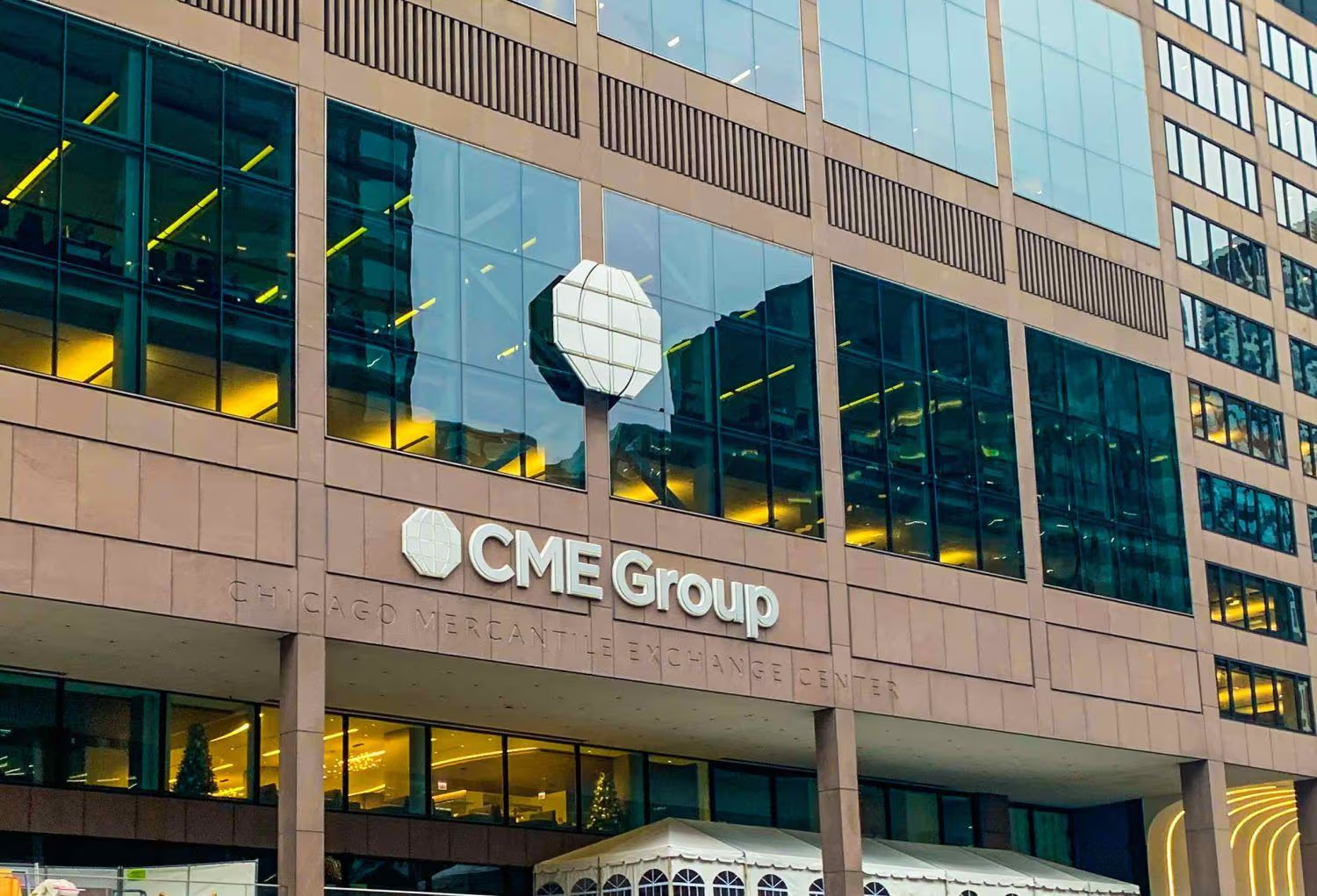
CME Group launches Solana and XRP options, expanding crypto offerings. SEC delays Solana and XRP ETF approvals, market awaits clarity. Strong institutional demand drives CME’s launch of crypto options contracts. In a bold move to broaden its cryptocurrency offerings, CME Group has officially launched options on Solana (SOL) and XRP futures. Available since October 13, 2025, these options will allow traders to hedge and manage exposure to two of the most widely traded digital assets in the market. The new contracts come in both full-size and micro-size formats, with expiration options available daily, monthly, and quarterly, providing flexibility for a diverse range of market participants. This expansion aligns with the rising demand for innovative products in the crypto space. Giovanni Vicioso, CME Group’s Global Head of Cryptocurrency Products, noted that the new options offer increased flexibility for traders, from institutions to active individual investors. The growing liquidity in Solana and XRP futures has made the introduction of these options a timely move to meet the needs of an expanding market. Also Read: Vitalik Buterin Reveals Ethereum’s Bold Plan to Stay Quantum-Secure and Simple! Rapid Growth in Solana and XRP Futures Trading CME Group’s decision to roll out options on Solana and XRP futures follows the substantial growth in these futures products. Since the launch of Solana futures in March 2025, more than 540,000 contracts, totaling $22.3 billion in notional value, have been traded. In August 2025, Solana futures set new records, with an average daily volume (ADV) of 9,000 contracts valued at $437.4 million. The average daily open interest (ADOI) hit 12,500 contracts, worth $895 million. Similarly, XRP futures, which launched in May 2025, have seen significant adoption, with over 370,000 contracts traded, totaling $16.2 billion. XRP futures also set records in August 2025, with an ADV of 6,600 contracts valued at $385 million and a record ADOI of 9,300 contracts, worth $942 million. Institutional Demand for Advanced Hedging Tools CME Group’s expansion into options is a direct response to growing institutional interest in sophisticated cryptocurrency products. Roman Makarov from Cumberland Options Trading at DRW highlighted the market demand for more varied crypto products, enabling more advanced risk management strategies. Joshua Lim from FalconX also noted that the new options products meet the increasing need for institutional hedging tools for assets like Solana and XRP, further cementing their role in the digital asset space. The launch of options on Solana and XRP futures marks another step toward the maturation of the cryptocurrency market, providing a broader range of tools for managing digital asset exposure. SEC’s Delay on Solana and XRP ETF Approvals While CME Group expands its offerings, the broader market is also watching the progress of Solana and XRP exchange-traded funds (ETFs). The U.S. Securities and Exchange Commission (SEC) has delayed its decisions on multiple crypto-related ETF filings, including those for Solana and XRP. Despite the delay, analysts anticipate approval may be on the horizon. This week, REX Shares and Osprey Funds are expected to launch an XRP ETF that will hold XRP directly and allocate at least 40% of its assets to other XRP-related ETFs. Despite the delays, some analysts believe that approval could come soon, fueling further interest in these assets. The delay by the SEC has left many crypto investors awaiting clarity, but approval of these ETFs could fuel further momentum in the Solana and XRP futures markets. Also Read: Tether CEO Breaks Silence on $117,000 Bitcoin Price – Market Reacts! The post Breaking: CME Group Unveils Solana and XRP Options appeared first on 36Crypto.
Share
Coinstats2025/09/18 02:35