

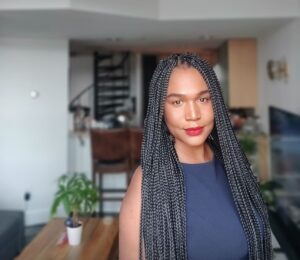
Kerry-Ann King, Strategic Enterprise ABM Manager, DailyPay
By Kerry-Ann King, Strategic Enterprise ABM Manager, DailyPay
There is no single way to belong. That idea sits at the heart of Dr. Martin Luther King Jr.’s vision and continues to shape how we think about dignity, identity, and community today. Belonging is not about sameness or fitting into a single narrative, but about being recognized as fully human – even when our histories, paths, and experiences differ.
As we observe Martin Luther King Day, I find myself reflecting on how his legacy lives beyond speeches and monuments. It shows up in everyday moments: in how we treat one another, how we listen, and how we create space for people to belong. His work reminds us that progress is not measured only by laws or milestones, but by the choices we make in our shared spaces, including the workplace. Dr. King challenged people to move beyond intention and into action when he asked, “Life’s most persistent and urgent question is, ‘What are you doing for others?’” That question anchors his philosophy in daily practice rather than abstract ideals.
That emphasis on action was grounded in a broader vision of dignity. Dr. King is often remembered for a single speech, but his thinking extended far beyond it. Central to his vision was the belief that dignity, fairness, and opportunity are deeply human values, not confined to one group or one nation. As he said, “I have a dream that my four little children will one day live in a nation where they will not be judged by the color of their skin but by the content of their character.” He understood that progress grows when people are allowed to retain their identities and are invited into systems without being forced to conform to a single norm. Inclusion, in this sense, was not about erasing difference, but about expanding who is seen, heard, and valued.
This perspective also shapes how many of us come to understand our own identities. My understanding of identity has been shaped by both history and discovery. Like many descendants of the transatlantic slave trade, parts of my ancestry were disrupted—names lost, languages erased, and direct connections to tribe and place severed. I grew up connected to my Jamaican heritage, aware that Jamaica itself reflects many influences, including African, Indigenous Taíno, and European. Over time, those cultures shaped how people lived, spoke, and expressed themselves, with even the language carrying traces of layered history.
Wanting to understand what existed beyond what had been preserved, I later explored my ancestry through DNA testing—not as a novelty, but as a way of reclaiming what had been fragmented. What I learned expanded my sense of self: in addition to Ashanti roots in present-day Ghana, part of the larger Akan cultural group known for its traditions of community, artistry, and governance, my lineage also includes Nigerian ancestry from distinct ethnic groups such as the Igbo, as well as Irish, French, and Southeast Asian roots. These cultures are not the same, but they are connected through shared histories of movement, trade, colonization, and adaptation. Together, they reinforced for me that identity is layered rather than singular—shaped by geography, history, and the enduring human instinct to belong.
That process of reconnecting—moving from abstraction to specificity—helped me better understand why Dr. King’s vision resonated across borders. He recognized that belonging is not created by erasing difference, but by expanding the circle so people can show up as their authentic selves. His thinking was shaped not only by the U.S. civil rights movement, but by global Black struggles and Pan-African ideas, including Caribbean anti-colonial movements that emphasized dignity, self-definition, and collective freedom. Dr. King’s visits to places like Jamaica and the Bahamas, where he witnessed majority-Black societies navigating independence and plural identity, reinforced his belief that unity does not require sameness.
This understanding helps explain why Caribbean and African American histories—though shaped by different geographies, legal systems, and timelines—share common themes of endurance, community-building, and the pursuit of dignity under pressure. These parallel histories carried ideas about leadership, self-worth, and belonging across generations, reinforcing Dr. King’s belief that justice and humanity are not confined to one nation’s experience.
Leaders across the African diaspora carried these ideas forward in different ways. While their approaches and contexts varied, the underlying belief remained consistent: people thrive when they are seen as whole individuals and given the freedom to define themselves, rather than being confined to a single narrative or path.
Dr. King’s legacy reminds us that people are not a monolith. There is no single background, culture, or experience that defines us. We are shaped not only by struggle, but by creativity, contribution, and care for one another. Recognizing that complexity is not a distraction from unity—it is what makes unity possible.
In today’s workplace, this perspective matters deeply. When people feel pressure to simplify or hide parts of who they are, they often disengage. But when environments make room for differences in background, thought, and lived experience, individuals are more likely to speak openly, share ideas, and build trust. Psychological safety grows when people are respected as whole people, not reduced to a single identity or expectation.
Martin Luther King Jr. Day is ultimately a moment to reflect on how we carry these values forward. His vision was not about sameness, but about shared humanity. By recognizing that there is no single way to belong—and by creating spaces where people feel valued as they are—we continue the work he believed in: building communities rooted in dignity, understanding, and collective progress.
We hope you’ll join us as we continue to build a culture rooted in dignity, respect, and belonging—because out of many, we are one people.


