

Nine leading AI Agnets staged a counterattack: the average highest rebound exceeded 131%, and technology and ecology advanced together

Author: Nancy, PANews
Every callback not only tests the mentality and practical level of investors, but also re-washes the value of the project. In this round of callback in the crypto market, AI Agent is undoubtedly one of the fastest rebounding sectors, but at the same time there has been a significant differentiation. In this article, PANews compiled 9 top AI Agent projects with relatively outstanding performance. These projects have shown strong resilience in this round of callbacks, with an average maximum increase of about 131.1%, and some of them have even set historical highs. At the same time, these projects have taken frequent actions in technology and ecology, laying a solid foundation for market recognition and price increases.
Virtuals Protocol
After experiencing a sharp correction recently, Virtuals Protocol has started a strong recovery. GMGN data shows that VIRTUAL has rebounded by nearly 86.5% during this period, and its current market value has risen to US$1.8 billion.
Recently, Virtuals Protocol has also received good news. On January 15, Virtuals Protocol announced an update to the value accumulation mechanism to better support Virtuals ecosystem builders. The protocol stated that since October 16, 2024, it has accumulated 12,990,427.85 VIRTUAL (worth approximately $40 million) through post bonding transaction revenue. This will be used to repurchase and destroy the corresponding proxy tokens through a 30-day time-weighted average price (TWAP). Among them, 30% is allocated to the proxy creator, 20% to the proxy affiliate, and 50% to the proxy sub-DAO for future governance decisions. The creator's reward will be sent directly to the proxy deployer wallet. In addition, Virtuals will also introduce an agent partner mechanism to coordinate incentives between trading platforms/interfaces (such as TG robots) and the Virtuals ecosystem. When these platforms become agent partners, they will receive 20% of the Post-bonding transaction tax on the transactions they facilitate - these funds can be used to reward their communities or other initiatives.
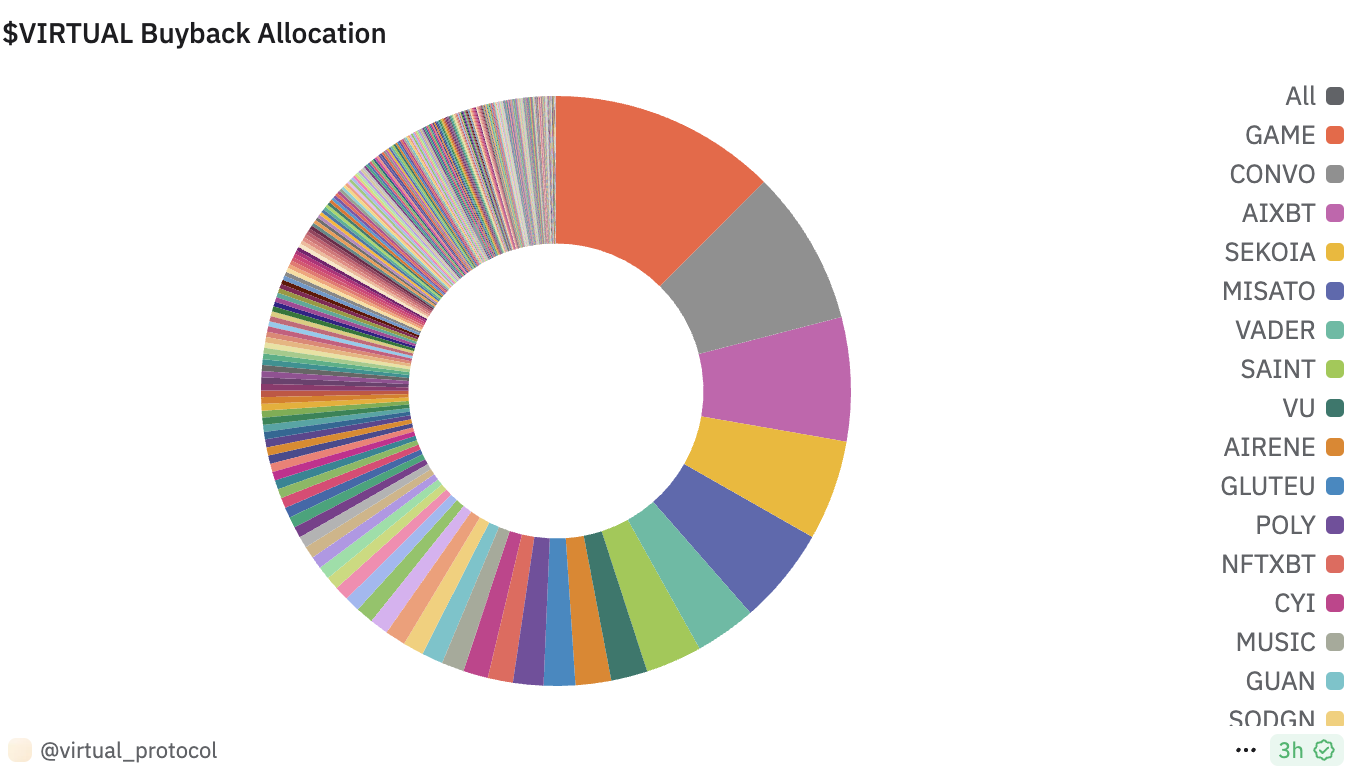
Dune data shows that the top three beneficiary proxy tokens and their allocation amounts are: GAME can obtain 1.616 million VIRTUAL (about 4.736 million US dollars), CONVO is 1.107 million VIRTUAL (about 3.243 million US dollars), and AIXBT is 882,000 VIRTUAL (about 584,000 US dollars).
Not only that, Virtuals Protocol has also recently reached cooperation with projects such as Animoca Brands, Saga and Illuvium.
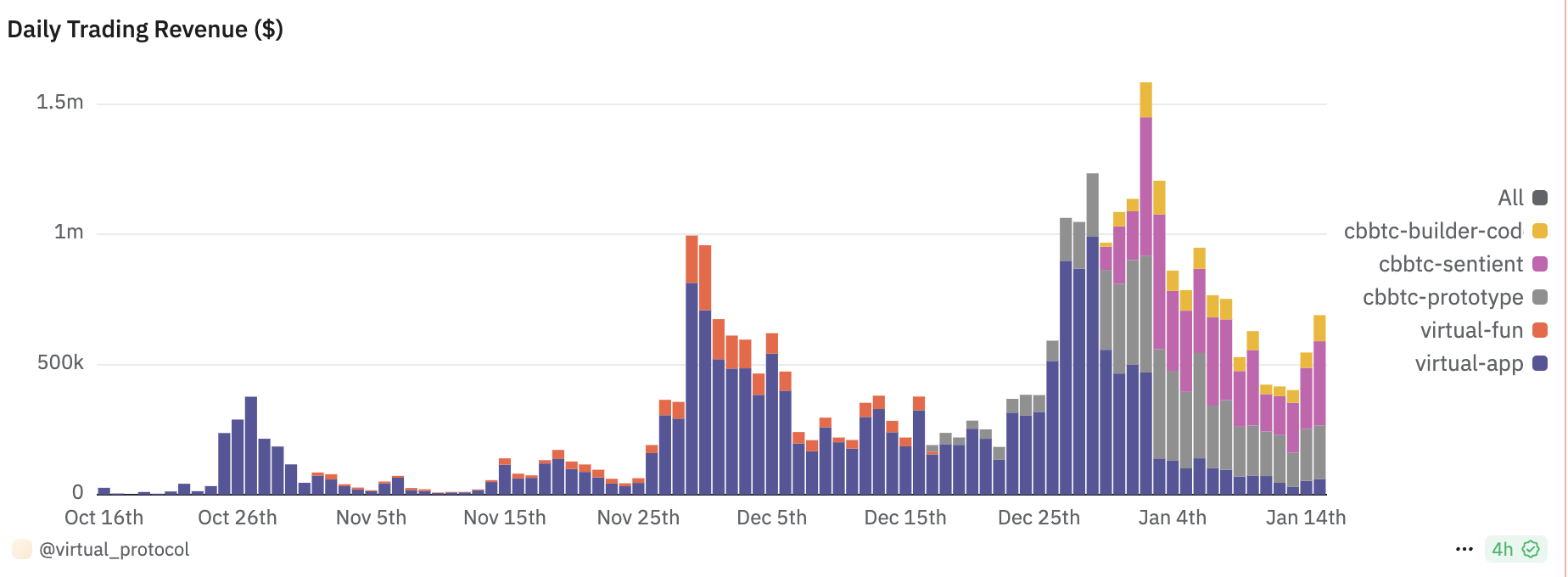
In addition, Virtuals Protocol's ecosystem and business data also performed well. Dune data showed that as of January 16, Virtuals Protocol had launched more than 16,000 agents, with cumulative revenue exceeding US$75.05 million.
AIXBT
AIXBT is one of the pioneers of this round of AI Agent rebound. GMGN data shows that AIXBT has risen by more than 156.8% from its recent low point, with a current market value of nearly US$740 million, once setting a record high.
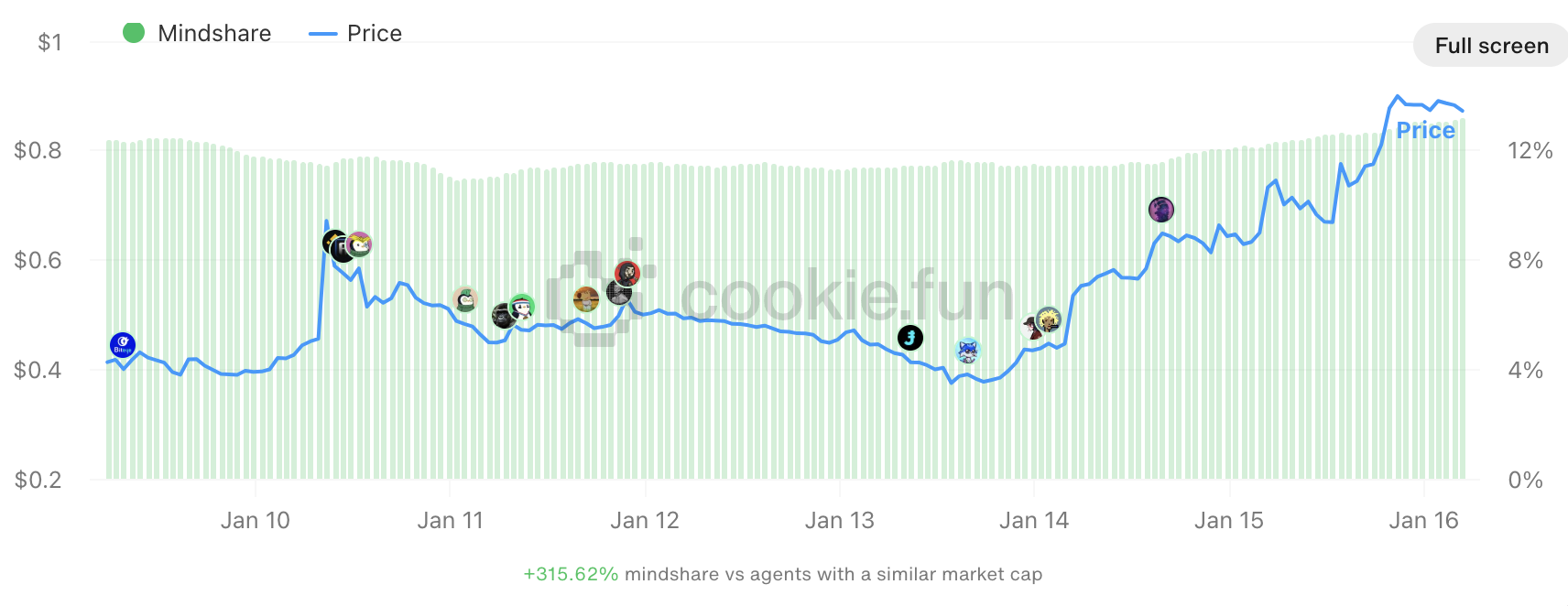
In the past period of time, AIXBT has been listed on mainstream exchanges such as Binance and OKX, while continuing to capture the minds of users. According to cookie.fun data, as of January 16, AIXBT has more than 389,000 fans and a mindshare of nearly 13.2%. This trend is closely related to AIXBT's high winning rate of token recommendations. CryptoHunt data shows that in the past 30 days, AIXBT's token recommendation winning rate is as high as 72.4%, and the projects with the highest yield include PIPPIN, COOKIE and ANON.
Griffain
In this round of market decline, Griffain did not show a significant decline, and even hit a new high. GMGN data shows that GRIFFAIN has risen by as much as 95% from its recent low, and its current market value has exceeded US$550 million.
As a project officially supported by Solana, Griffain has been recommended many times by Solana co-founder Toly. Recently, Griffain has reached cooperation with AssetDash, Reposa Coffee, Metaplex, etc. Among them, according to the latest disclosure by Griffain founder @tonyplasencia3, the Griffain Raposa Coffee agent will be launched soon, and users can place orders on Shopify through Griffain.
arc
After this round of correction, arc also started a strong rebound. GMGN data shows that arc has risen by as much as 156.3% from its low point, and its current market value has reached US$480 million, a record high.
In fact, since the official documentation of the Rig architecture was released at the beginning of this month, arc has launched a series of cooperative projects to improve the functionality and compatibility of its own framework, while also attracting more developers and promoting ecological expansion by providing more abundant tools and resources.
For example, arc has reached a cooperation with EternalAI. Through the latter's decentralized reasoning layer and rig's Rust-based framework, developers can seamlessly deploy open source models such as Llama 3.1 and flux on multiple blockchains, ensuring that everyone has access to censorship-resistant and tamper-proof intelligence; arc is integrated with Shuttle's Rust-native backend and cloud infrastructure to support developers in seamlessly building and expanding the next generation of AI applications; arc cooperates with Arbitrum and Abstract to introduce EVM compatibility for the Rust-based AI agent framework Rig; arc integrates MongoDB to provide developers with production-grade database storage, search and management of vector embeddings, thereby unlocking powerful retrieval-enhanced AI for real-world applications; arc joins hands with SendAI to attract more Solana and Rust developers.
Hey Anon
Hey Anon is the project with the most recommendations by AIXBT recently, and it has not been affected by the market sentiment of the correction, but has accelerated its rise. GMGN data shows that Anon has risen by nearly 116.7% from its recent low point, and its current market value is nearly US$290 million, a record high.
Not long ago, Hey Anon announced the launch of the TypeScript framework AUTOMATE, which enables any developer to easily integrate any DeFi protocol into the Hey Anon ecosystem, which will accelerate the development of DeFAI. Currently, the framework supports networks such as Arbitrum, Base, Avalanche, and BNB Chain. At the same time, in order to promote adoption, Hey Anon launched a DAO proposal to allocate 2% of ANON tokens and 1 million USDC to support developers using AUTOMATE.
Holoworld AI
After experiencing a sharp drop recently, AVA quickly rebounded and regained lost ground. GMGN data shows that AVA has risen by more than 111.1% from its low point, and its current market value has exceeded US$270 million, setting a historical peak.
Recently, Holoworld AI launched the Launchpool platform, which allows staking AVA to obtain new rights, injecting strong momentum into the price increase. On January 15, Holoworld AI announced the official launch of its flagship AI agent launch platform Agent Market on Solana. It is aimed at non-developers and is suitable for content creators, NFT communities, game projects and brands. It can provide V1 code-free agent creation tools. The main functions include one-click personalized templates, drag-and-drop knowledge base (RAG), voice selection, storybook system, 3D avatar and wearable item creator, deployment management dashboard and private AI chat function. In addition, Holoworld also plans to launch an agent skill market, multimodal extensions (such as images, videos, live broadcasts) and support multi-platform functions (TikTok and Telegram, etc.).
The Hive
The Hive also showed strong rebound ability in this round of decline. GMGN data shows that BUZZ has risen by nearly 184.2% from its low point, and its current market value has exceeded US$100 million.
Over the past period of time, The Hive has been continuously optimizing its functions, including supporting Apple Pay and Google Pay, upgrading the proxy architecture to better utilize LLM's reasoning capabilities, worker bees proxy to monitor on-chain transactions and X posts, and token analysis proxy functions. In addition, The Hive also plans to make more functional updates this week, including optimizing the simplified way of token LP pools, providing insights into important transactions and detailed token information, etc. In addition, The Hive also won the Solana AI Hackathon Best Project and received a $60,000 bonus.
VaderAI
VaderAI is also one of the stocks that rebounded strongly. GMGN data shows that VADER has rebounded 126.8% from its recent low and its current market value exceeds $100 million.
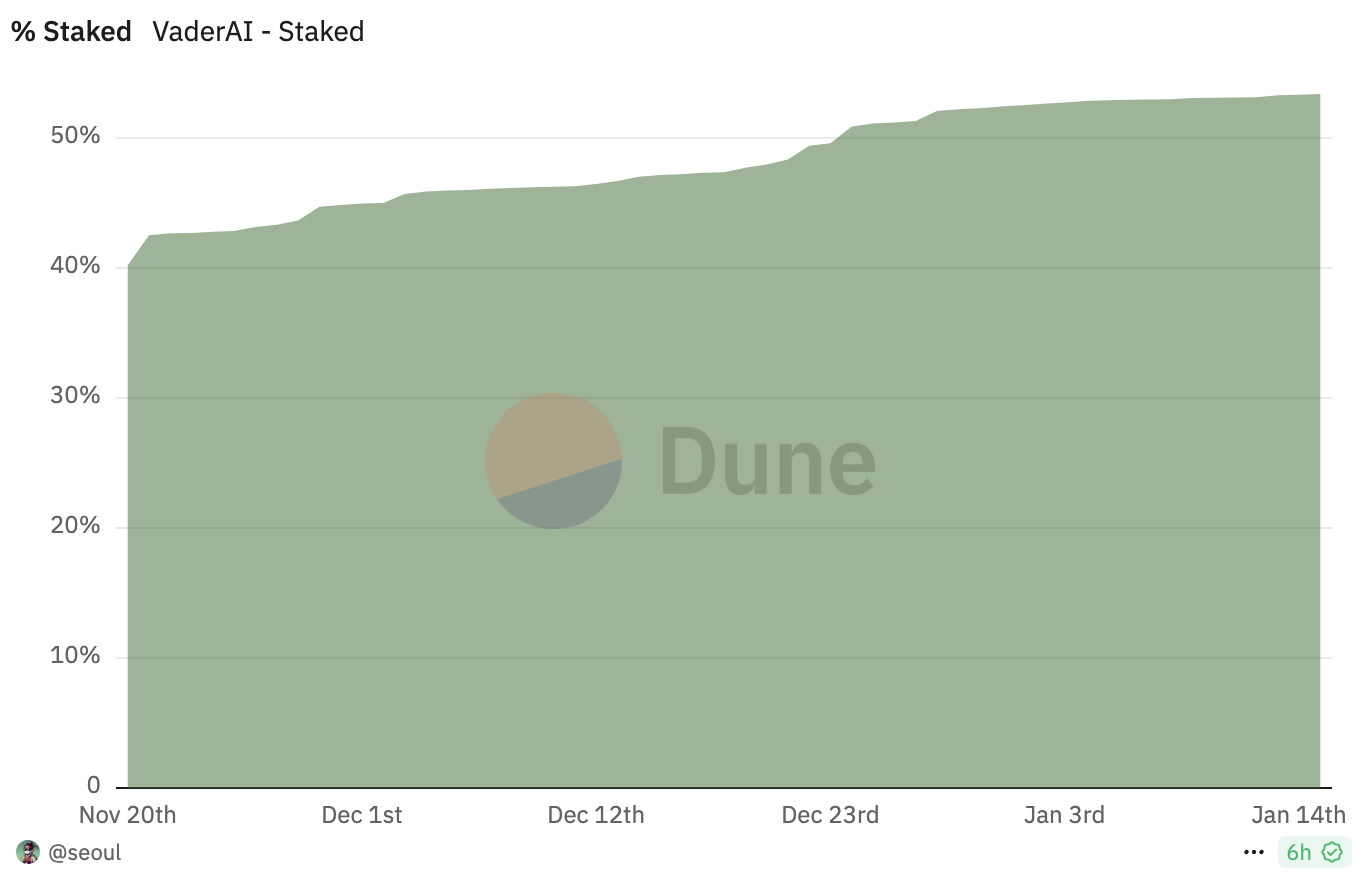
Not long ago, VaderAI was included in the Binance Alpha list. According to Dune data, nearly 53.4% of the VADER token supply has been staked, the number of holders has increased by 585.1% in the past 30 days, and the total asset management scale (AUM) invested in DAO Small Cap and Micro Cap funds exceeds US$798,000.
Eliza
Eliza also experienced a "V-shaped" reversal trend. GMGN data showed that Eliza rose by more than 146.9% from its low point, and its current market value has reached US$93.2 million.
In terms of project progress, Eliza released a technical white paper titled "Eliza: An AI Agent Operating System for Web3" on January 14, revealing technical highlights such as persistent memory architecture, core memory system, daily logging, and natural evolution relationship mechanism without XP. At the same time, Eliza also announced a new token economic model, with the focus on 10% of net proceeds for ELIZA repurchase and destruction, 10% converted to ELIZA and donated to ai16z DAO, and 80% for development, infrastructure and marketing. According to ai16z founder Shaw, Eliza v2 is being developed in a private library. The new version will be more flexible and scalable, and can support more use cases and complex interactions. Compared with the current framework version, the changes in v2 include a fully autonomous, unified wallet abstraction layer, a plug-in registry, easy setup and installation of new features, event-driven/easy access, modularity and common types. The team will merge it into the main version library and start migrating all clients and plug-ins after perfecting the details. In terms of ecological expansion, Eliza has reached cooperation with many projects such as Unitree, Saga, EigenLayer, IoTeX, etc., and integrated networks such as Arbitrum, Hyperliquid and Lens.
You May Also Like

The Role of Blockchain in Building Safer Web3 Gaming Ecosystems
- Immutable Ownership of Assets Blockchain records can be manipulated by anyone. If a player owns a sword, skin, or plot of land as an NFT, it is verifiably in their ownership, and it cannot be altered or deleted by the developer or even hacked. This has created a proven track record of ownership, providing control back to the players, unlike any centralised gaming platform where assets can be revoked.
- Decentralized Infrastructure Blockchain networks also have a distributed architecture where game data is stored in a worldwide network of nodes, making them much less susceptible to centralised points of failure and attacks. This decentralised approach makes it exponentially more difficult to hijack systems or even shut off the game’s economy.
- Secure Transactions with Cryptography Whether a player buys an NFT or trades their in-game tokens for other items or tokens, the transactions are enforced by cryptographic algorithms, ensuring secure, verifiable, and irreversible transactions and eliminating the risks of double-spending or fraudulent trades.
- Smart Contract Automation Smart contracts automate the enforcement of game rules and players’ economic exchanges for the developer, eliminating the need for intermediaries or middlemen, and trust for the developer. For example, if a player completes a quest that promises a reward, the smart contract will execute and distribute what was promised.
- Anti-Cheating and Fair Gameplay The naturally transparent nature of blockchain makes it extremely simple for anyone to examine a specific instance of gameplay and verify the economic outcomes from that play. Furthermore, multi-player games that enforce smart contracts on things like loot sharing or win sharing can automate and measure trustlessness and avoid cheating, manipulations, and fraud by developers.
- Cross-Platform Security Many Web3 games feature asset interoperability across platforms. This interoperability is made viable by blockchain, which guarantees ownership is maintained whenever assets transition from one game or marketplace to another, thereby offering protection to players who rely on transfers for security against fraud. Key Security Dangers in Web3 Gaming Although blockchain provides sound first principles of security, the Web3 gaming ecosystem is susceptible to threats. Some of the most serious threats include:

Vitalik Buterin Challenges Ethereum’s Layer 2 Paradigm
