Cardano vs. Bitcoin: Hoskinson’s 1,000x ADA prediction draws debate
Charles Hoskinson, the founder of Cardano, has sparked discussion around ADA’s long-term potential, claiming the token could outperform Bitcoin by a wide margin.
- Charles Hoskinson claims ADA could grow 100x–1,000x, reaching up to $6,000, while Bitcoin may rise only 10x.
- He cites ADA’s smaller $27.5B market cap, 60% staking rate, and expanding DeFi ecosystem as key growth drivers.
- Critics argue ADA lags in DeFi adoption, faces regulatory risk, and has yet to prove it can rival Bitcoin’s dominance.
Speaking with Blockworks co-founder Jason Yanowitz on July 28, Hoskinson argued that while Bitcoin (BTC) could increase tenfold to reach $1 million, Cardano (ADA) might rise by 100x or even 1,000x, pushing its price to between $600 and $6,000 from the current level of $0.7791.
He based this view on ADA’s market capitalization of $27.5 billion, which is far smaller than Bitcoin’s $2.34 trillion. According to Hoskinson, this relative size gives ADA more space for exponential returns.
He also pointed to ADA’s historical performance. Since its 2017 launch at $0.02, ADA has risen over 3,900%, compared to Bitcoin’s 2,410% growth from $4,337 over the same period. He added that Cardano’s initial coin offering allocation of 108,000 BTC, then worth roughly $12 billion, is now dwarfed by ADA’s market cap, which he says reflects a 2.8x outperformance.
Why Hoskinson believes ADA can outrun Bitcoin
Several reasons were given to support Hoskinson’s forecast. He noted that nearly 60% of ADA’s circulating supply, equivalent to over $14 billion, is staked. This, he argued, promotes supply stability and long-term holding behavior, which may support price appreciation.
He also highlighted Cardano’s growing decentralized finance capabilities. According to Hoskinson, Cardano could become a “yield layer” for Bitcoin, allowing BTC holders to generate returns via Cardano’s smart contract infrastructure. Upcoming ecosystem events, such as the Midnight Glacier Drop and future partner chain airdrops, were also presented as growth drivers.
Skepticism and technical challenges remain
Not everyone shares Hoskinson’s optimism. Cardano’s DeFi ecosystem is still lagging behind its rivals, according to critics, with a $354 million total value locked, far less than Ethereum’s $70 billion. Investor confidence has also been impacted by regulatory obstacles, especially in the U.S., and slower-than-anticipated feature rollouts.
Some Bitcoin maximalists maintain that BTC’s role as a store of value gives it an advantage that ADA is unlikely to overcome. Additionally, past concerns about ledger integrity, such as issues during the Allegra hard fork, continue to raise questions around Cardano’s governance.
Cardano technical analysis
After its strong rally in mid-July, ADA is showing a weakening trend in the short-term. Volatility has cooled as prices have returned to within the Bollinger Bands after briefly touching the upper range at $0.95. The current price sits just below the 20-day SMA at $0.7987, which now acts as resistance.
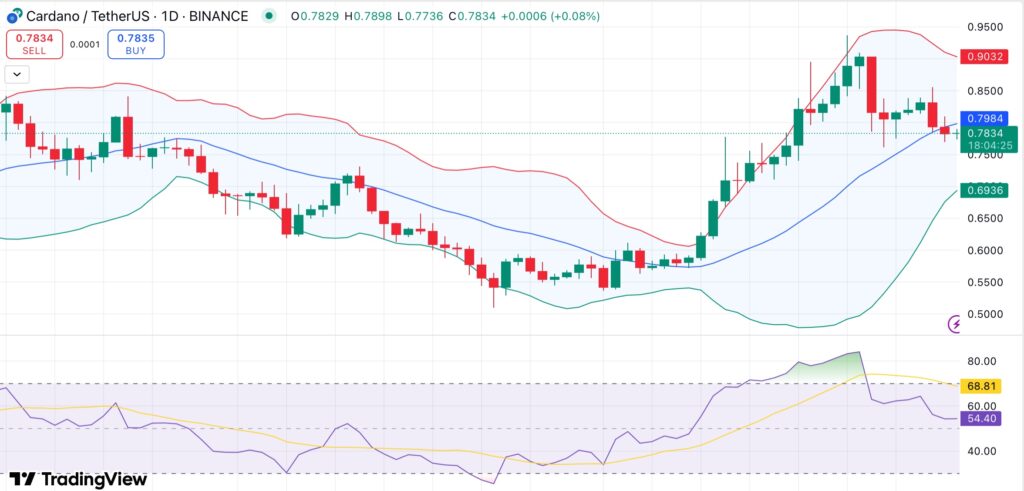
With a relative strength index of 54.4, ADA is in neutral territory, though momentum has faded from its prior overbought condition. The MACD has crossed below the signal line, turning bearish.
Price action shows a possible short-term head-and-shoulders pattern forming, which could confirm if ADA closes below $0.75. To recover strength, ADA needs to take back the $0.80–$0.82 range. A break below the $0.69 support level could open the door to a move toward $0.63.
You May Also Like

Tropical Storm Basyang expected to drench Caraga, Northern Mindanao

Crypto execs met with US lawmakers to discuss Bitcoin reserve, market structure bills
Lawmakers in the US House of Representatives and Senate met with cryptocurrency industry leaders in three separate roundtable events this week. Members of the US Congress met with key figures in the cryptocurrency industry to discuss issues and potential laws related to the establishment of a strategic Bitcoin reserve and a market structure.On Tuesday, a group of lawmakers that included Alaska Representative Nick Begich and Ohio Senator Bernie Moreno met with Strategy co-founder Michael Saylor and others in a roundtable event regarding the BITCOIN Act, a bill to establish a strategic Bitcoin (BTC) reserve. The discussion was hosted by the advocacy organization Digital Chamber and its affiliates, the Digital Power Network and Bitcoin Treasury Council.“Legislators and the executives at yesterday’s roundtable agree, there is a need [for] a Strategic Bitcoin Reserve law to ensure its longevity for America’s financial future,” Hailey Miller, director of government affairs and public policy at Digital Power Network, told Cointelegraph. “Most attendees are looking for next steps, which may mean including the SBR within the broader policy frameworks already advancing.“Read more