A viral post from analyst Alex Mason on X is making the rounds in the metals world, and it’s easy to see why. His claim is simple but explosive: the paper silverA viral post from analyst Alex Mason on X is making the rounds in the metals world, and it’s easy to see why. His claim is simple but explosive: the paper silver

Silver Price Time Bomb: Bank Shorts Are Now Bigger Than Global Supply

2026/02/12 16:00
4 min read

A viral post from analyst Alex Mason on X is making the rounds in the metals world, and it’s easy to see why. His claim is simple but explosive: the paper silver market has grown so large that bank short exposure now dwarfs the amount of physical silver the world can actually produce.

The chart he shared frames the situation as a potential “margin call threshold” event, where silver’s price approaching the $90–$100 zone could create stress across institutional short positions. Whether someone agrees with his conclusion or not, the setup highlights how unstable silver trading can become when leverage dominates the market.

The Core Claim: Paper Silver vs. Physical Reality

Mason points to a staggering imbalance: global silver production is roughly 800 million ounces per year, while bank short exposure is presented as 4.4 billion ounces. That’s multiple years of mining supply tied up in synthetic claims, which immediately raises questions about how “real” the pricing mechanism actually is.

This is the heart of the argument metals bulls always come back to. The silver price is being traded as a massive financial derivative product, where exposure can multiply far beyond what exists in vaults.

One of the most dramatic parts of Mason’s thread is the big drop from the low $90s into the mid-$60s in a very short window. He interprets that volatility not as normal price discovery, but as a forced reset designed to prevent silver from breaking into a zone where short positions become dangerous.

To be clear, silver is historically one of the most volatile major commodities, and sudden moves are not unusual. But Mason’s point is that these moves often happen exactly where liquidity is thinnest, which fuels suspicions about how heavily managed the paper market really is.

One interesting new development alongside all of this is that silver is no longer only a traditional futures trade. On Hyperliquid, silver can now be traded fully on-chain, meaning no-KYC access, instant execution, and the ability to trade even during weekends, unlike traditional TradFi metals platforms that shut down outside market hours. For traders who want flexibility this is a major change and with our link and code CAPTAIN4, trading fees also come with a discount.

The “Margin Call Threshold” Narrative

In the image, the $90+ region is marked as a critical stress zone, implying that a sustained push higher could trigger cascading margin calls for large institutional shorts. If enough leveraged players are positioned the wrong way, silver doesn’t need a slow grind upward. It can gap violently once pressure builds.
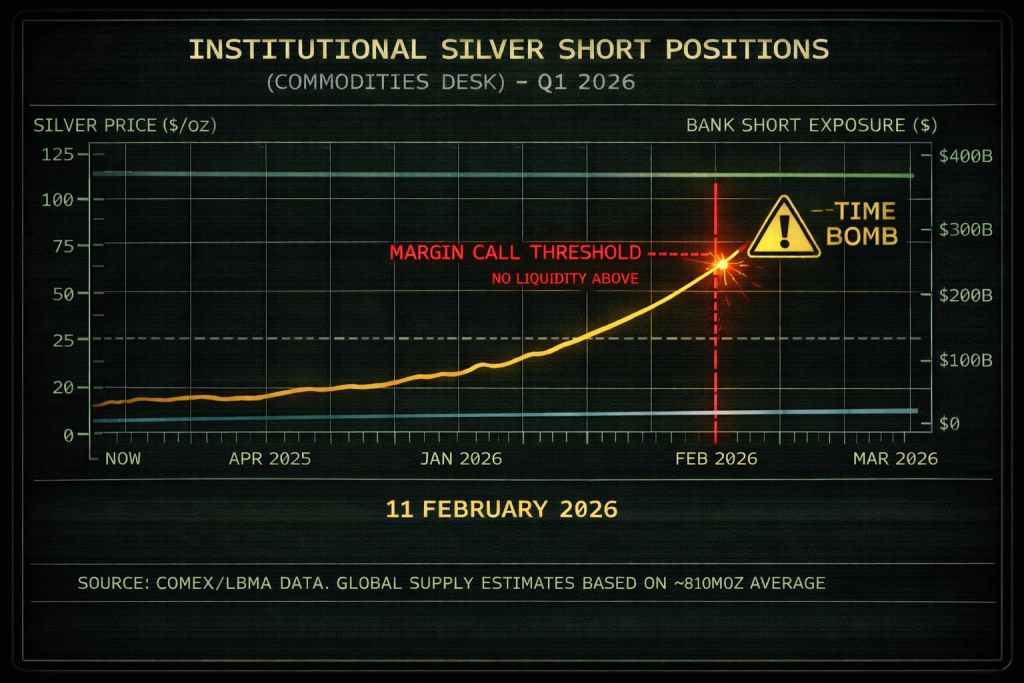
Source: X/@AlexMasonCrypto

That’s why silver rallies often feel discontinuous. The market can spend months doing nothing, then explode in weeks because positioning, not fundamentals, becomes the catalyst.

Mason also leans into the idea that physical silver demand is diverging from futures pricing. He mentions rising lease rates, delivery delays, and a scramble for immediate supply, suggesting that buyers increasingly want metal now, not contracts later.

This is a real theme worth watching, even without the apocalyptic framing. When physical tightness shows up, silver tends to react sharply because inventories are smaller and industrial demand is less flexible than people assume.

Read also: The Silver Price Chart Isn’t Lying – The $200 Math Is Starting to Show

My Take on the Silver Price “Time Bomb”

The broader message is directionally valid: silver is heavily financialized, and paper exposure absolutely amplifies volatility. Silver is not a clean supply-and-demand market like many retail investors imagine, and leverage plays a huge role in both rallies and crashes.

However, the most extreme conclusions (“banks will collapse” or “force majeure is next”) should be taken cautiously. The derivatives market is complex, and many short positions are hedges rather than naked bets, so the headline numbers alone don’t guarantee an imminent blow-up.

Still, Mason’s post captures something important: silver is sitting at the intersection of industrial necessity, monetary speculation, and extreme paper leverage. That combination is exactly why the next major silver move, whenever it comes, will probably not be quiet.

Read also: The Silver Price Doesn’t Look Real – And This Video Explains Why

Subscribe to our YouTube channel for daily crypto updates, market insights, and expert analysis.

The post Silver Price Time Bomb: Bank Shorts Are Now Bigger Than Global Supply appeared first on CaptainAltcoin.

Market Opportunity
Lorenzo Protocol Logo
Lorenzo Protocol Price(BANK)
$0.03255
$0.03255$0.03255
-0.09%
USD
Lorenzo Protocol (BANK) Live Price Chart
Disclaimer: The articles reposted on this site are sourced from public platforms and are provided for informational purposes only. They do not necessarily reflect the views of MEXC. All rights remain with the original authors. If you believe any content infringes on third-party rights, please contact service@support.mexc.com for removal. MEXC makes no guarantees regarding the accuracy, completeness, or timeliness of the content and is not responsible for any actions taken based on the information provided. The content does not constitute financial, legal, or other professional advice, nor should it be considered a recommendation or endorsement by MEXC.

You May Also Like

China Blocks Nvidia’s RTX Pro 6000D as Local Chips Rise

China Blocks Nvidia’s RTX Pro 6000D as Local Chips Rise

The post China Blocks Nvidia’s RTX Pro 6000D as Local Chips Rise appeared on BitcoinEthereumNews.com. China Blocks Nvidia’s RTX Pro 6000D as Local Chips Rise China’s internet regulator has ordered the country’s biggest technology firms, including Alibaba and ByteDance, to stop purchasing Nvidia’s RTX Pro 6000D GPUs. According to the Financial Times, the move shuts down the last major channel for mass supplies of American chips to the Chinese market. Why Beijing Halted Nvidia Purchases Chinese companies had planned to buy tens of thousands of RTX Pro 6000D accelerators and had already begun testing them in servers. But regulators intervened, halting the purchases and signaling stricter controls than earlier measures placed on Nvidia’s H20 chip. Image: Nvidia An audit compared Huawei and Cambricon processors, along with chips developed by Alibaba and Baidu, against Nvidia’s export-approved products. Regulators concluded that Chinese chips had reached performance levels comparable to the restricted U.S. models. This assessment pushed authorities to advise firms to rely more heavily on domestic processors, further tightening Nvidia’s already limited position in China. China’s Drive Toward Tech Independence The decision highlights Beijing’s focus on import substitution — developing self-sufficient chip production to reduce reliance on U.S. supplies. “The signal is now clear: all attention is focused on building a domestic ecosystem,” said a representative of a leading Chinese tech company. Nvidia had unveiled the RTX Pro 6000D in July 2025 during CEO Jensen Huang’s visit to Beijing, in an attempt to keep a foothold in China after Washington restricted exports of its most advanced chips. But momentum is shifting. Industry sources told the Financial Times that Chinese manufacturers plan to triple AI chip production next year to meet growing demand. They believe “domestic supply will now be sufficient without Nvidia.” What It Means for the Future With Huawei, Cambricon, Alibaba, and Baidu stepping up, China is positioning itself for long-term technological independence. Nvidia, meanwhile, faces…
Share
BitcoinEthereumNews2025/09/18 01:37
Over 260,000 Chrome users hit by 30 fake AI extensions stealing browsing & email data

Over 260,000 Chrome users hit by 30 fake AI extensions stealing browsing & email data

Tens of thousands of people have downloaded what they believed were useful AI tools for their browsers, only to give hackers a direct path into their most private
Share
Cryptopolitan2026/02/13 03:20
Unlocking Massive Value: Curve Finance Revenue Sharing Proposal for CRV Holders

Unlocking Massive Value: Curve Finance Revenue Sharing Proposal for CRV Holders

BitcoinWorld Unlocking Massive Value: Curve Finance Revenue Sharing Proposal for CRV Holders The dynamic world of decentralized finance (DeFi) is constantly evolving, bringing forth new opportunities and innovations. A significant development is currently unfolding at Curve Finance, a leading decentralized exchange (DEX). Its founder, Michael Egorov, has put forth an exciting proposal designed to offer a more direct path for token holders to earn revenue. This initiative, centered around a new Curve Finance revenue sharing model, aims to bolster the value for those actively participating in the protocol’s governance. What is the “Yield Basis” Proposal and How Does it Work? At the core of this forward-thinking initiative is a new protocol dubbed Yield Basis. Michael Egorov introduced this concept on the CurveDAO governance forum, outlining a mechanism to distribute sustainable profits directly to CRV holders. Specifically, it targets those who stake their CRV tokens to gain veCRV, which are essential for governance participation within the Curve ecosystem. Let’s break down the initial steps of this innovative proposal: crvUSD Issuance: Before the Yield Basis protocol goes live, $60 million in crvUSD will be issued. Strategic Fund Allocation: The funds generated from the sale of these crvUSD tokens will be strategically deployed into three distinct Bitcoin-based liquidity pools: WBTC, cbBTC, and tBTC. Pool Capping: To ensure balanced risk and diversified exposure, each of these pools will be capped at $10 million. This carefully designed structure aims to establish a robust and consistent income stream, forming the bedrock of a sustainable Curve Finance revenue sharing mechanism. Why is This Curve Finance Revenue Sharing Significant for CRV Holders? This proposal marks a pivotal moment for CRV holders, particularly those dedicated to the long-term health and governance of Curve Finance. Historically, generating revenue for token holders in the DeFi space can often be complex. The Yield Basis proposal simplifies this by offering a more direct and transparent pathway to earnings. By staking CRV for veCRV, holders are not merely engaging in governance; they are now directly positioned to benefit from the protocol’s overall success. The significance of this development is multifaceted: Direct Profit Distribution: veCRV holders are set to receive a substantial share of the profits generated by the Yield Basis protocol. Incentivized Governance: This direct financial incentive encourages more users to stake their CRV, which in turn strengthens the protocol’s decentralized governance structure. Enhanced Value Proposition: The promise of sustainable revenue sharing could significantly boost the inherent value of holding and staking CRV tokens. Ultimately, this move underscores Curve Finance’s dedication to rewarding its committed community and ensuring the long-term vitality of its ecosystem through effective Curve Finance revenue sharing. Understanding the Mechanics: Profit Distribution and Ecosystem Support The distribution model for Yield Basis has been thoughtfully crafted to strike a balance between rewarding veCRV holders and supporting the wider Curve ecosystem. Under the terms of the proposal, a substantial portion of the value generated by Yield Basis will flow back to those who contribute to the protocol’s governance. Returns for veCRV Holders: A significant share, specifically between 35% and 65% of the value generated by Yield Basis, will be distributed to veCRV holders. This flexible range allows for dynamic adjustments based on market conditions and the protocol’s performance. Ecosystem Reserve: Crucially, 25% of the Yield Basis tokens will be reserved exclusively for the Curve ecosystem. This allocation can be utilized for various strategic purposes, such as funding ongoing development, issuing grants, or further incentivizing liquidity providers. This ensures the continuous growth and innovation of the platform. The proposal is currently undergoing a democratic vote on the CurveDAO governance forum, giving the community a direct voice in shaping the future of Curve Finance revenue sharing. The voting period is scheduled to conclude on September 24th. What’s Next for Curve Finance and CRV Holders? The proposed Yield Basis protocol represents a pioneering approach to sustainable revenue generation and community incentivization within the DeFi landscape. If approved by the community, this Curve Finance revenue sharing model has the potential to establish a new benchmark for how decentralized exchanges reward their most dedicated participants. It aims to foster a more robust and engaged community by directly linking governance participation with tangible financial benefits. This strategic move by Michael Egorov and the Curve Finance team highlights a strong commitment to innovation and strengthening the decentralized nature of the protocol. For CRV holders, a thorough understanding of this proposal is crucial for making informed decisions regarding their staking strategies and overall engagement with one of DeFi’s foundational platforms. FAQs about Curve Finance Revenue Sharing Q1: What is the main goal of the Yield Basis proposal? A1: The primary goal is to establish a more direct and sustainable way for CRV token holders who stake their tokens (receiving veCRV) to earn revenue from the Curve Finance protocol. Q2: How will funds be generated for the Yield Basis protocol? A2: Initially, $60 million in crvUSD will be issued and sold. The funds from this sale will then be allocated to three Bitcoin-based pools (WBTC, cbBTC, and tBTC), with each pool capped at $10 million, to generate profits. Q3: Who benefits from the Yield Basis revenue sharing? A3: The proposal states that between 35% and 65% of the value generated by Yield Basis will be returned to veCRV holders, who are CRV stakers participating in governance. Q4: What is the purpose of the 25% reserve for the Curve ecosystem? A4: This 25% reserve of Yield Basis tokens is intended to support the broader Curve ecosystem, potentially funding development, grants, or other initiatives that contribute to the platform’s growth and sustainability. Q5: When is the vote on the Yield Basis proposal? A5: A vote on the proposal is currently underway on the CurveDAO governance forum and is scheduled to run until September 24th. If you found this article insightful and valuable, please consider sharing it with your friends, colleagues, and followers on social media! Your support helps us continue to deliver important DeFi insights and analysis to a wider audience. To learn more about the latest DeFi market trends, explore our article on key developments shaping decentralized finance institutional adoption. This post Unlocking Massive Value: Curve Finance Revenue Sharing Proposal for CRV Holders first appeared on BitcoinWorld.
Share
Coinstats2025/09/18 00:35