Bitcoin’s violent drawdown into the low-$60,000s has traders hunting for a floor. One of the market’s best-known on-chain analysts is arguing the risk-reward hasBitcoin’s violent drawdown into the low-$60,000s has traders hunting for a floor. One of the market’s best-known on-chain analysts is arguing the risk-reward has

Is The Bitcoin Bottom In? Leading On-Chain Analyst Sees A Floor Forming

2026/02/13 02:30
6 min read

Bitcoin’s violent drawdown into the low-$60,000s has traders hunting for a floor. One of the market’s best-known on-chain analysts is arguing the risk-reward has shifted meaningfully, even if the “bottom” is still a process rather than a single print.

James “Checkmate” Check, a former lead Glassnode researcher and now the author of Check On Chain, told What Bitcoin Did host Danny Knowles that once Bitcoin pushed into the $60,000 zone, it entered what he described as “deep value” territory across multiple mean-reversion frameworks, at the same time capitulation-style losses spiked to levels last seen at the 2022 cycle lows.

Check’s core framing is blunt: if Bitcoin is headed to zero, none of the models matter. If it’s not, then the statistical setup looks increasingly asymmetric after the selloff.

“If Bitcoin is going to zero, been nice playing. It’s been fun […] have fun playing with your bitcoins,” Check said. “If not, then you start looking at the statistics and the odds and go, ‘Well, if Bitcoin recovers, this is kind of a nice place to be. Don’t lose attention now. This is the time to pay attention.’”

Check was less interested in pinning the move on a single forced seller than in walking through the market structure that made the slide plausible.

Bitcoin Bottoms Are A Process

His conclusion was probabilistic, not declarative. “The odds that we’ve put a bottom in have gone up significantly,” he said, adding later that he’d put the chance the market already set a meaningful low at “more than 50/50 […] probably 60%,” while assigning just “15–20%” odds of a new all-time high in 2026 without a major macro “pivot” or “big print” event.

On ETFs, Check cited roughly $7.5 billion in outflows during the drawdown, while arguing the bigger picture looked less like a structural failure and more like positioning unwinds. He said that at around $80,000, roughly 62% of cumulative inflows were underwater, but noted ETF assets under management were down only mid-single digits (he referenced about 4–6%), and suggested earlier outflows aligned with CME open interest, consistent with basis-trade window-dressing rolling off.

Check pushed back hard on anchoring to the four-year halving cycle as a timing tool, calling it an “unnecessary bias.” His approach: watch investor behavior first, check the calendar second. “Show me when investors put the bottom in. Show me when investors sell the top,” he said. “I’m going to look at that instead because then I’ll check the date.”

Even if the low is in, Check expects the market to revisit it. Bottoms, he argued, tend to form through multiple “capitulation wicks” and then “time pain,” where boredom and lingering fear grind down late-cycle buyers. “If you are formulating a bear case right now, you’re doing it wrong,” he said, framing the current zone as the late innings of the move rather than the start, while still allowing price could go lower.

He pointed to two failed all-time-high attempts around October, topping near $126,000, followed by a “shot across the bow” crash on Oct. 10 that he said likely left “bodies out there.” From there, he described a “hodler’s wall” of invested wealth sitting above key levels, with $95,000 as what he called the “bull’s last stand” and argued that once price lost those shelves, downside odds accelerated.

A key reference level for him was $80,000, tied to the True Market Mean, a long-term center-of-gravity price that also overlapped with the ETF cost basis in his telling. Once that level broke, he said, the psychological regime changed: “Losing $80,000 was the acceptance phase. Now everyone believes that it’s a bear market. And what bear markets do, they trend lower.”

From there, Check argued the market was pulled toward the prior high-volume consolidation zone, roughly the mid-$50,000s to $70,000 range, where a large share of this cycle’s trading volume had previously occurred. He said the selloff itself likely involved leverage blowing up somewhere, but framed that as downstream of a broader shift: when the crowd believes it’s a downtrend, they “sell every rip.”

The most concrete “bottoming” signal Check emphasized was the scale of realized losses during the flush. He said capitulation losses ran around $1.5 billion per day, a figure he compared directly to the 2022 bottom and that the sellers were concentrated among recent cohorts: “class of 2025” and “class of 2026” buyers, plus people who bought the $80,000 bear-flag region.

He also flagged SOPR printing around minus one standard deviation, which he said has only appeared in two historical contexts: an early “this isn’t a dip” warning, and later near bottoming phases.

His conclusion was probabilistic, not declarative. “The odds that we’ve put a bottom in have gone up significantly,” he said, adding later that he’d put the chance the market already set a meaningful low at “more than 50/50 […] probably 60%,” while assigning just “15–20%” odds of a new all-time high in 2026 without a major macro “pivot” or “big print” event.

On ETFs, Check cited roughly $7.5 billion in outflows during the drawdown, while arguing the bigger picture looked less like a structural failure and more like positioning unwinds. He said that at around $80,000, roughly 62% of cumulative inflows were underwater, but noted ETF assets under management were down only mid-single digits (he referenced about 4–6%), and suggested earlier outflows aligned with CME open interest, consistent with basis-trade window-dressing rolling off.

Check pushed back hard on anchoring to the four-year halving cycle as a timing tool, calling it an “unnecessary bias.” His approach: watch investor behavior first, check the calendar second. “Show me when investors put the bottom in. Show me when investors sell the top,” he said. “I’m going to look at that instead because then I’ll check the date.”

Even if the low is in, Check expects the market to revisit it. Bottoms, he argued, tend to form through multiple “capitulation wicks” and then “time pain,” where boredom and lingering fear grind down late-cycle buyers. “If you are formulating a bear case right now, you’re doing it wrong,” he said, framing the current zone as the late innings of the move rather than the start, while still allowing price could go lower.

At press time, BTC traded at $67,788.
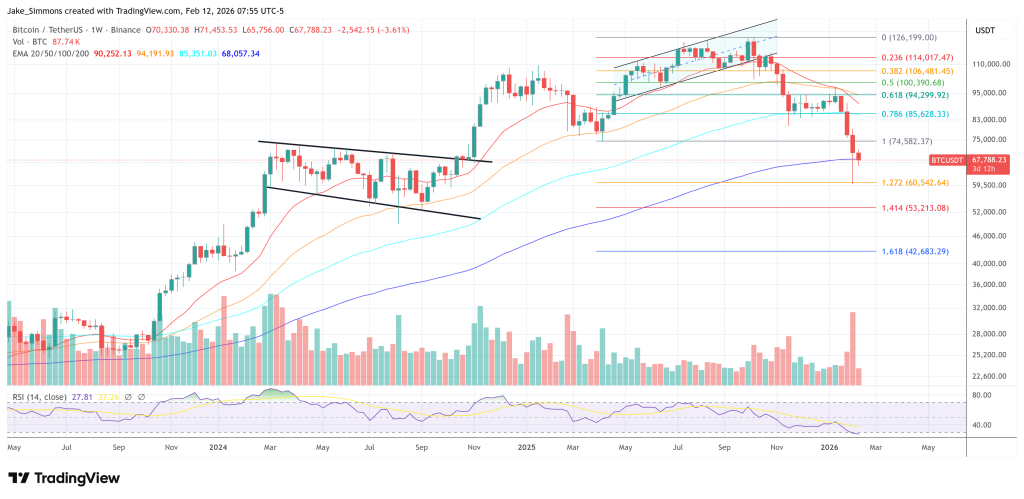
Bitcoin price chart
Market Opportunity
Checkmate Logo
Checkmate Price(CHECK)
$0.074293
$0.074293$0.074293
+1.34%
USD
Checkmate (CHECK) Live Price Chart
Disclaimer: The articles reposted on this site are sourced from public platforms and are provided for informational purposes only. They do not necessarily reflect the views of MEXC. All rights remain with the original authors. If you believe any content infringes on third-party rights, please contact service@support.mexc.com for removal. MEXC makes no guarantees regarding the accuracy, completeness, or timeliness of the content and is not responsible for any actions taken based on the information provided. The content does not constitute financial, legal, or other professional advice, nor should it be considered a recommendation or endorsement by MEXC.

You May Also Like

Fan Token Firm Chiliz Acquires 2-Time ‘Dota 2’ Champions, OG Esports

Fan Token Firm Chiliz Acquires 2-Time ‘Dota 2’ Champions, OG Esports

The post Fan Token Firm Chiliz Acquires 2-Time ‘Dota 2’ Champions, OG Esports appeared on BitcoinEthereumNews.com. In brief The Chiliz Group has acquired a controlling stake in OG Esports, a prominent competitive gaming organization. OG Esports unveiled its own fan token on Chiliz’s Socios.com platform back in 2020. It recently hit an all-time high price. Chiliz has teased various future team-related benefits for OG token holders, along with a new Web3-related project. The Chiliz Group, which operates the Socios.com crypto fan token platform, announced Tuesday that it has acquired a 51% controlling stake in OG Esports, the competitive gaming organization founded in 2015 by Dota 2 legends Johan “nOtail” Sundstein and Sébastien “Ceb” Debs. OG made history as the first team to win consecutive titles at The International—the annual, high-profile Dota 2 world championship tournament—in 2018 and 2019, and has since expanded into multiple games including Counter-Strike, Honor of Kings, and Marvel Rivals. The team was also the first esports organization to join the Socios platform with the 2020 debut of its own fan token, which Chiliz said recently became the first esports team token to exceed a $100 million market capitalization. OG was recently priced at $16.88, up nearly 9% on the day following the announcement. The token’s price peaked at a new all-time high of $24.78 last week ahead of The International 2025, where OG did not compete this year. Following the acquisition, Xavier Oswald will assume the CEO role, while the co-founders will turn their attention to “a new strategic project consolidating the team’s competitive foundation [and] driving innovation at the intersection of esports and Web3,” per a press release. No further details were provided regarding that project. “Bringing OG into the Chiliz Group is a major step toward further strengthening fan experiences, one where the community doesn’t just watch from the sidelines but gets to shape the journey,” Chiliz CEO Alex Dreyfus…
Share
BitcoinEthereumNews2025/09/18 09:40
Health Insurers To Cover Covid Vaccines Despite RFK, Jr. Moves

Health Insurers To Cover Covid Vaccines Despite RFK, Jr. Moves

The post Health Insurers To Cover Covid Vaccines Despite RFK, Jr. Moves appeared on BitcoinEthereumNews.com. The nation’s biggest health insurance companies will continue to cover vaccinations – including those against Covid-19 and seasonal flu – previously recommended by a federal advisory committee, America’s Health Insurance Plans said Wednesday, Sept. 17, 2025. In this photo is a free flu and Covid-19 vaccine shots available sign, CVS, Queens, New York. (Photo by: Lindsey Nicholson/Universal Images Group via Getty Images) UCG/Universal Images Group via Getty Images The nation’s biggest health insurance companies will continue to cover vaccinations – including those against Covid-19 and seasonal flu – previously recommended by a federal advisory committee. The announcement by America’s Health Insurance Plans (AHIP), which includes CVS Health’s Aetna, Humana, Cigna, Centene and an array of Blue Cross and Blue Shield plans as members, comes ahead of the first meeting of the reconstituted Advisory Committee on Immunization Practices, which now has new members chosen by U.S. Health and Human Services Secretary Robert F. Kennedy Jr., a vaccine critic. “Health plans are committed to maintaining and ensuring affordable access to vaccines,” AHIP said in a statement Wednesday. “Health plan coverage decisions for immunizations are grounded in each plan’s ongoing, rigorous review of scientific and clinical evidence, and continual evaluation of multiple sources of data.” The move by AHIP is good news for millions of Americans at a time of year when they flock to drugstores, pharmacies, physician’s offices and outpatient clinics to get their seasonal flu and Covid shots. Kennedy’s changes to U.S. vaccine policy have created confusion across the country over whether certain vaccines long covered by insurance would continue to be. AHIP has now provided some clarity for millions of Americans. “Health plans will continue to cover all ACIP-recommended immunizations that were recommended as of September 1, 2025, including updated formulations of the COVID-19 and influenza vaccines, with no cost-sharing…
Share
BitcoinEthereumNews2025/09/18 03:11
Vitalik Buterin Reveals Ethereum’s Bold Plan to Stay Quantum-Secure and Simple!

Vitalik Buterin Reveals Ethereum’s Bold Plan to Stay Quantum-Secure and Simple!

Buterin unveils Ethereum’s strategy to tackle quantum security challenges ahead. Ethereum focuses on simplifying architecture while boosting security for users. Ethereum’s market stability grows as Buterin’s roadmap gains investor confidence. Ethereum founder Vitalik Buterin has unveiled his long-term vision for the blockchain, focusing on making Ethereum quantum-secure while maintaining its simplicity for users. Buterin presented his roadmap at the Japanese Developer Conference, and splits the future of Ethereum into three phases: short-term, mid-term, and long-term. Buterin’s most ambitious goal for Ethereum is to safeguard the blockchain against the threats posed by quantum computing.  The danger of such future developments is that the future may call into question the cryptographic security of most blockchain systems, and Ethereum will be able to remain ahead thanks to more sophisticated mathematical techniques to ensure the safety and integrity of its protocols. Buterin is committed to ensuring that Ethereum evolves in a way that not only meets today’s security challenges but also prepares for the unknowns of tomorrow. Also Read: Ethereum Giant The Ether Machine Takes Major Step Toward Going Public! However, in spite of such high ambitions, Buterin insisted that Ethereum also needed to simplify its architecture. An important aspect of this vision is to remove unnecessary complexity and make Ethereum more accessible and maintainable without losing its strong security capabilities. Security and simplicity form the core of Buterin’s strategy, as they guarantee that the users of Ethereum experience both security and smooth processes. Focus on Speed and Efficiency in the Short-Term In the short term, Buterin aims to enhance Ethereum’s transaction efficiency, a crucial step toward improving scalability and reducing transaction costs. These advantages are attributed to the fact that, within the mid-term, Ethereum is planning to enhance the speed of transactions in layer-2 networks. According to Butterin, this is part of Ethereum’s expansion, particularly because there is still more need to use blockchain technology to date. The other important aspect of Ethereum’s development is the layer-2 solutions. Buterin supports an approach in which the layer-2 networks are dependent on layer-1 to perform some essential tasks like data security, proof, and censorship resistance. This will enable the layer-2 systems of Ethereum to be concerned with verifying and sequencing transactions, which will improve the overall speed and efficiency of the network. Ethereum’s Market Stability Reflects Confidence in Long-Term Strategy Ethereum’s market performance has remained solid, with the cryptocurrency holding steady above $4,000. Currently priced at $4,492.15, Ethereum has experienced a slight 0.93% increase over the last 24 hours, while its trading volume surged by 8.72%, reaching $34.14 billion. These figures point to growing investor confidence in Ethereum’s long-term vision. The crypto community remains optimistic about Ethereum’s future, with many predicting the price could rise to $5,500 by mid-October. Buterin’s clear, forward-thinking strategy continues to build trust in Ethereum as one of the most secure and scalable blockchain platforms in the market. Also Read: Whales Dump 200 Million XRP in Just 2 Weeks – Is XRP’s Price on the Verge of Collapse? The post Vitalik Buterin Reveals Ethereum’s Bold Plan to Stay Quantum-Secure and Simple! appeared first on 36Crypto.
Share
Coinstats2025/09/18 01:22