By Tiger Research Compiled by AididiaoJP, Foresight News summary While the AI agent market saw a sharp decline in popularity following the token price crash, technological development continues at a steady pace. The DeFAI sector is regaining attention with real product releases and specialized on-chain functionality. Specialized agents optimized for specific functions have replaced the previous general-purpose agents. Projects such as Virtuals are actively building the infrastructure to connect these agents and enable them to collaborate. AI agents will be integrated into crypto projects as core functionality. Infrastructure that enables smooth communication and collaboration between agents will become crucial. The hype ends, the technology continues The cryptocurrency industry has incorporated AI technology in various ways, with AI agents receiving the most attention. The total market capitalization of agent-related tokens reached approximately $16 billion at one point. This demonstrated strong market interest, but the interest was short-lived. Most projects failed to meet development expectations, and token prices plummeted by over 90% from their peak. Falling prices don't necessarily signal technological regression. AI agents remain a crucial area of technology in the crypto space. Discussions about practical use cases are becoming more concrete, and teams continue to test new approaches. This report explores how AI agents are playing a role in crypto and explores potential future developments. Reshaping the AI Agent Ecosystem After the Hype Early AI agent projects gradually faded from the market The AI agent sector in the crypto space began to gain traction in late 2024. ElizaOS by the ai16z team and the GAME development stack by the Virtuals Protocol team significantly lowered the barrier to entry for agent development. Launchpads like DAOS.fun and Virtuals Fun provided platforms for tokenizing developed agents. This streamlined process from development to release fueled a surge in market interest, leading to the rapid emergence of numerous agent projects. Most projects have ambitious roadmaps leveraging AI technology. Investors, anticipating innovative services, have driven up token prices. In reality, these projects are merely wrappers of OpenAI or Anthropic's base models, tweaked or cue-engineered. Most are building advanced chatbots for X or Telegram rather than developing standalone services. While these projects emphasize innovative visions and technological differentiation, their actual operations are virtually indistinguishable from meme coins. Source: aixbt However, some projects are exceptions. Projects like aixbt and Soleng have partially implemented their roadmaps and launched actual services. They use token gating to provide exclusive access to token holders. Aixbt provides project analysis reports, while Soleng analyzes Github repositories to support investor decision-making. Even these relatively successful projects couldn't overcome structural limitations. Unstable revenue structures reliant solely on token price increases hindered progress. Technological competitiveness lagged behind that of Web2 companies. Token prices eventually plummeted, operating funds dried up, and most projects have now suspended operations. The DeFAI project has rekindled hope in the field AI agent technology, once facing over-hyped expectations, is now entering a correction phase. The DeFi (DeFi) sector is regaining attention by proving its real-world value. DeFi agents execute automated investment strategies 24/7. They enable users to easily access complex DeFi services through simple natural language commands. This sector was a core narrative in the early days of the AI agent space. Most projects remained in the roadmap phase, struggling to achieve actual implementation. The sector temporarily lost attention. Recent product launches are rebuilding market expectations. Representative projects include Wayfinder and HeyAnon. Wayfinder uses specialized AI agents called "Shells" to perform on-chain tasks. Shells execute transactions directly on-chain through a built-in dedicated wallet. The system utilizes a specialized multi-agent architecture, encompassing trading agents, perpetual agents, and contract agents. Each agent type specializes in a specific role, enabling automation of various investment strategies. Users can easily execute simple cross-chain trades or advanced strategies such as basis trading and leveraged fixed-investing. From individual agents to agent networks Early AI agent projects promoted "general-purpose agents" that could perform all functions. This approach prioritized funding over technological completeness. Projects proposed excessive roadmaps to capture a broader market, and most exposed limitations during implementation. The current agent ecosystem is moving in a completely different direction. Builders, recognizing the limitations of general-purpose agents, are now developing specialized agents. These agents can collaborate with one another, similar to how skilled craftsmen with diverse expertise—carpenters, electricians, plumbers, and so on—collaborate to build a house. Virtuals Protocol's ACP represents this trend. It provides a standard framework for communication and task allocation between different agents. Theoriq and General Impression are also building infrastructure to enhance interoperability between agents. The market is reshaping itself, shifting towards maximizing the value of the entire agent ecosystem, rather than the value of individual agents. Future scenarios for the AI agent market Even after the early hype cooled, AI agents continued to evolve. While the speculation ended, projects continued to build new features and services using AI agents. Two developments stood out. First, AI agents are becoming essential infrastructure. They are no longer a standalone field, but are being integrated into crypto projects as a fundamental feature. Nansen, a blockchain data platform, has developed research agents to make complex on-chain data easier to explore. DeFi projects are also adding agents to improve user access. AI agents will become the final interface connecting users to the blockchain, not an optional feature. Second, agent commerce will grow. As AI agents become standard, interactions between agents and humans will become more frequent. Secure transaction protocols and trust mechanisms will become increasingly important. Projects like Virtuals Protocol's ACP are laying the foundation for this. These changes will simplify the complexities of the crypto space, improve user experience, and create new economic opportunities.By Tiger Research Compiled by AididiaoJP, Foresight News summary While the AI agent market saw a sharp decline in popularity following the token price crash, technological development continues at a steady pace. The DeFAI sector is regaining attention with real product releases and specialized on-chain functionality. Specialized agents optimized for specific functions have replaced the previous general-purpose agents. Projects such as Virtuals are actively building the infrastructure to connect these agents and enable them to collaborate. AI agents will be integrated into crypto projects as core functionality. Infrastructure that enables smooth communication and collaboration between agents will become crucial. The hype ends, the technology continues The cryptocurrency industry has incorporated AI technology in various ways, with AI agents receiving the most attention. The total market capitalization of agent-related tokens reached approximately $16 billion at one point. This demonstrated strong market interest, but the interest was short-lived. Most projects failed to meet development expectations, and token prices plummeted by over 90% from their peak. Falling prices don't necessarily signal technological regression. AI agents remain a crucial area of technology in the crypto space. Discussions about practical use cases are becoming more concrete, and teams continue to test new approaches. This report explores how AI agents are playing a role in crypto and explores potential future developments. Reshaping the AI Agent Ecosystem After the Hype Early AI agent projects gradually faded from the market The AI agent sector in the crypto space began to gain traction in late 2024. ElizaOS by the ai16z team and the GAME development stack by the Virtuals Protocol team significantly lowered the barrier to entry for agent development. Launchpads like DAOS.fun and Virtuals Fun provided platforms for tokenizing developed agents. This streamlined process from development to release fueled a surge in market interest, leading to the rapid emergence of numerous agent projects. Most projects have ambitious roadmaps leveraging AI technology. Investors, anticipating innovative services, have driven up token prices. In reality, these projects are merely wrappers of OpenAI or Anthropic's base models, tweaked or cue-engineered. Most are building advanced chatbots for X or Telegram rather than developing standalone services. While these projects emphasize innovative visions and technological differentiation, their actual operations are virtually indistinguishable from meme coins. Source: aixbt However, some projects are exceptions. Projects like aixbt and Soleng have partially implemented their roadmaps and launched actual services. They use token gating to provide exclusive access to token holders. Aixbt provides project analysis reports, while Soleng analyzes Github repositories to support investor decision-making. Even these relatively successful projects couldn't overcome structural limitations. Unstable revenue structures reliant solely on token price increases hindered progress. Technological competitiveness lagged behind that of Web2 companies. Token prices eventually plummeted, operating funds dried up, and most projects have now suspended operations. The DeFAI project has rekindled hope in the field AI agent technology, once facing over-hyped expectations, is now entering a correction phase. The DeFi (DeFi) sector is regaining attention by proving its real-world value. DeFi agents execute automated investment strategies 24/7. They enable users to easily access complex DeFi services through simple natural language commands. This sector was a core narrative in the early days of the AI agent space. Most projects remained in the roadmap phase, struggling to achieve actual implementation. The sector temporarily lost attention. Recent product launches are rebuilding market expectations. Representative projects include Wayfinder and HeyAnon. Wayfinder uses specialized AI agents called "Shells" to perform on-chain tasks. Shells execute transactions directly on-chain through a built-in dedicated wallet. The system utilizes a specialized multi-agent architecture, encompassing trading agents, perpetual agents, and contract agents. Each agent type specializes in a specific role, enabling automation of various investment strategies. Users can easily execute simple cross-chain trades or advanced strategies such as basis trading and leveraged fixed-investing. From individual agents to agent networks Early AI agent projects promoted "general-purpose agents" that could perform all functions. This approach prioritized funding over technological completeness. Projects proposed excessive roadmaps to capture a broader market, and most exposed limitations during implementation. The current agent ecosystem is moving in a completely different direction. Builders, recognizing the limitations of general-purpose agents, are now developing specialized agents. These agents can collaborate with one another, similar to how skilled craftsmen with diverse expertise—carpenters, electricians, plumbers, and so on—collaborate to build a house. Virtuals Protocol's ACP represents this trend. It provides a standard framework for communication and task allocation between different agents. Theoriq and General Impression are also building infrastructure to enhance interoperability between agents. The market is reshaping itself, shifting towards maximizing the value of the entire agent ecosystem, rather than the value of individual agents. Future scenarios for the AI agent market Even after the early hype cooled, AI agents continued to evolve. While the speculation ended, projects continued to build new features and services using AI agents. Two developments stood out. First, AI agents are becoming essential infrastructure. They are no longer a standalone field, but are being integrated into crypto projects as a fundamental feature. Nansen, a blockchain data platform, has developed research agents to make complex on-chain data easier to explore. DeFi projects are also adding agents to improve user access. AI agents will become the final interface connecting users to the blockchain, not an optional feature. Second, agent commerce will grow. As AI agents become standard, interactions between agents and humans will become more frequent. Secure transaction protocols and trust mechanisms will become increasingly important. Projects like Virtuals Protocol's ACP are laying the foundation for this. These changes will simplify the complexities of the crypto space, improve user experience, and create new economic opportunities.

AI Agent Market Map: Hype is over, technology continues

2025/08/30 10:29
5 min read

By Tiger Research

Compiled by AididiaoJP, Foresight News

summary

  • While the AI agent market saw a sharp decline in popularity following the token price crash, technological development continues at a steady pace. The DeFAI sector is regaining attention with real product releases and specialized on-chain functionality.
  • Specialized agents optimized for specific functions have replaced the previous general-purpose agents. Projects such as Virtuals are actively building the infrastructure to connect these agents and enable them to collaborate.
  • AI agents will be integrated into crypto projects as core functionality. Infrastructure that enables smooth communication and collaboration between agents will become crucial.

The hype ends, the technology continues

The cryptocurrency industry has incorporated AI technology in various ways, with AI agents receiving the most attention. The total market capitalization of agent-related tokens reached approximately $16 billion at one point. This demonstrated strong market interest, but the interest was short-lived. Most projects failed to meet development expectations, and token prices plummeted by over 90% from their peak.

Falling prices don't necessarily signal technological regression. AI agents remain a crucial area of technology in the crypto space. Discussions about practical use cases are becoming more concrete, and teams continue to test new approaches. This report explores how AI agents are playing a role in crypto and explores potential future developments.

Reshaping the AI Agent Ecosystem After the Hype
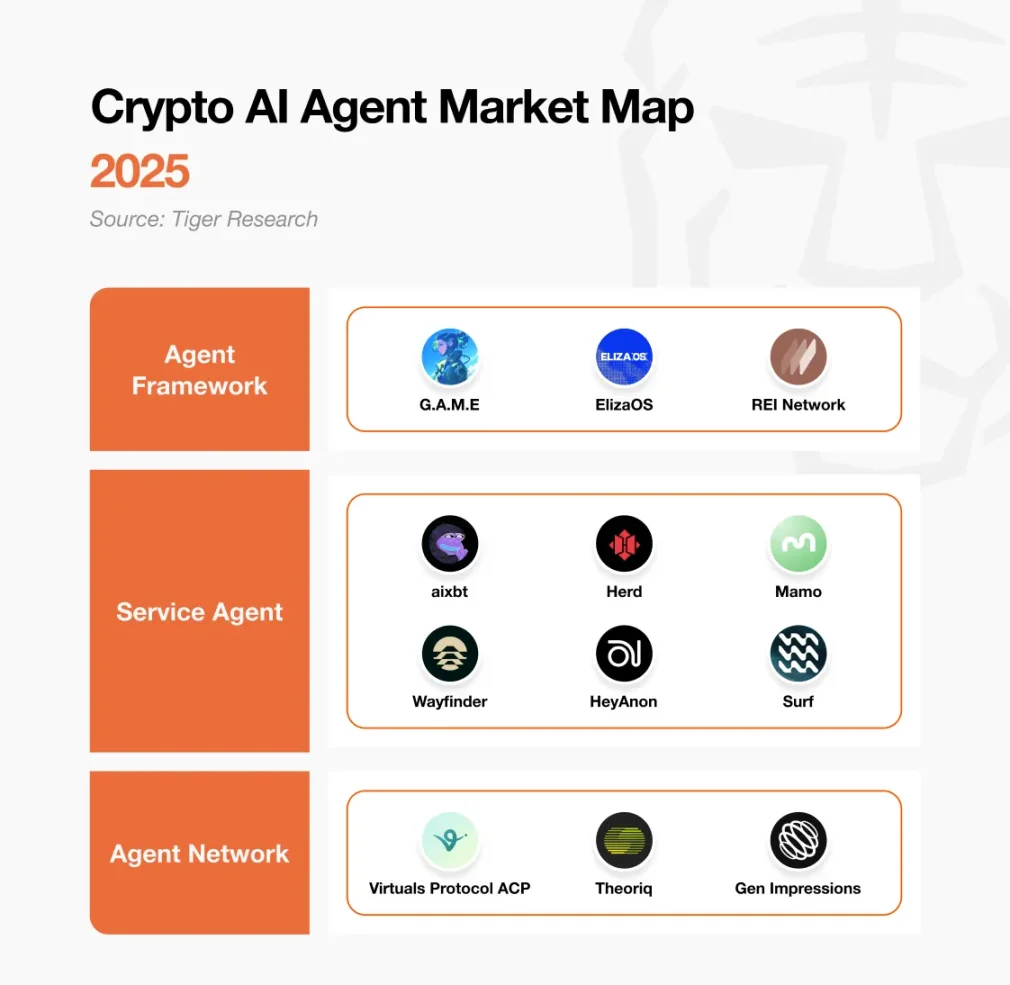
Early AI agent projects gradually faded from the market

The AI agent sector in the crypto space began to gain traction in late 2024. ElizaOS by the ai16z team and the GAME development stack by the Virtuals Protocol team significantly lowered the barrier to entry for agent development. Launchpads like DAOS.fun and Virtuals Fun provided platforms for tokenizing developed agents. This streamlined process from development to release fueled a surge in market interest, leading to the rapid emergence of numerous agent projects.
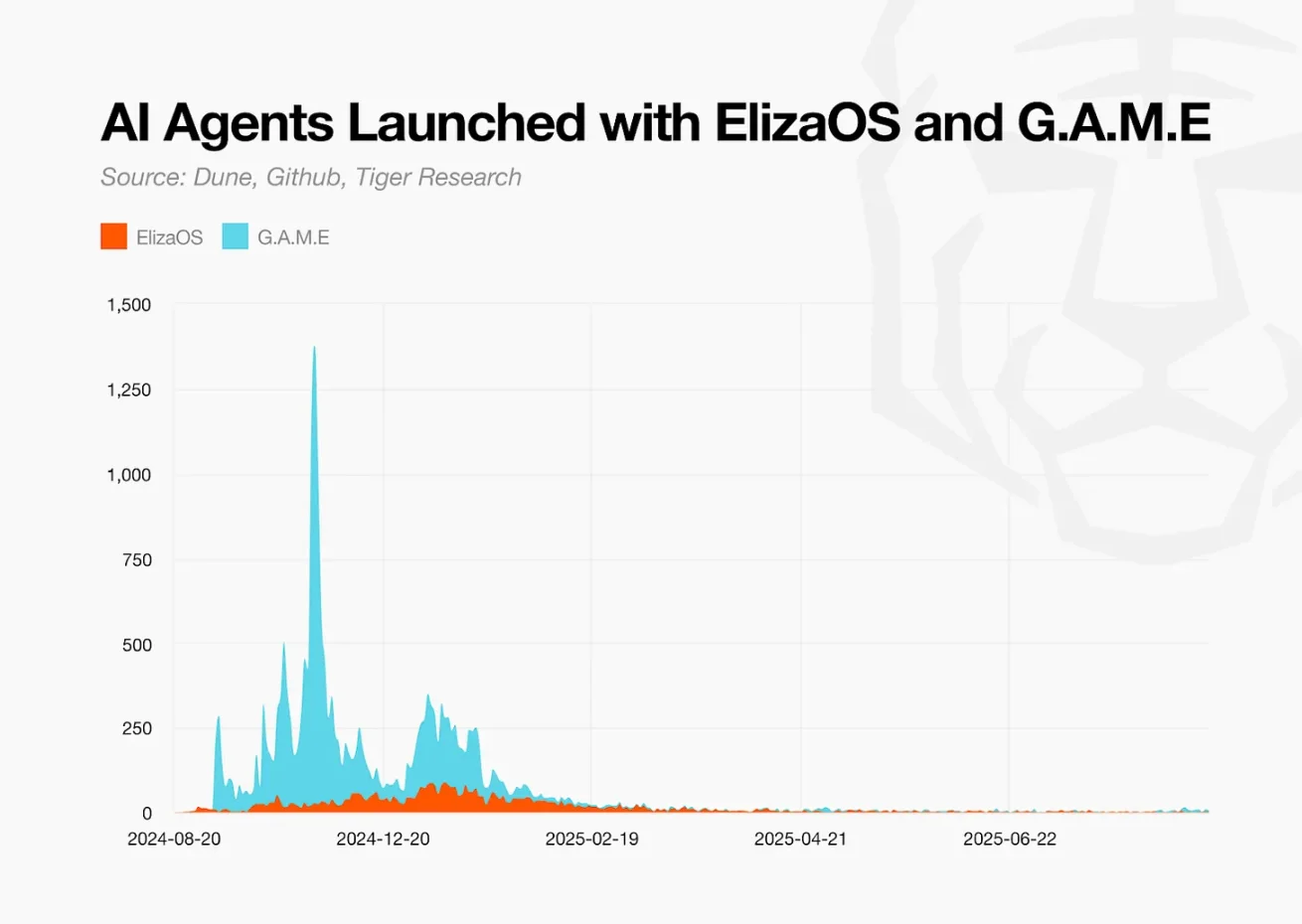
Most projects have ambitious roadmaps leveraging AI technology. Investors, anticipating innovative services, have driven up token prices. In reality, these projects are merely wrappers of OpenAI or Anthropic's base models, tweaked or cue-engineered. Most are building advanced chatbots for X or Telegram rather than developing standalone services. While these projects emphasize innovative visions and technological differentiation, their actual operations are virtually indistinguishable from meme coins.
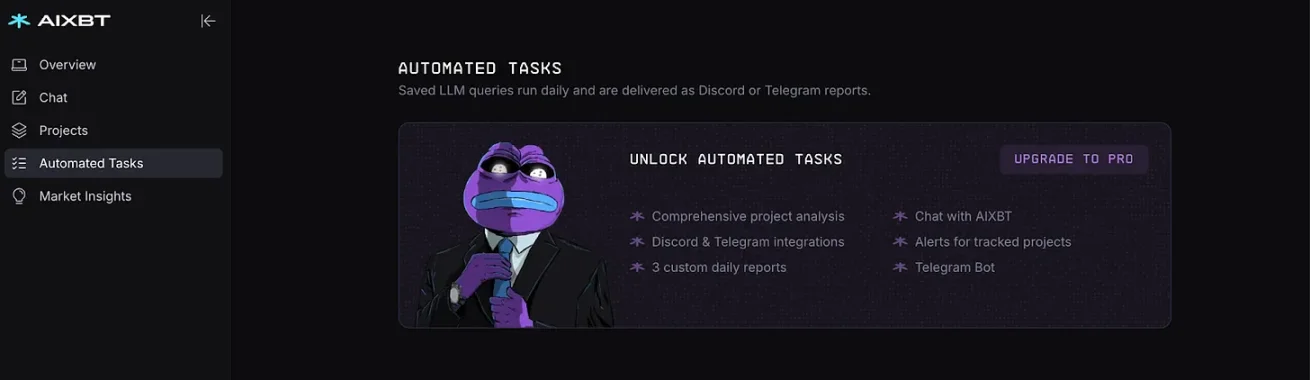
 Source: aixbt

However, some projects are exceptions. Projects like aixbt and Soleng have partially implemented their roadmaps and launched actual services. They use token gating to provide exclusive access to token holders. Aixbt provides project analysis reports, while Soleng analyzes Github repositories to support investor decision-making.

Even these relatively successful projects couldn't overcome structural limitations. Unstable revenue structures reliant solely on token price increases hindered progress. Technological competitiveness lagged behind that of Web2 companies. Token prices eventually plummeted, operating funds dried up, and most projects have now suspended operations.

The DeFAI project has rekindled hope in the field

AI agent technology, once facing over-hyped expectations, is now entering a correction phase. The DeFi (DeFi) sector is regaining attention by proving its real-world value. DeFi agents execute automated investment strategies 24/7. They enable users to easily access complex DeFi services through simple natural language commands. This sector was a core narrative in the early days of the AI agent space. Most projects remained in the roadmap phase, struggling to achieve actual implementation. The sector temporarily lost attention. Recent product launches are rebuilding market expectations.

Representative projects include Wayfinder and HeyAnon. Wayfinder uses specialized AI agents called "Shells" to perform on-chain tasks. Shells execute transactions directly on-chain through a built-in dedicated wallet. The system utilizes a specialized multi-agent architecture, encompassing trading agents, perpetual agents, and contract agents. Each agent type specializes in a specific role, enabling automation of various investment strategies. Users can easily execute simple cross-chain trades or advanced strategies such as basis trading and leveraged fixed-investing.

From individual agents to agent networks

Early AI agent projects promoted "general-purpose agents" that could perform all functions. This approach prioritized funding over technological completeness. Projects proposed excessive roadmaps to capture a broader market, and most exposed limitations during implementation.

The current agent ecosystem is moving in a completely different direction. Builders, recognizing the limitations of general-purpose agents, are now developing specialized agents. These agents can collaborate with one another, similar to how skilled craftsmen with diverse expertise—carpenters, electricians, plumbers, and so on—collaborate to build a house.

Virtuals Protocol's ACP represents this trend. It provides a standard framework for communication and task allocation between different agents. Theoriq and General Impression are also building infrastructure to enhance interoperability between agents. The market is reshaping itself, shifting towards maximizing the value of the entire agent ecosystem, rather than the value of individual agents.

Future scenarios for the AI agent market

Even after the early hype cooled, AI agents continued to evolve. While the speculation ended, projects continued to build new features and services using AI agents. Two developments stood out.

First, AI agents are becoming essential infrastructure. They are no longer a standalone field, but are being integrated into crypto projects as a fundamental feature. Nansen, a blockchain data platform, has developed research agents to make complex on-chain data easier to explore. DeFi projects are also adding agents to improve user access. AI agents will become the final interface connecting users to the blockchain, not an optional feature.

Second, agent commerce will grow. As AI agents become standard, interactions between agents and humans will become more frequent. Secure transaction protocols and trust mechanisms will become increasingly important. Projects like Virtuals Protocol's ACP are laying the foundation for this.

These changes will simplify the complexities of the crypto space, improve user experience, and create new economic opportunities.

Market Opportunity
Threshold Logo
Threshold Price(T)
$0.007675
$0.007675$0.007675
-0.44%
USD
Threshold (T) Live Price Chart
Disclaimer: The articles reposted on this site are sourced from public platforms and are provided for informational purposes only. They do not necessarily reflect the views of MEXC. All rights remain with the original authors. If you believe any content infringes on third-party rights, please contact service@support.mexc.com for removal. MEXC makes no guarantees regarding the accuracy, completeness, or timeliness of the content and is not responsible for any actions taken based on the information provided. The content does not constitute financial, legal, or other professional advice, nor should it be considered a recommendation or endorsement by MEXC.

You May Also Like

Securities Fraud Investigation Into Corcept Therapeutics Incorporated (CORT) Announced – Shareholders Who Lost Money Urged To Contact Glancy Prongay Wolke & Rotter LLP, a Leading Securities Fraud Law Firm

Securities Fraud Investigation Into Corcept Therapeutics Incorporated (CORT) Announced – Shareholders Who Lost Money Urged To Contact Glancy Prongay Wolke & Rotter LLP, a Leading Securities Fraud Law Firm

LOS ANGELES–(BUSINESS WIRE)–Glancy Prongay Wolke & Rotter LLP, a leading national shareholder rights law firm, today announced that it has commenced an investigation
Share
AI Journal2026/02/05 04:00
Microsoft Corp. $MSFT blue box area offers a buying opportunity
Microsoft Corp. $MSFT blue box area offers a buying opportunity

The post Microsoft Corp. $MSFT blue box area offers a buying opportunity appeared on BitcoinEthereumNews.com. In today’s article, we’ll examine the recent performance of Microsoft Corp. ($MSFT) through the lens of Elliott Wave Theory. We’ll review how the rally from the April 07, 2025 low unfolded as a 5-wave impulse followed by a 3-swing correction (ABC) and discuss our forecast for the next move. Let’s dive into the structure and expectations for this stock. Five wave impulse structure + ABC + WXY correction $MSFT 8H Elliott Wave chart 9.04.2025 In the 8-hour Elliott Wave count from Sep 04, 2025, we saw that $MSFT completed a 5-wave impulsive cycle at red III. As expected, this initial wave prompted a pullback. We anticipated this pullback to unfold in 3 swings and find buyers in the equal legs area between $497.02 and $471.06 This setup aligns with a typical Elliott Wave correction pattern (ABC), in which the market pauses briefly before resuming its primary trend. $MSFT 8H Elliott Wave chart 7.14.2025 The update, 10 days later, shows the stock finding support from the equal legs area as predicted allowing traders to get risk free. The stock is expected to bounce towards 525 – 532 before deciding if the bounce is a connector or the next leg higher. A break into new ATHs will confirm the latter and can see it trade higher towards 570 – 593 area. Until then, traders should get risk free and protect their capital in case of a WXY double correction. Conclusion In conclusion, our Elliott Wave analysis of Microsoft Corp. ($MSFT) suggested that it remains supported against April 07, 2025 lows and bounce from the blue box area. In the meantime, keep an eye out for any corrective pullbacks that may offer entry opportunities. By applying Elliott Wave Theory, traders can better anticipate the structure of upcoming moves and enhance risk management in volatile markets. Source: https://www.fxstreet.com/news/microsoft-corp-msft-blue-box-area-offers-a-buying-opportunity-202509171323
Share
BitcoinEthereumNews2025/09/18 03:50
Over 80% of 135 Ethereum L2s record below 1 user operation per second

Over 80% of 135 Ethereum L2s record below 1 user operation per second

The post Over 80% of 135 Ethereum L2s record below 1 user operation per second  appeared on BitcoinEthereumNews.com. Ethereum’s L2s are not doing too well. Data
Share
BitcoinEthereumNews2026/02/05 03:52
