Source: Alea Research Daily Newsletter Compiled by: Zhou, ChainCatcher Synthetic derivatives, decentralized oracles, and composable liquidity protocols enable traders to access everything from Bitcoin and ETH to gold and FX using stablecoin collateral. Since Avantis launched on the mainnet in February 2024, it has become the largest derivatives exchange on Base and the largest DEX in the RWA trading and market making field. The protocol has processed over $18 billion in cumulative trading volume and executed over 2 million trades for over 38,500 traders. With $23 million in TVL across 25,000+ LPs and over 80 markets, Avantis is solidifying its position as a hub for perps. This article will explore Universal Leverage, Avantis's architecture, and the launch of $AVNT. About Avantis Avantis is a perps DEX that allows users to trade cryptocurrencies, forex, commodities, and indices using stablecoin collateral. The protocol abstracts away individual order books and instead builds a “universal leverage layer” where any asset with a reliable price feed can be listed. Synthetic leverage is achieved through a USDC-based liquidity vault that acts as the counterparty for all trades, enabling capital-efficient exposure to multiple markets. Traders can choose up to 500x leverage, allowing them to express directional views with minimal capital, while liquidity providers (LPs) earn a yield by providing USDC to support their positions. Avantis distinguishes itself from other perpetual swap exchanges in that users can trade non-crypto markets like the Japanese Yen, gold, and US stock indices alongside BTC or ETH. The protocol's design also supports features like zero trading fees, loss rebates, and positive slippage, aligning incentives between traders and limited partners by returning a portion of fees or profits to users when they improve the protocol's risk profile. Avantis Architecture At its core, Avantis is a capital-efficient synthetic engine. Traders use the protocol's interface to open positions on supported assets. Instead of matching orders in an order book, Avantis pairs each trader with a USDC vault that takes the other side of the trade. This vault aggregates deposits from thousands of limited partners and acts as a single counterparty. This structure allows the protocol to offer deep liquidity across many markets without requiring separate liquidity pools for each pair, enabling Avantis to list over 80 markets, including 22 RWA assets. Avantis introduces risk tranches and time-lock parameters so that LPs can choose their preferred exposure. LPs can passively deposit in the senior tranche or take more risk in the junior tranche, which has higher return potential but also absorbs a greater share of losses. Additionally, LPs can choose a time lock (e.g., 30 or 90 days) to control the duration of their capital commitment, with longer locks incurring more fees. This design mimics the centralized liquidity model of Uniswap v3 while applying it to the risk management of perps exchanges. Trader <> LP Alignment Avantis' innovative mechanism further aligns the interests of traders and LPs. Loss Rebates: Traders who take the opposite side of open interest (helping balance the platform’s long/short skew) can receive up to 20% loss rebates. This encourages traders to arbitrage open interest and stabilize LP exposure. Positive Slippage: When a trader's order reduces the vault's risk (e.g., closing out a heavily long position), Avantis offers an entry price above the Mark Price. This "better-than-market" execution rewards traders for helping to balance flows. Zero Trading Fees: Avantis pioneered a product where traders pay no fees to open, close, or borrow positions. Instead, they pay only a portion of their profits when closing a winning trade. Available for $BTC, $SOL, and $ETH, with leverage up to 250x, this tool is popular with scalpers and high-frequency traders. Advanced Risk Management: LPs can act as passive lenders or active market makers by selecting risk tranches and time locks. Each tranche has its own share of fees and potential losses, enabling LPs to control risk and return. $AVNT: Token Issuance and Token Economics To facilitate its next phase of growth, Avantis has launched $AVNT, a utility and governance token. $AVNT has multiple functions: Security and Staking: Holders can stake $AVNT in the Avantis Security Module to support the USDC vault during periods of extreme market volatility. Stakers receive $AVNT rewards and discounted trading fees. Community Rewards: 50.1% of the total 1 billion token supply is reserved for traders, liquidity providers, referrers, and builders who contribute to Avantis. Airdrops (12.5% of the supply) will reward protocol activity starting in February 2024, while on-chain incentives (28.6%) will fund future XP seasons and community contributions. Builder and ecosystem grants (9%) will support the creation of new front-ends and trading tools, such as AI agents and Telegram bots. Governance: Token holders will be able to propose and vote on protocol decisions, ranging from asset listings and fee structures to buyback programs and cross-chain deployments. The remaining 49.9% of the supply is distributed as follows: Team (13.3%) Investors (26.61%) Avantis Foundation (4%) Liquidity reserve (6%)Source: Alea Research Daily Newsletter Compiled by: Zhou, ChainCatcher Synthetic derivatives, decentralized oracles, and composable liquidity protocols enable traders to access everything from Bitcoin and ETH to gold and FX using stablecoin collateral. Since Avantis launched on the mainnet in February 2024, it has become the largest derivatives exchange on Base and the largest DEX in the RWA trading and market making field. The protocol has processed over $18 billion in cumulative trading volume and executed over 2 million trades for over 38,500 traders. With $23 million in TVL across 25,000+ LPs and over 80 markets, Avantis is solidifying its position as a hub for perps. This article will explore Universal Leverage, Avantis's architecture, and the launch of $AVNT. About Avantis Avantis is a perps DEX that allows users to trade cryptocurrencies, forex, commodities, and indices using stablecoin collateral. The protocol abstracts away individual order books and instead builds a “universal leverage layer” where any asset with a reliable price feed can be listed. Synthetic leverage is achieved through a USDC-based liquidity vault that acts as the counterparty for all trades, enabling capital-efficient exposure to multiple markets. Traders can choose up to 500x leverage, allowing them to express directional views with minimal capital, while liquidity providers (LPs) earn a yield by providing USDC to support their positions. Avantis distinguishes itself from other perpetual swap exchanges in that users can trade non-crypto markets like the Japanese Yen, gold, and US stock indices alongside BTC or ETH. The protocol's design also supports features like zero trading fees, loss rebates, and positive slippage, aligning incentives between traders and limited partners by returning a portion of fees or profits to users when they improve the protocol's risk profile. Avantis Architecture At its core, Avantis is a capital-efficient synthetic engine. Traders use the protocol's interface to open positions on supported assets. Instead of matching orders in an order book, Avantis pairs each trader with a USDC vault that takes the other side of the trade. This vault aggregates deposits from thousands of limited partners and acts as a single counterparty. This structure allows the protocol to offer deep liquidity across many markets without requiring separate liquidity pools for each pair, enabling Avantis to list over 80 markets, including 22 RWA assets. Avantis introduces risk tranches and time-lock parameters so that LPs can choose their preferred exposure. LPs can passively deposit in the senior tranche or take more risk in the junior tranche, which has higher return potential but also absorbs a greater share of losses. Additionally, LPs can choose a time lock (e.g., 30 or 90 days) to control the duration of their capital commitment, with longer locks incurring more fees. This design mimics the centralized liquidity model of Uniswap v3 while applying it to the risk management of perps exchanges. Trader <> LP Alignment Avantis' innovative mechanism further aligns the interests of traders and LPs. Loss Rebates: Traders who take the opposite side of open interest (helping balance the platform’s long/short skew) can receive up to 20% loss rebates. This encourages traders to arbitrage open interest and stabilize LP exposure. Positive Slippage: When a trader's order reduces the vault's risk (e.g., closing out a heavily long position), Avantis offers an entry price above the Mark Price. This "better-than-market" execution rewards traders for helping to balance flows. Zero Trading Fees: Avantis pioneered a product where traders pay no fees to open, close, or borrow positions. Instead, they pay only a portion of their profits when closing a winning trade. Available for $BTC, $SOL, and $ETH, with leverage up to 250x, this tool is popular with scalpers and high-frequency traders. Advanced Risk Management: LPs can act as passive lenders or active market makers by selecting risk tranches and time locks. Each tranche has its own share of fees and potential losses, enabling LPs to control risk and return. $AVNT: Token Issuance and Token Economics To facilitate its next phase of growth, Avantis has launched $AVNT, a utility and governance token. $AVNT has multiple functions: Security and Staking: Holders can stake $AVNT in the Avantis Security Module to support the USDC vault during periods of extreme market volatility. Stakers receive $AVNT rewards and discounted trading fees. Community Rewards: 50.1% of the total 1 billion token supply is reserved for traders, liquidity providers, referrers, and builders who contribute to Avantis. Airdrops (12.5% of the supply) will reward protocol activity starting in February 2024, while on-chain incentives (28.6%) will fund future XP seasons and community contributions. Builder and ecosystem grants (9%) will support the creation of new front-ends and trading tools, such as AI agents and Telegram bots. Governance: Token holders will be able to propose and vote on protocol decisions, ranging from asset listings and fee structures to buyback programs and cross-chain deployments. The remaining 49.9% of the supply is distributed as follows: Team (13.3%) Investors (26.61%) Avantis Foundation (4%) Liquidity reserve (6%)

Zero Fees + 500x Leverage: Understanding Avantis, the Largest Derivatives Exchange on Base

2025/09/04 08:00
5 min read

Source: Alea Research Daily Newsletter

Compiled by: Zhou, ChainCatcher

Synthetic derivatives, decentralized oracles, and composable liquidity protocols enable traders to access everything from Bitcoin and ETH to gold and FX using stablecoin collateral.

Since Avantis launched on the mainnet in February 2024, it has become the largest derivatives exchange on Base and the largest DEX in the RWA trading and market making field.

The protocol has processed over $18 billion in cumulative trading volume and executed over 2 million trades for over 38,500 traders. With $23 million in TVL across 25,000+ LPs and over 80 markets, Avantis is solidifying its position as a hub for perps.

This article will explore Universal Leverage, Avantis's architecture, and the launch of $AVNT.

About Avantis

Avantis is a perps DEX that allows users to trade cryptocurrencies, forex, commodities, and indices using stablecoin collateral. The protocol abstracts away individual order books and instead builds a “universal leverage layer” where any asset with a reliable price feed can be listed.

Synthetic leverage is achieved through a USDC-based liquidity vault that acts as the counterparty for all trades, enabling capital-efficient exposure to multiple markets. Traders can choose up to 500x leverage, allowing them to express directional views with minimal capital, while liquidity providers (LPs) earn a yield by providing USDC to support their positions.

Avantis distinguishes itself from other perpetual swap exchanges in that users can trade non-crypto markets like the Japanese Yen, gold, and US stock indices alongside BTC or ETH. The protocol's design also supports features like zero trading fees, loss rebates, and positive slippage, aligning incentives between traders and limited partners by returning a portion of fees or profits to users when they improve the protocol's risk profile.

Avantis Architecture

At its core, Avantis is a capital-efficient synthetic engine. Traders use the protocol's interface to open positions on supported assets. Instead of matching orders in an order book, Avantis pairs each trader with a USDC vault that takes the other side of the trade. This vault aggregates deposits from thousands of limited partners and acts as a single counterparty. This structure allows the protocol to offer deep liquidity across many markets without requiring separate liquidity pools for each pair, enabling Avantis to list over 80 markets, including 22 RWA assets.
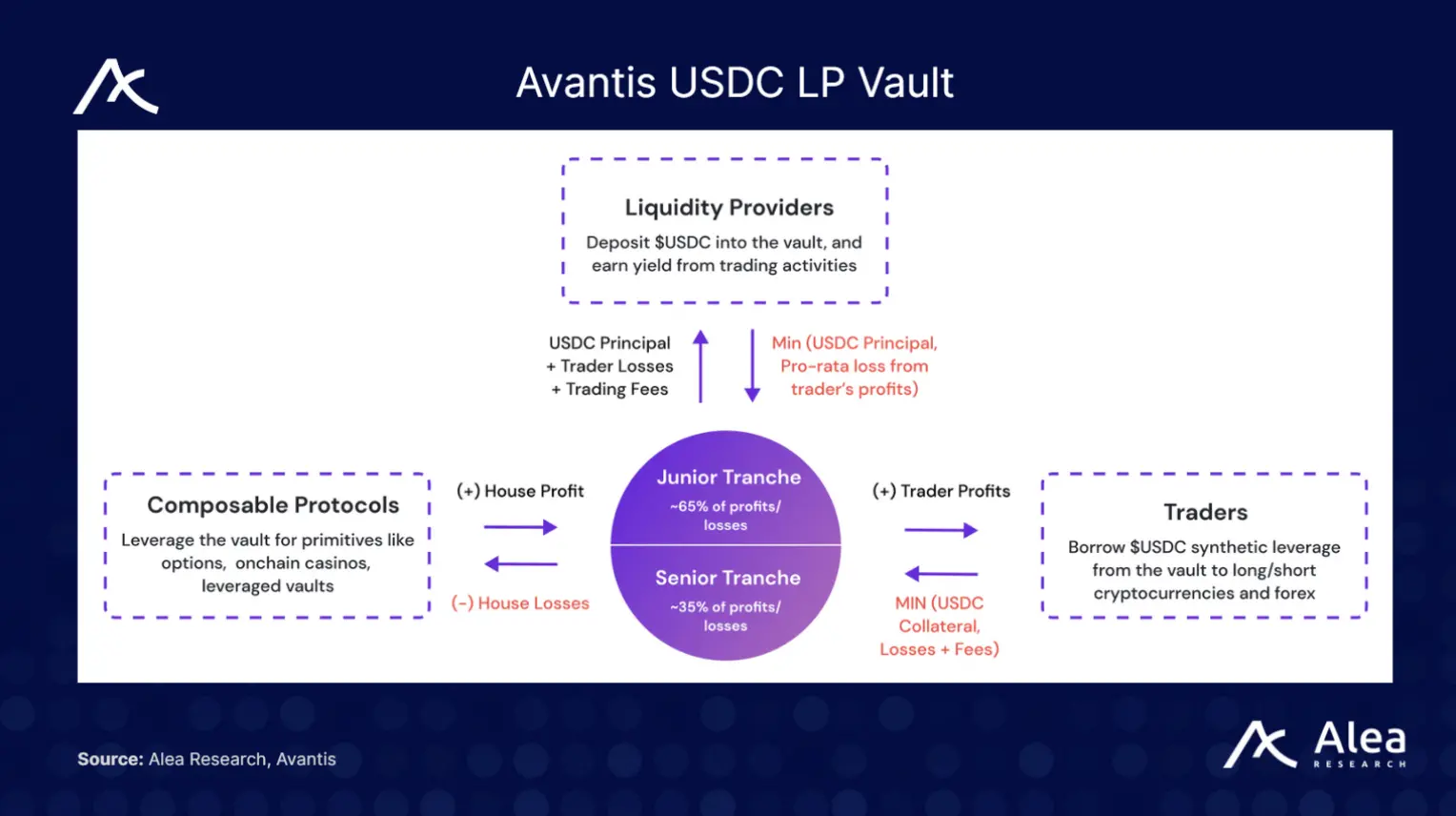
Avantis introduces risk tranches and time-lock parameters so that LPs can choose their preferred exposure. LPs can passively deposit in the senior tranche or take more risk in the junior tranche, which has higher return potential but also absorbs a greater share of losses.
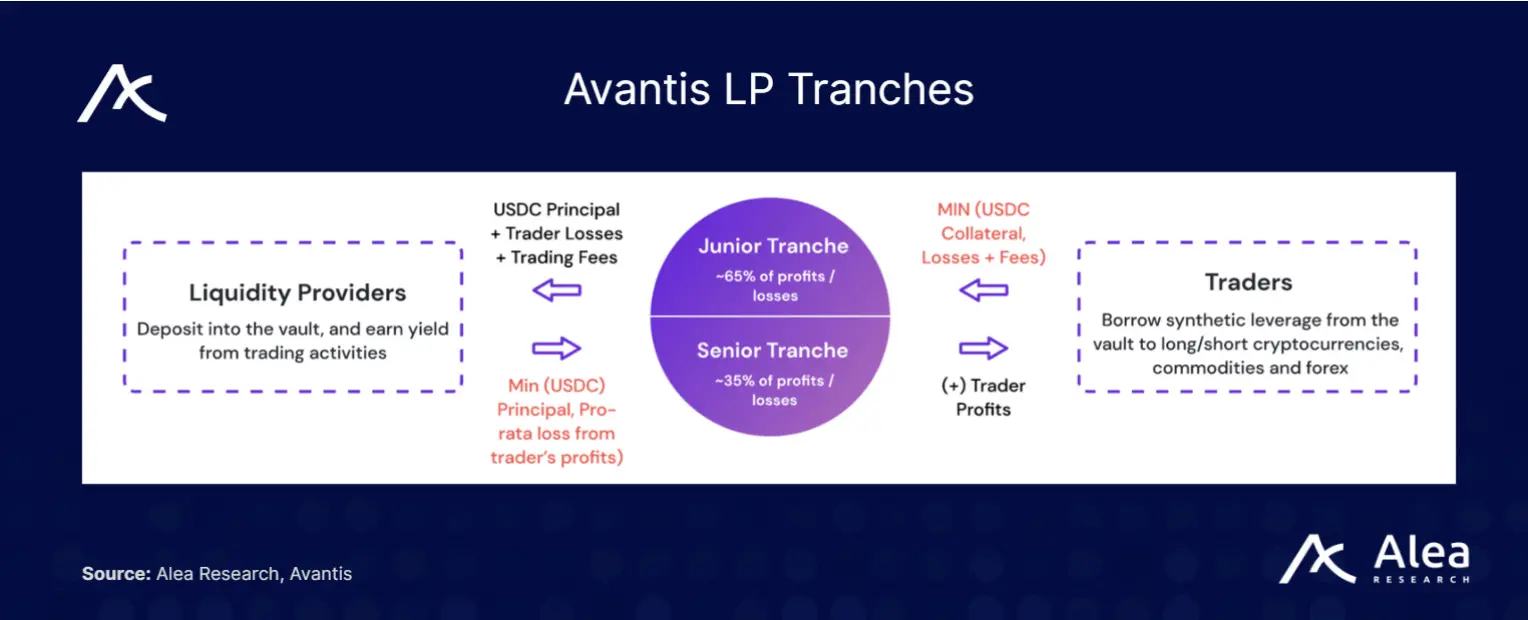
Additionally, LPs can choose a time lock (e.g., 30 or 90 days) to control the duration of their capital commitment, with longer locks incurring more fees. This design mimics the centralized liquidity model of Uniswap v3 while applying it to the risk management of perps exchanges.

Trader <> LP Alignment

Avantis' innovative mechanism further aligns the interests of traders and LPs.

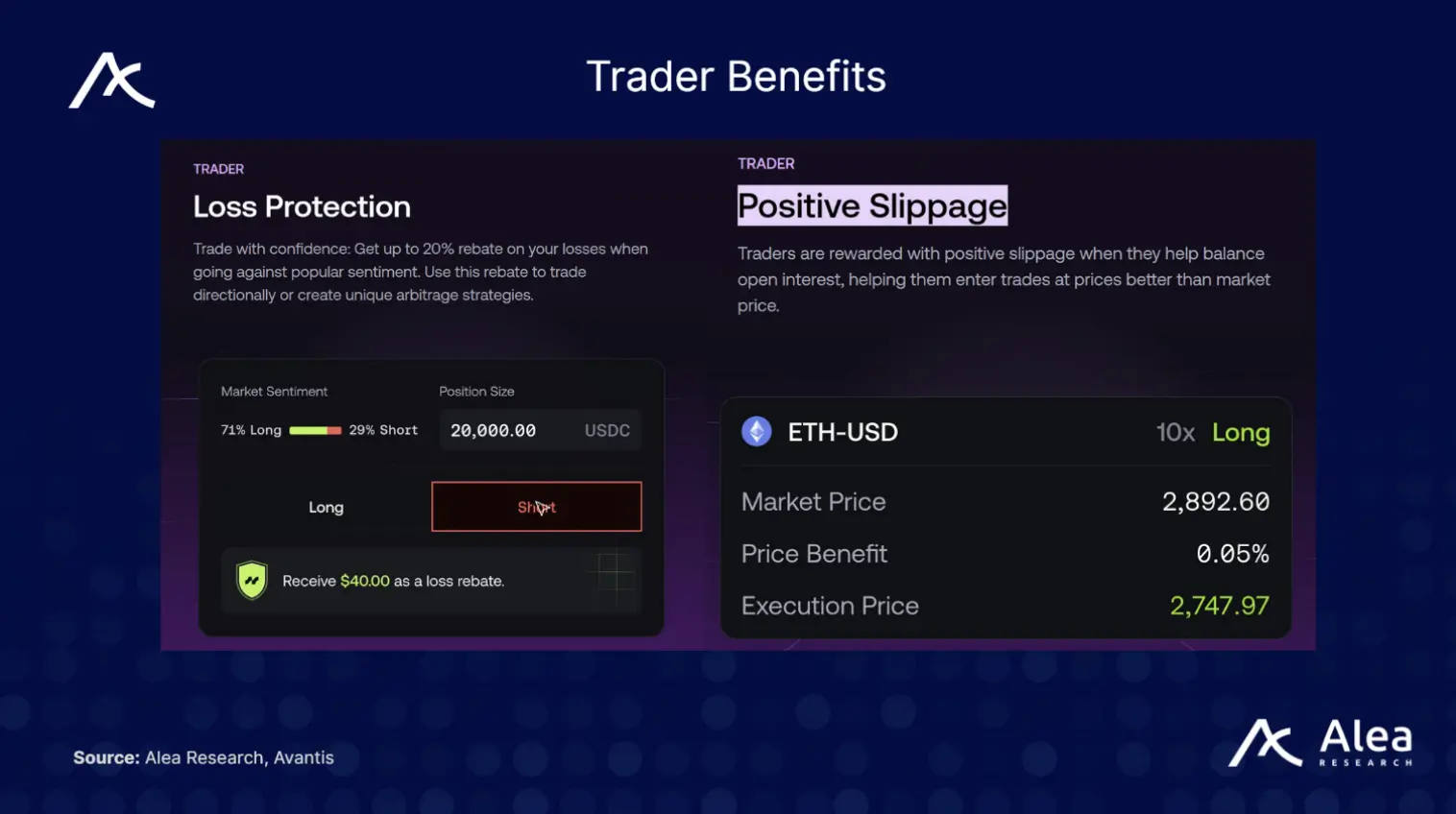
Loss Rebates: Traders who take the opposite side of open interest (helping balance the platform’s long/short skew) can receive up to 20% loss rebates. This encourages traders to arbitrage open interest and stabilize LP exposure.

Positive Slippage: When a trader's order reduces the vault's risk (e.g., closing out a heavily long position), Avantis offers an entry price above the Mark Price. This "better-than-market" execution rewards traders for helping to balance flows.
Zero Trading Fees: Avantis pioneered a product where traders pay no fees to open, close, or borrow positions. Instead, they pay only a portion of their profits when closing a winning trade. Available for $BTC, $SOL, and $ETH, with leverage up to 250x, this tool is popular with scalpers and high-frequency traders.

Advanced Risk Management: LPs can act as passive lenders or active market makers by selecting risk tranches and time locks. Each tranche has its own share of fees and potential losses, enabling LPs to control risk and return.

$AVNT: Token Issuance and Token Economics

To facilitate its next phase of growth, Avantis has launched $AVNT, a utility and governance token.

$AVNT has multiple functions:

Security and Staking: Holders can stake $AVNT in the Avantis Security Module to support the USDC vault during periods of extreme market volatility. Stakers receive $AVNT rewards and discounted trading fees.

Community Rewards: 50.1% of the total 1 billion token supply is reserved for traders, liquidity providers, referrers, and builders who contribute to Avantis. Airdrops (12.5% of the supply) will reward protocol activity starting in February 2024, while on-chain incentives (28.6%) will fund future XP seasons and community contributions. Builder and ecosystem grants (9%) will support the creation of new front-ends and trading tools, such as AI agents and Telegram bots.

Governance: Token holders will be able to propose and vote on protocol decisions, ranging from asset listings and fee structures to buyback programs and cross-chain deployments.

The remaining 49.9% of the supply is distributed as follows:

  • Team (13.3%)
  • Investors (26.61%)
  • Avantis Foundation (4%)
  • Liquidity reserve (6%)
Market Opportunity
Gravity Logo
Gravity Price(G)
$0.003585
$0.003585$0.003585
-5.28%
USD
Gravity (G) Live Price Chart
Disclaimer: The articles reposted on this site are sourced from public platforms and are provided for informational purposes only. They do not necessarily reflect the views of MEXC. All rights remain with the original authors. If you believe any content infringes on third-party rights, please contact service@support.mexc.com for removal. MEXC makes no guarantees regarding the accuracy, completeness, or timeliness of the content and is not responsible for any actions taken based on the information provided. The content does not constitute financial, legal, or other professional advice, nor should it be considered a recommendation or endorsement by MEXC.

You May Also Like

Polygon Tops RWA Rankings With $1.1B in Tokenized Assets

Polygon Tops RWA Rankings With $1.1B in Tokenized Assets

The post Polygon Tops RWA Rankings With $1.1B in Tokenized Assets appeared on BitcoinEthereumNews.com. Key Notes A new report from Dune and RWA.xyz highlights Polygon’s role in the growing RWA sector. Polygon PoS currently holds $1.13 billion in RWA Total Value Locked (TVL) across 269 assets. The network holds a 62% market share of tokenized global bonds, driven by European money market funds. The Polygon POL $0.25 24h volatility: 1.4% Market cap: $2.64 B Vol. 24h: $106.17 M network is securing a significant position in the rapidly growing tokenization space, now holding over $1.13 billion in total value locked (TVL) from Real World Assets (RWAs). This development comes as the network continues to evolve, recently deploying its major “Rio” upgrade on the Amoy testnet to enhance future scaling capabilities. This information comes from a new joint report on the state of the RWA market published on Sept. 17 by blockchain analytics firm Dune and data platform RWA.xyz. The focus on RWAs is intensifying across the industry, coinciding with events like the ongoing Real-World Asset Summit in New York. Sandeep Nailwal, CEO of the Polygon Foundation, highlighted the findings via a post on X, noting that the TVL is spread across 269 assets and 2,900 holders on the Polygon PoS chain. The Dune and https://t.co/W6WSFlHoQF report on RWA is out and it shows that RWA is happening on Polygon. Here are a few highlights: – Leading in Global Bonds: Polygon holds 62% share of tokenized global bonds (driven by Spiko’s euro MMF and Cashlink euro issues) – Spiko U.S.… — Sandeep | CEO, Polygon Foundation (※,※) (@sandeepnailwal) September 17, 2025 Key Trends From the 2025 RWA Report The joint publication, titled “RWA REPORT 2025,” offers a comprehensive look into the tokenized asset landscape, which it states has grown 224% since the start of 2024. The report identifies several key trends driving this expansion. According to…
Share
BitcoinEthereumNews2025/09/18 00:40
BetFury is at SBC Summit Lisbon 2025: Affiliate Growth in Focus

BetFury is at SBC Summit Lisbon 2025: Affiliate Growth in Focus

The post BetFury is at SBC Summit Lisbon 2025: Affiliate Growth in Focus appeared on BitcoinEthereumNews.com. Press Releases are sponsored content and not a part of Finbold’s editorial content. For a full disclaimer, please . Crypto assets/products can be highly risky. Never invest unless you’re prepared to lose all the money you invest. Curacao, Curacao, September 17th, 2025, Chainwire BetFury steps onto the stage of SBC Summit Lisbon 2025 — one of the key gatherings in the iGaming calendar. From 16 to 18 September, the platform showcases its brand strength, deepens affiliate connections, and outlines its plans for global expansion. BetFury continues to play a role in the evolving crypto and iGaming partnership landscape. BetFury’s Participation at SBC Summit The SBC Summit gathers over 25,000 delegates, including 6,000+ affiliates — the largest concentration of affiliate professionals in iGaming. For BetFury, this isn’t just visibility, it’s a strategic chance to present its Affiliate Program to the right audience. Face-to-face meetings, dedicated networking zones, and affiliate-focused sessions make Lisbon the ideal ground to build new partnerships and strengthen existing ones. BetFury Meets Affiliate Leaders at its Massive Stand BetFury arrives at the summit with a massive stand placed right in the center of the Affiliate zone. Designed as a true meeting hub, the stand combines large LED screens, a sleek interior, and the best coffee at the event — but its core mission goes far beyond style. Here, BetFury’s team welcomes partners and affiliates to discuss tailored collaborations, explore growth opportunities across multiple GEOs, and expand its global Affiliate Program. To make the experience even more engaging, the stand also hosts: Affiliate Lottery — a branded drum filled with exclusive offers and personalized deals for affiliates. Merch Kits — premium giveaways to boost brand recognition and leave visitors with a lasting conference memory. Besides, at SBC Summit Lisbon, attendees have a chance to meet the BetFury team along…
Share
BitcoinEthereumNews2025/09/18 01:20
Tether Advances Gold Strategy With $150 Million Stake in Gold.com

Tether Advances Gold Strategy With $150 Million Stake in Gold.com

TLDR Tether buys $150M Gold.com stake to expand digital gold infrastructure Partnership links physical gold supply with blockchain settlement rails XAUT token distribution
Share
Coincentral2026/02/06 10:09