The long-awaited $MIRROR token inspired by Netflix’s Black Mirror has launched on Base. With over 400,000 signups, the token enters Web3.The long-awaited $MIRROR token inspired by Netflix’s Black Mirror has launched on Base. With over 400,000 signups, the token enters Web3.

Black Mirror Token $MIRROR Officially Launches: Netflix Meets Crypto?

3 min read

Mirror Token: A New Chapter for Black Mirror

Netflix’s Black Mirror is known for satirizing the darker side of technology. Now, in an ironic twist, the franchise has officially stepped into Web3 with the launch of its $MIRROR token. After months of hype and over 400,000 registrations for its airdrop, the token went live on September 8 on Coinbase’s Base blockchain, instantly putting one of entertainment’s most recognizable brands at the center of crypto innovation.

The move is seen as a milestone: rarely has a global media franchise embraced blockchain at this scale, combining token rewards, NFTs, and community participation into a single ecosystem.

Launch Highlights and Token Details

The $MIRROR token launch combines Web3 mechanics with interactive storytelling:

  • Token Supply: 1 billion total tokens, with 58% allocated to the community.
  • NFT Integration: “Black Mirror Personas,” dynamic NFTs that evolve based on user activity, sold out almost immediately—7,000 minted at $40 each within three hours.
  • Fan Utility: Token holders can vote on creative decisions, such as cover designs for Black Mirror comics, and potentially influence future franchise expansions.
  • Interactive Ecosystem: Participants gain access to rewards, royalty opportunities, and deeper engagement in the Black Mirror universe.

The ecosystem is inspired by the 2016 episode “Nosedive,” which examined a society where social status was dictated by ratings—a theme that resonates strongly with tokenized identity and engagement.

Who’s Behind the Project?

The initiative comes through Banijay Rights, part of Banijay Entertainment, the powerhouse behind Black Mirror, Survivor, Lego Masters, and Big Brother. Banijay partnered with Web3 company Pixelynx to roll out the $MIRROR token and accompanying NFT platform.

This collaboration bridges traditional entertainment with blockchain-native engagement models, providing both a financial layer (tokens, royalties) and a cultural layer (community influence, identity tokens).

Market Debut: First Price Action

Based on launch data from Dexscreener:

  • Trading Pair: MIRROR/USDC on Aerodrome (Base).
  • Opening Spike: The token saw early volatility, spiking above $0.07 before correcting.
  • Current Price (as of chart data): ~$0.062.
  • Volume: ~17K traded in the opening hours.
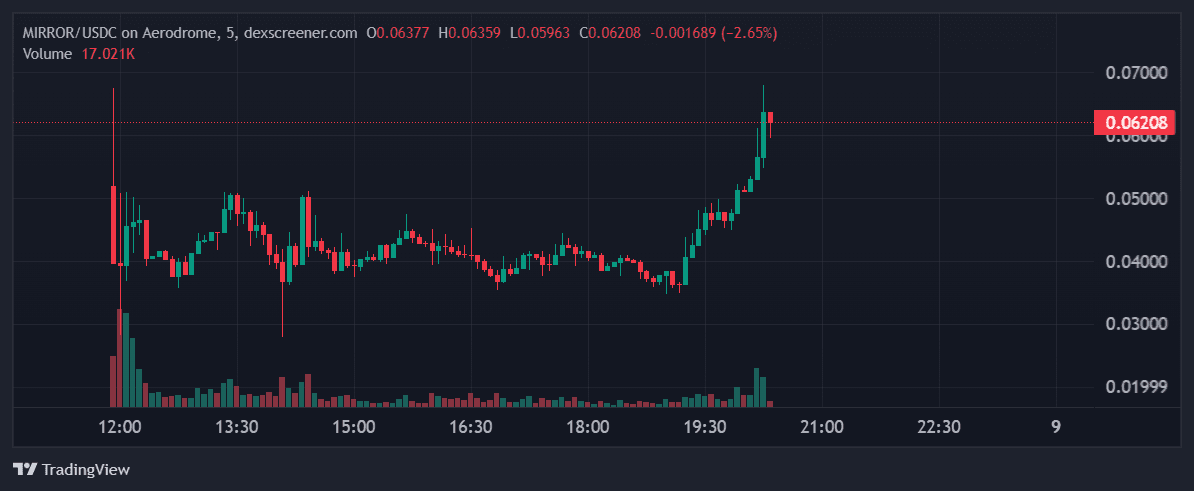
dexscreener.com_MIRROR_USDC_2025-09-08_23-21-11.png

MIRROR/USDC 5-mins chart - dexscreener

This performance reflects the classic memecoin-style debut: rapid interest, sharp swings, and strong community-driven trading.

👉 Track live MIRROR price here.

The Bigger Picture: Regulation and Industry Context

The $MIRROR launch also intersects with a shifting regulatory and cultural environment:

  • CLARITY Act Impact: U.S. legislation like the proposed CLARITY Act aims to define roles of agencies like the SEC, giving entertainment franchises more confidence to experiment with tokens and NFTs.
  • Mainstream Adoption: Netflix’s entry—given its 301 million subscribers and $534B market cap (2025)—signals that blockchain is no longer fringe for media giants.
  • AAA Franchise Momentum: Industry analysts expect other major titles (Stranger Things, Big Brother, Survivor) could follow if $MIRROR proves sustainable.

Community and Cultural Implications

Unlike traditional fan clubs, $MIRROR introduces ownership mechanics:

  • Fans earn tokens for activity.
  • NFTs evolve with participation, creating digital identities.
  • Token holders gain real influence, from creative votes to royalty opportunities.

This blurs the line between audience and creators, giving fans both a stake and a say in the entertainment ecosystem.

Critics, however, highlight the irony: a show that critiques technology’s grip on society is now monetizing that very dynamic. Whether this deepens fan engagement or fuels cynicism remains to be seen.

Market Opportunity
TokenFi Logo
TokenFi Price(TOKEN)
$0.003337
$0.003337$0.003337
+2.77%
USD
TokenFi (TOKEN) Live Price Chart
Disclaimer: The articles reposted on this site are sourced from public platforms and are provided for informational purposes only. They do not necessarily reflect the views of MEXC. All rights remain with the original authors. If you believe any content infringes on third-party rights, please contact service@support.mexc.com for removal. MEXC makes no guarantees regarding the accuracy, completeness, or timeliness of the content and is not responsible for any actions taken based on the information provided. The content does not constitute financial, legal, or other professional advice, nor should it be considered a recommendation or endorsement by MEXC.

You May Also Like

eurosecurity.net Expands Cryptocurrency Asset Recovery Capabilities Amid Rising Investor Losses

eurosecurity.net Expands Cryptocurrency Asset Recovery Capabilities Amid Rising Investor Losses

New York, NY/ GlobePRWire / Feb 6, 2026 – eurosecurity.net announces the expansion of its cryptocurrency asset recovery services, reflecting increased demand from
Share
CryptoReporter2026/02/06 17:24
Ethereum to boost scalability and roll out Fusaka upgrade on Dec 3

Ethereum to boost scalability and roll out Fusaka upgrade on Dec 3

Ethereum's Fusaka update may happen on December 3, based on the date set in the latest developer call.
Share
Cryptopolitan2025/09/19 17:00
Google Cloud taps EigenLayer to bring trust to agentic payments

Google Cloud taps EigenLayer to bring trust to agentic payments

The post Google Cloud taps EigenLayer to bring trust to agentic payments appeared on BitcoinEthereumNews.com. Two days after unveiling AP2 — a universal payment layer for AI agents that supports everything from credit cards to stablecoins — Google and EigenLayer have released details of their partnership to bring verifiability and restaking security to the stack, using Ethereum. In addition to enabling verifiable compute and slashing-backed payment coordination, EigenCloud will support insured and sovereign AI agents, which introduce consequences for failure or deviation from specified behavior. Sovereign agents are positioned as autonomous actors that can own property, make decisions, and execute actions independently — think smart contracts with embedded intelligence. From demos to dollars AP2 extends Google’s agent-to-agent (A2A) protocol using the HTTP 402 status code — long reserved for “payment required” — to standardize payment requests between agents across different networks. It already supports stablecoins like USDC, and Coinbase has demoed an agent checkout using its Wallet-as-a-Service. Paired with a system like Lit Protocol’s Vincent — which enforces per-action policies and key custody at signing — Google’s AP2 with EigenCloud’s verifiability and cross-chain settlement could form an end-to-end trust loop. Payments between agents aren’t as simple as they are often made to sound by “Crypto x AI” LARPs. When an AI agent requests a payment in USDC on Base and the payer’s funds are locked in ETH on Arbitrum, the transaction stalls — unless something abstracts the bridging, swapping and delivery. That’s where EigenCloud comes in. Sreeram Kannan, founder of EigenLayer, said the integration will create agents that not only run on-chain verifiable compute, but are also economically incentivized to behave within programmable bounds. Through restaked operators, EigenCloud powers a verifiable payment service that handles asset routing and chain abstraction, with dishonest behavior subject to slashing. It also introduces cryptographic accountability to the agents themselves, enabling proofs that an agent actually executed the task it…
Share
BitcoinEthereumNews2025/09/19 03:52