The post Christie’s Scales Back on NFTs as Art Market Faces Decline appeared on BitcoinEthereumNews.com. UK auction giant Christie’s is reportedly closing its department that handles non-fungible token sales, putting it under a broader department amid a global decline in the art market. The “strategic decision” will see the 258-year-old British auction house continue to sell digital art such as non-fungible tokens (NFTs), but now within the larger 20th and 21st-century art category, according to a report on Monday from Now Media that cited a statement from a Christie’s spokesperson. At the same time, Now Media reported the auction giant laid off two employees, including its vice president of digital art, but at least one digital art specialist will be kept on staff. Christie’s has had a huge presence in the NFT space, selling multiple artworks, including Mike “Beeple” Winkelmann’s Everydays: The First 5000 Days, which closed at auction in March 2021 with a bid of $69.3 million. Digital artist Laura El sold one of her digital artworks, known as Lonely Island at Christie’s in 2023. Source: Laura El The auction house had also been a supporter of the Web3 space, launching an NFT auction platform in September 2022 and a crypto-only real estate team in July. Market conditions could have spurred shift  Fanny Lakoubay, a digital art adviser, curator and collector, said in an X post on Monday that she suspects Christie’s move could be tied to the “current art market contraction.” The wider art market has been declining, with global sales down 12% in 2024 to $57 billion, along with combined public and private sales by auction houses dropping by 20% to $23 billion, according to the Art Basel & UBS Art Market Report 2025 released in April. “Auction houses can’t justify a whole department when it brings in less revenue than the others, even with some recent successful sales,” Lakoubay said. “It’s… The post Christie’s Scales Back on NFTs as Art Market Faces Decline appeared on BitcoinEthereumNews.com. UK auction giant Christie’s is reportedly closing its department that handles non-fungible token sales, putting it under a broader department amid a global decline in the art market. The “strategic decision” will see the 258-year-old British auction house continue to sell digital art such as non-fungible tokens (NFTs), but now within the larger 20th and 21st-century art category, according to a report on Monday from Now Media that cited a statement from a Christie’s spokesperson. At the same time, Now Media reported the auction giant laid off two employees, including its vice president of digital art, but at least one digital art specialist will be kept on staff. Christie’s has had a huge presence in the NFT space, selling multiple artworks, including Mike “Beeple” Winkelmann’s Everydays: The First 5000 Days, which closed at auction in March 2021 with a bid of $69.3 million. Digital artist Laura El sold one of her digital artworks, known as Lonely Island at Christie’s in 2023. Source: Laura El The auction house had also been a supporter of the Web3 space, launching an NFT auction platform in September 2022 and a crypto-only real estate team in July. Market conditions could have spurred shift  Fanny Lakoubay, a digital art adviser, curator and collector, said in an X post on Monday that she suspects Christie’s move could be tied to the “current art market contraction.” The wider art market has been declining, with global sales down 12% in 2024 to $57 billion, along with combined public and private sales by auction houses dropping by 20% to $23 billion, according to the Art Basel & UBS Art Market Report 2025 released in April. “Auction houses can’t justify a whole department when it brings in less revenue than the others, even with some recent successful sales,” Lakoubay said. “It’s…

Christie’s Scales Back on NFTs as Art Market Faces Decline

UK auction giant Christie’s is reportedly closing its department that handles non-fungible token sales, putting it under a broader department amid a global decline in the art market.

The “strategic decision” will see the 258-year-old British auction house continue to sell digital art such as non-fungible tokens (NFTs), but now within the larger 20th and 21st-century art category, according to a report on Monday from Now Media that cited a statement from a Christie’s spokesperson.

At the same time, Now Media reported the auction giant laid off two employees, including its vice president of digital art, but at least one digital art specialist will be kept on staff.

Christie’s has had a huge presence in the NFT space, selling multiple artworks, including Mike “Beeple” Winkelmann’s Everydays: The First 5000 Days, which closed at auction in March 2021 with a bid of $69.3 million.

Digital artist Laura El sold one of her digital artworks, known as Lonely Island at Christie’s in 2023. Source: Laura El

The auction house had also been a supporter of the Web3 space, launching an NFT auction platform in September 2022 and a crypto-only real estate team in July.

Market conditions could have spurred shift 

Fanny Lakoubay, a digital art adviser, curator and collector, said in an X post on Monday that she suspects Christie’s move could be tied to the “current art market contraction.”

The wider art market has been declining, with global sales down 12% in 2024 to $57 billion, along with combined public and private sales by auction houses dropping by 20% to $23 billion, according to the Art Basel & UBS Art Market Report 2025 released in April.

“Auction houses can’t justify a whole department when it brings in less revenue than the others, even with some recent successful sales,” Lakoubay said.

“It’s definitely not a great public signal, but we should also remember: auction houses only focus on secondary sales of already well-known artists and brands. It’s still too early for that model to really work/scale with digital art,” she added. 

Source: Fanny Lakoubay

Lakoubay said it could be a good time to focus on primary market development and introduce traditional collectors to new digital artists.

Christie’s could be having a “Kodak moment”

Meanwhile, an NFT collector and member of the Doomed decentralized autonomous organization, posting under the handle Benji, argued that Christie’s move to close its digital art department doesn’t reflect a weakness in the demand for digital art, or that “institutions are no longer coming for our jpegs.”

He speculates the business model is likely to blame for the decision because it was “flawed and unsustainable,” and this new direction could be Christie’s “Kodak moment.”

“How can you charge 25-30% commission on something that does not need to be authenticated / stored / insured / shipped, when your online competitors like Gondi charge zero commission for the exact same sale?” Benji said.

“I hate to see good people lose their jobs, but Christie’s exiting the space is a net positive— one less value extractor means more value for collectors and artists alike.”

Source: Benji

Christie’s didn’t immediately respond to Cointelegraph’s request for comment.

NFT market records mixed results

The NFT market has had a turbulent few years. Last year was flagged as the market’s worst year for trading volume and sales since 2020, partly because of volatility and rising token prices.

Related: NFT market cap drops by $1.2B as Ether rally loses steam

It has been showing signs of life in 2025. In August, the sector surged to a market capitalization of more than $9.3 billion, a 40% uptick from July, as Ethereum-based collections and Ether (ETH) increased in price.

The market has shown signs of cooling in recent weeks, but its current market capitalization is up 2% in the last 24 hours and sits at $5.97 billion. 

Several of the largest NFT collections by market capitalization have also experienced gains. CryptoPunks is up 1.9% in the last 24 hours, and has a trading volume of $208,319 with three sales.

Yuga Labs’ Bored Ape Yacht Club is up 3.7% and has clocked a trading volume of more than $1.2 million and 30 sales, while Pudgy Penguins is up 2%, with $905,526 in trading volume and 20 sales. 

Magazine: Astrology could make you a better crypto trader: It has been foretold

Source: https://cointelegraph.com/news/auction-christies-shuts-digital-art-nft-division?utm_source=rss_feed&utm_medium=feed&utm_campaign=rss_partner_inbound

Market Opportunity
Threshold Logo
Threshold Price(T)
$0.007023
$0.007023$0.007023
+0.32%
USD
Threshold (T) Live Price Chart
Disclaimer: The articles reposted on this site are sourced from public platforms and are provided for informational purposes only. They do not necessarily reflect the views of MEXC. All rights remain with the original authors. If you believe any content infringes on third-party rights, please contact service@support.mexc.com for removal. MEXC makes no guarantees regarding the accuracy, completeness, or timeliness of the content and is not responsible for any actions taken based on the information provided. The content does not constitute financial, legal, or other professional advice, nor should it be considered a recommendation or endorsement by MEXC.

You May Also Like

Young Republicans were more proud to be American under Obama than under Trump: data analyst

Young Republicans were more proud to be American under Obama than under Trump: data analyst

CNN data analyst Harry Enten sorts through revealing polls and surveys of American attitudes, looking for shifts, and his latest finding is an indictment of President
Share
Alternet2026/02/10 22:18
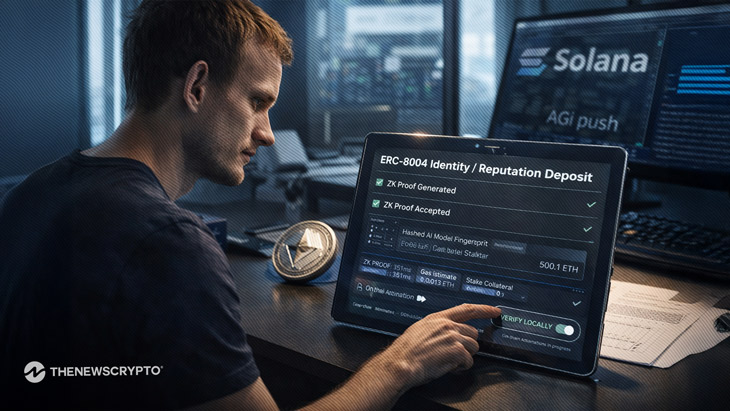
Vitalik Buterin Outlines Ethereum’s AI Framework, Pushes Back Against Solana’s Acceleration Thesis

Vitalik Buterin Outlines Ethereum’s AI Framework, Pushes Back Against Solana’s Acceleration Thesis

Ethereum co-founder Vitalik Buterin has reacted to Solana’s artificial general intelligence acceleration initiative. He did this through the establishment of his
Share
Thenewscrypto2026/02/10 18:40
Vitalik Buterin Reveals Ethereum’s Bold Plan to Stay Quantum-Secure and Simple!

Vitalik Buterin Reveals Ethereum’s Bold Plan to Stay Quantum-Secure and Simple!

Buterin unveils Ethereum’s strategy to tackle quantum security challenges ahead. Ethereum focuses on simplifying architecture while boosting security for users. Ethereum’s market stability grows as Buterin’s roadmap gains investor confidence. Ethereum founder Vitalik Buterin has unveiled his long-term vision for the blockchain, focusing on making Ethereum quantum-secure while maintaining its simplicity for users. Buterin presented his roadmap at the Japanese Developer Conference, and splits the future of Ethereum into three phases: short-term, mid-term, and long-term. Buterin’s most ambitious goal for Ethereum is to safeguard the blockchain against the threats posed by quantum computing.  The danger of such future developments is that the future may call into question the cryptographic security of most blockchain systems, and Ethereum will be able to remain ahead thanks to more sophisticated mathematical techniques to ensure the safety and integrity of its protocols. Buterin is committed to ensuring that Ethereum evolves in a way that not only meets today’s security challenges but also prepares for the unknowns of tomorrow. Also Read: Ethereum Giant The Ether Machine Takes Major Step Toward Going Public! However, in spite of such high ambitions, Buterin insisted that Ethereum also needed to simplify its architecture. An important aspect of this vision is to remove unnecessary complexity and make Ethereum more accessible and maintainable without losing its strong security capabilities. Security and simplicity form the core of Buterin’s strategy, as they guarantee that the users of Ethereum experience both security and smooth processes. Focus on Speed and Efficiency in the Short-Term In the short term, Buterin aims to enhance Ethereum’s transaction efficiency, a crucial step toward improving scalability and reducing transaction costs. These advantages are attributed to the fact that, within the mid-term, Ethereum is planning to enhance the speed of transactions in layer-2 networks. According to Butterin, this is part of Ethereum’s expansion, particularly because there is still more need to use blockchain technology to date. The other important aspect of Ethereum’s development is the layer-2 solutions. Buterin supports an approach in which the layer-2 networks are dependent on layer-1 to perform some essential tasks like data security, proof, and censorship resistance. This will enable the layer-2 systems of Ethereum to be concerned with verifying and sequencing transactions, which will improve the overall speed and efficiency of the network. Ethereum’s Market Stability Reflects Confidence in Long-Term Strategy Ethereum’s market performance has remained solid, with the cryptocurrency holding steady above $4,000. Currently priced at $4,492.15, Ethereum has experienced a slight 0.93% increase over the last 24 hours, while its trading volume surged by 8.72%, reaching $34.14 billion. These figures point to growing investor confidence in Ethereum’s long-term vision. The crypto community remains optimistic about Ethereum’s future, with many predicting the price could rise to $5,500 by mid-October. Buterin’s clear, forward-thinking strategy continues to build trust in Ethereum as one of the most secure and scalable blockchain platforms in the market. Also Read: Whales Dump 200 Million XRP in Just 2 Weeks – Is XRP’s Price on the Verge of Collapse? The post Vitalik Buterin Reveals Ethereum’s Bold Plan to Stay Quantum-Secure and Simple! appeared first on 36Crypto.
Share
Coinstats2025/09/18 01:22