Japan is taking significant steps to overhaul its cryptocurrency tax regulations as part of broader efforts to foster a more accommodating environment for blockchain innovation and digital asset adoption. The current rules, which have been in place for years, are viewed by industry experts as a barrier to the growth and maturity of the country’s [...]Japan is taking significant steps to overhaul its cryptocurrency tax regulations as part of broader efforts to foster a more accommodating environment for blockchain innovation and digital asset adoption. The current rules, which have been in place for years, are viewed by industry experts as a barrier to the growth and maturity of the country’s [...]

Japan Aims to Cut Crypto Tax Rates from 55% to 20% – Here’s Their Plan
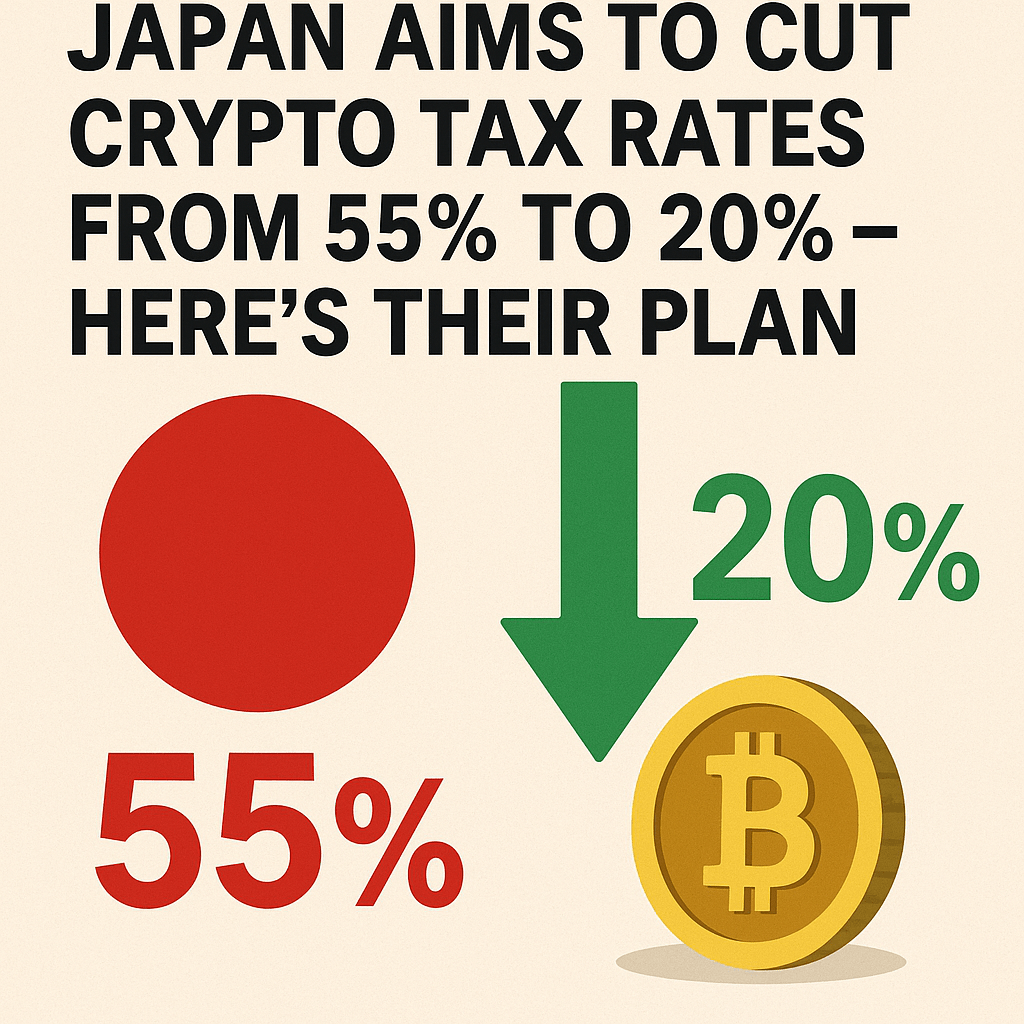
Japan Aims To Cut Crypto Tax Rates From 55% To 20% – Here's Their Plan

Japan is taking significant steps to overhaul its cryptocurrency tax regulations as part of broader efforts to foster a more accommodating environment for blockchain innovation and digital asset adoption. The current rules, which have been in place for years, are viewed by industry experts as a barrier to the growth and maturity of the country’s vibrant crypto sector. The proposed adjustments aim to simplify tax procedures and clarify how various digital assets are taxed, encouraging more participation from both retail and institutional investors.

Reforming Cryptocurrency Taxation Policies

Under Japan’s existing tax framework, cryptocurrency gains are taxed as miscellaneous income, which can result in a high tax burden and complex calculation methods. This has led to concerns that potential investors might be deterred from engaging with cryptocurrencies such as bitcoin, Ethereum, and other altcoins. To address these issues, authorities plan to revise tax policies by categorizing different types of digital assets more distinctly and providing clearer guidelines for their taxation.

One of the key reforms is to differentiate between various cryptocurrencies and tokens, including non-fungible tokens (NFTs) and decentralized finance (DeFi) assets, which currently fall into a vague regulatory gray area. These changes are expected to streamline the tax process, reduce compliance costs, and promote a more dynamic crypto ecosystem within Japan.

Enhancing Favorability for Blockchain Innovation

By refining its cryptocurrency regulations, Japan aims to bolster the country’s attractiveness as a hub for blockchain startups and crypto exchanges. The reforms are part of a broader strategy to foster innovation in digital finance and integrate new financial products safely into the economy. Additionally, clearer tax rules are expected to enhance transparency, making it easier for investors to report and pay taxes accurately, reducing the risk of legal disputes or penalties.

The move also aligns with global trends where jurisdictions are striving to create more crypto-friendly regulatory environments. Japan’s proactive approach demonstrates its commitment to staying at the forefront of the evolving blockchain and cryptocurrency landscape, encouraging the development of DeFi projects, NFTs, and other innovative digital assets.

Conclusion

Japan’s planned revisions to crypto tax regulations mark a significant step toward supporting the growth of digital assets and blockchain technology within its borders. By simplifying tax procedures and providing clearer guidance, the country hopes to attract more investment and innovation while ensuring a balanced and responsible regulatory framework. As the global crypto industry continues to evolve, Japan’s reforms highlight the importance of adaptive regulation in fostering a sustainable and thriving crypto sector.

This article was originally published as Japan Aims to Cut Crypto Tax Rates from 55% to 20% – Here’s Their Plan on Crypto Breaking News – your trusted source for crypto news, Bitcoin news, and blockchain updates.

Market Opportunity
Moonveil Logo
Moonveil Price(MORE)
$0.0005755
$0.0005755$0.0005755
-1.35%
USD
Moonveil (MORE) Live Price Chart
Disclaimer: The articles reposted on this site are sourced from public platforms and are provided for informational purposes only. They do not necessarily reflect the views of MEXC. All rights remain with the original authors. If you believe any content infringes on third-party rights, please contact service@support.mexc.com for removal. MEXC makes no guarantees regarding the accuracy, completeness, or timeliness of the content and is not responsible for any actions taken based on the information provided. The content does not constitute financial, legal, or other professional advice, nor should it be considered a recommendation or endorsement by MEXC.

You May Also Like

The Channel Factories We’ve Been Waiting For

The Channel Factories We’ve Been Waiting For

The post The Channel Factories We’ve Been Waiting For appeared on BitcoinEthereumNews.com. Visions of future technology are often prescient about the broad strokes while flubbing the details. The tablets in “2001: A Space Odyssey” do indeed look like iPads, but you never see the astronauts paying for subscriptions or wasting hours on Candy Crush.  Channel factories are one vision that arose early in the history of the Lightning Network to address some challenges that Lightning has faced from the beginning. Despite having grown to become Bitcoin’s most successful layer-2 scaling solution, with instant and low-fee payments, Lightning’s scale is limited by its reliance on payment channels. Although Lightning shifts most transactions off-chain, each payment channel still requires an on-chain transaction to open and (usually) another to close. As adoption grows, pressure on the blockchain grows with it. The need for a more scalable approach to managing channels is clear. Channel factories were supposed to meet this need, but where are they? In 2025, subnetworks are emerging that revive the impetus of channel factories with some new details that vastly increase their potential. They are natively interoperable with Lightning and achieve greater scale by allowing a group of participants to open a shared multisig UTXO and create multiple bilateral channels, which reduces the number of on-chain transactions and improves capital efficiency. Achieving greater scale by reducing complexity, Ark and Spark perform the same function as traditional channel factories with new designs and additional capabilities based on shared UTXOs.  Channel Factories 101 Channel factories have been around since the inception of Lightning. A factory is a multiparty contract where multiple users (not just two, as in a Dryja-Poon channel) cooperatively lock funds in a single multisig UTXO. They can open, close and update channels off-chain without updating the blockchain for each operation. Only when participants leave or the factory dissolves is an on-chain transaction…
Share
BitcoinEthereumNews2025/09/18 00:09
Top AI Crypto Presales 2026: IPO Genie Crushes the Competition with Pre-IPO Deal Intelligence and Massive Upside

Top AI Crypto Presales 2026: IPO Genie Crushes the Competition with Pre-IPO Deal Intelligence and Massive Upside

As the 2026 crypto bull run heats up, investors are chasing the next big AI-powered opportunity. But with so many […] The post Top AI Crypto Presales 2026: IPO
Share
Coindoo2026/02/11 05:02
IP Hits $11.75, HYPE Climbs to $55, BlockDAG Surpasses Both with $407M Presale Surge!

IP Hits $11.75, HYPE Climbs to $55, BlockDAG Surpasses Both with $407M Presale Surge!

The post IP Hits $11.75, HYPE Climbs to $55, BlockDAG Surpasses Both with $407M Presale Surge! appeared on BitcoinEthereumNews.com. Crypto News 17 September 2025 | 18:00 Discover why BlockDAG’s upcoming Awakening Testnet launch makes it the best crypto to buy today as Story (IP) price jumps to $11.75 and Hyperliquid hits new highs. Recent crypto market numbers show strength but also some limits. The Story (IP) price jump has been sharp, fueled by big buybacks and speculation, yet critics point out that revenue still lags far behind its valuation. The Hyperliquid (HYPE) price looks solid around the mid-$50s after a new all-time high, but questions remain about sustainability once the hype around USDH proposals cools down. So the obvious question is: why chase coins that are either stretched thin or at risk of retracing when you could back a network that’s already proving itself on the ground? That’s where BlockDAG comes in. While other chains are stuck dealing with validator congestion or outages, BlockDAG’s upcoming Awakening Testnet will be stress-testing its EVM-compatible smart chain with real miners before listing. For anyone looking for the best crypto coin to buy, the choice between waiting on fixes or joining live progress feels like an easy one. BlockDAG: Smart Chain Running Before Launch Ethereum continues to wrestle with gas congestion, and Solana is still known for network freezes, yet BlockDAG is already showing a different picture. Its upcoming Awakening Testnet, set to launch on September 25, isn’t just a demo; it’s a live rollout where the chain’s base protocols are being stress-tested with miners connected globally. EVM compatibility is active, account abstraction is built in, and tools like updated vesting contracts and Stratum integration are already functional. Instead of waiting for fixes like other networks, BlockDAG is proving its infrastructure in real time. What makes this even more important is that the technology is operational before the coin even hits exchanges. That…
Share
BitcoinEthereumNews2025/09/18 00:32