

Is the S&P 500 Crash Almost Over? Morgan Stanley Says Watch These Signals
TLDR
- Morgan Stanley downgraded global equities to “equal weight” and raised cash and U.S. Treasuries to “overweight”
- Brent crude jumped over 59% this month, passing $116 a barrel, its biggest monthly gain ever
- More than 50% of Russell 3000 stocks are down at least 20% from their 52-week highs
- Morgan Stanley’s equity team says the S&P 500 correction is entering its final stages
- The firm kept its year-end S&P 500 target at 7,800, assuming no recession
Morgan Stanley is turning more cautious on global stocks while signaling that the U.S. stock market correction may be close to ending.
The Wall Street firm downgraded global equities from “overweight” to “equal weight” on Friday. At the same time, it raised U.S. Treasuries and cash to “overweight,” a sign that investors are seeking safety.
The move comes after Brent crude oil prices surged more than 59% in a single month — the steepest monthly rise on record, topping gains from the 1990 Gulf War. Futures climbed above $116 a barrel on Monday.
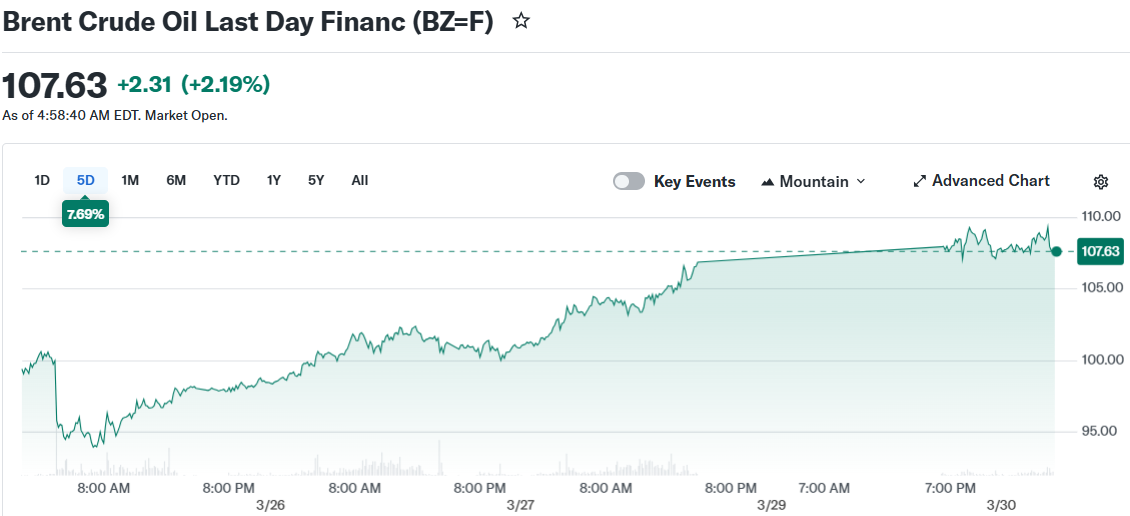 Brent Crude Oil Last Day Financ (BZ=F)
The oil spike is connected to the Middle East conflict, with concerns over the Strait of Hormuz, a key route for global oil shipments. Morgan Stanley warned that if oil holds between $150 and $180 per barrel, global equity valuations could shrink by nearly 25%.
The firm cut both U.S. and Japanese stocks to “equal weight” from “overweight.” Japan was flagged as particularly exposed to supply chain disruptions and a potential global recession if the Strait stays closed.
Still, Morgan Stanley said it prefers U.S. stocks over other regions because of stronger earnings-per-share growth.
Signs the U.S. Stock Correction May Be Ending
Despite the caution, Morgan Stanley’s equity strategy team, led by Michael Wilson, said there are growing signs the S&P 500 correction is near its end.
More than half of Russell 3000 companies are down at least 20% from their 52-week highs. The S&P 500’s forward price-to-earnings ratio has also fallen by 17%, in line with past growth scares that didn’t lead to a recession.
Wilson said current conditions look different from past oil-driven downturns. Earnings growth is running at 14% year-over-year and accelerating, while in prior downturns earnings were already falling.
The year-on-year rise in oil prices is also about half the size of those earlier episodes.
Defensive sectors like Consumer Staples have actually underperformed the broader market since the conflict started, which Morgan Stanley sees as a sign that the market has already priced in most of the oil shock.
Rate Risk and the AI Trade
The bigger short-term risk, in Wilson’s view, is rising interest rates. The 10-year Treasury yield is approaching 4.50%, a level that historically triggers stock market pressure.
The stock-yield correlation has turned sharply negative, meaning stocks are now very sensitive to rate moves.
Markets are pricing in a partial rate hike this year, which conflicts with Morgan Stanley’s own economists, who still expect cuts.
On AI-related stocks, Wilson noted that memory stocks remain heavily owned while hyperscaler positioning is low. He flagged last week’s Google memory compression announcement as a sign that crowded trades may be starting to unwind.
The Magnificent 7 stocks now trade at roughly the same price-to-earnings multiple as Consumer Staples, despite having over three times the earnings growth.
Morgan Stanley maintained its year-end S&P 500 target of 7,800, contingent on the U.S. avoiding a recession.
The post Is the S&P 500 Crash Almost Over? Morgan Stanley Says Watch These Signals appeared first on CoinCentral.

You May Also Like

FTSE 100 News: Bitcoin Retraces Below $110K – Magax Could Rally 32% Before 2025 Ends
Institutionele interesse in BTC groeit terwijl CME een record bereikt
![[OPINION] Bowels of the earth, limitless energy source](https://www.rappler.com/tachyon/2026/03/2026-03-24T151648Z_1771186604_RC2GC1ACJWNQ_RTRMADP_3_RUSSIA-BUDGET-OIL-scaled.jpg?resize=75%2C75&crop_strategy=attention)

