

In an era of energy shocks, Chinese solar is the world’s default answer
As global energy markets reel from war and weather, new solar installations can’t come fast enough.
When Tam Hussein looks out the window of his apartment each morning, he sees rays of early sunlight hitting the hills of northern Damascus and the hundreds of unsanctioned breeze-block buildings that cluster towards their peaks. On the rooftop of almost every one of those buildings is now an array of deep blue solar panels, lapping up the light.
“Syria has got so much sun,” said Hussein, a journalist who has covered the country for over a decade and experienced first-hand the effects of its deep energy crisis. “They’ve discovered it, and that’s going to last. It’s like they’ve taken on a trick.”
It was once a powerful energy exporter, but during its nearly 15 years of civil war, Syria’s infrastructure was decimated, and public electricity access fell to a few hours per day. By 2015, residents were turning to diesel generators and paying some of the world’s highest prices for fuel. But in the last half-decade, cheap Chinese solar panels connected to car batteries have rapidly displaced generators.
Data is scarce, but one estimate has the country’s total capacity of domestic solar installations at 2 gigawatts — as much as the Hoover Dam.
“Solar panels, especially in these unofficial places, is the only way you can get electricity,” said Hussein.
Crisis means opportunity for solar power
Syria’s turn to solar is just one example of a trend being mirrored around the world: In economies both large and small, cheap and abundant solar power is coming to the rescue. After Covid-19 lockdowns left the world with an unprecedented energy glut in 2020, a series of shocks have fractured global energy systems: environmental disasters, climate policy, and trade conflict. Most recently, the U.S. and Israel’s war with Iran has set off an “apocalypse” in oil and gas markets.
At the same time, a slate of fiercely competitive and heavily subsidized Chinese manufactures have made solar panels one of the cheapest forms of power on earth. This, combined with solar’s relative simplicity when compared to traditional electricity sources like gas turbines, nuclear plants or hydro dams, has made solar the go-to solution for an energy crisis for everyday citizens and national governments alike.
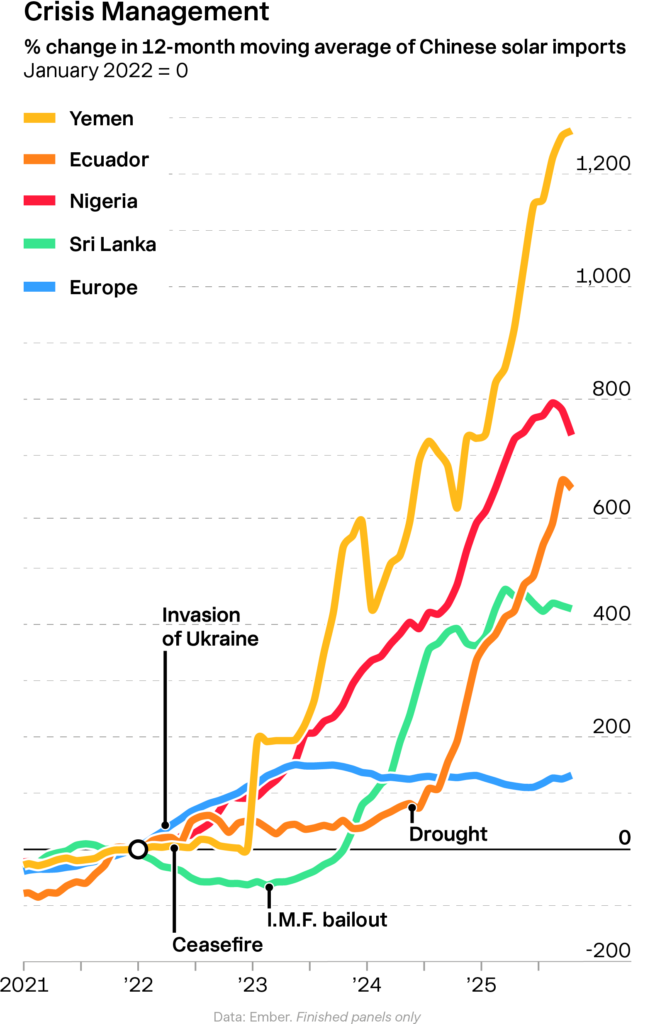
When drought set off rolling blackouts in Ecuador’s hydropower-dependent energy system in 2024, the country spiraled into a “doom loop.” That autumn, solar imports from China shot up, and by February 2025, the government announced large new renewable investments led by solar power. In Sri Lanka, after a spiraling currency devaluation left the island nation unable to pay for oil and coal imports in spring 2022, blackouts ensued and spurred widespread protests. When exchange rates stabilized 18 months later, solar panel imports spiked as ministers and the I.M.F. looked to boost renewables to strengthen security.
National security concerns drive adoption
Perhaps most significantly, Russia’s full-scale invasion of Ukraine in 2022 exposed Europe’s over-reliance on Russian fossil fuel imports. In weaning itself off Russian supply, Europe’s energy prices shot up and remained high. That year, imports of solar panels and cells nearly doubled – and by 2025, solar and wind power were responsible for a greater share of Europe’s electricity generation than fossil fuels.
In Ukraine itself, relentless bombing of traditional energy resources have spurred rapid rollouts of wind turbines and solar panels. While a single air strike can take out large fossil fuel-powered plants for months or years, solar panels are inherently too spread out and decentralized to be weaponized in this way.
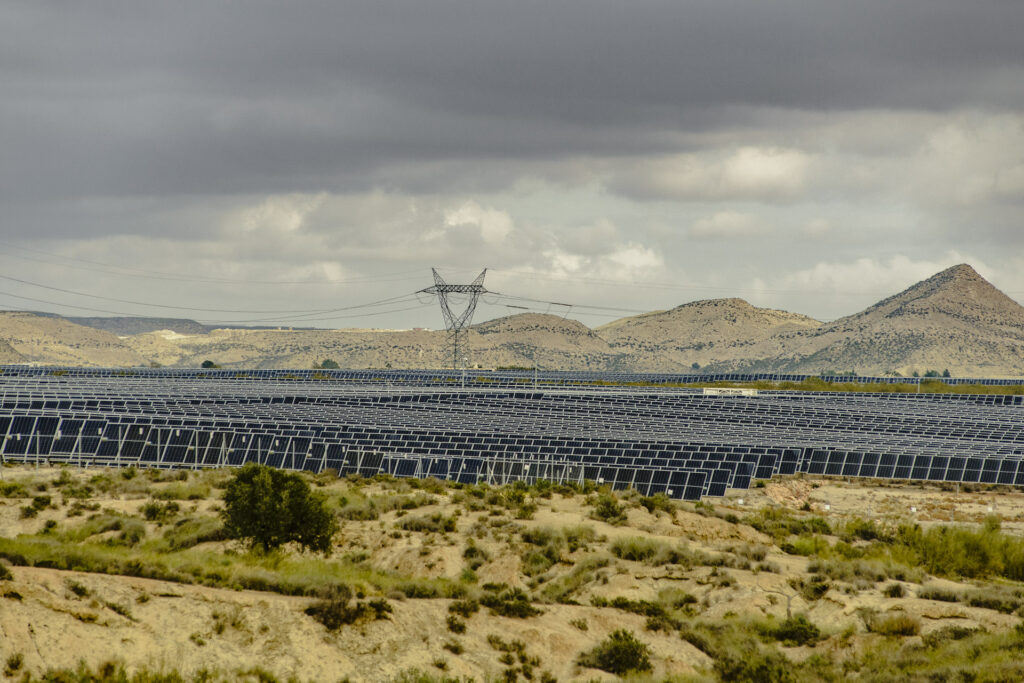 Solar panels in Spain’s Tabernas Desert. The country’s rapid solar rollout has insulated it from energy shocks | Photo by Reuben J. Brown
Increasingly, the political case for solar installations is being made around these national security imperatives, rather than the need to reduce emissions. “Green is basically a curse word in Europe lately,” said Nina Hojnik, Director of the Slovenian Photovoltaic Association. But energy independence and energy security concerns remain top-of-mind, she added.
Most countries, including most of Europe, depend on imported fossil fuels, leaving them exposed to fluctuations in currency, trade wars, and global conflict. But once a solar panel is installed, it essentially continues producing power as long as there’s sun, insulating countries that expand their renewables capacity from these geopolitical risks.
In Slovenia, dependence on fossil fuel imports was compounded by a move, made just before the invasion of Ukraine, to shutter the country’s coal industry. In the following years, solar panel installations “surged,” Hojnik said, tripling capacity in four years. Plans are progressing for Europe’s largest floating solar array to be built on a lake formed from an old coal mine. The challenge now for the country’s solar “success story” is to support it with battery storage systems, said Tomislav Tkalec, who leads the energy ministry’s renewables department.
This allure of solar isn’t universal. Governments in both Japan and the U.S. hold a wavering stance on solar development, even as rising power demand from data centers makes some projects impossible to put off. Japanese Prime Minister Sanae Takaichi has tightened solar regulation even as the country’s heavy reliance on energy imports puts pressure on her premiership; and President Donald Trump has cut support for solar power while showering it on fossil fuels.
But cases like these — in countries with great financial might and powerful corporate interests in fossil fuels — are exceptions that prove the rule. Almost everywhere else, the charge of cheap Chinese solar appears unstoppable.
In Nigeria, solar panel imports have increased by a factor of eight in the last four years, as millions of households and small businesses look to replace dirty diesel generators. Solar buyers cite the lower energy costs for their decision — but they’ll also benefit from a lower risk of lung cancer from the generators’ toxic fumes, and reduced hearing damage from their incessant noise.
Similar benefits have spread throughout West Asia. In Lebanon, Chinese solar imports have leapt by a factor of 30 since 2021, with panels proliferating across rooftops as citizens seek reliable electricity amid chronic grid blackouts. And in Yemen, imports of solar panels shot up after a ceasefire was brokered in 2022, often funded by remittances from family relatives overseas. “If it weren’t for the cost changes, it wouldn’t have been possible”, said Abeer Al-Eryani, a Yemeni energy researcher at American University in Washington, D.C. Only 12 percent of the country’s population had access to grid electricity after years of civil war, making cheap solar panels one of the few ways people could access power.
“It has nothing to do with people’s awareness of global warming, or the need to decarbonize,” said Al-Eryani. “It’s necessity.”
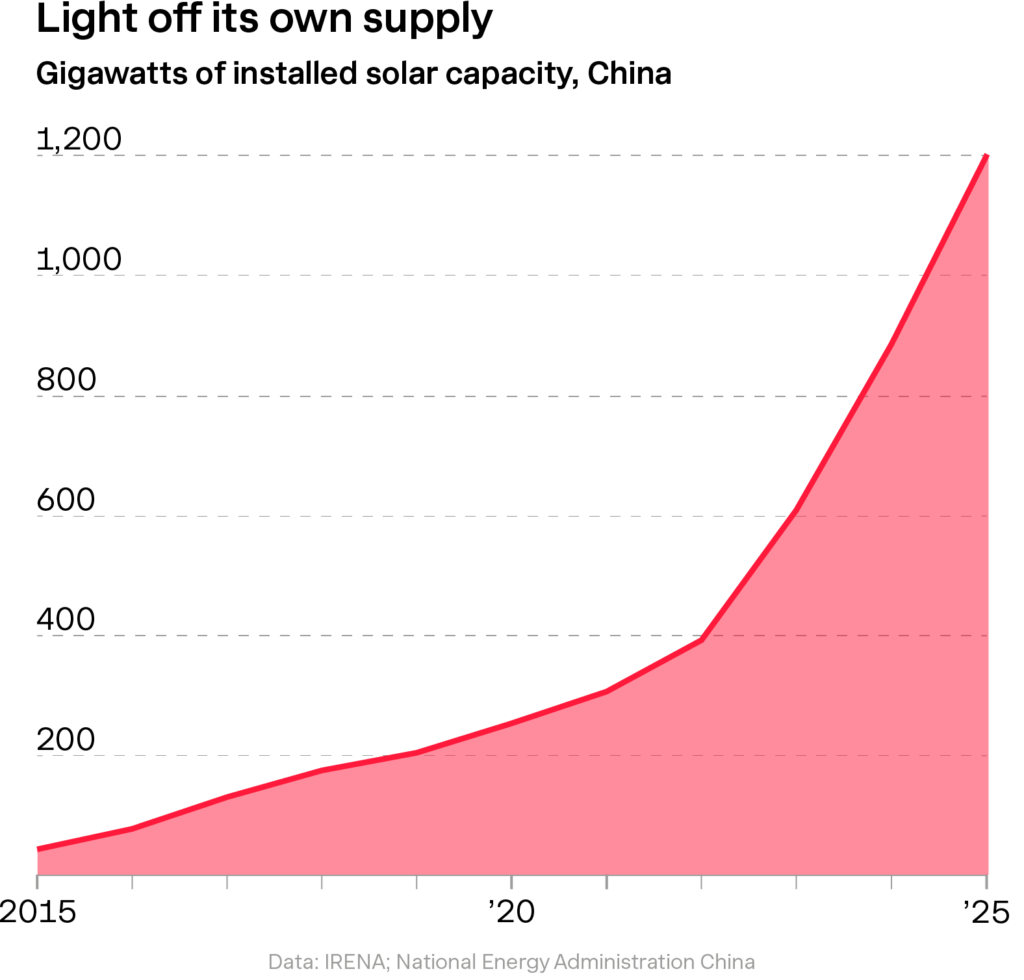
In China itself, solar capacity has quadrupled since 2021, when a post-pandemic economic rebound combined with a shortage of coal imports and drought-led hydropower declines. The resulting power crunch sent shockwaves throughout global supply chains. This year, China expects solar to provide more electricity than coal for the first time.
The huge domestic demand has helped the country’s dominant solar manufacturers bring down costs for the rest of the world through expanding economies of scale, said China policy analyst Belinda Schäpe. But as countries welcome China’s supply of cheap, modular power machines as a salve to their energy security worries, some — from Europe to Japan — are voicing concerns that the solar rollout is just trading one form of energy dependency for another.
Next in Cracking The Sun: As Europe Welcomes Chinese Solar, Some See a Trojan Horse
The post In an era of energy shocks, Chinese solar is the world’s default answer appeared first on The Reynolds Center.
You May Also Like
Trump expects to lose a massive case — and rain fire on Supreme Court: reporter

USDC Treasury mints 250 million new USDC on Solana


