

Did a judge block the Pentagon’s anthropic supply chain label?
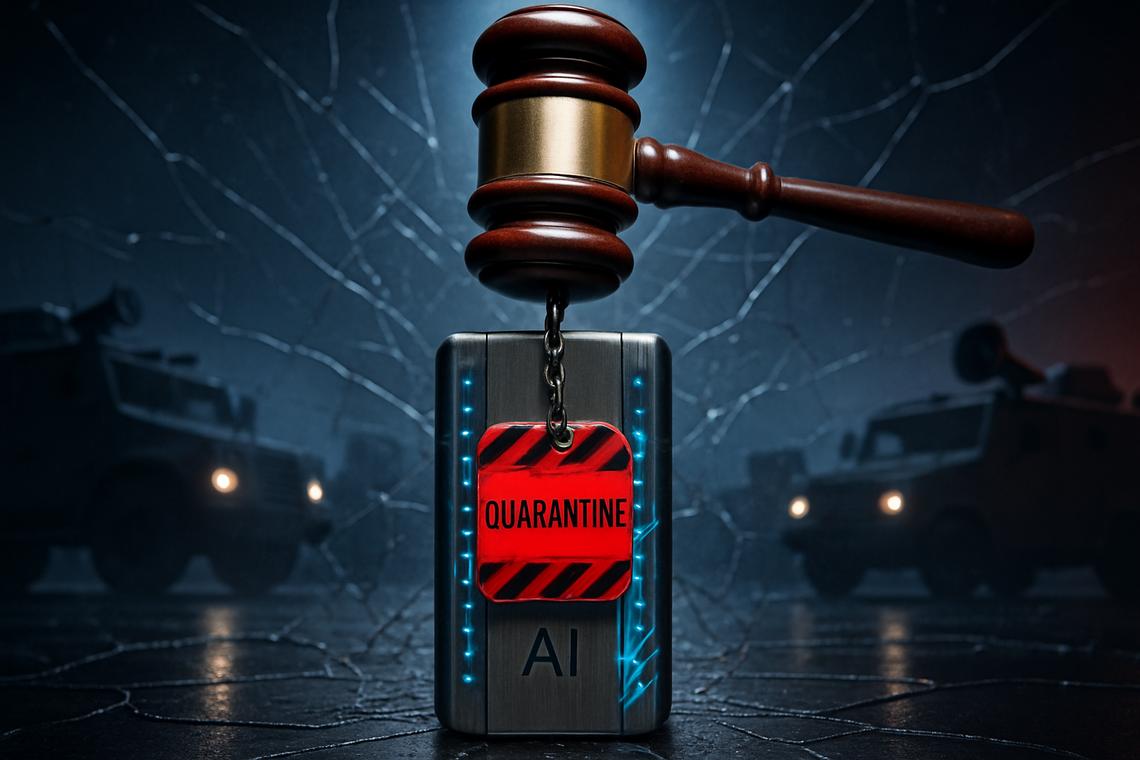
A federal judge has temporarily halted a high-profile anthropic supply chain dispute, highlighting mounting tensions between the US government and major AI vendors.
Judge halts Pentagon effort to blacklist Anthropic
On Thursday, a California federal judge temporarily blocked the Pentagon from labeling Anthropic a supply chain risk and ordering federal agencies to stop using its AI systems. The ruling is the latest twist in a month-long feud, and the matter remains unresolved as the government now has seven days to appeal.
Moreover, Anthropic is pursuing a second case challenging the same designation under a different legal theory, which has not yet been decided. Until those proceedings conclude, the company effectively remains persona non grata in much of the federal government, despite the judge’s intervention.
A contract dispute escalates into an AI culture war
The stakes in the case have been clear from the beginning: how far the government can go in punishing a company that refuses to “play ball” on sensitive policy issues. That said, Anthropic has attracted an unusually broad coalition of senior supporters, including former authors of President Donald Trump‘s AI policy who rarely side with Silicon Valley platforms.
However, Judge Rita Lin‘s 43-page opinion suggests the underlying issue is essentially a contract dispute that never needed to explode into a broader culture war. The judge found that the government bypassed established procedures for handling such disputes, then inflamed the situation with social media posts that later contradicted positions taken in court.
The Pentagon, in effect, signaled it wanted a political confrontation layered on top of the actual war in Iran, which began just hours after some of the key posts went live. This intertwining of legal, political, and military agendas weighed heavily in the court’s assessment of the record.
Claude’s use inside the Pentagon and rising tensions
According to court filings, the government used Anthropic’s Claude across 2025 without raising significant complaints. During that period, the company tried to balance its brand as a safety-focused AI developer with its role as a defense contractor, walking what one filing described as a “branding tightrope.”
Defense employees who accessed Claude through Palantir had to accept a government-specific usage policy. In a sworn declaration, Anthropic cofounder Jared Kaplan said that policy “prohibited mass surveillance of Americans and lethal autonomous warfare,” although he did not provide the full text to the court. Only when the Pentagon sought to contract directly with Anthropic did serious disagreements surface.
Tweet first, justify later: Trump’s and Hegseth’s public threats
What most angered the judge was that once the dispute became public, the government’s actions looked more like punishment than a simple decision to cut ties. Moreover, there was a consistent pattern: tweet first, lawyer later.
On February 27, President Trump posted on Truth Social referring to “Leftwing nutjobs” at Anthropic and directing every federal agency to stop using its AI. Soon after, Defense Secretary Pete Hegseth echoed that stance, saying he would instruct the Pentagon to label the company a supply chain risk.
Formally designating a company as such requires the Secretary of Defense to follow a defined sequence of statutory steps. However, Judge Lin found that Hegseth did not complete those steps. Letters to congressional committees, for example, claimed that less drastic measures had been evaluated and deemed impossible, but they offered no factual detail to support that claim.
The government also argued that the supply chain risk label was necessary because Anthropic could deploy a “kill switch” to disable its systems. Yet, under questioning, its lawyers admitted there was no evidence of such a capability, according to the opinion. That contradiction further undermined the Pentagon’s case.
Legal authority vs political messaging
Hegseth’s social media post asserted that “No contractor, supplier, or partner that does business with the United States military may conduct any commercial activity with Anthropic.” The government’s own lawyers later conceded on Tuesday that the Secretary does not actually have the authority to make such a sweeping prohibition.
The judge and the Justice Department attorneys agreed that Hegseth’s blanket ban had “absolutely no legal effect at all.” However, the aggressive tone of these posts led Judge Lin to conclude that Anthropic had a credible First Amendment complaint. The court found that officials had effectively set out to publicly punish the company for its “ideology” and “rhetoric,” as well as for what they called its “arrogance” in refusing to compromise.
Labeling Anthropic a supply chain risk, the judge wrote, would be tantamount to branding it a “saboteur” of the US government. She found the evidence insufficient to support such an accusation and accordingly issued an order last Thursday halting the designation, blocking the Pentagon from enforcing it, and forbidding the government from carrying out the sweeping promises made by Hegseth and Trump.
A “devastating” ruling and a second lawsuit in DC
Dean Ball, who helped craft AI policy in the Trump administration but filed a brief supporting Anthropic, described the ruling as “a devastating ruling for the government.” He said the court found Anthropic likely to prevail on nearly all of its theories that the government’s actions were unlawful and unconstitutional.
The administration is widely expected to appeal the California decision. At the same time, Anthropic is pressing a separate case in Washington, DC, that raises similar allegations but cites a different part of the statute governing supply chain risks. Together, the cases could define how far federal officials may go in retaliating against AI vendors whose views they dislike.
Pattern of public rhetoric and legal backfilling
The court documents outline a consistent pattern in which public statements by senior officials and the President did not match what the law requires in a contract dispute. Moreover, government lawyers repeatedly had to construct legal justifications after the fact for earlier social media attacks on the company.
Pentagon and White House leaders knew that pursuing the most extreme option would inevitably trigger litigation. Anthropic publicly vowed on February 27 to challenge any supply chain risk label, days before the government formally filed the designation on March 3. That timeline shows that, even as the Iran war erupted, senior leadership chose to move ahead.
During the first five days of the conflict, officials were both overseeing military strikes and assembling evidence to portray Anthropic as a saboteur. However, the judge noted that the Pentagon could have simply ended its business with the company through far less dramatic, and far more conventional, procurement steps.
Consequences for Anthropic and the broader AI industry
Even if Anthropic ultimately wins both cases, the ruling makes clear that Washington still has informal ways to sideline the company from future government work. Defense contractors that depend on the Pentagon for revenue now have little incentive to partner with Anthropic, even if it is never officially listed as a supply chain risk.
“I think it is safe to say that there are mechanisms the government can use to apply some degree of pressure without breaking the law,” said Charlie Bullock, a senior research fellow at the Institute for Law and AI. That said, he stressed that much depends on how invested the administration is in punishing Anthropic over this dispute.
From the evidence so far, the administration is dedicating top-level time and attention to winning what amounts to an AI culture war. At the same time, Claude appears central enough to Pentagon operations that President Trump himself said the Defense Department needed six months to phase it out. This contradiction undercuts the narrative that the anthropic supply chain risk designation was purely about security.
Limits of government leverage over AI vendors
The case also highlights the White House’s efforts to demand political loyalty and ideological alignment from leading AI companies. However, the conflict with Anthropic exposes the limits of that leverage, at least when public threats collide with statutory procurement rules and constitutional protections.
Moreover, the dispute sends a clear signal to other AI vendors building tools for national security agencies. Aggressive public rhetoric may not survive judicial scrutiny if it is not backed by evidence and formal process. The courts appear willing to police that line more closely as AI becomes integral to US defense operations.
For now, Anthropic remains in a precarious position: legally bolstered by a strong early ruling, but commercially vulnerable to quiet blacklisting across the defense ecosystem. The outcome of its parallel cases will shape not only its own future but also the contours of government power in the AI era.
If you have information about the military’s use of AI, you can share it securely via Signal (username jamesodonnell.22).
You May Also Like
MetaMask Looking to Roll Out In-Wallet Perpetuals Trading via Hyperliquid
Trump expects to lose a massive case — and rain fire on Supreme Court: reporter


