Electric Coin Co. (ECC) chief executive Josh Swihart says Zcash has crossed a psychological and developmental threshold after a week of outsized price action and unusually dense ecosystem activity around Token2049 and adjacent events in Singapore. In a long post on X, Swihart characterized the moment as an inflection driven by fundamentals, the macro “zeitgeist,” […]Electric Coin Co. (ECC) chief executive Josh Swihart says Zcash has crossed a psychological and developmental threshold after a week of outsized price action and unusually dense ecosystem activity around Token2049 and adjacent events in Singapore. In a long post on X, Swihart characterized the moment as an inflection driven by fundamentals, the macro “zeitgeist,” […]

Zcash (ZEC) Hits A ‘Tipping Point,’ Says Electric Coin Co. CEO

Electric Coin Co. (ECC) chief executive Josh Swihart says Zcash has crossed a psychological and developmental threshold after a week of outsized price action and unusually dense ecosystem activity around Token2049 and adjacent events in Singapore. In a long post on X, Swihart characterized the moment as an inflection driven by fundamentals, the macro “zeitgeist,” amplification by key opinion leaders, and the memetic spread that often accompanies crypto upswings.

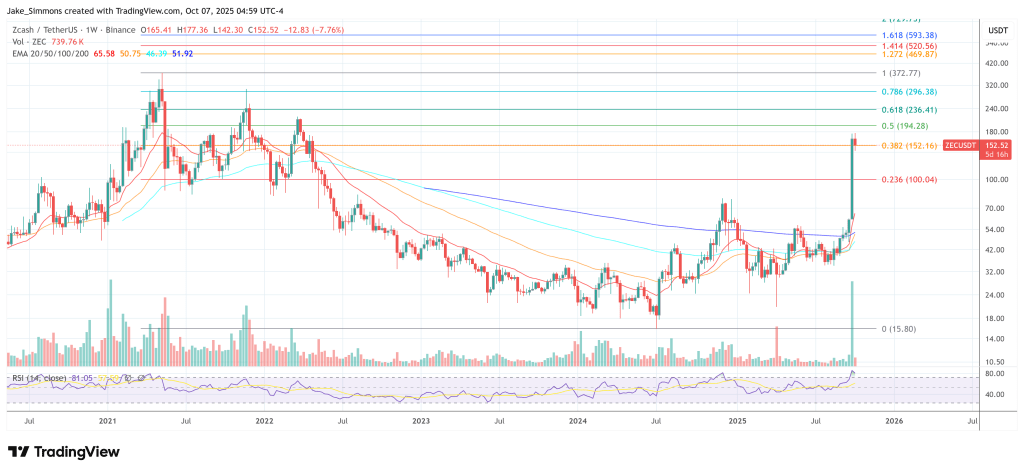
“Zcash saw a ‘god candle’ this week… The token price and market cap have seen rises in the past, but this time, it really is different. We reached a tipping point,” he wrote. When asked repeatedly “Why now?”, Swihart added with some caution: “The truth is that ‘I can’t say for sure.’ Perhaps it’s as simple as ‘Zcash’s time has come.’ But maybe it’s because the elements that spark and fuel the spread of a movement were finally in place.”

Why Has Zcash Printed A ‘Godcandle’ Last Week?

Swihart anchored his argument in first principles and recent shipping cadence. “Simply, Zcash is the most ideologically and technologically sound form of private money,” he said, pointing to zero-knowledge cryptography, a protocol and community that have “galvanized and matured through many difficult years,” and, crucially, a new layer of usability arriving over the past 12–18 months.

In his view, Zashi—ECC’s consumer wallet—has been a material unlock, especially once paired with Keystone hardware-wallet support for cold storage, NEAR Intents for swapping and spending ZEC, Flexa point-of-sale integrations, and a scaling path “to billions with Tachyon,” a roadmap Swihart credited to engineer Daira Hopwood (@ebfull).

He directed readers to recent theses that predated this week’s move—“Why Zcash Now” (Arjun Khemani), “My Zcash investment thesis” (Frank Braun), and “The case for a small allocation to ZEC” (S. Saint-Léger)—as evidence that fundamentals had been coalescing even before markets noticed.

The “environment,” he argued, is doing the rest. Swihart sketched a stark backdrop of political polarization, censorship creep, and pervasive surveillance—from street cameras to proposed client-side scanning and digital ID programs—contending that this climate naturally elevates private, bearer-style money. “Many are now waking up and realizing that we need tools to protect our liberties… As decentralized private money, Zcash provides shelter from this storm,” he wrote. The macro narrative, in other words, is meeting an asset designed around privacy as a civil-liberties primitive.

Amplification, in Swihart’s telling, has come from a mix of public voices and behind-the-scenes connectors. He credited months of “regular” Zcash commentary from Helius CEO Mert Mumtaz (@0xMert_), new engagement from investor Naval Ravikant (@naval), long-standing advocacy from Balaji Srinivasan (@balajis), and support from builders and investors in adjacent ecosystems, naming @_TomHoward, @akshaybd, @chronear, @juanaxyz00, and @TheVladCostea. “These leaders are the spark that ignited the fire,” he wrote, adding that broader crypto influencers—@gainzy222, @Cryptopathic, @cobie—“have been buzzing.”

Memes, inevitably, are doing distribution. Swihart cited older Zcash slogans—“1 ZEC = 7 BTC,” “ZODL,” “Privacy is Normal”—and newer ones circulating this week, including “encrypted bitcoin,” “$1k ZEC,” and “$50k ZEC,” alongside the rise of @genzcash as a “memetic warfare division” pumping out short-form video.

He also leaned into Zcash lore—Edward Snowden’s involvement in a past ceremony, Zooko Wilcox’s early-days connections to Hal Finney and Satoshi—arguing that narrative capital is unusually deep for ZEC. Even the chart, he suggested, has become memetic: “ZEC recently broke above long-standing trends against both fiat and BTC.”

Zcash Is Evolving

Beneath the narrative, Swihart published a tranche of concrete product metrics and core-protocol milestones that help explain his confidence. Zashi’s swap and payments flow since late August totaled “over $9.5 million in ZEC (at $163/ZEC),” with average daily throughput of “1,509 ZEC” and “just under $1M” swapped into ZEC this past week.

Distribution data show “12.1k” unique iOS installs (14.4k total downloads, “4.9*” rating) and an Android install base of “4.83k” (24.2k total including open beta, “4.347*” Play rating). On the protocol side, ECC “finished ZIP 48 transparent multisig support in the Rust crates,” added the same support to zcash-devtool, “ran the Key Holder Organization ceremony for NU 6.1 mainnet,” “set NU 6.1 mainnet consensus rules,” and “released zcashd 6.10.0” along with supporting Rust crates. Mobile SDK FFI changes to accommodate Zashi’s new features also landed this week.

The near-term roadmap focuses on removing friction in everyday use and on-ramp flows without diluting privacy guarantees. Swihart flagged “rotating ephemeral transparent addresses for one-time use cases (swaps, Coinbase onramp),” the ability to “mark received transactions as trusted to reduce the number of confirmations required before spending,” and a draft ZIP for key rotation covering “ZSA issuance keys & lockbox FROST multisig disbursement keys” targeted at NU7.

He also noted review work on QEDit’s ZSA pull requests to the Orchard crate. On the wallet side, forthcoming Zashi features include “ephemeral, transparent addresses for all NEAR-intent-supported functionalities,” “Marking a Transaction as Trusted,” and continued debugging and design finalization for “Transparent Address Rotation, support for Ledger Hardware Wallet, Duress/Decoy Wallet feature, Multi-Account Support, [and] Reset Zashi revamp & home buttons personalization.”

The week’s activity extended beyond GitHub. Swihart said he and long-time Zcash engineer Str4d “spent the week in Singapore in various meetings around Token 2049 and the Network State in support of Zcash, Zashi, Tachyon, and Cross Link with the Shielded Labs team.” He and Zooko also spoke at the Network State Conference, with a recording available, and community organizers held a Zcash day at the Network School featuring a roundtable with Balaji Srinivasan.

The cumulative effect, in Swihart’s reading, is a feedback loop between shipping, discourse, and market structure: “fuel + environment + spark + spread = tipping point.”

At press time, ZEC traded at $152.
Zcash price
Piyasa Fırsatı
Zcash Logosu
Zcash Fiyatı(ZEC)
$401.16
$401.16$401.16
-1.52%
USD
Zcash (ZEC) Canlı Fiyat Grafiği
Sorumluluk Reddi: Bu sitede yeniden yayınlanan makaleler, halka açık platformlardan alınmıştır ve yalnızca bilgilendirme amaçlıdır. MEXC'nin görüşlerini yansıtmayabilir. Tüm hakları telif sahiplerine aittir. Herhangi bir içeriğin üçüncü taraf haklarını ihlal ettiğini düşünüyorsanız, kaldırılması için lütfen service@support.mexc.com ile iletişime geçin. MEXC, içeriğin doğruluğu, eksiksizliği veya güncelliği konusunda hiçbir garanti vermez ve sağlanan bilgilere dayalı olarak alınan herhangi bir eylemden sorumlu değildir. İçerik, finansal, yasal veya diğer profesyonel tavsiye niteliğinde değildir ve MEXC tarafından bir tavsiye veya onay olarak değerlendirilmemelidir.

Ayrıca Şunları da Beğenebilirsiniz

South Korea Launches Innovative Stablecoin Initiative

South Korea Launches Innovative Stablecoin Initiative

The post South Korea Launches Innovative Stablecoin Initiative appeared on BitcoinEthereumNews.com. South Korea has witnessed a pivotal development in its cryptocurrency landscape with BDACS introducing the nation’s first won-backed stablecoin, KRW1, built on the Avalanche network. This stablecoin is anchored by won assets stored at Woori Bank in a 1:1 ratio, ensuring high security. Continue Reading:South Korea Launches Innovative Stablecoin Initiative Source: https://en.bitcoinhaber.net/south-korea-launches-innovative-stablecoin-initiative
Paylaş
BitcoinEthereumNews2025/09/18 17:54
Trump Cancels Tech, AI Trade Negotiations With The UK

Trump Cancels Tech, AI Trade Negotiations With The UK

The US pauses a $41B UK tech and AI deal as trade talks stall, with disputes over food standards, market access, and rules abroad.   The US has frozen a major tech
Paylaş
LiveBitcoinNews2025/12/17 01:00
Summarize Any Stock’s Earnings Call in Seconds Using FMP API

Summarize Any Stock’s Earnings Call in Seconds Using FMP API

Turn lengthy earnings call transcripts into one-page insights using the Financial Modeling Prep APIPhoto by Bich Tran Earnings calls are packed with insights. They tell you how a company performed, what management expects in the future, and what analysts are worried about. The challenge is that these transcripts often stretch across dozens of pages, making it tough to separate the key takeaways from the noise. With the right tools, you don’t need to spend hours reading every line. By combining the Financial Modeling Prep (FMP) API with Groq’s lightning-fast LLMs, you can transform any earnings call into a concise summary in seconds. The FMP API provides reliable access to complete transcripts, while Groq handles the heavy lifting of distilling them into clear, actionable highlights. In this article, we’ll build a Python workflow that brings these two together. You’ll see how to fetch transcripts for any stock, prepare the text, and instantly generate a one-page summary. Whether you’re tracking Apple, NVIDIA, or your favorite growth stock, the process works the same — fast, accurate, and ready whenever you are. Fetching Earnings Transcripts with FMP API The first step is to pull the raw transcript data. FMP makes this simple with dedicated endpoints for earnings calls. If you want the latest transcripts across the market, you can use the stable endpoint /stable/earning-call-transcript-latest. For a specific stock, the v3 endpoint lets you request transcripts by symbol, quarter, and year using the pattern: https://financialmodelingprep.com/api/v3/earning_call_transcript/{symbol}?quarter={q}&year={y}&apikey=YOUR_API_KEY here’s how you can fetch NVIDIA’s transcript for a given quarter: import requestsAPI_KEY = "your_api_key"symbol = "NVDA"quarter = 2year = 2024url = f"https://financialmodelingprep.com/api/v3/earning_call_transcript/{symbol}?quarter={quarter}&year={year}&apikey={API_KEY}"response = requests.get(url)data = response.json()# Inspect the keysprint(data.keys())# Access transcript contentif "content" in data[0]: transcript_text = data[0]["content"] print(transcript_text[:500]) # preview first 500 characters The response typically includes details like the company symbol, quarter, year, and the full transcript text. If you aren’t sure which quarter to query, the “latest transcripts” endpoint is the quickest way to always stay up to date. Cleaning and Preparing Transcript Data Raw transcripts from the API often include long paragraphs, speaker tags, and formatting artifacts. Before sending them to an LLM, it helps to organize the text into a cleaner structure. Most transcripts follow a pattern: prepared remarks from executives first, followed by a Q&A session with analysts. Separating these sections gives better control when prompting the model. In Python, you can parse the transcript and strip out unnecessary characters. A simple way is to split by markers such as “Operator” or “Question-and-Answer.” Once separated, you can create two blocks — Prepared Remarks and Q&A — that will later be summarized independently. This ensures the model handles each section within context and avoids missing important details. Here’s a small example of how you might start preparing the data: import re# Example: using the transcript_text we fetched earliertext = transcript_text# Remove extra spaces and line breaksclean_text = re.sub(r'\s+', ' ', text).strip()# Split sections (this is a heuristic; real-world transcripts vary slightly)if "Question-and-Answer" in clean_text: prepared, qna = clean_text.split("Question-and-Answer", 1)else: prepared, qna = clean_text, ""print("Prepared Remarks Preview:\n", prepared[:500])print("\nQ&A Preview:\n", qna[:500]) With the transcript cleaned and divided, you’re ready to feed it into Groq’s LLM. Chunking may be necessary if the text is very long. A good approach is to break it into segments of a few thousand tokens, summarize each part, and then merge the summaries in a final pass. Summarizing with Groq LLM Now that the transcript is clean and split into Prepared Remarks and Q&A, we’ll use Groq to generate a crisp one-pager. The idea is simple: summarize each section separately (for focus and accuracy), then synthesize a final brief. Prompt design (concise and factual) Use a short, repeatable template that pushes for neutral, investor-ready language: You are an equity research analyst. Summarize the following earnings call sectionfor {symbol} ({quarter} {year}). Be factual and concise.Return:1) TL;DR (3–5 bullets)2) Results vs. guidance (what improved/worsened)3) Forward outlook (specific statements)4) Risks / watch-outs5) Q&A takeaways (if present)Text:<<<{section_text}>>> Python: calling Groq and getting a clean summary Groq provides an OpenAI-compatible API. Set your GROQ_API_KEY and pick a fast, high-quality model (e.g., a Llama-3.1 70B variant). We’ll write a helper to summarize any text block, then run it for both sections and merge. import osimport textwrapimport requestsGROQ_API_KEY = os.environ.get("GROQ_API_KEY") or "your_groq_api_key"GROQ_BASE_URL = "https://api.groq.com/openai/v1" # OpenAI-compatibleMODEL = "llama-3.1-70b" # choose your preferred Groq modeldef call_groq(prompt, temperature=0.2, max_tokens=1200): url = f"{GROQ_BASE_URL}/chat/completions" headers = { "Authorization": f"Bearer {GROQ_API_KEY}", "Content-Type": "application/json", } payload = { "model": MODEL, "messages": [ {"role": "system", "content": "You are a precise, neutral equity research analyst."}, {"role": "user", "content": prompt}, ], "temperature": temperature, "max_tokens": max_tokens, } r = requests.post(url, headers=headers, json=payload, timeout=60) r.raise_for_status() return r.json()["choices"][0]["message"]["content"].strip()def build_prompt(section_text, symbol, quarter, year): template = """ You are an equity research analyst. Summarize the following earnings call section for {symbol} ({quarter} {year}). Be factual and concise. Return: 1) TL;DR (3–5 bullets) 2) Results vs. guidance (what improved/worsened) 3) Forward outlook (specific statements) 4) Risks / watch-outs 5) Q&A takeaways (if present) Text: <<< {section_text} >>> """ return textwrap.dedent(template).format( symbol=symbol, quarter=quarter, year=year, section_text=section_text )def summarize_section(section_text, symbol="NVDA", quarter="Q2", year="2024"): if not section_text or section_text.strip() == "": return "(No content found for this section.)" prompt = build_prompt(section_text, symbol, quarter, year) return call_groq(prompt)# Example usage with the cleaned splits from Section 3prepared_summary = summarize_section(prepared, symbol="NVDA", quarter="Q2", year="2024")qna_summary = summarize_section(qna, symbol="NVDA", quarter="Q2", year="2024")final_one_pager = f"""# {symbol} Earnings One-Pager — {quarter} {year}## Prepared Remarks — Key Points{prepared_summary}## Q&A Highlights{qna_summary}""".strip()print(final_one_pager[:1200]) # preview Tips that keep quality high: Keep temperature low (≈0.2) for factual tone. If a section is extremely long, chunk at ~5–8k tokens, summarize each chunk with the same prompt, then ask the model to merge chunk summaries into one section summary before producing the final one-pager. If you also fetched headline numbers (EPS/revenue, guidance) earlier, prepend them to the prompt as brief context to help the model anchor on the right outcomes. Building the End-to-End Pipeline At this point, we have all the building blocks: the FMP API to fetch transcripts, a cleaning step to structure the data, and Groq LLM to generate concise summaries. The final step is to connect everything into a single workflow that can take any ticker and return a one-page earnings call summary. The flow looks like this: Input a stock ticker (for example, NVDA). Use FMP to fetch the latest transcript. Clean and split the text into Prepared Remarks and Q&A. Send each section to Groq for summarization. Merge the outputs into a neatly formatted earnings one-pager. Here’s how it comes together in Python: def summarize_earnings_call(symbol, quarter, year, api_key, groq_key): # Step 1: Fetch transcript from FMP url = f"https://financialmodelingprep.com/api/v3/earning_call_transcript/{symbol}?quarter={quarter}&year={year}&apikey={api_key}" resp = requests.get(url) resp.raise_for_status() data = resp.json() if not data or "content" not in data[0]: return f"No transcript found for {symbol} {quarter} {year}" text = data[0]["content"] # Step 2: Clean and split clean_text = re.sub(r'\s+', ' ', text).strip() if "Question-and-Answer" in clean_text: prepared, qna = clean_text.split("Question-and-Answer", 1) else: prepared, qna = clean_text, "" # Step 3: Summarize with Groq prepared_summary = summarize_section(prepared, symbol, quarter, year) qna_summary = summarize_section(qna, symbol, quarter, year) # Step 4: Merge into final one-pager return f"""# {symbol} Earnings One-Pager — {quarter} {year}## Prepared Remarks{prepared_summary}## Q&A Highlights{qna_summary}""".strip()# Example runprint(summarize_earnings_call("NVDA", 2, 2024, API_KEY, GROQ_API_KEY)) With this setup, generating a summary becomes as simple as calling one function with a ticker and date. You can run it inside a notebook, integrate it into a research workflow, or even schedule it to trigger after each new earnings release. Free Stock Market API and Financial Statements API... Conclusion Earnings calls no longer need to feel overwhelming. With the Financial Modeling Prep API, you can instantly access any company’s transcript, and with Groq LLM, you can turn that raw text into a sharp, actionable summary in seconds. This pipeline saves hours of reading and ensures you never miss the key results, guidance, or risks hidden in lengthy remarks. Whether you track tech giants like NVIDIA or smaller growth stocks, the process is the same — fast, reliable, and powered by the flexibility of FMP’s data. Summarize Any Stock’s Earnings Call in Seconds Using FMP API was originally published in Coinmonks on Medium, where people are continuing the conversation by highlighting and responding to this story
Paylaş
Medium2025/09/18 14:40