Bitcoin’s Four-Year Cycle Under Scrutiny: Political and Liquidity Factors Take Center Stage While Bitcoin’s traditional four-year cycle, often linked to its halvingBitcoin’s Four-Year Cycle Under Scrutiny: Political and Liquidity Factors Take Center Stage While Bitcoin’s traditional four-year cycle, often linked to its halving

Bitcoin’s Four-Year Cycle Shifts: Now Fueled by Politics, Not Halving, Expert Reveals
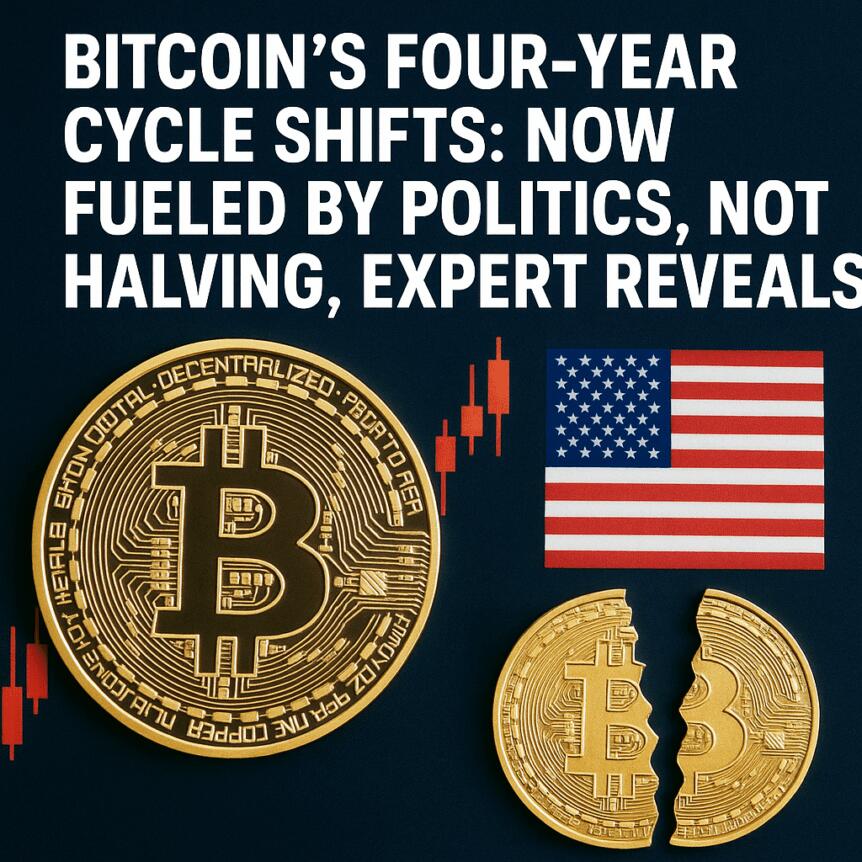
Bitcoin’s Four-Year Cycle Shifts: Now Fueled By Politics, Not Halving, Expert Reveals

Bitcoin’s Four-Year Cycle Under Scrutiny: Political and Liquidity Factors Take Center Stage

While Bitcoin’s traditional four-year cycle, often linked to its halving events, remains a topic of debate, recent insights suggest that external factors such as political developments and liquidity conditions are now driving market dynamics more than ever. Analysts are reassessing the role of supply cuts, emphasizing the influence of the US election cycle and monetary policy on Bitcoin’s price movements.

Key Takeaways

  • Market peaks in 2013, 2017, and 2021 closely align with US presidential elections and political uncertainty.
  • Bitcoin’s price movements are increasingly influenced by US political events rather than halving schedules.
  • Federal Reserve rate cuts are struggling to reignite Bitcoin’s momentum amid cautious institutional investment.
  • The emphasis shifts from halving-driven cycles to political and liquidity factors in timing market moves.

Tickers mentioned: Bitcoin: BTC

Sentiment: Neutral

Price impact: Neutral. The market appears to be consolidating rather than trending strongly in either direction, as liquidity conditions tighten and institutional caution prevails.

Market context: As macroeconomic factors take precedence, Bitcoin’s cyclical behavior is increasingly correlated with global political and monetary developments rather than its internal supply events.

Rethinking Bitcoin’s Cycles Amid Political and Liquidity Shifts

Recent insights from Markus Thielen, head of research at 10x Research, highlight a paradigm shift in Bitcoin’s traditional four-year cycle. Speaking on The Wolf Of All Streets Podcast, Thielen argued that the cycle isn’t broken but has evolved. Instead of being primarily driven by Bitcoin’s programmed supply reductions, the cycle now responds more to external factors such as US election timelines, central bank policy shifts, and the flow of capital into risk assets.

Historical market peaks in 2013, 2017, and 2021 coincide more with election periods and heightened political uncertainty rather than the timing of halving events. Thielen noted that the political environment, including potential shifts in US congressional power, influences investor sentiment and market outcomes. For example, the possibility of reduced legislative push from a sitting president influences risk appetite, thereby impacting Bitcoin’s price trajectory.

Concurrent to these geopolitical considerations, Bitcoin has struggled to regain upward momentum following the Federal Reserve’s recent rate cut. Unlike previous easing cycles that supported risk assets, institutional investors are adopting a cautious stance amid mixed policy signals and tightening liquidity conditions. Consequently, capital inflows into Bitcoin have slowed compared to last year, dampening the prospects for a substantial rally.

This evolving narrative suggests investors should pay closer attention to political and macroeconomic catalysts rather than relying solely on halving schedules to anticipate market moves. As Thielen emphasized, a deeper understanding of external factors is essential in navigating the current crypto landscape.

Meanwhile, voices like former BitMEX co-founder Arthur Hayes have weighed in, arguing that the four-year cycle has become obsolete, replaced by liquidity-driven market trends more than any predictable timing model. He maintains that Bitcoin’s bull markets are now primarily influenced by global monetary conditions rather than adherence to historical cycles or halving events.

This article was originally published as Bitcoin’s Four-Year Cycle Shifts: Now Fueled by Politics, Not Halving, Expert Reveals on Crypto Breaking News – your trusted source for crypto news, Bitcoin news, and blockchain updates.

Piyasa Fırsatı
Nowchain Logosu
Nowchain Fiyatı(NOW)
$0.00254
$0.00254$0.00254
-1.55%
USD
Nowchain (NOW) Canlı Fiyat Grafiği
Sorumluluk Reddi: Bu sitede yeniden yayınlanan makaleler, halka açık platformlardan alınmıştır ve yalnızca bilgilendirme amaçlıdır. MEXC'nin görüşlerini yansıtmayabilir. Tüm hakları telif sahiplerine aittir. Herhangi bir içeriğin üçüncü taraf haklarını ihlal ettiğini düşünüyorsanız, kaldırılması için lütfen service@support.mexc.com ile iletişime geçin. MEXC, içeriğin doğruluğu, eksiksizliği veya güncelliği konusunda hiçbir garanti vermez ve sağlanan bilgilere dayalı olarak alınan herhangi bir eylemden sorumlu değildir. İçerik, finansal, yasal veya diğer profesyonel tavsiye niteliğinde değildir ve MEXC tarafından bir tavsiye veya onay olarak değerlendirilmemelidir.

Ayrıca Şunları da Beğenebilirsiniz

Kalshi Jumps to 62% Market Share While Polymarket Eyes $10B Valuation

Kalshi Jumps to 62% Market Share While Polymarket Eyes $10B Valuation

The post Kalshi Jumps to 62% Market Share While Polymarket Eyes $10B Valuation appeared on BitcoinEthereumNews.com. Fintech 19 September 2025 | 16:03 Event-based trading platforms are no longer niche experiments – they’re emerging as a major arena where finance, crypto, and information converge. After months of subdued activity, volumes are climbing again, and U.S.-regulated Kalshi has unexpectedly taken the lead. Betting on Everything From Rates to Sports Analysts at Bernstein describe prediction markets as a new “interface for information,” where users speculate not only on sports results but also on Federal Reserve decisions, quarterly earnings, and even crypto price moves. This year alone, more than $200 million changed hands on Polymarket contracts linked to the Fed’s recent 25 bps rate cut, while $85 million traded on Kalshi around the same decision. Mainstream brokers like Coinbase and Robinhood are watching closely, with ambitions to capture some of the momentum. With U.S. sports betting already worth tens of billions annually, the overlap is too big to ignore. Against that backdrop, Kalshi has delivered one of its strongest months since the 2024 elections. The platform reports $1.3 billion in trading volume so far in September, accounting for 62% of global prediction market activity. Just a year ago, Kalshi’s share stood at 3%. CEO Tarek Mansour called the growth “remarkable,” noting that the exchange still serves only U.S. clients. Polymarket’s Pushback Its main rival, Polymarket, has logged about $773 million in trades this month. While that trails Kalshi for now, Polymarket has unique advantages: as a crypto-native platform, it has carved out strong global demand and is working toward a formal U.S. relaunch via its acquisition of derivatives exchange QCEX. The two platforms now stand as the clear leaders of the sector, though they embody different philosophies — one regulated from the ground up, the other built around decentralization. Investors Take Notice The boom hasn’t escaped venture capital. Reports suggest…
Paylaş
BitcoinEthereumNews2025/09/19 21:34
Visa Expands USDC Stablecoin Settlement For US Banks

Visa Expands USDC Stablecoin Settlement For US Banks

The post Visa Expands USDC Stablecoin Settlement For US Banks appeared on BitcoinEthereumNews.com. Visa Expands USDC Stablecoin Settlement For US Banks
Paylaş
BitcoinEthereumNews2025/12/17 15:23
Bitcoin Lightning Network Capacity Surges to Historic Peak as Exchange Adoption Accelerates

Bitcoin Lightning Network Capacity Surges to Historic Peak as Exchange Adoption Accelerates

The Bitcoin Lightning Network has reached an all-time high in total network capacity, marking a significant milestone for the layer-2 scaling solution designed to enable fast and inexpensive Bitcoin transactions. The surge comes as major cryptocurrency exchanges increasingly integrate Lightning functionality, bringing the technology to millions of users who previously relied solely on slower, more expensive on-chain transactions. This capacity expansion reflects growing confidence in Lightning's reliability and utility after years of development and real-world testing. What began as an experimental protocol discussed primarily among technical enthusiasts has matured into infrastructure that some of the industry's largest platforms now consider essential to their operations.
Paylaş
MEXC NEWS2025/12/17 17:14