SoFi has become the first U.S. nationally chartered retail bank to issue a dollar-backed stablecoin on a public, permissionless blockchain, marking a turning pointSoFi has become the first U.S. nationally chartered retail bank to issue a dollar-backed stablecoin on a public, permissionless blockchain, marking a turning point

SoFi Makes History: First U.S. National Bank to Issue Stablecoin on Public Blockchain

SoFi has become the first U.S. nationally chartered retail bank to issue a dollar-backed stablecoin on a public, permissionless blockchain, marking a turning point in how regulated banks participate in on-chain finance.

The company announced the launch of SoFiUSD, a fully reserved stablecoin issued by SoFi Bank, N.A., positioning the bank not only as a consumer-facing issuer but also as an infrastructure provider for other banks, fintech firms, and enterprise platforms.

SoFi Brings Stablecoins Inside the Banking System

According to SoFi, the stablecoin is live for internal settlement activity and will be made available to SoFi members in the coming months.

The launch places SoFi at the center of a fast-moving shift in U.S. financial regulation, where federal agencies are beginning to formally integrate blockchain-based payment instruments into the banking system rather than treating them as an external risk.

SoFiUSD is issued directly by SoFi Bank, an OCC-regulated and FDIC-insured depository institution, and is backed one-to-one by cash reserves held at the Federal Reserve.

That structure seeks immediate redemption while avoiding credit or liquidity risk tied to commercial paper or other yield-bearing instruments.

As a national bank, SoFi is required to provide certified reserve reporting under the rules established by the Guiding and Establishing National Innovation for U.S. Stablecoins Act, or GENIUS Act, which was signed into law in July 2025.

GENIUS Act Ends Years of Stablecoin Uncertainty for U.S. Banks

The GENIUS Act created the first comprehensive federal framework for payment stablecoins in the United States.

It permits insured depository institutions to issue stablecoins through approved structures, provided they meet strict reserve, disclosure, and supervisory requirements.

Updated guidance from the OCC and FDIC followed in the months after the law’s passage, explicitly allowing banks to engage in stablecoin issuance, custody, and tokenized settlement under a defined rulebook.

That clarity reversed years of uncertainty that had previously forced SoFi to pause its crypto services in 2023.

SoFi said the stablecoin will be used across a range of settlement functions, including crypto trading, card network settlement, merchant payments, and international remittances.

For users in countries with volatile currencies, the company plans to support SoFiUSD as a dollar-denominated balance within debit or secured credit products.

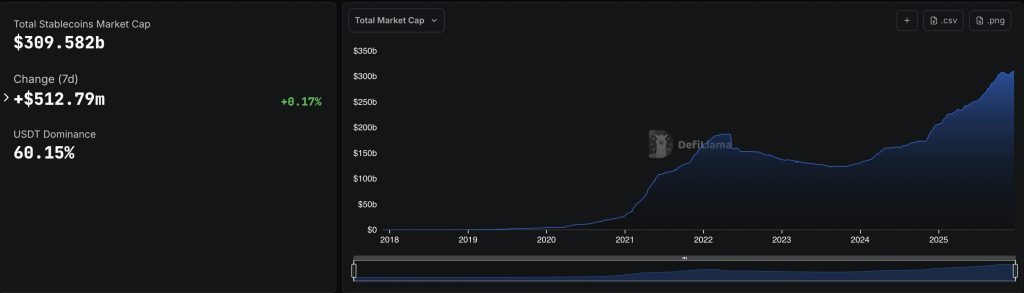
The launch comes as the stablecoin market continues to grow rapidly. Data from DefiLlama shows the total stablecoin market capitalization at roughly $309 billion, with Tether’s USDT accounting for more than $186 billion and Circle’s USDC close to $78 billion.
Source: DefiLlama

Analysts project that the global stablecoin market could exceed $3 trillion by 2030, driven by demand for faster settlement, lower-cost cross-border payments, and access to dollar liquidity outside the traditional banking system.

Stablecoins Step Into the Mainstream as U.S. Oversight Tightens

Regulatory momentum has accelerated alongside market growth. On December 16, the FDIC approved a proposed rule outlining how FDIC-supervised banks can apply to issue payment stablecoins under the GENIUS Act.

The proposal establishes a formal application process and confirms that only approved entities, known as permitted payment stablecoin issuers, can issue such assets in the U.S.

Earlier this month, the OCC also conditionally approved several crypto firms, including Circle and Ripple, to pursue national trust bank charters, bringing more digital-asset companies under a single federal supervisory framework.

Piyasa Fırsatı
Union Logosu
Union Fiyatı(U)
$0.003149
$0.003149$0.003149
-6.72%
USD
Union (U) Canlı Fiyat Grafiği
Sorumluluk Reddi: Bu sitede yeniden yayınlanan makaleler, halka açık platformlardan alınmıştır ve yalnızca bilgilendirme amaçlıdır. MEXC'nin görüşlerini yansıtmayabilir. Tüm hakları telif sahiplerine aittir. Herhangi bir içeriğin üçüncü taraf haklarını ihlal ettiğini düşünüyorsanız, kaldırılması için lütfen service@support.mexc.com ile iletişime geçin. MEXC, içeriğin doğruluğu, eksiksizliği veya güncelliği konusunda hiçbir garanti vermez ve sağlanan bilgilere dayalı olarak alınan herhangi bir eylemden sorumlu değildir. İçerik, finansal, yasal veya diğer profesyonel tavsiye niteliğinde değildir ve MEXC tarafından bir tavsiye veya onay olarak değerlendirilmemelidir.

Ayrıca Şunları da Beğenebilirsiniz

U.S. Court Finds Pastor Found Guilty in $3M Crypto Scam

U.S. Court Finds Pastor Found Guilty in $3M Crypto Scam

The post U.S. Court Finds Pastor Found Guilty in $3M Crypto Scam appeared on BitcoinEthereumNews.com. Crime 18 September 2025 | 04:05 A Colorado judge has brought closure to one of the state’s most unusual cryptocurrency scandals, declaring INDXcoin to be a fraudulent operation and ordering its founders, Denver pastor Eli Regalado and his wife Kaitlyn, to repay $3.34 million. The ruling, issued by District Court Judge Heidi L. Kutcher, came nearly two years after the couple persuaded hundreds of people to invest in their token, promising safety and abundance through a Christian-branded platform called the Kingdom Wealth Exchange. The scheme ran between June 2022 and April 2023 and drew in more than 300 participants, many of them members of local church networks. Marketing materials portrayed INDXcoin as a low-risk gateway to prosperity, yet the project unraveled almost immediately. The exchange itself collapsed within 24 hours of launch, wiping out investors’ money. Despite this failure—and despite an auditor’s damning review that gave the system a “0 out of 10” for security—the Regalados kept presenting it as a solid opportunity. Colorado regulators argued that the couple’s faith-based appeal was central to the fraud. Securities Commissioner Tung Chan said the Regalados “dressed an old scam in new technology” and used their standing within the Christian community to convince people who had little knowledge of crypto. For him, the case illustrates how modern digital assets can be exploited to replicate classic Ponzi-style tactics under a different name. Court filings revealed where much of the money ended up: luxury goods, vacations, jewelry, a Range Rover, high-end clothing, and even dental procedures. In a video that drew worldwide attention earlier this year, Eli Regalado admitted the funds had been spent, explaining that a portion went to taxes while the remainder was used for a home renovation he claimed was divinely inspired. The judgment not only confirms that INDXcoin qualifies as a…
Paylaş
BitcoinEthereumNews2025/09/18 09:14
MSCI’s Proposal May Trigger $15B Crypto Outflows

MSCI’s Proposal May Trigger $15B Crypto Outflows

MSCI's plan to exclude crypto-treasury companies could cause $15B outflows, impacting major firms.
Paylaş
CoinLive2025/12/19 13:17
This U.S. politician’s suspicious stock trade just returned over 200% in weeks

This U.S. politician’s suspicious stock trade just returned over 200% in weeks

The post This U.S. politician’s suspicious stock trade just returned over 200% in weeks appeared on BitcoinEthereumNews.com. United States Representative Cloe Fields has seen his stake in Opendoor Technologies (NASDAQ: OPEN) stock return over 200% in just a matter of weeks. According to congressional trade filings, the lawmaker purchased a stake in the online real estate company on July 21, 2025, investing between $1,001 and $15,000. At the time, the stock was trading around $2 and had been largely stagnant for months. Receive Signals on US Congress Members’ Stock Trades Stocks Stay up-to-date on the trading activity of US Congress members. The signal triggers based on updates from the House disclosure reports, notifying you of their latest stock transactions. Enable signal The trade has since paid off, with Opendoor surging to $10, a gain of nearly 220% in under two months. By comparison, the broader S&P 500 index rose less than 5% during the same period. OPEN one-week stock price chart. Source: Finbold Assuming he invested a minimum of $1,001, the purchase would now be worth about $3,200, while a $15,000 stake would have grown to nearly $48,000, generating profits of roughly $2,200 and $33,000, respectively. OPEN’s stock rally Notably, Opendoor’s rally has been fueled by major corporate shifts and market speculation. For instance, in August, the company named former Shopify COO Kaz Nejatian as CEO, while co-founders Keith Rabois and Eric Wu rejoined the board, moves seen as a return to the company’s early innovative spirit.  Outgoing CEO Carrie Wheeler’s resignation and sale of millions in stock reinforced the sense of a new chapter. Beyond leadership changes, Opendoor’s surge has taken on meme-stock characteristics. In this case, retail investors piled in as shares climbed, while short sellers scrambled to cover, pushing prices higher.  However, the stock is still not without challenges, where its iBuying model is untested at scale, margins are thin, and debt tied to…
Paylaş
BitcoinEthereumNews2025/09/18 04:02